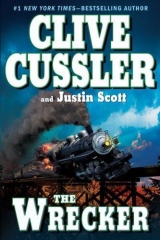
Текст книги "The Wrecker"
Автор книги: Clive Cussler
Жанр:
Боевики
сообщить о нарушении
Текущая страница: 15 (всего у книги 24 страниц)
The rough wood dug through his coat, and he regretted not taking a blanket from the wagon to cushion his shoulder. The pain started as a dull ache. It sharpened quickly, biting deep. It cut into the muscle of his shoulder and ground against the bone. After only half a mile, it burned like fire. Should he put it down, run back to the wagon, and get a blanket? But then Bell’s patrols could find it lying by the rails.
The Wrecker’s legs were tired already. His knees began to shake. But his shaking knees and the awful pain in his shoulder were soon forgotten as the weight compressed the bones in his spine, squeezing nerves. The nerves radiated a burning sensation into his legs, shooting sharp pains through his thighs and calves. He wondered if he put the tie down and stopped to rest whether he could lift it again. While he debated the risk, the decision was made for him.
He had carried the tie for a mile when he saw a creamy glow in the sky up ahead. It brightened quickly. A locomotive headlamp, he realized, coming fast. Already he could hear it over the sound of his labored breathing. He had to get off the tracks. There were trees close by. Feeling his way in the dark, he descended the slope of the roadbed and careened through them. The headlamp threw crazy beams and shadows. He pushed in deeper, then knelt down carefully, tipping the massive crosstie down until its end rested on the ground.
The relief of having the weight off him was an almost overwhelming pleasure. He leaned the other end of the tie against a tree. Then he sagged to the ground and stretched out on the pine needles to rest. The locomotive grew louder and roared past, drawing a train that rattled with the peculiar higher pitch of empty cars. It passed too quickly. Too soon, he had to stand up, tip the crushing weight onto his shoulder, and struggle up the slope to the rails.
The heel of his boot caught on the head of the rail as he tried to step between the tracks. He felt himself pitching forward, falling face-first. He fought to regain his balance. But before he could get his feet under him in the headlong rush, the weight pushed him down. He twisted frantically to get out from under the tie. But the weight was too massive to escape entirely. A sledgehammer blow crushed his arm, and he cried out in pain.
Facedown on the roadbed, he wrenched his arm out from under the tie, knelt as if in prayer, heaved it onto his aching shoulder, stood up, and pressed on. He tried to count his steps but kept losing track. He had five miles to go. But he had no idea how far he had staggered. He started counting ties. His heart sank. There were almost three thousand ties for every mile of track. After a hundred, he thought he would die. After five hundred, he was almost destroyed by the realization that five hundred ties was no more than a fifth of a mile.
His mind began to scatter. He imagined carrying the tie all the way to Tunnel 13. Through the stone mountain all the way to the Cascade Canyon Bridge.
I’mthe “Hero Engineer”!
Giddy-headed laughter dissolved into a sob of pain. He felt himself drifting out of control. He had to shift his thoughts away from the pain and the fear that he could not continue.
He drove his mind toward his early rote training in mathematics and engineering. Structure-the physics that made a bridge stand or fall. Struts. Ties. Foundation piers. Cantilever arms. Anchor arms. Live loads. Dead loads.
The laws of physics ruled how to distribute weight. The laws of physics said he could not carry the crosstie another foot. He drove that madness from his mind and concentrated instead on fencing moves, the light, airy motion of a sword. “Attack,” he said aloud. “Beat. Lunge. Parry. Riposte. Feint. Double feint.” On he plodded, the weight pounding his bones to jelly. Attack. Beat. Lunge. Parry. German intruded. Suddenly, he was mumbling the engineering terms from his student days. Then shouting the language of Heidelberg when he learned to kill. “Angriff. Battutaangriff. Ausfall, Parade. Doppelfinte.”He imagined someone humming in his ear. Attack: Angriff.Beat: Battutaangriff.Lunge: Ausfall.Parry: Parade.Double feint: Doppelfinte.Someone he could not see was humming a tuneless ditty. It grew shrill. Now he heard it right behind him. He whirled around, the weight of the crosstie nearly spinning him off his feet. Harsh acetylene light blazed on the tracks. It was a police patrol pumping along on an almost silent handcar.
A sheer rock wall pressed against the right-of-way on his left. To his right, the mountain dropped sharply. He sensed more than saw a steep drop. The feathery tops of small trees piercing the dark indicated it could be as much as twenty feet down. He had no choice. The handcar was almost on top of him. He dropped the tie over the edge and jumped after it.
He heard the tie hit a tree and snap the trunk. Then he smashed into a springy tree, knocking the wind out of him.
The humming dropped in tone. The handcar was slowing down. To his horror, they stopped. He could hear men talking fifteen feet above his head and saw beams of flashlights and lanterns. They dismounted. He could hear their boots crunching on the ballast as they strode the rail bed, shining their lights. A man shouted. Abruptly as they had appeared, they left. The handcar creaked into motion and hummed away, leaving him fifteen feet down the steep embankment in the dark.
Moving cautiously, hunched over on the slope, digging his boots in, he felt in the dark for the crosstie. He smelled pine pitch and traced the odor to the broken tree. Several feet down, he bumped into the square end of the tie. He felt for his tools. Still tied on. He looked up the slope. The rim of the rail bed towered above him.
How would he climb up it carrying the tie?
He tipped it on one end, worked his shoulder under it, and struggled to stand.
Every mile he had come so far, every escape, meant nothing. This was the real test: to climb back up the embankment. It was only twenty feet, but each foot could have been a mile. The combination of the weight he was carrying and the distance he had come and the steepness of the embankment seemed insurmountable.
As his strength failed, he saw his dreams of wealth and power fading before his eyes. He slipped and fell, then struggled to his feet again. If only he had killed Isaac Bell. He began to realize that he was battling Bell more than the tie, more than the cutoff, more than the Southern Pacific.
The nightmare of Bell stopping him gave him the strength to rise. Inch by inch, foot by foot. Attack: Angriff.Beat: Battutaangriff.Lunge: Ausfall.Parry: Parade.Double feint: Doppelfinte.Twice he fell. Twice he got up. He reached to the top and staggered on. If he lived to be ninety, he would never forget that gut-wrenching climb.
The pounding of his heart was growing louder and louder, so loud that he eventually realized it couldn’t be his heart. A locomotive? He stopped dead in the middle of the tracks, stunned and dismayed. Not another patrol. Thunder? Lightning flickered. He was hearing the rumble of thunder. Cold rain began to fall. He had lost his hat. Rainwater streamed down his face.
The Wrecker laughed.
The rain would drench the patrols, chase them indoors. He laughed deliriously. Rain instead of snow. The rivers were rising, but the tracks would not blocked by snow. Osgood Hennessy must be delighted. So much for the experts predicting an early winter. The railroad president had given up on the meteorologists and had actually paid an Indian medicine man to predict the weather, and he told Hennessy that the snows would come late this year. Rain instead of snow meant more time to complete the cutoff.
The Wrecker steadied the tie on his shoulder, and spoke aloud.
“Never.”
A huge bolt of lightning lit everything stark white.
The tracks curved sharply, clinging to the narrow cut. Below was a dizzying view of a rampaging river at the bottom of a deep canyon. This was the spot. The Wrecker dropped the hemlock tie, loosened the ropes that held his tools, and pried up the spikes on both sides of an existing tie and set them carefully aside. Then he scrabbled at the crushed rock with the spike puller, loosening the sharp stones. He raked them out from under the tie and spread them carefully so they didn’t roll down the embankment.
When he had dug the ballast away, he used the puller as a lever to work the tie out from under the rails. Then he shoved his hemlock tie with the dynamite in it into the space and began scooping back the stone ballast, packing it under the tie. Last, he hammered in the eight spikes. With the tie securely under the rails and the ballast carefully spread, he attached the trigger, a nail wedged under the rail into a hole drilled in the tie.
The nail rested in the wood an inch above a fulminate-mercury detonator. He had calculated carefully, driving a hundred nails to measure the force, so that a patrol walking the ties or a handcar rolling on the rails would not press the nail deeply enough to detonate the explosive. Only the full weight of a locomotive could trigger the detonator.
One last brutal task remained. He tied his tools to the crosstie he had removed, tipped it onto his shoulder, and rose on shaking legs. He staggered a quarter mile from the trap he had laid and heaved tie and tools down the cliff where no patrol could see it.
He was reeling with exhaustion, but his heart set with icy resolve.
He had crippled the cutoff with dynamite, collision, and fire.
He had shaken the mighty Southern Pacific by derailing the Coast Line Limited.
So what if Bell had twisted his New York attack to Hennessy’s advantage?
The Wrecker raised his face to the storming sky and let the rain cleanse him. Thunder pealed.
“It is mine!” he roared back. “Tonight I earned it.”
He would win this final round.
Not one man on the work train would survive to finish Tunnel 13.
31
A THOUSAND MEN MILLED ABOUT THE CUTOFF CONSTRUCTION camp at dawn. Twenty cars of wooden benches stood empty behind a locomotive venting excess steam. The men stood in the rain, preferring the cold and wet to shelter on the work train.
“Stubborn bastards!” Hennessy raged, watching from his private car. “Wire the Governor, Lillian. This is insurrection.”
Lillian Hennessy placed her fingers on the telegraph key. Before she tapped, she said to Isaac Bell, “Is there nothing else you can do?”
In Bell’s opinion, the men bunched in the rain did not look stubborn. They looked afraid. And they looked embarrassed to be afraid, which said a lot for their courage. The Wrecker had erased innocent lives by dynamite, train wreck, collision, and fire. Death and injury had attended attack after attack. Men had died in derailments, the tunnel collapse, the ditched Coast Line Limited, the runaway railcar, and the terrible explosion in New Jersey.
“The patrols have inspected every inch of rail,” he answered Lillian. “I don’t know what I can do that they haven’t done already. Short of riding on the cowcatcher to check it myself …”
The detective spun on his heel, strode from Hennessy’s car, crossed the rail yard at a rapid pace, and shouldered through the crowd. He climbed the ladder on the back of the work train’s tender, nimbly crossed the heaped coal, and jumped on the roof of the locomotive’s cab. From the vantage of the pulsing machine, he could see sullen track layers and hard-rock miners spread from one end of the yards to the other. They fell silent. A thousand faces were rising toward the incongruous sight of a man in a white suit standing on the locomotive.
Bell had once heard William Jennings Bryan address a crowd at the Atlanta Exposition. Standing in front near Bryan, he had been struck by how slowly the famous orator spoke. The reason, Bryan told him at a later meeting, was that words bunched up as they moved through the air. When they reached the back of the crowd, they arrived at a normal cadence.
Bell now raised his hands. He brought his voice up from deep within. He spoke slowly, very slowly. But every word was a challenge thrown in their faces.
“I will stand watch.”
Bell reached slowly into this coat.
“This locomotive will steam slowly to the railhead.”
Slowly, he drew his Browning pistol.
“I will stand on the cowcatcher on the front of this locomotive.”
He pointed the pistol at the sky.
“I will fire this pistol to signal the engineer to stop the train the instant I see danger.”
He squeezed the trigger. A shot echoed off the roundhouse and shops.
“The engineer will hear this shot.”
He fired again.
“He will stop the train.”
Bell held the weapon pointed at the sky and continued speaking slowly.
“I will not say that any man unwilling to ride behind me is the lowest coward in the Cascade Mountains.”
Another shot echoed.
“But I will say this … Any man unwilling to ride should go back to where he came from and live in the care of his mother.”
Laughter rumbled from one end of the yard to the other. There was a tentative surge of movement toward the train. For a second, he thought he had convinced them. But an angry voice bawled, “You ever work on a track gang?” And another voice: “How the hell will youknow if something’s wrong?” Then a big man with a beefy red face and hot blue eyes clambered up the tender’s ladder and stalked across the coal to where Bell stood atop the locomotive’s cab. “I’m Malone. Track boss.”
“What do you want, Malone?”
“So you’re going to stand on the cowcatcher,are you? You don’t even know enough to call the engine Pilotby its proper name, and you’regoing to spot what’s wrong on the rails before it blows you to kingdom come? Cowcatcher, for the love of God … But I’ll give you one thing: you got guts.”
The foreman thrust a callused hand at Bell.
“Put ‘er there! I’ll ride with you.”
The two men shook hands for all to see. Then Malone raised his voice, which carried like a steamship horn.
“Any man here says Mike Malone won’t know trouble when he sees it?”
None did.
“Any of youse wants to live with his mother?”
With a roar of laughter and a thousand cheers, the workmen jumped aboard the train and crowded into the wooden benches.
Bell and Malone climbed down and mounted the wedge-shaped pilot. There was room to stand on either side, hanging into a rail just under the locomotive’s headlamp. The engineer, conductor, and fire-man came up front for orders.
“How fast you want to go?” the engineer asked.
“Ask the expert,” said Bell.
“Keep her under ten miles a hour,” said Malone.
“Ten?” the engineer protested. “It’ll take two hours to get to the tunnel.”
“You prefer a shortcut over a cliff?”
The train crew trooped back to the cab.
Malone said, “Keep that pistol handy, mister.” Then he grinned at Bell. “Just remember, if we hit a mine or jump a loose rail, we’ll be the first to experience the consequences.”
“The thought had occurred to me,” Bell said drily. “But, fact is, I’ve had every foot of this line scoured for the past two days. Handcar, on foot, horse patrol.”
“We’ll see,” said Malone, grin fading.
“Would you like these?” asked Bell, offering his Carl Zeiss binoculars.
“No thanks,” said Malone. “I’ve been inspecting track with these eyes for twenty years. Today’s not the day to learn something new.”
Bell slung the binoculars strap over his head so he could drop the glasses and draw his pistol to fire a warning shot.
“Twenty years? You’re the man to tell me, Malone. What should I look for?”
“Missing spikes that hold the rails to the ties. Missing fishplates that join the rails. Breaks in the rails. Signs of digging in the ballast in case the bastard mined it. The roadbed’s newly laid. It should look smooth, no dips, no humps. Look for loose rock on the ties. And whenever we round a bend in the road, look extra hard ‘cause the saboteur knows that around the bend is where the engineer will never see it in time to stop.”
Bell raised the binoculars to his eyes. He was acutely aware that he had persuaded the thousand men behind him to risk their lives. As Malone had observed, he and Bell, riding in front, would take the brunt of an attack. But only at first. A derailment would tumble them all to their deaths.
32
THE TRACKS HUGGED THE EDGE OF THE MOUNTAIN ON A NARROW cut. To the left rose sheer rock, scarred by drills and dynamite. To the right was air. The drop-off varied from mere yards to a quarter of a mile. Where canyon floors were visible from the tracks, Bell saw treetops, fallen boulders, and raging rivers swollen by the rain.
He scanned the tracks a hundred feet ahead. His binoculars had modern Porro prisms that intensified the light. He could see the offset spike heads clearly, eight driven into each tie. The chocolate-brown squared timbers flowed under him with numbing regularity.
“How many ties per mile?” he asked Malone.
“Two thousand seven hundred,” answered the foreman. “Give or take.”
Brown tie after brown tie after brown tie. Eight spikes in each. Each spike securely embedded in the wood. Fishplates holding each joint, half hidden by the bulge of the rail. The ballast, sharp-edged crushed stone, glistened in the rain. Bell watched for dips in the smooth surface. He watched for loose stone. He watched for loose bolts, missing spikes, breaks in the gleaming rails.
“Stop!”shouted Malone.
Bell triggered his Browning. The sharp crack of the gunshot resounded off the rock wall and echoed across the canyons. But the engine kept rolling.
“Fire!”Malone shouted. “Again!”
Bell was already squeezing the trigger. The drop was steep along this bend in the road, the canyon floor below littered with boulders. As Bell’s second shot rang out, the brake shoes struck with a bang and a hiss, and the locomotive slid to a halt on screeching wheels. Bell hit the ground running. Malone was right behind him.
“There!” said Malone.
Twenty feet ahead of the train, they stopped and stared at an almost imperceptible bulge in the ballast. Whereas the freshly laid crushed stone presented a smooth, flat incline from the ties to the edge of the cliff, here was a gentle bump that rose a few inches higher.
“Don’t get too close!” Malone warned. “Looks like they’ve been digging here. See how it didn’t settle like the original?”
Bell walked straight to the bulge and stepped onto it.
“Look out!”
“The Wrecker,” said Bell, “would make absolutely certain that nothing less than the weight of a locomotive would detonate a mine.”
“You seem mighty sure of that.”
“I am,” said Bell. “He’s too smart to waste his powder on a handcar.”
He knelt down on a tie and looked closely. He passed his hand over the crushed stone.
“But what I don’t see are any signs of recent digging. These stones have been sitting awhile. See the coal dust undisturbed?”
Malone stepped closer reluctantly. Then he knelt beside Bell, scratching his head. He ran his fingers over the coal dust crusting in the rain. He picked up some chunks of ballast and examined them. Abruptly, he rose.
“Shoddy work, not explosives,” he said. “I know exactly who was in charge of laying this section and he is going to hear from me. Sorry, Mr. Bell. False alarm.”
“Better safe than sorry.”
By then, the train crew had disembarked. Behind them, fifty workmen gawked, and others were piling off the cars.
“Everyone back on the train!” Malone roared.
Bell took the engineer aside.
“Why didn’t you stop?”
“You caught me by surprise. Took me a moment to act.”
“Stay alert!” Bell retorted coldly. “You’ve got men’s lives in your hands.”
They got everyone back on the train and rolling again.
The ties slid by. Squared timber after squared timber. Eight spikes, four on each rail. Fishplates securing the rails. Sharp-edged crushed ballast glistened in the wet. Bell watched for more bumps in the flat surface, disturbed stone, missing bolts, absent spikes, cracks in the rails. Tie after tie after tie.
For seventeen miles, the train trundled slowly. Bell began to hope against hope that his precautions had paid off. The patrols and constant inspections had ensured the line was safe. Only three miles to go and then the men could return to work, boring the vital Tunnel 13.
Suddenly, as they rounded a sharp curve that rimmed the deepest canyon on the route, something unusual caught Bell’s eye. He couldn’t pinpoint what it was at first. For an instant, it barely penetrated.
“Malone!” he said in a whipcrack voice, “Look! What’s wrong?”
The red-faced man beside him leaned forward, squinted, his face a mask of concentration.
“I don’t see nothing.”
Bell raked the tracks with his binoculars. Bracing his feet on the pilot, he held the glasses with one hand and drew his pistol with the other.
The ballast was smooth. No spikes were missing. The ties …
In seventeen miles, the work train had crossed fifty thousand ties. Each of the fifty thousand was a chocolate-brown color, the wood darkened by preservatives absorbed in creosoting. Now, only a few yards ahead of the locomotive, Bell saw a wooden tie that was colored yellowish white-the shade of freshly milled mountain hemlock that had not been creosoted.
Bell fired his pistol again and again as fast as he could pull the trigger.
“Stop!”
The engineer slammed on the brakes. Wheels locked. Steel screeched on steel. The heavy locomotive slid along on the massive force of its momentum. The weight of twenty cars shoved behind it.
Bell and Malone leaped off the pilot and ran ahead of the skidding locomotive.
“What is it?” the track foreman shouted.
“That tie,” Bell pointed.
“God Almighty!” roared Malone.
The two men turned as one and raised powerful arms as if to stop the train with their bare hands.
33
THE ENGINEER THREW HIS JOHNSON BAR INTO REVERSE.
Eight ponderous drive wheels spun backward, showering sparks and slivers from the rails. For a moment, it looked as if two strong men were actually stopping a Consolidation locomotive. And when it did grind to a stop with a ground-shaking shudder, Isaac Bell looked down and saw his boots planted firmly on the suspect crosstie.
The tip of the pilot was hanging over it. The leading wheels of the engine truck had come within two yards of it.
“Back her up,” ordered Malone. “Softly!”
GENTLY SCRAPING AWAY THE ballast from either end, Bell discovered upon close inspection that the suspect tie had a round wooden plug like a whiskey barrel bung. It was the diameter of a silver dollar and almost indistinguishable from the timber’s end grain.
“Move everyone farther back,” he told Malone. “He packed the tie with dynamite.”
The triggering device was a nail positioned to set off a detonator. There was enough dynamite to blow rails out from under the locomotive, which would have tumbled off the cut and dragged the whole train down the side of the mountain. Instead, Bell was able to wire back to Osgood Hennessy that the Van Dorn Detective Agency had won another victory over the Wrecker.
Hennessy moved his special train to the head of the line, where the miners and trackmen who had arrived safely were hard at work boring through the last hundred feet of Tunnel 13.
EARLY NEXT MORNING, OSGOOD HENNESSY called Bell onto his private car. Lillian and Mrs. Comden offered coffee. Hennessy was grinning ear to ear. “We’re about to hole through. We always do a ceremony on the long tunnels where I clear the last stone. This time, the hands sent a delegation demanding that you take the last poke for what you did yesterday. It’s a big honor, I’d accept it if I were you.”
Bell walked into the tunnel with Hennessy, hugging the wall when they had to step off the tracks to let a locomotive pass with debris-filled dump cars. For hundreds of yards, the sides and arched ceiling were already finished with masonry shoring. Near the end, a temporary web of timbers shored up the ceiling. In the final yards, the miners worked under a shield of cast iron and timber that protected them from falling rock.
The chattering drills stopped as Bell and the railroad president approached. Miners cleared the crumbling stone with sledges and shovels, then stepped back from the wall that remained.
A towering hard-rock miner with long apish arms and a gap-toothed grin handed Bell a sixteen-pound sledgehammer.
“Ever swing one of these before?”
“Driving tent pegs for the circus.”
“You’ll do fine.” The miner leaned in and whispered, “See that chalk mark? Smack her there. We always set it to come down for the ceremony … Gangway, boys! Give the man room.”
“Are you sure you don’t want to do this?” Bell asked Hennessy.
Hennessy stepped back. “I’ve dug plenty of tunnels in my day. You earned this one.”
Bell whipped the heavy sledge over his shoulder and swung hard at the chalk mark. Cracks spread, and a gleam of light showed in the wall. He swung again. The miners cheered as the rock collapsed and daylight poured in.
Bell stepped into the jagged opening and saw the Cascade Canyon Bridge glittering in the sunlight. The long, layered latticework of steel spanned the deep gorge of the Cascade River on two tall, slim towers set on massive stone piers. Floating high above the watery mists and foam, the most important bridge on the cutoff line looked almost complete. Crossties were already laid on it in anticipation of steel rails arriving through the tunnel.
Bell saw that it was heavily guarded. Railroad police stood every fifty feet. A sentry house stood at either end and one at each pier. As Bell watched, a cloud passed over the sun, and the shadow turned the silvery girders black.
“What do you think, son?” Hennessy asked proudly.
“She’s a beauty.”
How would the Wrecker strike?
In the shadow of the bridge nestled the town of Cascade, established where the original lowland railroad from the desert terminated at the foot of the mountains. He could see the elegant 1870s Cascade Lodge, long a draw for intrepid tourists willing to brave the long, slow climb on endless switchbacks up the foothills. From that railhead, Hennessy had built a temporary freight line with even more switchbacks to lift materials to the bridge construction site. Almost impossibly steep, it was a jagged series of sharp climbs and hairpin turns that had been nicknamed by the railroad workers the Snake Line. The grade was so heavy that a string of freight cars Bell saw ascending were pulled by three smoke-billowing locomotives, with four pusher engines helping from behind. The Snake Line locomotives had done their job. From now on, materials would arrive on the cutoff line.
The Wrecker wouldn’t hit the Snake Line, its job was done. He wouldn’t hit the town. He would hit the bridge itself. Destroying the long truss-and-pier bridge would set back the cutoff project by years.
“What the deuce is that?” asked Hennessy. He pointed at a column of dust racing up a switchback buggy road from the town below.
Isaac Bell’s face opened in a broad grin of appreciation. “Thatis the Thomas Flyer automobile you and I were talking about. Model 35, four cylinders, sixty horsepower. Look at him go!”
The bright yellow motor car topped the switchback, bounced over the rocky shelf, and skidded to a halt twenty feet away from where Bell and Hennessy stood in the mouth of the tunnel. The canvas top was down and folded back, and the only one in it was the driver, a tall man clad in boot-length duster, hat, and goggles. He jumped from behind the wooden steering wheel and strode toward them.
“Congratulations!” he called, whipping off his goggles with a dramatic flourish.
“What the hell are you doing here?” asked Hennessy. “Isn’t Congress in session?”
“Celebrating your cutoff hole through,” said Charles Kincaid. “I happened to be meeting with some very important California gentlemen at the Cascade Lodge. I told my hosts they would have to wait while I drove up to shake your hand.”
Kincaid seized Hennessy’s hand and pumped it heartily.
“Congratulations, sir. Magnificent achievement. Nothing can stop you now.”
THE BRIDGE

34
NOVEMBER 1 , 1907
CASCADE CANYON, OREGONi
RED-FACED, FIERY-EYED SOUTHERN PACIFIC TRACK BOSS MIKE Malone stalked from the mouth of Tunnel 13 trailed by handlers gripping heavy lengths of rail in their tongs and a locomotive behind them belching smoke and steam. “Somebody move that automobile before it gets squashed,” he bawled.
Charles Kincaid ran to rescue his Thomas Flyer.
Isaac Bell asked Osgood Hennessy, “Are you surprised to find the Senator waiting here?”
“I’m never surprised by men hoping for my daughter’s inheritance,” Hennessy answered over the clatter of Malone’s track gangs spreading roadbed stone ballast in front of the engine and laying down crossties.
Senator Kincaid came running back.
“Mr. Hennessy, the most important businessmen and bankers of California wish to throw a banquet for you in the Cascade Lodge.”
“I’ve got no time for banquets before I lay track across that bridge and build my staging yards on the other side.”
“Can’t you come down after dark?”
Mike Malone barreled up.
“Senator, if it wouldn’t be too much trouble would you please move that goddamned automobile before I have my boys throw it off the cliff?”
“I just moved it.”
“It’s still in our way.”
“Move it,” growled Hennessy. “We’re building a railroad here.”
Bell watched Kincaid hurry off to move his car again, and said to Hennessy, “I’d like to see what they’re up to at that banquet.”
“What the hell for?”
“It is a strange coincidence that Kincaid is here today.”
“I told you, he’s hanging around my daughter.”
“The Wrecker has inside knowledge of the Southern Pacific. How does he know about your plans?”
“I told you that too. Some busybody put two and two together. Or some fool blabbed.”
“Either way, the Wrecker is no stranger to your circle.”
“All right,” said Hennessy. “I can stand a banquet if you can.” He raised his voice over the din to shout. “Kincaid! Tell your friends if the invitation still holds in three days, I’ll take it.”
The Senator professed astonishment. “Surely you won’t be across and set up in only three days.”
“Heads will roll if I’m not.”
The shrunken old man snapped his fingers. Engineers rushed to his side, unfurling blueprints. Surveyors were right behind, propping transits on their shoulders, trailed by chainmen with red-and-white ranging rods.