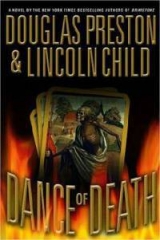
Текст книги "Dance Of Death"
Автор книги: Lincoln Child
Соавторы: Douglas Preston
Жанр:
Триллеры
сообщить о нарушении
Текущая страница: 12 (всего у книги 30 страниц)
TWENTY-SIX
Margo hesitated at the door to Menzies's office, took a deep breath, and knocked. The door was answered by Menzies himself; he'd done away with the prerogative of a secretary years before, complaining it distracted him. He smiled, nodded, and stepped aside, gesturing for her to enter.
She knew the office well. During her first stint at the museum as a graduate student, it had been the office of Menzies's predecessor, her old thesis adviser, Dr. Frock. Back then it had been stuffed with Victorian furniture, fossils, and curiosities. With Menzies, it seemed more spacious and pleasant, the dusty fossil plaques replaced by tasteful prints, the heavy old furniture retired in favor of comfortable leather chairs. A new flat-panel iMac sat in a corner. The last rays of the setting sun came through one of the west-facing windows, cutting a parallelogram of red across the wall behind Menzies's mahogany desk.
Menzies steered Margo to an armchair, then took his own seat behind the desk. He clasped his hands together and leaned forward. "Thank you for coming at such short notice, Margo."
"No problem."
"Working late, I see?"
"I've got to put Museologyto bed this evening."
"Of course." He unclasped his hands and leaned back into the sun, his unruly white hair suddenly haloed in gold. "As you may have guessed, I asked you here because I received an answer from the board of trustees in relation to the Tano masks."
Margo adjusted herself in the armchair, tried to look confident and assertive.
He issued a long sigh. "I won't beat around the bush. We lost. The board voted to keep the masks."
Margo felt herself go rigid. "I can't tell you how sorry I am to hear that."
"I'm sorry, too. Lord knows I gave it my best shot. Collopy was not unsympathetic, but the issue hit a wall with the trustees. Most of them are lawyers and bankers who have as much knowledge of anthropology as I have of writs or currency futures. Unfortunately, the world is such that they can presume to tell us what to do, and not vice versa. Frankly, I don't find the outcome surprising in the least."
Margo could see that the usually even-tempered curator was nettled. She had been hoping that the trustees, despite all indications to the contrary, would do the right thing. It seemed so obvious to her. But then again, it wasn't even obvious to other members of her department, so how could she expect a bunch of Wall Street lawyers to understand?
Menzies leaned on the table, looking at her intently. "This puts you rather more in the hot seat than before."
"I realize that."
"There's going to be a lot of pressure on you not to publish this editorial. They'll say the decision's been made, it's done-why stir up trouble?"
"I'm publishing, anyway."
"That's what I thought you'd say. Margo, I want you to know that I'm behind you one hundred percent. But you must be realistic and expect some fallout."
"I'm ready. Museology'sbeen an independent voice in museum affairs for more than a century, and I'm not about to knuckle under– not with my first issue."
Menzies smiled. "I admire your spirit. But there's another complication I must share with you."
"And what's that?"
"The Tanos are planning a cross-country protest caravan, due to arrive at the museum the night of the opening. It isn't just to call attention to their demands, but ostensibly to 'call back the lost souls of the masks' or something along those lines. They're going to stage an all-night religious ceremony and dances on Museum Drive, directly outside the museum. The trustees received notice earlier today."
Margo frowned. "The press is going to eat it up."
"Indeed."
"The administration's going to be embarrassed."
"Undoubtably."
"The opening's going to be total chaos."
"Without question."
"God, what a mess."
"My sentiments exactly."
There was a long pause. Finally, Menzies spoke. "You do what you have to do. Academic freedom is a critical issue in these parlous times. May I venture a piece of advice?"
"Please."
"Don't speak to the press– at all.When they come calling, politely refer them to the editorial you wrote and tell them that's all you have to say on the matter. The museum can't fire you over the editorial, but you can bet they'll be looking for another reason. Lie low, keep your mouth shut, and don't give it to them."
Margo rose. "Dr. Menzies, I thank you more than I can say."
The man smoothed down his unruly mane and rose as well, taking Margo's hand. "You're a brave woman," he said with a smile of admiration.
TWENTY-SEVEN
A light rap sounded on the glass of the office door. Laura Hayward, who'd been peering intently at her computer screen, sat up in surprise. For a ridiculous moment, she thought it might be D'Agosta, suitcase in hand, offering to take her home. But it was just the Guatemalan cleaning lady, armed with mop and pail, smiling and nodding her head.
"Is okay I clean?" she asked.
"Sure." Hayward wheeled away from her desk to allow the woman access to her wastebasket. She glanced up at the clock: almost 2:30 in the morning. So much for getting to bed early. But all of a sudden, she found she had a lot to do-anything to avoid going back to her empty apartment.
She waited until the woman had gone, then wheeled back to the terminal, scrolling through the federal database once again. But it was really just a perfunctory check: she had what she needed, for now.
After a few more moments, she turned to her desk. Messy on the best of days, it was now awash in computer printouts, manila folders, SOC photographs, CD-ROMs, faxes, and index cards-the results of her search of recent unsolved homicides meeting certain criteria. The papers formed a vague sort of pile. On a far corner of the desk, neater and very much smaller, sat another pile containing only three folders. Each had been labeled with a name: Duchamp. Decker. Hamilton.All acquaintances of Pendergast. And now all dead.
Duchamp and Decker: one a friend of Pendergast, the other a colleague. Was it really a coincidence they were murdered within days of each other?
Pendergast had disappeared in Italy-under strange and almost unbelievable circumstances, as related by D'Agosta. There were no witnesses to his death, no body, no proof. Seven weeks later, three acquaintances of his were brutally murdered, one after the other. She glanced at the pile. For all she knew, there might be other victims whose connections to Pendergast she had not yet uncovered. Three was troubling enough.
What the hell was going on here?
She sat for a moment, tapping the small pile of folders restlessly. Then she pulled out the one marked Hamilton,opened it, reached for her phone, and dialed a long-distance number.
The phone rang seven, eight, nine times. At last, someone picked up. There was a silence so long Hayward thought she'd been disconnected. Then, heavy breathing and a slurred, sleep-heavy voice came on.
"Somebody'd better be dying."
"Lieutenant Casson? I'm Captain Hayward of the NYPD."
"I don't care if you're Captain Kangaroo. You know what time it is in New Orleans?"
"It's an hour later in New York, sir. I apologize for the late call, but it's important. I need to ask you a few questions about one of your cases."
"Damn it all, can't it wait until morning?"
"It's the Hamilton murder. Torrance Hamilton, the professor."
There was a long, exasperated sigh. "What about it?"
"Do you have any suspects?"
"No."
"Any leads?"
"No."
"Evidence?"
"Precious little."
"What, exactly?"
"We have the poison that killed him."
Hayward sat up. "Tell me about it."
"It's as nasty as they come-a neurotoxin similar to what you find in certain spiders. Only this stuff was synthetic and highly concentrated. A designer poison. It gave our chemists quite a thrill."
Hayward tucked the phone under her chin and began to type. "And the effects?"
"Leads to brain hemorrhaging, encephalitic shock, sudden dementia, psychosis, grand mal seizures, and death. I've had a medical education from this case you wouldn't believe. Happened right in front of his class at Louisiana State University."
"Must've been quite a scene."
"You're not kidding."
"How'd you isolate the poison?"
"We didn't need to. The killer thoughtfully left us a sample. On Hamilton's desk."
Hayward stopped typing. "What?"
"Seems he walked, bold as brass, into Hamilton's temporary office and left it on the desk. Right while the old guy was delivering the last lecture of his life. He'd spiked Hamilton's coffee with it half an hour earlier, which means he'd been on the premises for a while. The perp left it there in plain sight, like he was sending some kind of message. Or maybe it was just a taunt to the police."
"Any suspects?"
"None. Nobody noticed anybody going in or out of Hamilton's office that morning."
"Is this information public? About the poison, I mean."
"That it was poison, yes. As to what kind, no."
"Any other evidence? Latents, footprints, anything?"
"You know how it is, the SOC team picks up a shitload of crap that has to be analyzed, hardly any of it relevant. With one possible exception: a recently shed human hair with root, enough to get a DNA reading. Doesn't match Hamilton's DNA, or his secretary's, or anyone else's who frequented the office. Kind of an unusual color-secretary said she couldn't recall any recent visitors with that hair color."
"Which was?"
"Light blond. Ultra-light blond."
Hayward felt her heart suddenly pounding in her chest.
"Hello? Are you still there?"
"I'm here," said Hayward. "Can you fax me the evidence list and the DNA data?"
"Sure can."
"I'll call your office first thing, leave my fax number."
"No problem."
"One other thing. I assume you're investigating Hamilton's past, his acquaintances, that sort of business."
"Naturally."
"Run across the name Pendergast?"
"Can't say I have. Is this a lead?"
"Take it for what you will."
"All right, then. But do me a favor-next time, call me during the day. I'm a lot more charming awake."
"You were charming enough, Lieutenant."
"I'm from the South-I suppose it's genetic."
Hayward replaced the phone in its cradle. For a long time, perhaps ten minutes, she remained motionless, staring at it. Then, slowly and deliberately, she replaced the file marked Hamilton,picked up the one marked Decker,lifted the phone again, and began to dial.
TWENTY-EIGHT
a nurse-tall, slender, wizened, dressed in black with white shoes and stockings, a real Addams Family creation-stuck her head out from behind a mahogany door. "The director will see you now, Mr. Jones."
Smithback, who'd been cooling his heels in a long hallway on the second floor of River Oaks, jumped so fast he sent the antimacassar flying. "Thanks," he said hastily as he patted it back on the chair.
"This way." And ushering Smithback through the doorway, she began leading him down another one of the mansion's dim, ornate, and seemingly endless corridors.
It had been surprisingly difficult to secure an audience with the director. It seemed "guests" often demanded to see Dr. Tisander, usually to announce that the walls were whispering to them in French or to demand that he stop beaming commands into their heads. The fact that Smithback had been unwilling to divulge the matter he wished to see the director about had made things even more difficult. But Smithback had insisted. Last night's dinner with Throckmorton, and the stroll around the manor house that had followed-with sidelong glances at the shuffling, empty-eyed waxworks and glum-looking fossils inhabiting the library and the various parlors-had been the final straw. Pendergast's concern was all very well, but he simply couldn't face the thought of another day-or another night-in this creepy mausoleum.
Smithback had worked it all out. He'd get a hotel room in Jersey City, take the PATH train to work, stay well away from Nora until all this blew over. He could take care of himself. He'd explain it all to the director. They couldn't very well keep him here against his will.
He followed the tiny figure of the nurse down the endless corridor, passing rows of closed doors bearing gold-leaf numbers. At some point, two burly orderlies had slipped into step behind him. At last, the corridor ended in a particularly grand door bearing the single word Director.The nurse knocked on it, then stepped aside, gesturing for Smithback to enter.
Smithback thanked her and stepped through. Beyond lay an elegant suite of rooms dressed in dark wood, illuminated by sconces. A fire flickered in an ornate marble fireplace. Sporting prints decorated the walls. The rear wall of the main room was dominated by a bow window, which afforded a view of the wintry landscape beyond. There were no bookshelves or anything else to suggest this was the office of a hospital director, although through one of the two side doors of the suite, Smithback made out what looked like a medical library.
In the center of the room was a huge desk, surfaced in glass, with heavy, eagle-claw feet. Behind the desk sat Dr. Tisander, writing busily with a fountain pen. He looked up briefly, gave Smithback a warm smile.
"How nice to see you, Edward. Have a seat."
Smithback seated himself. For a minute or so, the only sound in the room was the crackle of the fire, the scratch of the pen. Then Tisander placed the pen back into its desk set, blotted the paper, and set it aside. He leaned back in his heavy leather chair and smiled confidentially, giving Smithback his utmost attention.
"There, that's finished. Tell me what's on your mind, Edward. How's the adjustment to life at River Oaks?" His voice was low and mellifluous, and the kindly lines of his face were smoothed by age. He had a domed forehead, from which white hair arose in a gravity-defying leonine shock not unlike Einstein's.
Smithback noticed that the two orderlies were standing against the wall behind him.
"Can I offer you any refreshment? Seltzer? Diet soda?"
"Nothing, thanks." Smithback gestured at the orderlies. "Do they have to be here?"
Tisander gave a sympathetic smile. "One of the house rules, alas. Just because I'm the director of River Oaks doesn't mean I'm above its rules."
"Well, if you're sure they can be trusted to keep quiet."
"I have absolute confidence in them." Tisander nodded encouragingly, gestured for Smithback to proceed.
Smithback leaned forward. "You know all about me, why I'm here, I assume."
"Naturally." A warm, concerned smile lit up the director's wise features.
"I agreed to come here for protection, for my own safety. But I have to tell you, Dr. Tisander, that I've changed my mind. I don't know how much you know about this killer who's supposedly after me, but bottom line, I can take care of myself. I don't need to be here any longer."
"I see."
"I've got to get back to my job in New York at the Times."
"Andwhy is that?"
Smithback was encouraged by Dr. Tisander's receptiveness. "I was working on a very important story, and if I don't get back there, I'll lose it to another reporter. I can't afford that. This is my career.A lot's at stake here."
"Tell me about this story you're working on."
"It's about the Duchamp murder-you know it?"
"Tell me about it."
"Akiller hung an artist named Duchamp out of a high-rise window, dropped him through the glass roof of a restaurant. This is one of those sensational stories that don't come along every day."
"Why do you say that?"
"The bizarre mode of death, the prominence of the victim, the fact that the killer seems to have escaped all detection-it's a super story. I can'tlet it go."
"Can you be more specific?"
"The details aren't important. I need to get out of here."
"The details are always important."
Smithback's feeling of encouragement began to evaporate. "It isn't just my job. There's my wife. Nora. She thinks I'm in Atlantic City undercover, working another story, but I'm sure she's worried about me. If I could just get out and call her, let her know I'm all right. We've only been married a few months. Surely, you understand."
"I certainly do." The director was listening with utmost sympathy and attention.
Smithback, encouraged anew, went on. "This supposed killer who's after me, I'm not concerned about him. I can look out for myself. I don't need to hide up here any longer, pretending to be some nutcase."
Dr. Tisander nodded again.
"So, anyway, that's it. Even though I was placed in here with the best of intentions, the fact is, I can't stay a moment longer." He rose. "Now, if you'd be so kind as to call for a car? I'm sure that Agent Pendergast will cover the cost. Or I'll be happy to send you a check once I get back to New York. He took away my wallet and credit cards on the way up here." He remained standing.
For a moment, the room was silent. Then the director sat forward slowly, leaned his arms on the desk, and interlaced his fingers. "Now, Edward," he began in his calm, kindly voice, "as you know-"
"And no more of this Edward business," Smithback interrupted with a flare of irritation. "The name's Smithback. William Smithback Jr."
"Please allow me to continue." A pause, another sympathetic smile. "I'm afraid I cannot accede to your request."
"This isn't a request: it's a demand. I'm telling you, I'm leaving. You can't keep me here against my will."
Tisander cleared his throat patiently. "Your care has been entrusted to us. Your family has signed papers to that effect. You've been committed here for a period of observation and treatment. We're here to help you, and to do that, we need time."
Smithback stared incredulously. "Excuse me, Dr. Tisander, but do you think we could dispense with the cover?"
"What cover might that be, Edward?"
"I'm not Edward!Jesus. I know what you've been told, and there's no need for this pretense any longer. I need to get back to my job, to my wife, to my life.I tell you, I'm not worried about any killer. I'm leaving here. Now."
Dr. Tisander's face retained its kindly, patient smile. "You are here, Edward, because you are ill. All this talk of a job with the New York Times,about a cover story, about being hunted by a killer-that's what we're here to help you with."
"What?" Smithback spluttered again.
"As I said, we know a great deal about you. I have a file two feet thick. The only way for you to get better is to face the truth, to abandon these delusions and fantasies, this dreamworld you inhabit. You've never had a job at the Timesor anyplace else. You're not married. There's no killer after you."
Smithback slowly sank back into his chair, holding on to the arms for support. A terrible chill came over him. Pendergast's words on the drive up from New York City returned to him, pregnant with ominous new meaning: The director knows all about you. He's fully informed, he has all the necessary documents.Smithback realized that, despite what he'd assumed-despite what Pendergast implied-the director was notin on the deception. The "necessary documents" were probably legal papers of commitment. The full scope of Pendergast's plan to protect him lay suddenly revealed. He couldn't leave even if he wanted to. And everything he said-all his protestations and denials and talk of a killer-only confirmed what the director had learned from reading his case files: that he was delusional. He swallowed, tried to sound as reasonable and sane as possible.
"Dr. Tisander, let me explain. The man who brought me up here, Special Agent Pendergast? He gave me a false identity, put me here in order to protect me from a killer. All those papers you have are forged. It's all a ruse. If you don't believe me, call the New York Times.
Ask them to fax up a picture of me, a description. You'll see that I'm William Smithback. Edward Jones doesn't exist."
He stopped, realizing how crazy it must all sound. Dr. Tisander was still listening to him, smiling, giving him his full attention-but now Smithback recognized the nuances of that expression. It was pity, mixed perhaps with a faint expression of that relief with which the sane view the insane. That same expression had no doubt been on his own face at dinner last night as he listened to Throckmorton talk about a business meeting with God.
"Look," he began again. "Surely, you've heard of me, read my books. I've written three best-selling novels: Relic, Reliquary,and Thunderhead.If you have them in your library, you can see for yourself. My picture's on the back of all three."
"So now you're a best-selling author as well?" Dr. Tisander allowed his smile to widen slightly. "We don't stock our library with best sellers. They pander to the lowest common denominator of reader and-worse-tend to overexcite our guests."
Smithback swallowed, tried to make himself sound the soul of sanity and reason. "Dr. Tisander, I understand that I must sound crazy to you. If you would please allow me to make one call with that phone on your desk-just one-I'll show you otherwise. I'll talk to my wife or my editor at the Times.Either one will immediately confirm I'm Bill Smithback. Just one call-that's all I ask."
"Thank you, Edward," said Tisander, rising. "I can see you'll have a lot to discuss with your therapist at your next session. I have to get back to work."
"Damn you, make the call!"Smithback exploded, leaping to his feet and lunging for the phone. Tisander jumped back with amazing quickness, and Smithback felt his arms seized from behind by the two orderlies.
He struggled. "I'm not crazy! You cretin, can't you tell I'm as sane as you are? Make the frigging call!"
"You'll feel better once you're back in your room, Edward," the director said, settling back in his chair, composure returning. "We will speak again soon. Please don't be discouraged; it's often difficult to transition to a new situation. I want you to know that we're here to help."
"No!" Smithback cried. "This is ridiculous! This is a travesty!You can't do this to me-"
Howling in protest, Smithback was gently-but firmly-escorted from the office.