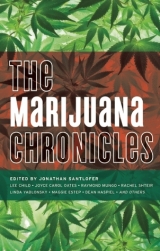
Текст книги "The Marijuana Chronicles"
Автор книги: Jonathan Santlofer
сообщить о нарушении
Текущая страница: 12 (всего у книги 13 страниц)

R
ACHEL
S
HTEIR
is the author of three nonfiction books, most recently
The Steal: A Cultural History of Shoplifting
. She has written for many magazines and newspapers, including the
New York Times
and the
New Republic
. During the 2011 Chicago mayoral election, she wrote a weekly column for
Tablet
magazine about Rahm Emanuel called “The Rahm Report.” She is the recipient of many awards for her writing, and has taught at many universities.
julie falco goes west: illinois poster girl for legalizing medicinal cannabis leaves town
by rachel shteir
I first met Julie Falco in September of 2012, after she had decided to go to California. I was looking for a person involved in the fight to make medical marijuana legal in Illinois. Everyone mentioned Julie.
When she greets me at the door of her nearly bare one-bedroom apartment, one of the first stories she tells me is how three years ago, she flew to DC to attend the Marijuana Policy Project’s fifteenth-anniversary gala—fifteen states in fifteen years. The event was held at the Hyatt Regency on Capitol Hill. The MPP was honoring her, Cheech and Chong—who received a Trailblazer Award—and Joseph McSherry, a physician who helped pass medical marijuana laws in Vermont.
Julie is telling me this because despite her efforts, and the efforts of many others, IL House Bill 30, which would make medical marijuana legal in Illinois, has yet to pass. Julie herself is less active in the movement than she used to be, but she remains the best-known patient advocate in the state, a rock star of the movement, albeit one who often had to sleep on the floor of the hotel room because the beds were too soft for someone with multiple sclerosis.
Recalling that night, Julie says she didn’t know three hundred people would show up at the MPP gala to support her. Nor did she plan to bring up one of her biggest irritations—the word “marijuana,” or as she sometimes says, “the M word”—which she stopped using around 2005 when she concluded that it prevented legislators from taking the plant’s medicinal uses seriously. Since then, she has always “thought in cannabinoid.” When she took the podium that night in DC to give her speech, the plea for changing the word to cannabis just tumbled out. Later, she was gratified to see Tommy Chong agree that the government uses the word marijuana to demonize pot. It was a golden evening and Julie could not have imagined that six months later, her dedication to cannabinoid science would take another shape—that she would begin to dream of California.
Today, pursuing that dream is how Julie spends most of her time. She is forty-seven, but she could be mistaken for ten years younger despite needing a walker to move around inside her apartment. She has an open, unlined face, brown hair, and brown eyes. The day I visit, she is wearing a peach-colored T-shirt with sequins splattered around the front, light-colored jeans, and a thin silver ring on her thumb. She arranges her hair in the style of Dorothy Hamill and is quick to smile.
Julie has had MS since 1986 when she was a communications major at Illinois State University in Normal, 133 miles from Chicago, and a girl guitarist in an alternative rock band, which went by various names but ended up as Zero Balance. Home for spring break to attend her mother’s second wedding, she first noticed her foot dragging in the supermarket parking lot. Before she had time to worry about the foot, it cleared up. She went back to school.
Two years later, Julie relapsed with totally different symptoms. Now she couldn’t see. The disease “hit her optic nerve.” There was no cure. She was told to go home and rest. Instead, she tried to live her life. She got a job at Design Lab Chicago, a theatrical lighting firm, and then went to Europe for a month. She backpacked, limping through France and Switzerland. She stayed with her grandfather’s sister in Germany in his 500-year-old house. She went to Amsterdam, she says, although she does not elaborate on the obvious—the legality of marijuana in Holland. From that time until 2004, she tried maybe forty different treatments—acupuncture, hydrotherapy, Zanaflex, Valium, BETASERON. She was “debilitated, lethargic, one big ball of symptoms.” She walked with a cane, and then two canes, and then a walker. (Now she uses her walker indoors and outdoors a power scooter or a wheelchair.)
Julie was scared. She had many different symptoms, including facial paralysis. She moved back to Chicago. She wanted to be near her family and moved into a small apartment on the second floor, above her grandmother’s, in Beverly, on Chicago’s South Side.
Twenty-six years later, Julie is tired. No one understands her dedication to cannabis, not even her mother, who told her she understands that it is her only medicine but that she hopes Julie keeps an open mind. What about Big Pharma, why don’t they keep an open mind? Julie asked.
She is tired of reading about drugs that suppress symptoms. She wishes for a drug that will eliminate symptoms. Most of the new ones are focused on newly diagnosed people, she complains. And when you read the side effects, when you get down to risk of death, “Let’s eliminate that one right off the bat,” she jokes. She is often joking.
These days when Julie wants to leave the apartment, which she does no more than ten times a month, she has to call the fire department. She could have built a ramp but ultimately decided against it. She now lives on the first floor in a typical one-bedroom on the northside, a little down at the heels, probably built in the 1930s, with a fake fireplace. There is a large massage table folded up in its cover by one wall and boxes piled by the window. She has been in this apartment for over twenty years. So, when she recently donated, gave away, and threw out around eighty percent of her possessions, it was a big job.
Now, every day Julie spends around four or five hours working on leaving town, to move to Berkeley or Oakland. It’s hard to find an accessible, affordable apartment. She was going to go with a friend but that person got ill. She’s exploring hiring a personal assistant. She’s on a waiting list for six or eight apartments.
“I’m not completely clear on my exit strategy. No one has responded to me. Is anyone interested that I’m giving my body to cannabinoid science?”
When I ask about cannabinoid, Julie is happy to explain: “Cannabinoid science is not marijuana. It’s a common mistake. Anyone who uses the word marijuana, they are living under Prohibition to demonize this plant. I use the words cannabis and cannabinoid medicine. I am studying the science. This is what the plant is called; there are cannabinoids; we have a cannabinoid system in our bodies, even if you do not imbibe in the cannabis system. I’ve written a book, it took me five years to research: The Cannabis Papers: a citizen’s guide to cannabinoids. It’s on Amazon and on lulu.com. It’s a signaling system, it regulates all the other systems of your body. We are deficient in this system.”
From 2004 until 2011, when Julie worked to advocate legislation allowing medical marijuana in Illinois—today seventeen states have these laws but Illinois still isn’t one of them—she would drive the several hours to Springfield about once a month. Then, in July 2010, she was invited to speak at the Science and Compassionate Care Seminar at the Radisson Plaza Hotel in Kalamazoo, Michigan. Also invited were Dr. William L. Courtney and his wife Kristen Peskuski, who had managed to control lupus and many other ailments by juicing cannabinoids. Kristen talked about how cannabinoids can best be absorbed into the body by juicing, putting maybe ten or fifteen fresh palm-sized leaves in a blender with some apples or some carrots, and drinking the mixture like a smoothie, daily. “The focus is always on smoking the biggest, grandest bud; there’s gotta be a paradigm shift, because the juicing is what cures you.”
And juicing was best accomplished in California.
Julie’s tiny, old-fashioned Chicago kitchen doubles as her war room and she keeps manila folders full of clippings in piles. She hands me a printout of a multicolored pie chart showing the amount of CBD (cannabidiol)—one of the compounds in the cannabis plant—and the amount of THC (tetrahydrocannabinol), which she says is less able to heal disease. On the chart, dozens of arrows point outward, each representing its own compound with its own healing properties.
Julie started taking cannabis in 2004, when she had already been ill for nearly twenty years. She was so ill she was thinking of suicide. A lot of things contributed toward her decision to try using cannabis as a treatment for MS: she had smoked in college, and while researching online she read about a woman with glaucoma who used it. At the same time, she began talking to Illinois NORML (National Organization to Reform Marijuana Laws).
Soon Julie began baking one-inch cube brownies and eating them three times a day. It helped with her symptoms and she thought, This is fantastic. She could speed around the living room doing twenty to thirty laps, exponentially increasing her energy level.
Each pan of brownies contained about half an ounce (roughly fourteen grams) of marijuana. According to Illinois law, possessing ten to thirty grams of pot is a misdemeanor with a maximum penalty of a year in prison and a $2,500 fine. Julie tried not to think about that. But cannabis helped so much that her most immediate response was gratitude. The sensation wasn’t like smoking where the effect goes to the brain. She was on an even keel all day long and it kept her numbness and tingling at bay so she could function well. Gradually, she weaned herself off pharmaceuticals and now she only takes Tylenol with codeine.
Julie began with a brownie mix, mostly Duncan Hines Double Fudge. She moved on to Ghirardelli brownie mix. She refined the recipe, sautéing what she genteelly calls “the plant material” in olive oil to release the benefits in it and to evenly distribute it. In other words, so she wouldn’t choke on a clump. She included many “add-ins,” such as walnuts and hemp seeds. More recently, though, she switched to what the NORML website calls Ginger Snap Surprise, which she buys already made, because she is too tired to bake.
Julie “takes” cannabis in a tincture of glycerine from an old brown glass bottle with an eyedropper, which goes right into her bloodstream. The tincture can also be made with flavored alcohol or with Everclear. There is also cannabis honey, the heat of which, stirred into tea, helps protect the compounds.
She likes dark chocolate and there is a box of chocolate almonds on the kitchen table. She takes her hemp juice, hemp oil. Sometimes she stops the cookies and brownies, like you would any medication. She is concerned about titration—in other words, how much medicine is good for her body.
Even back when she was “taking” brownies, Julie was sure that the changes she was going through were too profound to keep to herself. She began to speak about cannabis publicly and testified before the Illinois Senate, which, at that time, was in the first year of hearing a bill to legalize medical marijuana. Right away she wondered whether she should use her real name: She thought, Wow, do I say I’m Julie F. or Julie Anonymous? I’m talking about all my stuff and something that’s illegal. I can’t imagine sitting in a jail cell.
Then Julie read an article in the Washington Post about Jonathan Magbie, a paraplegic arrested for marijuana possession, who wound up in a cell where he couldn’t communicate with the guards.
“They found him dead, soaked in his own urine,” Julie says. “Are you kidding me? This is what we’re coming to? Someone who doesn’t have fully functioning limbs can’t take something that helps him? It’s just insanity. Well, I have use of my limbs, I have use of my voice. I am Julie Falco and it makes me feel better.”
Julie began to visit every legislator in Springfield, making trips once or twice a month to tell her story, which back then not a lot of people were doing. Still, in the ensuing six years, as state after state passed laws legalizing marijuana for medical use, Illinois did not. The Marijuana Policy Project would set up a hotel room and transportation, and she would pretty much have to pack it up, spend a few days down there, bring her wheelchair, going through every office in the capital. It was taxing—she would get tremors just from the noise and the crowd, her nerves were so sensitive she couldn’t process it all. It got easier over time. She’d bring a little container of brownies or ginger snap cannabis cookies. She would pull them out and say, “This is my medicine.”
Over the years, as Julie’s condition deteriorated, advocacy work became physically harder. Getting out of the house took its toll. She did as much as she could, but newer patients were more physically able and could take up the charge.
But year after year, the law would get passed in the Senate and stymied in the House. They were about two votes short. She would hear the same objections every year and the same anxieties about what would happen if the bill did pass: “Look at California,” people would say to her, referring to the chaos that ensued there as dispensaries got shut down by the feds, since federal law doesn’t recognize the state laws.
But according to Julie, the problem with Illinois is that it doesn’t have a referendum. The states that have gotten it passed have had a referendum; the people could vote it in. And yet it’s a hard issue to get people to rally around.
“How do you get chronically ill people to storm the Capitol about cannabis?” she asks, laughing. “It’s not like the teachers’ union.”
Last December, Julie was falling a lot. She had what she calls a “mini exacerbation,” a relapse of some of her symptoms, and had to go into a nursing home and the hospital. She returned home at the end of March.
What Julie knows about California is that in the dispensaries, there is a much greater level of sophistication about which brand of pot treats which ailment. With all those crazy brands—Lemon Skunk, White Diesel, Maui, Alien Dawg, Girl Scout Cookies, White Widow, Purple Urkle, Northern Lights—which in Illinois are hard to grow, it’s easier to cure yourself. Plus, people are just throwing leaves away because everyone’s focusing on the buds.
She sighs. “Get me to California right now.”

P
HILIP
S
PITZER
worked from 1966 to 1969 as a literary agent for John Cushman Associates, then the American affiliate of Curtis, Brown, London, representing hundreds of British writers. In 1969 he formed the Philip G. Spitzer Literary Agency, representing a wide range of fiction and nonfiction writers, as well more than a dozen French publishers. He specializes in general fiction and literary crime fiction, as well as the nonfiction subjects of politics, sports, and works of sociological interest. This is his first
written
work of fiction.
tips for the pot-smoking traveler
by philip spitzer
My wife and I rarely travel without weed. In spite of all the risks and possible consequences involved, it’s nothing next to traveling without it. After all, my wife and I met in Paris—but we might not have without the weed. Since that worked out positively, why change it?
Our prescription still reads, Take two a day or as needed.
Like anyone else, we have had our share of close calls whether alone or together. And this story is about close calls, although the episodes are not intended to be a deterrent.
Last Exit to Brussels
or
Tip #1: Check Your Weed’s Potency
In 1984, I was traveling to Paris to visit my family. I had to find the most reasonable fare, which turned out to be round-trip to Brussels and a train from Brussels to Paris. I was only going to be in Paris for a week, and so I brought along one ounce of pot, which I casually slipped into my jacket pocket. While still at JFK airport in New York. I had plenty of time to roll a joint, step outside, and have a smoke. The ounce being a last-minute addition, I wasn’t certain of its strength. It turned out to be high-voltage pot, enough to induce paranoia, which I was not used to. During the night flight I imagined that someone of authority had seen me smoke, followed me to the plane with the intention of making an arrest in Brussels, where the consequences would surely be more severe. Unlike the usual calming effect of the drug, I was unable to sleep, one eye open the entire flight. As I arrived in the Brussels train station, I was still scanning my surroundings to make sure I was not being followed. Like a spy or a fugitive, I made my way across the station, every passerby a possible threat.
My train ticket put me in a compartment with three other travelers, each of whom left at various stops in Belgium, and I soon found myself comfortably alone and finally relaxed.
Just as I was dozing off, there was a knock on the compartment door. It opened up to reveal a police officer standing in the corridor, mumbling something about drugs! Had I really been followed, after all? Had one of my fellow passengers, smelling the weed in my pocket, turned me in? Or was I experiencing the lingering paranoia of the joint I had smoked hours earlier? All of these possibilities (along with the rest of my life behind the bars of a Brussels prison) flashed before my eyes, ending with my bulging, odiferous jacket pocket no more than a meter from the police officer’s nose.
It took me awhile to come to my senses and understand that the officer needed to use my compartment to strip-search a passenger suspected of having drugs. I welcomed the officer, but not until I had already fled to the relatively fresh air of the corridor where I managed to stop shaking and consider the irony of my situation
(Rule #4: Never confess until asked.)
Would I even put myself in such a situation again? But of course!
Club Med or Bust
or
Tip #2: Talcum Powder Is Best Applied Dried
Like everyone else, my wife and I have discovered all sorts of ways of concealing our pot while traveling, just about everything short of disabling dogs at the airport. But one of our best efforts came close to landing us in a Mexican jail.
It was 1990 and we were traveling to a Club Med in southwestern Mexico. We knew that the nearest village was as tiny as it was remote, and we suspected that the Club Med (especially this one, focused on middle-aged guests and families with children) would not be a likely place to score drugs. My wife had rolled a dozen joints and buried them in a container of talcum powder. Safe enough, it would seem, especially if you considered the profile of the passengers: Screaming children and fat, middle-aged fathers wearing basketball jerseys and sneakers that looked to be size Shaq. A motley middle-class group that the authorities would surely ignore.
Customs was situated outside the terminal building (“terminal,” in this case, seeming like the operative word). We disembarked and took our place in a line, which snaked back almost to the plane. The building was hidden from our sight by various types of shrubbery, as if intentionally camouflaged. When the station itself finally came into view, we were shocked to see what was taking place. As each passenger took a turn before the agents, he or she was asked to press a large button of sorts, in plain view of everyone else. If the light that came on green, the passenger could pass through without inspection. If the light was red, the passenger was ushered to the side and his baggage was inspected. But not just inspected. Every item of clothing, every pocket, every gadget or container, was taken apart and pored over. Was a cavity search next? Possibly. Probably.
I broke out in a cold sweat, as did my wife. My trembling hands quickly surveyed the pockets of my jacket and trousers, which I had not worn for some time. Of course, each of the pockets on my jacket harbored at least one roach, which I managed to drop into the bushes as we inched along the path. I kept picturing the agents opening that container of talcum powder, laughing their asses off triumphantly, then checking our asses, and finally leading us off to a damp, stony prison cell (without a cell phone, without a call to our embassy, without our lawyer or our families). We would surely spend the rest of our lives there, dreaming of Club Med cocktails on the beach at sunset while we dined on tostada gruel and Montezuma’s Revenge water.
My wife and I walked up and hit the dreaded button together, holding our collective breath. I can still see my shaking hand reach for the button, which somehow turned green. A miracle. We could breathe again—though I think it was several minutes before either one of us did.
(Rule #2a: Whether you are traveling to Club Med, Disney World, or even on a Carnival cruise, do not take anything for granted.)
Did I learn my lesson? Of course not.
The Safety of Amsterdam
or
Tip #3: Don’t Skip the Dry Cleaners
I was going to be in Belgium for a business meeting and asked my wife to join me. After the three-day meeting, we would take a train to Amsterdam for a few days. The business part of the trip was going to be serious and boring; thus, no need to bring along any reefer. (Why waste good weed on boring business meetings?)
Business concluded, we headed to Amsterdam, just a few days into the trip. The train ride was long and tiresome, a local as it turned out that stopped frequently in Belgium and then Holland. We had planned to get to Amsterdam in time to check in to our hotel and then go out to dinner, and though the train ride seemed to take forever we made it in time, the trip uneventful.
The hotel turned out to be old and beautiful and we were told there was a wonderful restaurant just across the canal. As we were unpacking, my wife asked me if I had a light for her cigarette. I didn’t, as I hadn’t wanted to lose yet another lighter to US Customs.
But as I was going through my valise, I found a match box I didn’t remember bringing along, and I handed it to my wife, who opened it and said, “What the hell is this?!”
It turned out to be packed tight with pot. Then, looking in my shoulder bag, I found a rolled joint, along with a roach or two. Of course, we were safe in Amsterdam, a city that has been attracting pot smokers for years. But needless to say, the businesspeople with whom I was meeting in Antwerp would not have looked kindly upon me if I had missed my plane out of JFK or was stopped entering Belgium because of a drug violation. Once again luck was on my side—or in this case, ignorance was bliss.
(Rule #10 or 11 [I’ve lost count]: Unpack your bags before loading up for another trip!)
But here’s a fact, the truth, whatever you want to call it. I am a man of serious aches and pains, an actual condition that has impeded my walking, and pot is my medicine. I swear. I could no more walk the cobblestone streets of Europe than I could walk on air, something the drug makes possible. Should I move to California, or better yet, Washington or Colorado? Maybe. The only problem is getting there. Plane? Train?
And then there was the time I found four kilos of cocaine on a beach in Miami. But that’s another story for another time.
Happy traveling!