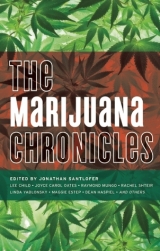
Текст книги "The Marijuana Chronicles"
Автор книги: Jonathan Santlofer
сообщить о нарушении
Текущая страница: 11 (всего у книги 13 страниц)
“No, that’s okay. You enjoy it. I’m fine.”
By now I had spread out and was lying on my back. The sun had begun its lazy descent. Claire lay on her back next to me, to my right. B. sat in a shapeless lump to Claire’s right, still savoring the first joint, then the second. Time passed. A gentle breeze rustled the deep green leaves of the Japanese Stewartia.
B. interrupted the silence. Softly, she said, “You know, Claire, if you ever need any gravel, just give us a shout. Bob would be glad to give you all you want—I mean free of charge.”
“Well, thank you. That’s very nice of you to offer—”
“With pleasure! It’s the least a good neighbor can do. And that goes for you too, Eric. Free gravel. As much as you want—although I guess you don’t have a big need for gravel where you live.”
I grunted. I was not sure if I was high from the pot or tipsy from B.’s spiked lemonade or simply enervated and even nauseous from the heat. The brownie had not helped. Would I ever know what it felt like to get high from smoking pot? Was this it, in some perverted, upside-down, Eric in Wonderland kind of way?
The kaftan at Claire’s side was spread out, with B. in it, flat on the ground, gazing up at the sky. One of Claire’s cats, a big tabby, entered the garden, knocked over a lemonade glass with its swinging tail, and brushed up against B.’s thigh before settling down there, in a thicket of polka dots. The moon had arrived in the early-evening sky.
I wondered how holy basil had earned its name. For the Indians, was it a sacred plant? I thought about how interesting it would be to make drawings of all of the plants in Claire’s garden. First I would have to do some serious research. I remembered that the best botanical illustrations always included each plant’s distinctive details. I wondered if watercolors, colored pencils, or my new set of colored felt-tip markers would be the best materials to use to capture the spirit of Claire’s garden and all that was in it. I thought that, with a few pounds of very small gravel neatly spread out in a shallow tray, I could create a miniature version of one of those Japanese Buddhist-temple gardens, the kind in which some dutiful monk, probably pulled away from his most profound meditations, must attentively rake the finely crushed stones that are symbols, in their smallness, silence, and durability, of the ocean’s countless waves or the timelessness of time or the notion that an entire universe can be found in even the tiniest grain of sand. I wondered if Bob was a good man and if, over the years, he had personally chosen all those chairs. Who had picked out the cuckoo clock? A second cat approached and snuggled in, between my feet.
“Am I high? Did I get high?” I asked, addressing my question to no one in particular.
“Do you feel high?” B. replied.
“I don’t know. I mean, maybe. Or, well, I really can’t say.”
“You’re high,” B. asserted. “I’d say that one of the two pot specimens had some effect. But then again …”
“Only you would know, Eric,” Claire said, turning her head slowly to face me. “You would know.”
“By the way, dear,” B. offered, “your pot is much better than my pot. The results of the taste test are in. You win. It’s that green thumb.”
Looking up, I couldn’t believe it—I could clearly see the Big Dipper and some other constellations whose names I should have known but could not recall. “Wow! You can’t see any of this down in the city. The city lights wash out everything.” Even the crusty, textured surface of the moon was vaguely visible. “I’m sorry I was such a failure at getting high,” I said to my companions as another cat climbed up and settled down, in a sphinx position, with its front paws turned in, on my chest, facing me.
“You’re no failure,” Claire consoled, as she took my right hand in hers and, on her right side, found B.’s hand floating above her kaftan and gave it a squeeze. We lay there in silence for a long time, with two cats purring, and cicadas buzzing in the bushes. The sky sparkled, and the moon glowed.
“There are many ways to get that feeling of being high, you know,” Claire said, peering into the night’s vast ocean of unfathomably far-away, intoxicating eternal light. Taking my hand in hers and lifting it up above our heads like a teacher’s pointer as we lay there on the grass, she turned to me and whispered, as though revealing a long-kept secret known only to the members of an ancient tribe: “All you really have to do, if you’re looking for it on a night like this, is lie back, look up, reach up, and touch the stars.”

PaRT IV
GOOD & BaD meDICIne

R
AYMOND
M
UNGO
is the author of
Famous Long Ago, Total Loss Farm, Palm Springs Babylon
, and many other books. An original founder of Liberation News Service in Washington, DC in 1967, he has published articles on the 1960s counterculture in periodicals and anthologies.
Famous Long Ago
was recently reissued in paperback as a college textbook in American history. Mungo lives in Southern California, where he is also a social worker tending primarily to AIDS patients and the severely mentally ill.
kush city
by raymond mungo
GOT KUSH? screamed the green billboard adorned with a sparkling crystallized bud, Humboldt quality, looming over Pacific Coast Highway and Cherry Avenue in Long Beach, California, a thousand miles south of grass country. A bold black 1-800 number was prominently advertised. That was it, no explanation, a freaking ad for reefer, as big as the Ritz. I damn near crashed the Honda hatchback into the car ahead of me. The nation was swirling down the 2008 rabbit hole of depression, panic was in the air, and some old Republican Vietnam War POW who thought marijuana was a gateway drug to heroin was running for president. But this cheerful note lifted my spirits.
I had plenty of pot, but no “kush.” Smoking grass daily since 1963, I used it as a tool for writing, but in fifty years of herbal appreciation never called it kush, and the stuff I got from Charlie was definitely not in that exalted category. Charlie home-delivered rather ordinary shit, but he was reliable, affordable, and always ready. As a fifty-five-year-old sometime jazz musician, he needed the extra green, but he sold the brown. Charlie carried only one variety at a time. The price never changed, but if he thought something was extraordinary, he’d recommend buying ahead. He dispensed professionally sealed packets for fifty bucks. No dickering, no discounts, no scales. Looked like a quarter, but he called it a lid.
Charlie was a nice guy, and I was glad to be free of the lifelong pursuit of fickle dealers, hanging around squalid apartments waiting for delivery, now that I’m an old fart. If the neighbors thought anything of the gray ponytailed beatnik visitor who showed up with some regularity but never stayed more than five minutes, they didn’t comment on it. The pungent aroma of the Mexican rag weed seeped from my front door into the hallway, but I wasn’t the only head in the building. The evangelical Christian on the floor below, who began and ended every conversation with invocations to the deity, more or less smoked all day long and never seemed to go to work. He drove a silver Beemer and had a trophy girlfriend.
“Hey, Charlie, what’s with all these GOT KUSH? billboards popping up everywhere around town?” I ventured.
He just groaned. “It’s driving me out of business, man. All my best customers in Silver Lake have gone legal.” He lived in LA.
“Legal?” What a concept.
“As in medical. You know, with a doctor’s prescription. The dispensaries are everywhere now.”
“They are?” I hadn’t noticed a single one in Long Beach, and anyway, who ever heard of a pot dispensary? “But that’s only for people with AIDS or cancer or some other horrible disease.”
“Nah, man, anybody can get a prescription. You can claim insomnia, migraines, appetite problems, mental stuff, anything, man. You pay the doctor’s fee and you get the prescription. Nobody gets turned down.”
Holy kush. Charlie was either giving our friendship a higher value than his business acumen, or had figured that my loyalty to him would dissuade me from trying this legal maneuver. Probably the latter, although in fact I was just a customer, not particularly a close friend. I was already scheming to get some of this stuff. What did I have to lose? The doctor might find me too goddamn healthy to qualify.
“Mental stuff” reminded me that I had vials of antidepressants and anxiety pills with my name on them, prescribed by my regular physician at the HMO. Never mind that both vials were badly outdated. Mental illness had been documented. I used the antidepressants exactly one day, then ditched ’em because they gave me a strong desire to kill myself. The doc offered to replace them with some other kind of antidepressant but I said, no, I’d rather be a little depressed than suicidal. The anxiety pills came in handy during a six-month stint in France, where pot was hard to find, and they actually helped me tolerate the dreaded cannabinoid withdrawal syndrome, which every daily user knows sets in after ten days of abstinence. The French smoke hash mixed with black tobacco and cured with some kind of poison that always makes me choke.
Coughing is one thing, and actually considered a good sign, but choking is another.
I set up an appointment with the pot doctor at a Medi-Cann clinic on a seedy block of Atlantic Avenue. It cost $110 for the visit, discounted if you happened to be on Medicare or Medicaid, and the operator explained that it was only sixty-five dollars for the annual renewal thereafter. Cash or credit cards were accepted, no checks.
Medi-Cann was a storefront with dirty windows covered by closed Venetian blinds on a block of abandoned retail locations—the only other functioning business, a corner liquor store. The tiny sign on the door gave no indication of the nature of the place, which was hard to find and would have attracted little notice except for the scaggy-looking long-haired young guys smoking cigarettes right outside. I arrived fifteen minutes before the clinic started seeing patients, but the place was already packed, only one forlorn folding chair unoccupied.
The Mayo Clinic this was not, but it might be the Mungo Clinic. Unlike any doctor’s office I’d ever seen, it had no magazines or medical brochures, but rather stacks of advertisements for Long Beach pot dispensaries and specialty marijuana publications, mostly from Northern California, with dispensary advertising from all over the state. Postcards touted twenty percent discounts for new patients, “free” joints, pipes, grams of hash, and rolling papers with a minimum “donation” and “membership.” I crammed a bunch of these into my briefcase and sat down with a Julian Barnes novel from the library.
All the patients in the waiting room were strapping young men in their late teens or early twenties, Testosterone City, except for one old guy in a wheelchair, very talkative, who seemed like a Vietnam vet/panhandler, and an old woman missing front teeth. Of course, you can’t tell just by looking at someone what his or her particular ailment may be, but this roomful of youths could not all be suffering from terminal illness. They joked around loudly, a party going on.
Every five or ten minutes, a young woman in capri pants opened the door to the inner office and called a new patient by name. The nurse or medical assistant, I guessed. Given the number of people crammed in the room and the frequency of her appearances, I assumed there must have been three or four doctors on duty. Nonetheless, by the time I was summoned, it was forty-five minutes past my scheduled appointment. These docs were evidently on Kush Daylight Time.
When the young woman summoned me into the back room, I was startled to find that she was the doctor—Dr. Monica. No nurse, assistant, or other physician was on duty. The office was devoid of trappings associated with medical practice, she never took my blood pressure or weighed me, there wasn’t a stethoscope or even a computer terminal in sight. The room was furnished with a battered wooden desk covered with stacks of files, on which a gooseneck lamp was clamped, and folding chairs for doctor and patient. I produced the vials of outdated pills, which she scrutinized briefly, nodded, and hastily scrawled notes on what seemed to be my chart, but made no comment. She asked only how often I smoked pot, and how—joint, pipe, vaporizer? Every day, for over forty-five years, usually in joints.
“You ought to give yourself a vacation from it for a week or ten days every now and then, give your lungs a break. You’ll also get more value for your money when you do go back to it.”
(Fair enough, I thought, but in fact not gonna happen.) (Except in France.)
“And you should look into a vaporizer. Some daily smokers can’t make the transition, but the advantage is that it delivers the THC without the harsh smoke. The best one is from Vape Brothers.” (Now there’s an idea.)
Thank you, doctor ma’am. She marched me back to the receptionist who’d taken my $110 and handed me a document certifying my prescription for twelve months. The secretary took a Polaroid photo and promised I’d get a laminated ID card in the mail within two weeks. The prescription was ready for immediate use, and the nearest dispensary was only a few blocks away.
Natural Health Collective, identified only as NHC on the door, was in an alley behind a commercial building, up an outdoor wooden staircase to the second floor. Even with the street address from its postcard advertisement, the place was clandestine, the door locked. A handmade sign advised me to Ring Buzzer for Admittance. I noticed a video camera mounted above me and a wave of paranoia washed over me. The door clicked and I entered a small waiting room with a cashier shielded behind what looked like bullet-proof glass.
“Your first time?” the guy asked.
“Yeah.”
“Can I see your doctor’s rec and driver’s license or photo ID?”
I slid the documents through the narrow glass slot.
“Have a seat, this will just take a few minutes,” he said.
Voices murmured behind the wall and another locked door under video surveillance. Ten minutes passed while I wondered what was going on and felt vaguely insecure about the clerk having my driver’s license and doctor’s prescription, but he emerged smiling from his cage and returned my belongings to me.
“You’re clear.” A buzzer sounded and he waved me to the entrance of the inner sanctum. “One for the showroom,” he barked into a walkie-talkie contraption as the door swung open.
It was a pot smoker’s candy store. Glass display cases held rows of Mason jars crammed with gorgeous buds labeled with fanciful names. Purple Haze. Strawberry Cough. Blue Dream. Jedi OG. Super Sour Kush. Sensitive electronic scales and boxed displays of paraphernalia covered the glass countertops. One wall was dominated by a huge white board on which varieties and prices were posted in erasable felt tip. Prices were quoted by gram, eighth, or full ounce and got higher with perceived quality and more economical with greater volume, but my first impression was pure sticker shock. The cost was more or less double Charlie’s. As a first-time patient, I would get a twenty percent discount as well as some freebie—choice of a free gram or joint with minimum of purchase of an eighth, choice of a small pipe, pack of papers, or lighter.
All the clerks were scantily clad young women showing considerable décolletage, grinning broadly. They jabbered away, gaily advising me about the special deals, like extra-heavy eighths on Tuesdays, free eighths in exchange for referring a new patient, and a ten percent discount for seniors and the disabled. I qualified for the former, but you couldn’t combine it with a first-timer discount. Payment was by cash only, no plastic, checks, or receipts. The weed was bagged in the familiar mortar-and-pestle prescription sack used by regular pharmacies.
The product was outstanding, like the best Maui Wowee, and I was instantly too spoiled to get off on Charlie’s stuff anymore. Since every dispensary offered the twenty percent introductory discount plus “free gift,” I became a first-time patient in each.
With new dispensaries popping up all over town, they soon outnumbered Starbucks. My newbie status lasted a good two years before I had to visit the same one twice. Each had its unique properties, some larger than others, but all of them were fairly hard to see from the street, marked only by initials. The prices were remarkably competitive with one another, almost universal, as was the cash-only/no-receipt payment policy. The quality varied, but I was seldom disappointed. A few of these shops were evidently not playing by the rules. I saw a tall, golden Adonis in tank top and shorts buying three thousand dollars’ worth of bud—there was no specific dosage on the prescription, but the medicine was by law for personal use only—who remarked casually that he was “buying for my collective in Huntington Beach.” One sleazy outfit offered sample hits from a vaporizer on-site, not kosher, and one proprietor boasted of a full guarantee: “If you’re not satisfied, bring it back and I’ll replace it,” he crowed. One place actually had a bubble gum machine in its lobby and permitted children to wait there while their parents shopped the showroom. An elderly retired nurse from Orange County ran her own tiny shop, called the Green Nurse, and offered to weigh you and take your blood pressure. A young, bearded stoner guy in torn jeans took the money and put it in his pocket before handing you your purchase.
I finally settled on Quality Discount Caregivers (QDC), one of the busiest dispensaries in town, which had a huge selection of top-grade stuff. The prices weren’t any lower but they featured a kind of “frequent flyer” program. Save the empty plastic vials from twelve eighths, then redeem them for a free one, a baker’s dozen. Zig-Zag papers were gratis. On the fifteenth of the month, everything in the store was twenty-five percent off, and patients lined up on the sidewalk, but even on regular days you always had to wait your turn to get into the vault. The clerks were all mostly bosomy, half-naked chicks, the patients almost all male. I wondered how they got away with hiring only the youngest and most endowed female clerks—wasn’t that a violation of equal opportunity employment or something? The amount of money changing hands was staggering. Security precautions were practically military, with TV monitors everywhere and muscular, young, uniformed security guards with “badges” and guns.
By 2010, Long Beach had become a kushier town than Amsterdam, Bangkok, Maui, Bern, or Lugano. All those places had anti-marijuana laws they simply declined to enforce. Of course the brown cafés of Amsterdam were the most famous, the novelty of being able to walk into a storefront and score your stash over the counter almost unique in the world. But Switzerland, quietly and without controversy, has a similar system—in fact, growing and possessing marijuana has never been against Swiss law, but they cleverly get around it with a loophole; they call it hemp and prohibit its use “for narcotic purposes.” Hah hah hah.
The difference in California is that the storefront dispensaries are legal under state law. The state passed the first medical marijuana initiative in the nation, the famous Proposition 215, way back in ’96, and many attempts to repeal it have been soundly rejected by the electorate. Federal law adamantly forbids pot, but when Obama took office, he very early indicated that his attorney general would not pursue medical marijuana patients. Cities and towns in California adopted their own local ordinances, adding to the confusing miasma of different laws.
How groovy is that? But some upscale towns and better neighborhoods shunned the dispensaries. I found myself in places I wouldn’t frequent after dark. I raced past loitering bums eyeballing every customer who emerged from the store. I parked in conspicuous spots.
While few people would deny medicine to patients with serious illnesses, everyone knew you could get a prescription for nothing worse than a headache, and public objections to blatantly obvious pot stores grew into an uproar. Parents complained about cannabis storefronts located near schools and parks. Neighbors took offense at the late-night shenanigans and clusters of loitering stoners on the street. The Long Beach City Council dickered over the matter, divided into liberals and conservatives like the Supreme Court, and finally crafted a “compromise”—a bizarre lottery system intended to award a limited number of dispensary licenses and thus rein in the explosive growth of the industry. Some rogue dispensaries ignored it entirely and kept opening their doors and raking in cash until the city cops raided and smashed up their shops. A full-scale war was underway by 2011.
Uh-oh. Trouble in Paradise. But every time I asked one of the babes if the dispensary was going to be closed down, she said something like, “Oh, no, it’s all just politics, it’s all about money, we’re staying open, here you go honey, see you next time!”
Eventually the city got the amount of stores down to what it considered a manageable number, but then the federal government filed suit to invalidate the local ordinance, ruling that city law could not supersede federal. The crackdown seemed to contradict Obama’s original promise not to interfere with medical users, and was applied selectively to a few places that were singled out. Total chaos descended by the summer of 2012, with dispensaries vowing to defy the ban and pushing for a popular vote. Medical marijuana doesn’t fail at the ballot box.
This unstable, troubled paradise could not survive indefinitely and after six more months of feverish wrangling, Long Beach closed down its pot shops in August 2012, while LA did the same. Anticipating this tragedy, I’d stocked up in advance. In the last couple of weeks, the store was crammed from opening to closing. I saw all my street buddies. Everyone was worried sick. But we joked about it and the girls winked. I knew the end was near, however, when on my last visit there was only one babe on duty, the others having been replaced by grim-looking hairy men, the bosses.
Not every store complied, of course, but the rogue operations seemed doomed to violent police raids.
Sob. The GOT KUSH? billboards are gone now and it appears that the golden era of freewheeling liberation is behind us, but the horse got out of the barn and won’t go back. I shopped at one of the several dispensaries who refused to shut, and they were welcoming new customers by the score with a twenty-five percent discount. The scene there resembled rush hour on the freeway, with slow-moving lanes of potheads.
Even the owners forced to shut down now make the dubious claim that they can still deliver kush to your home quite legally as long as you have the doctor’s letter, and certainly these home deliveries will be more difficult to regulate than public stores, since they are essentially invisible. There’s no risk of running out of medicine.
But in five years it’s come full circle in Kush City. I wonder if Charlie has branched into the “legal” home delivery business. I wish I hadn’t lost his number. But the babe slipped hers into the bag.