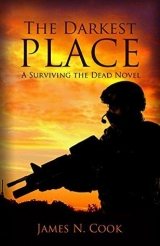
Текст книги "The Darkest Place"
Автор книги: James N. Cook
сообщить о нарушении
Текущая страница: 6 (всего у книги 34 страниц)
“All squads are in position,” Thompson said, pointing his rifle toward the horde. “Advance.”
TEN
Caleb’s team approached, Cole out front, the rest of the squad formed up and advancing on their right. Thompson brought up the rear, rifle in hand, the only one still armed with an M-4. As squad leader, it was Thompson’s job to hang back, direct the fight, and use his carbine to assist anyone who got in trouble. The rest of the squad—Caleb included—had to engage the enemy with hand weapons. It was not an ideal way to fight the undead, but with the Army’s resources stretched as thin as they were, conserving ammunition was critical.
He watched Cole wade into the press with his usual glee, bar mace moving in a steady figure-eight pattern, an infected skull crushed like a melon with every downswing. To Cole’s right, Eric went to work with his Y-shaped stick and long, elegant sword. The sword had no edges, just a wickedly sharp tip. Eric dispatched walkers by holding the stick under his arm like a jouster’s lance, catching a ghoul by the throat with its Y-shaped end, and stabbing it in the brain through the eye socket.
When Eric had first described his method to Caleb, he had doubted Eric’s claims of how well it worked.
Then he had seen it in action.
Eric could kill walkers twice as fast as anyone Caleb had ever met, himself included. Lieutenant Jonas had even recorded Eric’s tactics on a digital camera and sent it back to Central Command for review, recommending that the folks at AARDCOM (Army Anti-Revenant Defense Command) find a way to adapt the method for use by regular infantry.
Caleb’s thoughts were interrupted as a walker stumbled away from one of Cole’s backswings, but did not go down. He stepped forward, spear cocked back at shoulder level in a two-handed grip, and thrust forward. The needle-sharp point crunched through the ghoul’s nasal cavity and pierced its brain with such force that two inches of blade protruded from the back of its skull before Caleb yanked his weapon free.
Beside him, Holland’s twin tomahawks flashed in the sunlight as he began frenetically attacking the ghouls coming at them from the left. A second-degree black belt in tae kwon do, Holland utilized hard kicks to knock walkers to the ground, then dispatched them with precise chops to the brain stem. When his kicks failed to knock a ghoul over, he moved in and slashed at their knees and ankle tendons, then backed off to let other walkers trip over them, making for easy kills.
Caleb stayed busy, utilizing front kicks to keep walkers at distance and thrusting his arms like twin pistons, every stab claiming another ghoul. The fight raged around him, the howls of the undead mixing with battle cries and grunts of effort from his fellow soldiers. One of the men in his squad shouted for help somewhere to his right, followed by the crack of Thompson’s rifle.
A ghoul appeared in front of Caleb, mouth gaping, black tongue rolling in its putrid mouth. It moaned at him, the stench of its breath threatening to gag him through his scarf. Before he could bring his spear to bear, the corpse grabbed his shoulders and lunged at him. He caught it by the throat with one hand and pushed it away, its teeth snapping inches from his face.
Knowing his strength would not last long against the unnatural power of the ghoul, he thrust his spear into the ground next to him and drew his Beretta. After a quick glance to make sure no soldiers were in the line of fire, he pressed the barrel to its infected forehead and pulled the trigger. The pressure on his arms released immediately as the ghoul fell, but there were three more hot on its heels.
Caleb re-aimed his pistol and fired twice in rapid succession, dropping two of them. The falling ghouls tripped the third one on the way down, giving him time to holster his pistol and retrieve his spear.
“Hicks, you okay?” Thompson shouted.
“I’m good,” Caleb said through clenched teeth as he rammed the blade of his spear upward through a walker’s soft palate and then kicked it away. The fight continued a few more minutes before the press of walkers began to thin and he could see Alpha and Bravo squads fighting their way toward him. The walkers paid no heed to their impending doom, focused solely on the gnawing hunger driving them onward.
Caleb watched one of the last infected’s eyes as he killed it. The mindless, enraged half-light burning within winked out of existence. He let it slide from his blade and stood panting, eyes searching for the next target, but saw only other soldiers in gore-spattered uniforms. All four squad leaders pressed fingers to their ears at the same time, receiving instructions from Sgt. Ashman.
Sergeant Kelly, the most senior squad leader, was the first to speak up. “All right, we got the all clear from Sergeant Ashman. Squad leaders, form your men up and rally back at the trail. We need to decon ASAP and get back on the road.”
Caleb turned to his staff sergeant, along with the rest of the squad. “You heard him,” Thompson said. “Let’s go pick up our gear.”
There was no cheering. The men removed their armored gloves, checked each other for bites, and walked wearily back to where they had left their belongings. From their backpacks, they removed green aerosol cans with DECON AGENT stenciled on the labels. It was one of the Army’s many new innovations: a disinfectant spray that could kill just about anything. From what Caleb understood, it was essentially just a more caustic version of Lysol. While no one fully understood how the Reanimation Bacteriophage worked, it was well known that outside its host, the Phage was as vulnerable to disinfectants as any other pathogen.
The men sprayed each other down, taking care to scrape off dead tissue and soak any area of cloth that had come into contact with infected flesh or blood. When all squads were finished, and the squad leaders had reported in, Ashman gave the order to march.
“Nothing like a workout first thing in the morning, eh?” Eric said, nudging Caleb in the arm as they trudged along the path.
Caleb thought about the last ghoul he killed, and the way it seemed almost relieved as it died, and shook his head.
He was silent for the rest of the march.
*****
The situation at Fort McCray, as per usual, followed the ages-old pattern of activity known to every army since the dawn of warfare.
Hurry up and wait.
While Caleb and the rest of his platoon awaited orders in the mess hall, Eric stayed busy. His first order of business was to corral a radioman and bribe him into sending a message to the sheriff’s office. It was a coded message, the cypher of which only he and a few other people in Hollow Rock knew. The gist of the message was that something big was going down with Echo Company, and Mayor Stone needed to contact Captain Harlow at her earliest opportunity.
Next, he waited in the shade of an oak tree outside the headquarters building where he could be easily found. Less than ten minutes later, an earnest young MP approached him and politely asked if he would accompany him to Captain Harlow’s office.
The best way Eric could describe Captain Harlow would be to say he was medium. Medium height, medium build, voice a solemn tenor, black hair carefully trimmed and combed to the side, uniform immaculate, shoe shine impeccable, as neatly put together as anyone Eric had ever met.
He had a hard time picturing Captain Harlow in combat attire, rifle in hand, leading men into battle. He would have looked more at home in a suit and tie selling tax-free municipals to Florida retirees. But upon closer inspection, Eric detected a certain firmness to the set of his jaw, a clarity in the chilly gray eyes, a surprising strength in the proffered handshake, his movements brisk and efficient, his demeanor possessed of an air of assured authority that belied of his youthful appearance.
“It’s good to see you again Mr. Riordan,” Harlow said. “Please, have a seat.”
“Thank you, Captain.” Eric sat in one of two folding chairs in front of Harlow’s plain metal desk.
“Mayor Stone contacted my staff a short while ago. It seems she’s concerned as to why I’ve called First Platoon to headquarters.”
Eric nodded. “And the Ninth TVM.”
“I’m sure the mayor understands why I can’t contact her by radio. Operational security. I’ll need to speak with her in person.”
“Of course. In the mayor’s message, did she appoint a representative in her absence?”
Eric detected a slight narrowing of Harlow’s eyes. “Yes. That would be you.”
“I thought as much. So, would you mind telling me exactly what’s going on?”
“You have to understand, Mr. Riordan, the nature of that information is very sensitive.”
“I understand completely.”
“Then you understand I can’t divulge information about ongoing operations to civilians simply because they drop by and ask me to.”
Eric sat forward in his seat, not caring for Harlow’s tone. “You do realize you’re talking to the guy who infiltrated the Free Legion, right?”
“Yes, I am aware of that. And I certainly appreciate everything you’ve done for your country, but-”
“And you do realize that General Phillip Jacobs, head of Army Special Operations Command, is a good friend of mine, right?”
Harlow stared, but said nothing.
“Furthermore, the treaty between the free community of Hollow Rock and Central Command stipulates that the mayor’s office is to be briefed on any military operations which might affect the safety of the community’s citizenry. Were you aware of that?”
A few seconds ticked by. “I’m afraid I haven’t read the treaty yet, Mr. Riordan.”
“Well, you should. It’s a bit dry, but once you get past the boilerplate there’s some important information there.”
Harlow steepled his fingers under his chin. “Tell me, Mr. Riordan. What did you do before the Outbreak? I’m guessing … lawyer.”
“Financial analyst, actually. Now let me ask you a question, Captain. Is there a possibility these ongoing operations you referred to could adversely affect the people of Hollow Rock in any way?”
A muscle in Harlow’s jaw twitched a few times before he answered. “Yes. That is a possibility. Which is exactly why we have to keep a tight lid on what’s going on.”
Eric sat back in his seat. “I’m listening.”
Harlow let out a slow breath and placed his hands flat on the desk. Eric had the distinct impression the young captain would have liked nothing better at that moment than to gut him with a rusty machete. When he spoke, his tone was frosty.
“You understand any information I share with you is classified, and is to be shared only with Mayor Stone, correct?”
“Of course.”
“And you are aware of the penalties for leaking this information, correct?”
“Correct. And I am duly intimidated. Now can we get on with it?”
Harlow scowled. “I’m sure you’ve kept up to date on the trouble we’ve been having with the Midwest Alliance.”
Eric nodded. “Allow me to summarize: What was once a loose affiliation of independent city states came together nearly a year ago under a centralized government and declared their independence from the Union. While the federal government has not officially recognized their independence, they haven’t attempted to bring them to heel either. In the interim, the Alliance has been fighting a shadow war against the Union and its interests, including but not limited to supplying arms and personnel to anti-Union militant groups. There is also evidence to suggest the Alliance is in cahoots with the Republic of California, which is really just a puppet government under the control of foreign forces who have invaded and subdued a large section of Northern California, Oregon, and Washington. Did I touch on all the major points, Captain?”
“Yes, you did. Are you also aware of the problems we’ve been having with marauders harassing border communities in Kentucky and Kansas?”
“I’ve heard a rumor or two. Some people think the Alliance is behind it.”
Harlow nodded. “A few months ago, a special operations task group was deployed to the border to assess the severity of the problem and determine if the Alliance was indeed involved. Long story short, the answer is yes, although we can’t prove it beyond plausible deniability on the Alliance’s part. However, the problem is much worse than we thought.”
“How so?”
“What they’re doing goes far beyond simple harassment. It’s a land grab. They’re trying to get the people living in these border communities to flee south and abandon their territory.”
“And how are they doing that?”
“I’ll give you an example. What used to be the town of Kevil, Kentucky is now known as Fort Carter. Like many towns that survived the Outbreak, it’s population has grown significantly in recent years as survivors from nearby areas have filtered in. Fort Carter is surrounded by fertile farmland, grows enough crops to feed its population and then some, and until recently, the town’s principle export was livestock. Goats and chickens, mostly.”
“So what happened?”
“These so-called marauders happened. They showed up with a horde of about two-thousand revenants and unleashed them on the town. While the town’s defenders were busy trying to keep the undead from beating down their walls, the marauders went to work on the fields and livestock. They didn’t destroy everything, but the damage was pretty severe. Fort Carter will need federal assistance to make it through the winter this year. And that’s just one example; this is happening to towns all along the border.”
“Jesus. I didn’t realize it was that bad.”
“No one did. Not until the task group got there.”
“And now that the Army knows, you have to do something about it.”
“Exactly.”
“And unless I miss my guess, Fort McCray is the nearest FOB to the border.”
“That we are.”
Eric was quiet a few moments, fingers drumming on his knee. “This is all very interesting, Captain, but what threat do these marauder groups pose to Hollow Rock? They’d be crazy to attack here.”
“One would think. But according to our intelligence sources, that’s exactly what they intend to do.”
Eric let out a low whistle. “The Alliance’s leadership isn’t completely stupid, Captain. I guarantee you they have people watching this place. They know we have tanks, and helicopters, and heavy artillery, and hundreds of troops.”
“I concur.”
“So how do they expect to win against all that without starting a war?”
Captain Harlow held out his hands, palms up. “That, Mr. Riordan, is the million dollar question.”
ELEVEN
Caleb sat on the concrete floor of the drill hall—a massive pre-fab metal building resembling a small airplane hangar—and listened to the briefing.
An hour after hustling to Fort McCray and being told to wait in the mess hall, Lieutenant Jonas returned from headquarters and ordered them to leave their gear behind and follow him to the drill hall. There, they were ordered to have a seat on the floor and wait for Captain Harlow to arrive. Second and Third Platoons showed up shortly thereafter, followed closely by the Ninth TVM. The sound of a generator roaring to life and the lights coming on overhead preceded the captain’s arrival by five minutes.
The captain greeted his company, then nodded to a sergeant who turned on a projector connected to a laptop. As he often did, Captain Harlow spent an hour droning on about a plan that should have taken no more than five minutes to convey.
In short, First Platoon was being deployed to the border to meet up with special operations forces, designated Task Force Falcon, already in the area. Half of Third Platoon, which was essentially an ad-hoc detachment of tank and helicopter crews, pilots, artillerymen, and mechanics, would go along as support, as well as a few scouts from the Ninth TVM. The other half of Third Platoon, all of Second Platoon, and the remainder of the Ninth TVM would stay behind to defend Hollow Rock.
While his company commander’s briefing method was repetitive and overly detailed, Caleb had to admit it was effective. By the time it was over, every soldier in the room had a clear idea of what lay ahead of them, and what role they were to play. When he was finished, Captain Harlow instructed those troops bound for the border to be ready to deploy in forty eight hours, and then turned them over to their platoon leaders. Lieutenant Jonas held a quick meeting with his squad leaders and instructed them to get their men ready to move out. As they were leaving, Caleb spotted Eric approaching and motioned him over.
“Learn anything?” Caleb asked, keeping his voice low.
“Yeah, lots. But you heard most of it in the ops briefing. The rest I can’t talk about.”
Caleb raised an eyebrow. Eric leaned in close. “Look, there’s some serious shit headed our way. All right? Keep your eyes open and your ear to the ground.”
“I always do,” Caleb said. Eric clapped him on the arm as Sgt. Ashman gave the order to march.
As First Platoon exited the gate, Caleb looked back to see Eric staring after them.
*****
“You’re squared away, Hicks,” Thompson said. “See you Tuesday morning.”
“Thanks.”
As he stowed his spare gear in his footlocker, he noticed Thompson staring at him. “Hey,” he said. “Everything all right with you? You’ve been more quiet than usual lately.”
Caleb did not pause in his work. “I’m fine.”
“Listen, man, I’m not talking to you as your squad leader right now. I’m talking to you as your friend. What’s going on with you?”
Caleb looked Thompson in the eye, measuring. Finally, he looked away and said, “Personal things.”
“Miranda?”
Caleb nodded.
“Everything okay between you two?”
“Yeah, we’re fine. It’s me that’s the problem.”
Thompson stepped closer. “Catch up with me when I’m off duty. I’ll buy you a drink. We’ll talk about it.”
“Nothing to talk about, really. Just letting her weigh the baggage.”
The staff sergeant smiled. “Sounds like things are getting serious.”
Caleb shrugged silently and left the barracks.
*****
“So how long do you think you’ll be gone?” Miranda asked. She and Caleb were sitting on her couch with the last fading light of the afternoon slanting in through curtained windows.
“No telling. Could be a couple of weeks, could be more than a month.”
Miranda chewed her lip, absorbing the news. “You’ve been on missions like this one before, right?”
“Yep. Lots of them.”
“You don’t sound worried.”
“That’s because I’m not.”
Miranda smiled and ran a hand down his left cheek, fingers tracing over the splatter of scar tissue there. “You’re not invincible, you know.”
“I know.”
“Then you should be at least a little scared.”
“I’ll save it for when the shooting starts. A healthy measure of fear keeps you sharp; worrying just makes you tired and sloppy. Burns up energy. That’s how people get killed. They lose focus.”
Miranda stared at him with irritation and affection, then slid closer to lay her head on the hollow of his shoulder. “When do you leave?”
“Tuesday morning. 0900.”
“Do you have to report for duty tomorrow?”
He shook his head. “Not until Tuesday morning. Got all my stuff ready earlier. All I have to do is grab it and go.”
She smiled and kissed him on the side of the neck. “So we get to spend the day together?”
“Yep. What do you want to do?”
Miranda sat up on her knees and began unbuttoning her shirt. “I can think of a few things.”
Caleb grinned and pulled her onto his lap.
*****
Later, after the sun set and they had enjoyed a shower together, Miranda lit a few candles in her bedroom and she and Caleb lay entwined in the soft light, their faces almost touching. “So you left off with the men who attacked Lauren,” she said.
Caleb waited a few heartbeats to answer. “Yeah.”
“What happened next?”
He pushed a lock of blonde hair behind Miranda’s ear and let out a heavy sigh. “Had to come up sooner or later, didn’t it?”
“It’s all right if you don’t want to talk about it.”
“No. It needs to be said. Full disclosure and all that.”
“Okay.”
“I’ll warn you again: you might not like what you’re going to hear.”
Miranda kissed his lips and then the tip of his nose. “I’ll take my chances.”
TWELVE
Houston Metro Area, Texas
Lauren was never the same again after the attack. The next year was a bad one for us all.
She lost weight. She had nightmares. The lines of her face deepened, and dark rings took up permanent residence under her eyes. Little sounds made her jumpy. She got a conceal and carry license and wouldn’t leave the house unarmed. Dad tried to convince her to start seeing a therapist, but she was having none of it. She insisted she was fine, though it was plain for anyone to see she wasn’t. There were cracks in her foundation.
Then came the Outbreak.
I remember exactly where I was that day. I had just turned eighteen and had finished school a few months early. We were out on the patio eating a steak dinner to celebrate when my dad’s cell phone rang. He picked it up, checked who was calling, and answered.
“What’s up, Blake?”
I watched his face grow confused, then disbelieving, then tight with strain. “How bad is it?” he asked.
That got Lauren’s attention. We sat still, the two of us, watching him intently.
“Okay. I’ll do that. No, not yet. If it comes to that, we’ll communicate via radio. All right, see you soon.” Dad hung up and sat quietly, staring into nowhere.
“What is it?” Lauren asked, eyes worried.
“Trouble in Atlanta,” Dad said and stood up. “Come on, let’s see what’s going on.”
Lauren and I shared a confused glance, then got up and followed him inside. Dad turned the television on to CNN and increased the volume. By then, the first of many, many hordes had already overrun the initial police barricades and begun to spread throughout the city. Fires raged, riots broke out, people looted stores, neighbors turned on each other, violence grew rampant. The city looked like a war zone. The three of us sat on the couch in shocked disbelief, our dinner sitting forgotten on the picnic table outside. An hour or so after turning on the TV, we watched three ghouls drag a reporter to the ground and begin ripping him apart. As the cameraman fled, the news feed abruptly cut away.
Lauren made a small choking sound and ran for the bathroom. I looked over at my father, a cold feeling spreading through my hands and face, and said, “Dad, what the hell are those things? They can’t be people.”
The old man said nothing for a long time. Finally, he stood up and walked over to the window. “I heard rumors from other operators, but I didn’t think they were true.”
“What rumors? What are you talking about?”
He put his hands on his hips and looked down. “About some kind of disease that turns people into … those things you saw. Other operators, guys who did missions in North Korea and China talked about it-” Dad looked up suddenly, realizing what he was saying. He never talked about his time in Delta Force, not even to Lauren and me.
“Caleb, son, we might be in trouble here.”
“What do you know, Joseph?”
Dad and I turned to see Lauren standing in the hallway. We hadn’t realized she was standing there. Her arm trembled as she pointed at the television. “Joseph Hicks, if you know something about what’s going on in Atlanta, you tell us right now.”
Dad shook his head. “Lauren, you know I can’t talk about that stuff. I signed a con-”
“I don’t give a shit about your confidentiality agreement!” Lauren advanced on Dad, hands balled into fists, veins standing out on her forearms. “If you know something, you tell us now!”
“Okay, okay,” Dad said, hands upraised. “Calm down, honey. Listen, just sit down, all right? Come on.” Moving slowly, he put a gentle hand on her arm and carefully guided her back to the couch.
It wasn’t the first time since the attack that she had blown up under stress. Dad and I knew the best way to handle it was to give her time to calm down, but I didn’t think it would work in this case. She practically hummed with tension.
When we were all seated, Dad kept his voice low. “Look, all I know is rumors. Okay? Stuff I heard in bars over too many drinks. The first time I heard about it, this guy I knew from another unit and I were talking, and he got drunk, and he told me the North Korean’s had some kind of virus or something that turns people into cannibals. Said it … messes up their brains somehow. They can’t move very fast, but they don’t feel pain either. The only way to drop them is to shoot them in the head. He said …” Dad stopped and put a hand over his mouth.
“What, Joe?” Lauren asked. “What did he say?”
“This is going to sound crazy.”
Lauren’s voice rose. “What did he say, Joe?”
“He said they’re dead.” Dad looked Lauren in the eye. “He said they’re walking dead people.”
If not for the television and the low drone of household appliances, you could have heard a pin drop.
“Joe,” Lauren said, “that’s not possible.”
Dad held out his hands. “Look, I didn’t believe him either. Later on, I heard the same thing from other people and I still didn’t believe it. I passed it off as superstition, or people seeing something that wasn’t there. There had to be some other explanation. Those guys were soldiers, after all, not scientists. But after what I’ve seen today ...”
“Is it contagious?” I asked.
He turned to look at me. “From what I’ve heard, yeah.”
“Oh God, is it airborne?” Lauren asked.
Dad held out his hands. “Look, at this point, you know as much as I do. For now, let’s just stay calm and keep an eye on things. I’m sure the government will get it all sorted out.”
It comforted me, then, to hear him say that. But in retrospect, we should have followed our instincts.
We should have run for our lives.
Instead, for the next few days, we huddled together around the television and watched the end of the world unfold.
*****
Hope is a powerful force.
The best thing about hope is it is tenacious. It does not die easily. And like every emotion, it has it’s dark counterpart. To love, hate. To joy, sorrow. To confidence, fear.
To hope, despair.
The bad thing about hope is it can get in the way of another, more important emotion: acceptance. And acceptance, important and helpful at it is, also has its counterpoint.
Denial.
We held out hope in those early days. Hope that the government would find a cure, that the military would find a way to defeat the undead (and by then we knew that was what they were). We kept faith that someone, somewhere, would figure out a solution. But by the time the Outbreak crossed the Mississippi River, it was no longer hope.
We were in full-blown denial.
Eleven days after the Outbreak started, I woke up to an angry orange sky out my bedroom window. Not the soft yellow of a spring morning, or the gray of a rainy day, or even the clear blue of a cloudless sky.
No.
Orange. Dark orange, like some great torch had suffused the surface of the sky. I got out of bed, dressed quickly, and went to wake up my father.
“Hey Dad, you need to see this,” I said, shaking his shoulder. He awoke in an instant, the glaze of sleep clearing rapidly from his eyes.
“What is it, son?” he asked. Beside him, Lauren stirred and began to sit up.
I pointed. “Look out the window.”
His eyes shifted and grew wide. “Mother of God.”
Lauren’s hand went to her mouth. “What …”
Dad threw off the covers, shrugged into a shirt, and started toward the front door with me and Lauren following close behind. I kept my hand on his shoulder as he opened the door like we were about to execute a room entry. Dad hesitated for a moment and looked back at me.
“Caleb, take a deep breath, son.”
I did, and let my hand drop.
“Stay calm.” His eyes tracked back and forth between Lauren and me. “Whatever is happening, we’ll handle it together, okay?”
I nodded. “Okay.”
Behind me, Lauren was silent, but I could feel her fingers gripping the back of my shirt.
I was a head taller than my father by then, so I could see over his shoulder as he opened the door. According to the clock in the living room, it was just after eight in the morning. But judging from the darkness outside, I would have thought the hour no earlier than five or six. A malignant haze hung over the neighborhood, painting houses in shades of amber and black. Everywhere I looked something drifted down like snow, covering lawns, streets, and cars with a thin sheen of gray.
“Is that … ash?” I asked.
Dad said nothing. He pushed out the door and strode into the front yard, one palm turned upward. He stared at it for a few moments, then rubbed his fingers together. Looking around, I could see a few of our neighbors standing in their yards doing the same thing, faces locked in dumbfounded fear.
“It’s ash.” Dad said. “Come on.”
I followed him to the end of the street and around the corner. Our house faced south, away from nearby Houston. There was a hill at the end of the street where we could see the city’s skyline to the east. The three of us climbed it, Dad leading the way. When we reached the summit, we stopped cold.
At the edge of the horizon, Houston was in flames.
Great black pillars of smoke streaked upward, staining the clouds above. The city skyline was invisible, obscured by the choking haze. Undulating silvery streaks extended along the highways where people were fleeing the city. The sounds of explosions and gunfire popped and echoed across the distance. I stood transfixed, unable to speak or even think, Lauren’s hand clutched in my own.
My father chose that moment to utter the most profound understatement in human history. “This is bad.”
I couldn’t help it. I let out a bark of hysterical laughter. “Oh, really? You think?”
Dad turned and glared at me. It was on his lips to say something harsh, but whatever he saw on my face stopped him. His dark eyes softened and he laid a hand on my shoulder. “Come on, son. Let’s go home. We have things to do.”
*****
If there was one thing my father believed in, it was preparedness.
He and I stood in front of a workbench in the garage. In front of us lay a collection of pistols and rifles, boxes of ammunition, spare magazines, tactical gear, and freeze-dried emergency rations.
“We’ll take a rifle, a pistol, and a backup piece each,” Dad said. “No point in bringing anything else. It’ll just be extra weight.”
“We should bring the hunting rifle and the .22s,” I replied. “Useful. Ammo’s easy to find.”