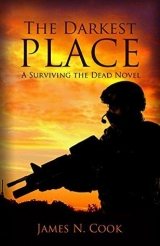
Текст книги "The Darkest Place"
Автор книги: James N. Cook
сообщить о нарушении
Текущая страница: 31 (всего у книги 34 страниц)
FIFTY-EIGHT
The wagon was moving away from us.
I drew my pistol and fired a single shot into the trees. Even from a hundred yards, I could see the driver jump. His initial reaction was to lay flat against the bench, snatch a rifle from the buckboard, and take aim in our direction. Tyrel and I both raised our hands and waved them over our heads.
The driver’s face was bright red when he reached us. “What the hell is wrong with you two? There’s infected all over the place.”
“Relax,” Tyrel said. “If they were close enough to be a problem, they’d have heard your wagon. You hear any moans?”
The driver’s anger dimmed somewhat. “No. I guess I don’t.”
“Then why don’t you hop down and help us with the bags?”
“I ain’t no goddam porter,” the man said. “Move your own cargo.”
“You just used a double negative,” I replied. “Which means you are, in fact, a porter. Now if you want any more business from us in the future, my friend, you’ll hop your ass down here and get to work. You might be cheap, but you’re not the only game in town.”
He looked confused for a moment, shook his head, said something unpleasant, and set the brake.
When we had left Woodland Park, we knew our bags of salvage were too heavy to carry more than a few hundred yards. We also knew it would not be long before the infected thawed out, so after retrieving our gear from where we had cached it in the hills, we liberated a tarp from an abandoned house and used sticks and paracord to improvise a sled. What followed was a long, difficult hike, and we were both exhausted by the time we reached the rendezvous.
Overhead, clouds began to gather. Low, dark, gunmetal gray clouds born along on a high, speeding wind. On the slopes above us, snow blew down in swirling plumes, scattering on the surrounding pines and cedars. The wind funneled down into the valley, and by the time we finished loading the salvage, we had to cover our eyes against the stinging ice and lean forward to keep our footing.
“We need to move,” the driver shouted over the howling noise. “Bad weather coming in.”
No shit, detective. “Let’s go then,” I said.
As we hurried back toward town, the horses tossed their heads and whinnied at the storm. The driver leaned over to Tyrel and asked, “Where’s that Mexican fella that was with you?”
Tyrel set his jaw and shook his head.
“What happened?”
“None of your goddam business.”
The driver looked offended. He started to say something else, but Tyrel turned his flat black-eyed glare toward him, and the driver snapped his mouth shut.
The wind blew strong and cold on the way back to the Springs.
*****
The headquarters for the Colorado Springs Volunteer Militia Corps occupied the gutted remains of what had once been a big-box retail store.
Outside was an empty parking lot, the cars abandoned there long since hauled away for scrap. On the inside, shelves and display stands had been cleared out and replaced with rows of desks, file cabinets, and locked storage containers. The containers covered two-thirds of the floor space and were where the militias kept the majority of their after-tax wealth.
After putting our salvage in storage on the west side of town, Tyrel and I hired a carriage to drive us to headquarters to deliver the bad news about Rojas. When we arrived, LaGrange was at his desk, as usual. Sometimes I wondered if the man ever left the building when not on a mission. Maybe he slept and took his meals there and only went outside to use the latrine.
He looked up when he heard us coming, his face its usual mask of barely concealed irritation. His eyes flicked back and forth between us.
“I don’t like the looks on your fool-ass faces,” he said.
Tyrel and I sat down in two of the three chairs facing him. He put down his pen and stared at us. “Well? What is it?”
I looked at Tyrel, who nodded to me. “We ran into some trouble in Woodland Park,” I said, not meeting LaGrange’s eyes. “Rojas … he didn’t make it.”
The irritation left LaGrange’s face. His cheeks sagged and the lines around his eyes seemed to deepen. “Shit. What happened, infected get him?”
I shook my head. “No. Salvage hunters. Rogue group, never seen them before.”
The sagging cheeks began to darken. “Where are they now?”
“Dead,” Tyrel said. “We killed them.”
“All of them?”
Ty nodded.
LaGrange heaved a sigh. “Any indication of where they came from?”
“No,” Tyrel said. “We searched, but all they had were clothes and weapons. That was it.”
No one spoke for a stretch, the noise of the other militias doing business around us a low din of voices and chairs scraping over concrete. LaGrange opened a desk drawer, removed two forms from a binder, and held them out to us. We took them, and he shoved a cup full of pens in our direction.
He said, “Start from the beginning.”
I spent the next hour describing what happened, leaving out the incriminating parts and omitting certain items of salvage we recovered, such as a dozen grenades. Tyrel and I had gotten our story straight on the way over, so I knew his account would match up with mine with no discrepancies. When we were finished, LaGrange read both our reports and nodded in satisfaction.
“I’ll turn this in to the police in the morning. Shouldn’t be any trouble for you two. Looks like a clear-cut case of self-defense. Regardless, it’s not like the other guys are around to tell their side.” He set the papers down. “You ever find the sniper that got Rojas?”
Tyrel said, “Officially? No.”
A slight smile creased LaGrange’s face. “Unofficially?”
“I took care of it.”
“Good.” LaGrange sat back in his desk and rubbed his hands over his tired face. “Damn shame about Rojas. He was a good man. He’ll be missed.” Our platoon leader stood up and stretched and picked up a stack of papers. “I’ll let the rest of the men know what happened. We’ll put together a memorial service. Think there’s any chance of recovering the body?”
“Maybe,” Tyrel said. “If it stays cold and the infected don’t get to him we might be able to send a few guys. If so, I’ll go with them.”
“Me too,” I said.
“I’ll see what I can do. In the meantime, you two go home and get some rest. You look like shit.”
The two of us nodded and stood up to leave. LaGrange began to walk away, then stopped in his tracks and turned around. “Wait, Hicks, I almost forgot.” He opened a drawer and pulled out a letter in a sealed envelope. “This came for you yesterday morning. Courier said it was urgent.”
I took the envelope. “He say anything else?”
“Nope. Try reading the letter.” With that, he left.
I stared at it for a few seconds, brows close together. There was nothing written on the outside, no indication of who it came from. I opened it and took out a small scrap of paper. It read:
Caleb,
Sophia went into labor last night. She’s at the hospital. The doctors said there’s something wrong. Come to the maternity ward as soon as you get this letter. Ask for doctor Caligan.
It was signed by one of Sophia’s old co-workers. I stared at it for several long seconds willing the words to change, hoping if I wished hard enough the letters would rearrange themselves and tell me everything was all right. Tyrel broke the trance by putting a hand on my arm.
“Hey, kid, you all right? What does the letter say?”
I handed it to him and sprinted for the door.
*****
Dr. Caligan was a short red-haired woman in her late forties. She stepped into the waiting room and stood in front of me under fluorescent lights. The hospital was one of the few facilities in the Springs with electricity, powered by fuel brought in from some strategic reserve or another. She introduced herself and asked me to have a seat.
I said, “Where’s Sophia?”
“Sir, please don’t shout.”
I ground my teeth, took a breath, and said, “Please, doctor.”
“Would you take a seat?”
I didn’t move. A grinding sound reached my ears, and I felt a terrible pressure behind my eyes. The doctor looked down, wiped her mouth, and said, “Last night, your wife went into labor. There were complications.”
My legs began to feel weak. “What complications?”
“Sir, you’re shaking. Please sit down.”
This time, I did as ordered. The doctor took a seat beside me, her eyes filled with genuine sympathy. “She was in labor for two hours. She delivered the baby, but suffered severe hemorrhaging in the process. We did everything we could for her, but … Mr. Hicks, I’m afraid she didn’t make it. She lost too much blood and passed away during surgery.”
The floor disappeared beneath my feet.
I knew it was there, but could not feel it. My ears rang, sounds coming to me as from a great distance. I broke out in a cold sweat. My hands went numb. A hot tingling roared around my cheeks and in my chest. I was not hearing this. This was not real. I was not in this hospital, this doctor was not talking to me, and none of this was happening. It was a nightmare, and I would wake up soon. Sophia would be beside me in bed, and Rojas would still be alive, and Lauren, and Dad, and Blake, and the living dead would never have devoured the world and destroyed everything and it just all had to stop.
Closing my eyes, I said, “Where is she now?”
“She’s in the morgue. I’ll need you to identify the body.”
I nodded numbly. “What about the baby?”
Some questions, you ask them and you already know the answer. It is intuition. It is instinct. It is the subtle inferences one can make in the course of conversation that reveal a truth without actually saying it. We convey these truths by tone, by body language, by the prerequisites of human experience, and by the things not said in their correct places. Such as telling a man the mother of his child died in childbirth and not immediately salving the wound by mentioning the child survived. So the next sentence out of her mouth was no surprise.
“I’m sorry, Mr. Hicks.”
The doctor told me Sophia held her before she died. My daughter. Before the end, she had enough time to give her a name.
Lauren.
I leaned my head back against the wall, felt warmth pour down my cheeks, and remembered the picture in the locked chest in that shithole shipping container I lived in, and the beautiful blue-eyed blonde woman holding a wrinkled little baby, and her pale face, her blue lips, the sadness in her smile, and all the years of watching my father try to put himself back together.
My life had finally come full circle.
And now it was over.
FIFTY-NINE
Six weeks later, I woke up in the street.
It was night. I had no idea what time. A howling wind roared through the streets, hurling loose snow and ice like a frozen sandstorm. A hand shook my shoulder, trying to roll me over.
“Hey, mister, wake up. You can’t sleep out here.”
I rolled to my back. The sky above was black, starry, and clear, the streets and buildings around me illuminated by the full moon. I sat up and looked down at myself. My jacket was missing, as were my boots. Whoever robbed me had left my socks, although they weren’t doing me much good. I could not feel my feet.
I looked up at the person who woke me. He was a soldier about my age, maybe eighteen or nineteen, the visible part of his face ruddy and windblown. A scarf covered his mouth and nose.
“Sir, it’s freezing out here. We have to get you some place warm. Can you stand up?”
“I can try.”
The soldier wrinkled his nose as he helped me stand. I managed about four steps on the wooden blocks attached to my legs before the world began to spin and I went down to my knees and was violently sick. Not that there was much in my stomach to throw up. A few minutes of dry heaves later, I staggered up.
“Okay. I think I’m a little better now. Where are we going?”
“There’s a place up the street. You can warm up there for a while.”
“Where are we?”
He told me. I said, “Well, at least I’m not far from home. Must have been on the way there when I passed out.”
The place the soldier mentioned turned out to be a tavern built on the foundation of a building that burned down during the Outbreak. It looked like something out of the mid nineteenth century: plank floors, wooden tables and chairs, dark paneling on the walls, a long polished bar to the left of the door, and a roaring fireplace in a brick chimney on the far side of the dining room. Upstairs, a railed walkway encircled three sides of the tavern, doors spaced every eight feet or so. The soldier helping me eased me down into a chair near the fire.
“Wait here a minute,” he said.
I leaned against the table, laughing to myself. I could not have gone anywhere if I had wanted to. The fire was warm and inviting, and I turned so I could rest my feet on the hearth.
Looking across the room, I saw the soldier talking to the bartender. There were only a few other patrons scattered about, all of them staring at me. The noise was low enough I could hear the conversation.
“The hell you bring him in here for?” the bartender demanded. He was a stout man with thick arms, a shaven head, and a face like a bulldog.
“Found him in the street. If I’d left him out there he would have frozen to death.”
The bartender eyed me skeptically. “Probably would have been a kindness. Look at him, for Christ’s sake.”
There was a mirror on the wall at the coat rack. I turned and looked at myself and almost cringed at what I saw. The blond beard was so stained it was almost brown, matted and crusted with dried vomit. My eyes peered out from sunken sockets, ringed in black, the cheeks beneath them hollow, the bones of my face standing out sharply against dry, cracked skin. My lips looked like pink grub worms. My clothes were beyond filthy, stained so badly I could not tell what color they had originally been. There was a rip in my shirt at waist level through which I could see a long expanse of gaunt, scarred rib cage. It would not have surprised me if someone mistook me for a walker and put a bullet through my head. And honestly, I don’t think I would have tried to stop them.
“I know he looks bad, but he’s a human being, Dave,” the soldier said.
“Barely.”
“Can I get some water and a bowl of soup?”
The bartender, Dave, turned his big ball of a head my way, then looked back at the soldier. “You payin’? I don’t run no charity.”
“I can pay for my own food,” I said, raising my voice to be heard. The money belt beneath my pants was still in place. Whoever stole my jacket and boots must not have thought to look there. I dug a hand in it, came out with a small plastic zip-lock bag filled with sugar packets, and shook it where the bartender could see. A few sets of eyes focused greedily on the bag.
Money, or trade rather, was not a problem. I still had most of what I had earned with the militia in storage. But after Sophia died, I stopped showing up for work, and despite Tyrel’s best efforts, had no intention of going back. The only thing I cared about anymore was pouring as much alcohol down my throat as I could manage before passing out. Because when I drank, I forgot. I forgot the blue eyes, and the long blonde hair, and the soft skin, and the musical laughter, and the shared meals, and touches, and comforting each other when things looked bleak. Most importantly, I forgot the night I felt my daughter move in her stomach.
The daughter I would never know.
As I sat at the table, my eyes stung from the memories. My heart sped up, and I knew the withdrawal symptoms were coming. The speedy heartbeat would soon become a painful pounding, my hands would shake, there would be nausea, cold sweat, and labored breathing. If I waited too long, the auditory hallucinations would start. Better to order a drink, something strong to take the edge off, and then follow it up with as many as I could buy. And since I was paying with sugar, arguably the most valuable trade item next to toilet paper and feminine hygiene products, I could afford a lot.
The bartender stomped over to my table, put his hands on his hips, and said, “If you got trade like that, what the hell you doin’ runnin’ around lookin’ like a bum?”
“None of your fucking business, friend. You take the trade or not?”
His eyes shifted to the bag on the table, and he looked almost contrite. “Sure.”
“Double whiskey, and keep ‘em coming.” I withdrew a packet from the bag and slid it across the table.
“Ain’t got no whiskey. Just grog.”
Grog was a clear liquor brewed from whatever fruit or vegetable matter a distiller could get his hands on. It tasted like turpentine and sweat, but it was strong and it got the job done.
“Fine,” I said. “But since it’s grog, that packet is worth two doubles.”
“For five more packets, you can have a whole damn bottle.”
I handed them over. “Done.”
He took the sugar, started to walk away, and then looked over his shoulder. “We got a bath in the back if you want to use it, fella. I can smell you from over here.”
“Maybe later.”
“Suit yourself.”
He returned with a bottle and a glass, his attitude toward me much improved. Leaning down, he said, “You should probably stay the night here. Some undesirables across the room are giving you the glad-eye. Probably try to rob you the minute you step out the door.”
I shrugged. “Let ‘em try.”
“You might also have noticed it’s cold outside and you ain’t got no shoes or jacket.”
“I do, actually, just not here. I’ll be fine.”
Dave the bartender shook his head and walked away. “Your funeral.”
I poured my first drink since passing out in the street and downed it gratefully. The taste was terrible, and it burned my stomach like someone had poured gasoline down my throat and lit it, but it slowed my heart rate almost immediately. I thought back to the days before the Outbreak, and how heavily bartenders could be fined for serving people under the age of 21. Now, no one seemed to care. If you could reach over the bar, you were old enough to drink.
The soldier who had helped me inside finished his mug of hot herbal tea and stopped by my table. “You going to be okay?”
I nodded. “Doing much better now, thank you. Care for a drink?”
“Can’t. I’m on duty.”
“You see any uniforms around here?”
He smiled. “How are your feet?”
Now that I had warmed up some, I could feel them again. They had not been exposed long enough for frostbite to set in, but they still ached. “Hurts, but I’ll survive. Come on, let me pour you a drink.”
He shook his head, still smiling. “I can’t stand that stuff. Grog, I mean.”
I looked down at my glass. “It’s not so bad once you get used to it.”
“I have to go back out on patrol. You have a good evening, sir.”
I watched as he walked out the door and held it open while another man walked in. The newcomer thanked the soldier politely, walked up to the bar, and ordered water and a bowl of soup.
The dining room was not large. Maybe thirty feet by twenty feet, not including the bar. From where I sat, I could see a glint of metal around the newcomer’s neck, a necklace with a gold medallion that looked familiar. I tossed my drink back, poured another one, and tried to remember where I had seen it before. With all the drinking I had been doing lately, my brain was in a constant fog. The only modes I operated in anymore were drunk, hung over, or suffering from withdrawal symptoms. Cognitive gymnastics that were once easy now took time and great effort to accomplish. So I sat, and drank, and stared, and halfway through the bottle, I remembered where I had seen the medallion.
I could not move for a while. The rage was too intense. I did not dare look in the direction of the bar lest I alert the man eating his soup. But my mind was moving, and moving quickly. I put the cork in the bottle and carried it across the room in my stocking feet.
“I think I’ve had enough for tonight,” I told Dave the bartender. “Mind keeping this behind the bar for me?”
He took it and placed it on a shelf under the bar. “Not at all. What name should I put it under?”
“Bacchus.”
He grabbed a notepad and pencil. “How do you spell that?”
I told him, then asked if the offer to utilize his bath was still valid. He said it was, and offered to have someone wash my clothes for me.
“You got a runner around here?”
“I do.”
I handed him the key to my shipping container. “Send him to get me some new clothes and a pair of boots. Shouldn’t take him more than about ten minutes. I live close by here.”
“Will do.” He shouted for someone named Nicky, and a moment later a skinny kid no older than thirteen showed up at the bar. He took the key and the instructions, and turned to leave. I grabbed him by the arm on the way by and informed him I knew exactly where everything was in my home, and if anything went missing, I knew where to find him. “I ain’t no thief,” the kid said defiantly. “I earn my way.”
“Keep that attitude and we’ll get along just fine.”
As the kid took off, I motioned the bartender to lean closer. He held his breath, but complied. “That guy at the end of the bar? Keep him here. Offer him a drink, tell him … tell him a guy was in here a little while ago, paid for the drink, then got in an argument with his woman and left before you had a chance to serve it.”
Dave’s eyes narrowed. “I ain’t lookin’ to get myself in no trouble, kid.”
“No trouble, mister. It’s just I think I know him from back before the Outbreak, and I don’t want him to see me like this. I doubt he’ll recognize me in this condition.”
The eyes stayed narrow. I reached in my money belt, took out a plastic bag full of instant coffee packets, palmed it, and slid it across the bar. “For your trouble. And there’s more where that came from.”
After a moment’s hesitation, he took the coffee and whispered, “Anything happens to that guy, and people come around askin’, I’m gonna tell ‘em the truth. You hear?”
“Understood.”
He grunted and moved away. At a signal from Dave, an older woman who had been wiping tables came over and told me to follow her. She led me into the back and set two metal buckets of water on a pot-bellied stove, then handed me a washcloth, a dry towel, a comb, and a ball of homemade soap. I sponged myself down with warm water, wet the rag and the soap, and spent the better part of ten minutes scrubbing myself from head to toe. I even managed to get all the crust out of my beard. The comb looked clean enough, but just to be sure, I cleaned it in one of the buckets before running it through my hair. I had just finished toweling off when the old woman knocked on the door.
“You decent?”
I wrapped the towel around myself. “Come on in.”
She came inside and retrieved the two buckets, the soap, the comb, and the washcloth. “What do you want me to do with your old clothes?”
“Burn them.”
A nod. “Probably for the best.”
A minute or two later, the runner boy, Nicky, knocked at the door. I let him in, and he handed me my clothes and the key to my home. His eyes widened as they roved over the scars on my torso. A few seconds passed while I waited for him to leave, but he didn’t budge. I snapped my fingers in his face. “Got a staring problem, kid?”
He flushed, said, “Sorry sir,” and ran off.
A quick peek in the mirror told me I had accomplished my goal. Anyone who saw me walk out the front door would not recognize me as the same man who went in.
I dressed hurriedly and went back into the dining room. The newcomer with the medallion was still seated at the bar nursing a glass of grog. I nodded to the bartender on the way out, walked a block down the street, and ducked into an alley.
Now it was a waiting game. If the table of men who eyed my trade so jealously were really going to rob me, they would not wait long to come out. Too much chance of losing my trail. Perhaps a minute ticked by, and sure enough, I saw all three of them emerge from the tavern.
“Which way you think he went?” one of them said. He was short, older, thick beard, stocky build.
“There’s his footsteps,” another said, pointing at my tracks in the snow. “Come on.”
I eased back into the alley and waited.