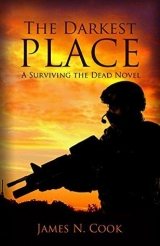
Текст книги "The Darkest Place"
Автор книги: James N. Cook
сообщить о нарушении
Текущая страница: 19 (всего у книги 34 страниц)
THIRTY-FIVE
Where highways 281 and 290 came together outside of Austin, the northbound lanes were a snarled mess of cars and corpses.
When the people fleeing the capital of Texas realized they weren’t getting anywhere, they jumped the median and tried to use the southbound lanes to escape. The result was a wide, stalled parking lot that spilled out onto the shoulder for dozens of yards in every direction. At some point the infected had shown up, and it was all over but the dying.
I was out on point with Dad, Mike, Blake, and a couple of combat engineers when we made the discovery. Tyrel had stayed behind due to his injuries, along with Sophia, Lauren, Lance, and Lola.
Morgan had decided the best use of our skills was to have us scout the way ahead. We surveyed the scene, then radioed back to the convoy. One of Morgan’s senior sergeants acknowledged and told us to stand by. Shortly thereafter, the Bradleys, a couple of HEMTTs, and the Abrams showed up, along with a dozen troops in a deuce-and-a-half in case infantry support was needed.
After they arrived, Morgan got on the radio and asked us to draw away as many infected as we could while his people worked to clear the road. The rest of the day consisted of my group off-roading in our Humvees and leading the undead around in circles while the troops dragged dead bodies from vehicles, put transmissions in neutral, and stood clear as the heavy armor pushed wrecks aside.
By nightfall, we had made it all of thirty miles and the infected had bitten four troops. But we had reached a point where we could use side roads to parallel the highway, which would make for faster transit. Despite the long, hot hours the convoy had just endured, Captain Morgan elected to press on a few hours into the night.
Tired as we were, no one argued. The moans of the San Antonio horde were close enough to carry to us on the wind.
The four bitten soldiers were kept under observation in the back of a truck for a couple of hours until it became clear their condition would not improve. When the medics gave their final diagnosis, Morgan ordered the convoy to a halt and the men were led out of sight under heavy guard. Three of them looked resigned to their fate, stumbling along and convulsing in the throes of their infection. The fourth, however, struggled and screamed and kicked and begged his brothers in arms to let him go, to let him run for it and take his chances. His words fell on deaf ears.
His voice sounded familiar, so before he was out of sight, I raised my scope to get a better look.
It was Johansen.
While I had not enjoyed my first meeting with the man, I did not wish him to die as one of the infected. Come to think of it, I would not have wished that on anyone.
About a hundred other people and I, including the survivors from the RV encampment, watched in silence as the doomed men were led away. Johansen’s increasingly panicked screams carried to us over the crest of a hill until the boom of a pistol echoed through the woods.
The shouting stopped.
Seconds later, there were three near-simultaneous cracks. Shortly thereafter, a few men lowered a small bucket loader from the back of a HEMTT and drove it in the direction of the shots. Half an hour later, their work finished, they returned to the convoy, faces drawn and somber. No one tried to speak to them. Morgan came over the radio in a quiet voice and ordered to convoy to get under way.
*****
We couldn’t follow 281 forever, so we cut toward Highway 16 and used any flat, wide, unobstructed stretch of ground we could find to take us north until we were within four miles of Interstate 20.
Along the way, we found a gas station with diesel tanks that had not been looted, allowing us to refuel and restock our gerry cans and fuel barrels as well as supplement our meager provisions. Near where we stopped, a side road led into a heavily wooded region away from any significantly populated areas. According to the map, there was a large natural pond nearby. Morgan’s senior sergeant ordered a HEMTT and a few Humvees to break off and get to work purifying as much of that water as they could. Morgan himself radioed us to wait for him and approached our position in his command vehicle.
“Got a mission for you,” he said as he pulled alongside.
“Let me guess,” Blake called back. “Recon I-20, see what we’re up against.”
“You are a man of impeccable logic.”
Dad exchanged a look with his old friend, then said, “Can do. But we’ll need to refuel first.”
Morgan motioned to his driver. “Not a problem.”
After topping off the tanks, we headed north toward the interstate. The section of highway we approached lay in the middle of a steep, broad V that had once been a hill. There were many such places along the interstate where the highway builders had blasted through the landscape in order to keep the road nice and straight. The resulting formation allowed us to park the vehicles at the base of the hill and approach the summit on foot, staying low to avoid detection. At the top we fanned out at ten-meter intervals along the hillside and surveyed the scene through our optics.
By that point, I thought I had seen some bad things. Crossing the bridge over I-35 that flaming evening had been something out of a fevered nightmare. The City of Houston in flames in the dark red distance was a sight that would haunt me for years. The 281/290 junction had been a blood-soaked cluster-fuck of epic proportions. But when I looked down that hillside at Interstate 20, for the second time in my life, I felt a sinking, bowel-constricting panic that I had died and my soul had been damned for all eternity.
It would have taken me years to count the infected. There were cars piled on top of cars on top of even more cars. Tractor-trailers and buses and RVs and every other vehicle imaginable lay overturned and crashed and burned down to skeletal husks. The stench of corpses was a living, crawling thing that reached down my throat and closed a hand around my windpipe. Dead bodies lay everywhere, some still in their vehicles, some on top of them, some on the side of the road, still others crawling, too damaged from the infected who consumed them to mount much mobility.
Organs, limbs and bloody streaks covered every surface, stained the ground red, splattered against windshields, and lay rotting in the ditches on the side of the road. I scanned left and saw a Blackhawk helicopter crashed in the middle of traffic, tail rotor pointing skyward, the skeletal visage of the pilot slumped against his restraints. I scanned to the right and saw a vintage convertible with the top down, the driver in pieces on the ground nearby, and, to my horror, a baby seat in the back. For a moment, the baby seat looked empty, then I realized the padding was beige under the red, and that lump at the bottom was-
NO!
I dropped my rifle, scrambled back down the slope, and got as far away as I could before I was violently, gut-wrenchingly sick. I heaved up everything inside me and kept going, dry-heaving, ribs cramping, abdomen trying to tear itself apart.
Finally, the seizures subsided and I managed to crawl away from my own bile before I collapsed and lay on my side, gasping for breath. A few moments later, I felt a hand on my shoulder.
“Hey,” Blake’s voice said. “I’d ask if you’re okay, but I think the answer is pretty obvious.”
“Can’t …” was all I could manage to croak out.
“Come on, Caleb. It’s not safe here. Let’s go back to the Humvee. We’ll wait there for the others.”
I followed him, barely conscious of where I was going, dimly accepting my rifle and slinging it over my shoulder. Blake helped me into the passenger’s seat, then climbed in, cranked the engine, and turned the AC to its highest setting. After a few minutes, the cold air blowing in my face started to make me feel better.
“Sorry about that,” I said, feeling a flush come up my neck.
Blake shook his head. “Don’t be. If I’d stayed a few more seconds, I wouldn’t have been in much better shape.”
“That makes me feel a little better.”
“Man, I’ve seen some things, but that …”
“Yeah. No shit.”
“How the hell we gonna get past that?”
“I’m sure the good captain will think of something.”
We waited with no further conversation until Dad, Mike, and the two combat engineers came back down the hillside. On the way down, one of the soldiers hesitated, turned to the side, and heaved his guts behind a pine tree. The others waited, faces stoic, until he had mastered himself and started on his way again.
Back in his vehicle, Dad calmly and in detail explained the situation on the interstate. Morgan told him to stand by, presumably to confer with his staff, then came back on the radio and requested we return to the convoy.
“Roger that,” my father said. “En route. Recon one out.”
*****
The first time you see heavy artillery fire on a target at close range, you never forget it.
Like the others in the convoy, I waited at a good safe distance for the fireworks to start. Morgan’s men had scouted the various access roads until they found a flat approach on a narrow two-lane. The Abrams and two Howitzers took point, the Bradleys backing them up, APCs waiting the wings in case infantry support was needed during the crossing.
I sat in a Humvee with Blake and Sophia at the rear of the column. My father, Lauren, and Lance were in front of us. Tyrel and Lola waited behind, Mike bringing up the rear in his truck. Dad had loaned his Ram to a trio of pregnant women from the RV encampment so they could escape the discomfort of the deuce-and-a-half they had been riding in.
Travis had observed the transaction, and afterward offered Dad a handshake and a tight-lipped thanks. He did not look in my direction.
Later, we sat on the road eyeing the woodlands around us for signs of infected and waited. There was just enough bend in the road I could see the armor as they rolled forward, stopped about two-hundred yards from the teeming, screeching mass of infected frothing through the twisted metal obstructing the interstate, spread out, rolled to a stop, and aimed their guns.
The radio crackled to life. “All stations stand by. Engaging in three, two, one …”
BOOM-BOOM-BOOM
The projectiles traveled so fast there was no distinguishable difference between the thunder of shots and the detonation of high explosives. When the smoke cleared, there was a massive dent in the derelicts blocking our path, cars blown on top of other cars in twisted, broken heaps. But the way was not clear. With surprising speed, the crews reloaded, passed along another warning, and then fired in tandem.
BOOM-BOOM-BOOM
The shells pushed the wreckage back further, but not enough to allow the convoy to cross. So the crews kept at it, firing, issuing warnings, and firing again. It took eleven rounds of three-gun bombardment before they finally blasted a lane wide enough to allow the convoy to pass.
The ordnance obliterated the infected closest to the target area, while those standing farther away were either disabled or sent hurtling through the air. Ghouls poured into the gap from all directions, making it obvious we would have to move quickly to get clear.
“All stations, listen up,” Morgan said over the radio. “I want Bradleys Alpha and Bravo to push up the edges of the path and make sure the heavy armor can get through. Once you’re across, Alpha face east, Bravo face west, and annihilate anything undead that comes your way. All other armored units, clear the road ahead until all non-armored vehicles and civilian transports are safely through. Acknowledge.”
After a hasty stream of affirmatives, the first two Bradleys behind the Abrams drove around it and shoved the few remaining cars blocking the path out of the way. Once done, they crossed the highway, drove on top of clusters of tightly packed sedans, and aimed their TOW missiles, chain guns, and M-240s toward the approaching infected.
“And to think,” Blake said beside me, “there was a time people thought Bradleys were a waste of money.”
The Abrams and Howitzers crossed the cratered expanse of I-20 first, Bradleys and APCs close behind, then the HEMTTs, troop transports, Humvees, and finally us civilians in our collection of vehicles.
“Doesn’t it strike you as odd that Morgan chose to make sure his most valuable assets made it across first?” Sophia said. “It’s like we poor useless civilians were just an afterthought.”
The Humvee bounced and jumped as we floundered across the gaping holes left in the wake of the artillery shells. There were a couple of worrisome near-stalls, but finally we cleared the highway and picked up speed on the flat two-lane beyond.
“We made it across, didn’t we?” I said, turning to look at her in the back seat.
Sophia looked at me skeptically, then went back to staring out her window. Looking past her, I watched the two remaining Bradleys open up on the approaching horde with their M-240s and chain guns.
The effect was devastating.
At close range, a 25mm chain gun can penetrate tank armor. During the first Gulf War, Bradleys were credited with more kills on enemy armored vehicles than their vaunted Abrams counterparts. So needless to say, firing such a powerful weapon into a mass of necrotic flesh at less than fifty yards was nothing less than gruesomely spectacular.
The dead did not simply fall down. They did not jerk a few times and continue shambling onward as they did when hit with small arms fire. Rather, they flew apart as if someone had implanted several grenades in various points of their anatomy and set them off at the same time.
An arm flew in one direction, a leg the other, a torso disintegrated into a red and black pulp, a head flew apart like a melon blasted with a shotgun at point-blank range, limbs pinwheeled through the air to land dozens of yards away. And because the tungsten rounds were so heavy, and traveled at such high velocity, they didn’t just go through one infected, but several of them, their trajectories being thrown off only after bursting through a dozen or more corpses. There were hundreds of TINGs, PANGs, and POCKs as errant rounds hit doors and wheel hubs and engine blocks. Shrapnel and ricochets sent parts and pieces of ghouls flying in all directions.
The M-240s wreaked their own brand of havoc on the infected’s legs, blasting them to pieces the same as I had seen in the brewery parking lot back in Blanco. However, despite the hail of lead and tungsten, only the first few ranks of undead went down. The horde behind them was so large the Bradleys’ onslaught did little to halt their advance. It was like trying to hold back an avalanche with two bulldozers. Realizing they were doing nothing more than buying themselves a few extra seconds, the Bradleys reversed, turned up the road, and fled with the rest of the convoy.
By that point, Sophia had turned around to watch the show. As the Bradleys gained on the column and Morgan broadcast an order to pick up the pace, she turned and looked at me, her face pale and drawn, lips pressed tightly together.
“They just don’t stop, do they?” she said. “It doesn’t matter how many of them we kill, how many we blow up, nothing scares them. They just keep coming.”
I reached back and clasped her hand, feeling the tremor in her grasp. “We have a few advantages over them, Sophia.”
“Like what?”
“Well for one, we’re smarter than they are. We’re also faster, we can use weapons, and we can build fortifications. They can’t do any of those things.”
“But what if that changes? What if they get smarter? What if they start to remember things?”
I thought about it, and felt a cold black dread well up inside me. I let go of Sophia’s hand and sat down in my seat.
“We just have to hope that doesn’t happen.”
THIRTY-SIX
Two days later,
Near Boise City, Oklahoma
There are times when you sense trouble coming. When you see its shadow darken your sky, and your hackles go up, and you reach for the nearest sharp object.
It happens in the sleeping mind, beneath the surface, where we understand the patterns that connect the ebb and flow of life and events. Where we perceive the symmetry of probabilities and execute the intuitive calculus of expected outcomes. Within this hidden depth, we understand the mercurial animal that is human nature and how it creates its own cause and effect. If we are careful, and wary, and keep our eyes open, we can sometimes deduce the problems before they catch us. We can strike, dodge, parry, and set traps.
There are also times when trouble catches us by surprise.
*****
The slow, tedious slog up the Texas panhandle took its toll.
It takes a lot of food to fill over a hundred hungry bellies, and we were three days into a road trip that under normal circumstances should have taken no more than two. So out of necessity, anytime we saw someplace that looked uninhabited and could potentially be a source of food, we stopped and raided it. Doing so kept us fed, but also slowed our progress and cost the lives of two more soldiers.
The deaths happened at a trailer park in the middle of a small town too insignificant to have its own sign. We passed it on the highway, and after a few minutes of observation, one of Morgan’s staff sergeants deemed it abandoned. The usual crowd—Dad, Blake, Mike and I—accompanied two squads of regular infantry to the park. (Tyrel’s leg was still healing, and Lance had taken it upon himself to make sure none of the soldiers got any funny ideas about our womenfolk. Consequently, the four of us had become Morgan’s de facto outriders.)
The regular troops waited while we zipped through the trailer park and fired a few rounds in the air before returning to their position. That done, we gripped our weapons and watched for movement. Other than a slight breeze to mitigate the blazing midday sun and air rippling upward from the hot pavement, we saw nothing.
“All stations, Recon One,” Dad said into his handheld. “You are clear to move in, but take it slow. Keep your eyes peeled, and be ready to bug out on a moment’s notice.”
“Copy,” said the senior squad leader, a young staff sergeant named Alvarado. “Moving in.”
We followed the four Army Humvees at a distance, Mike manning the machine-gun turret and Dad driving. The vehicles ahead of us stopped and the soldiers piled out, weapons up, ready for trouble. Almost immediately, I saw a profound difference between the two squads.
Alvarado’s men were alert, focused, and seemed to appreciate the gravity of the situation. They moved with the skill of long practice, each man knowing his role, maintaining muzzle discipline, checking their corners, communicating in the shorthand of soldiers who knew what to expect from one another.
The other squad, led by a sergeant named Farrell, strolled casually through the cracked and pitted streets, their attitudes every bit that of the conquistador. Sergeant Farrell reminded me of every rich-kid frat-boy who ever came to Black Wolf Tactical on his father’s dime looking to inflate his fragile ego by busting caps on the close-quarters combat range.
His men glared around greedily, grins on greasy, dirty faces, gleeful avarice written in every gesture. I had the profound impression I was witnessing both the best and worst the United States Army had to offer.
“Take the west end, Farrell,” Alvarado radioed. “We’ll start from the east and meet you in the middle. Recon One, I need you on patrol.”
“Wilco,” Dad replied.
We drove slowly, bouncing and jostling over potholes and sending lizards scurrying through the brown grass lining the dead gray streets. The trailer park looked like any other trailer park from Texas to the Carolinas: shabby, poorly constructed rectangles squatting sullenly on tiny lots, dented mail boxes standing at vandal-abused angles, garbage lining the shallow drainage ditches, underpinning torn away to reveal collapsing insulation and cinder block mountings, sagging porches, windows covered with cheap blinds, rust marks streaking down from window-mounted air conditioners, and a general miasma of hopelessness and despair endemic of the crippling poverty so many Americans didn’t want to admit existed.
I had lived in places like this. I got to know the people who occupied them. There were generally two kinds: the renters, the people who stayed for a short while and then moved on, and then there were the owners, the permanent residents. Renters were the overwhelming majority.
Most people from both categories worked their asses off at low-paying jobs that made civilized life possible for the more fortunate. They usually did not have health insurance or retirement savings. Many of them were on government assistance of one form or another. Drug and alcohol abuse were common, but no worse than anywhere else, really.
People drove past these homes and sneered or shuddered or shook their heads in pity. Many of the people living in these places had children early in life, limiting their options and giving their kids little chance of escaping the circumstances they were born into. It was a repeating cycle, generation after generation, with the occasional success story giving some aging mother or father something be proud of, or dismiss with jealousy. Those who escaped were often not welcome when they returned to visit. Perhaps not in an overtly hostile way, but behind whispers, and looks, and a deadpan stiffness to any attempt at being polite.
In its own way, these places were as exclusive as the country clubs and boardrooms of the well-heeled. If you were from here, you were one of them, love you or hate you. You had a pass. You could come and go at your leisure.
Outsiders, not so much.
I watched through the dusty window as the Humvee rumbled through the trailer park’s confines, rifle between my knees, eyes searching for movement. Radio chatter rattled in my ears. Alvarado’s squad cleared trailers and hastily stacked food in yards for later pickup, while Farrell’s men took their sweet time ransacking the place for anything valuable and gathering non-perishables as an afterthought.
An hour passed. Since we had a surplus of fuel, we kept the AC running. Mike’s bulk occupied enough space in the gunner’s hatch he kept us from losing too much cool air. I pitied the Army grunts for not having a climate control option in their vehicles. When they rolled, they were forced to sweat it out under the merciless Oklahoma sun. But they rarely complained. I respected that, even though I felt no guilt whatsoever at not sharing in their misery.
After a while, I got bored. The trailers all looked the same, the junked vehicles on blocks looked like a waste of good scrap metal, the chatter was repetitive. We passed Alvarado’s team, and though they were sweating in the heat and visibly tired, they moved quickly and remained focused on their mission. Farther down the road, Farrell’s squad was a study in contrasts.
They had found a trailer with a generator and several gallons of fuel, and had used it to fire up the air conditioner. We heard the sounds of motors shattering the silence from over a hundred yards away and moved in to investigate. After knocking on the door, Dad and I entered the trailer to find them lounging in a cool living room drinking whiskey from a hodge-podge of collected shot glasses. The roar of the AC in the window reminded me of the dinosaur cartoons I used to watch as a child. It amazed me the soldiers were able to carry on their ribald conversations over its incessant din. Upon closer inspection, I saw they had cranked it up to its highest setting.
“Taking a break?” my father asked, not bothering to hide the disdain in his voice. Sgt. Farrell grinned and took another shot from a bottle of Bushmills.
“Yes, we are, civilian. Now kindly fuck off until the professionals are ready to resume their work.” He held up a shot glass full of yellow liquor and tossed it back. My dad’s flat brown eyes looked on blankly, then after a few seconds, he shrugged. “Have it your way.” He motioned for me to leave with him. I cast a final contemptuous look around the room and followed.
Dad marched purposefully toward the Humvee, threw it into gear, and roared away to the other side of the trailer park. He stopped where Alvarado and his men were working and got out. I stepped out as well, curiosity piqued.
“You might want to check on your boy Farrell,” he said. “Last I checked, drinking on duty was a serious offense.”
Alvarado made a disgusted noise and tossed down a box he was holding, eyes squinting westward. He wiped a sleeve across his sweaty brow and said, “All right. I’ll take care of it. Sergeant Gomez, you’re in charge until I get back.”
“Got it,” Gomez replied.
A few minutes later, we made another pass through the neighborhood and saw Alvarado follow Farrell and his men out of the trailer. I couldn’t hear what he was saying to them, but it was, by all appearances, forceful, one-sided, and involved a lot of gesticulating.
Farrell’s squad ducked their heads and trundled down the steps. Alvarado stood them at attention and spent a few more minutes with his finger inches from each man’s face in turn, ending with Farrell. For Farrell’s part, the speech only deepened the condescending smirk on his face.
Finished, or at least with no further time to waste chewing asses, Alvarado got back in his Humvee and drove to the other side of the trailer park. Farrell motioned to his men, and they turned in the direction of another trailer, forming up for a room entry through the front door.
One of them hefted a sledgehammer, lifted it to shoulder height, and brought it down on the flimsy door handle. The handle shattered, and the men backed off, waiting to see if any infected would emerge. None did, so they poured in.
Before following his men, Farrell looked in our direction and glared for a long moment. Gone was the smirk, and the smugness, and the devil-may-care attitude. His gaze was flat and cold and utterly emotionless. I’ve seen hungry reptiles with more life in their eyes. I stared back, not daring to look away. Some instinct, some hairy-knuckled, slope-browed leftover in the deeper portions of my lizard brain warned me that to look away was to show weakness, and I was staring at a creature who would perceive any weakness as an invitation to attack.
The contest dragged on until one of his men shouted for him. Looking startled, Farrell ducked into the trailer, rifle at the low ready. Seconds later, the boom of a shotgun thundered from a room near the far end of the trailer followed by shouting and the staccato rattle of M-4s firing in a confined space.
“Shit,” Dad said, accelerating toward the trailer.
More gunfire sounded, and as we skidded to a halt near the front door, a high, agonized scream came from within the trailer. Someone shouted, “Get it off him! Get that fucking thing off him!”
I entered the house behind my father. Mike and Blake were behind us. We turned left and headed toward the shouting at the end of a far hallway. The trailer was laid out like many others I had seen: the front door opened into the living room, to the right was a bedroom, bathroom, and laundry room, the kitchen was separated from the living room by a low island counter, and to my left was a long hallway with more bedrooms and another bathroom. The commotion came from the far bedroom at the end of the hallway. The four of us took a few brief moments to clear the rooms on our right—the doors were closed and Farrell’s men had not used their orange spray paint to mark them as clear—then pushed on to see what the shouting was about.
On the way, we heard a guttural growling and snarling beneath the continuing high-pitched screams of one of Farrell’s men. I had never heard a scream like that in my life, and hoped I never would again.
Fate, sadly, did not conspire to grant that wish.
A soldier’s dead body lay in the entrance to the bedroom, no doubt the victim of the shotgun blast from a few moments earlier. The shot had taken him in the chest and splattered blood, flesh, and chunks of bone in a wide cone-like pattern halfway down the length of the hallway. Mike seized him by the handle on the back of his vest and dragged him into the kitchen, out of the way. Once there, he grabbed a blanket from one of the bedrooms and draped it over him.
The room the rest of us walked into was small, crowded with soldiers, and so thick with foul odor the smell nearly made me gag. A combination of body odor, rotting meat, spent cordite, and vomit hung suspended in the thick air. There was a final crack of a rifle, deafeningly loud in the confined space, and the shouting stopped. The men in front of us went still, eyes looking down at something we could not see past them.
“All right, clear the goddamn room,” my father shouted. So firm was his tone of command, no one questioned him. They simply turned and filed out, gathering in the hallway. “Go on,” Dad said, shooing them along. “Wait outside.”
They did as ordered, faces stunned, muttering among themselves. Farrell remained behind, squatting next to a bleeding soldier and trying to bandage a massive wound on the stricken man’s forearm. A few feet away, a naked woman, mid-forties by the look of her, lay on the ground with a gaping exit wound in the back of her head. Her hands were tied behind her back, a rope trailing behind her toward the wall. By her mottled skin and milky white eyes—not to mention the gore smeared around her mouth—it was obvious she was one of the infected.
My eyes tracked the rope across the room to where a portly, middle-aged man lay slumped against the wall. A shotgun lay at his feet, and he clutched a hunting knife in his left hand. A quick glance around the room told the story of what happened.
The infected woman’s bound hands were secured to an eyebolt driven into the floor. A short length of rope allowed her to move halfway toward the entrance, but no further. Flies buzzed on smears of blood and scraps of bones scattered across the bare plywood flooring.
There was a picture on the wall next to me of the two people when they were alive. It looked recent. They were standing on a pier, the bright sunny ocean behind them, holding cocktails and smiling at the camera, arms around each other’s shoulders.