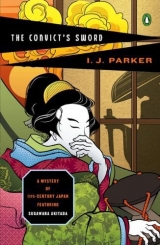
Текст книги "The Convict's Sword "
Автор книги: Ingrid J. Parker
Жанр:
Исторические детективы
сообщить о нарушении
Текущая страница: 24 (всего у книги 25 страниц)
“Thank you, but work is a distraction.” Akitada did not want to dwell on the black abyss of his grief. “Is all well with you and yours?”
Kosehira nodded. “I sent them away after all. Now I’m the only one staying in my big house, except for one servant. It’s an eerie feeling, being all alone. I keep hearing ghosts. Perhaps you will come to keep me company some evening?”
Akitada looked at his friend gratefully. “Of course. I shall need your cheerful and practical advice. But is it true? You’re taking Soga’s position?”
Kosehira flushed. “A temporary appointment. I rely on you totally. Know nothing of this stuff. You were gone and I was available, and well, it’s always a matter of rank, isn’t it? I know very well that you should be running the ministry. I hope you don’t mind.”
He looked so nervous that Akitada smiled. The smile felt strange after so many days of sadness. “Nonsense,” he said, “I could not be more pleased. Frankly, Soga hated me. I fully expected to be dismissed with a bad report.” He glanced around the office. “But where is Nakatoshi?”
Kosehira’s face had lit up at Akitada’s first words. Now it fell. “Under arrest.”
“In jail? Why? What happened?”
“I found a treasonable letter written by him. Yesterday. I walked into the office and saw him slipping some paper away before leaving the room. He looked so guilty that I decided to take a look. And there it was, right on top of one of the document boxes. I was deeply shocked, my dear Akitada. The letter was addressed to Ito Mitsutaka, that notorious renegade in Mutsu Province. Nakatoshi suggested to Ito that this would be a very good time for an uprising, the capital and surrounding countryside being decimated by smallpox, and the government no longer functional with so many officials dead. Dreadful. I had him placed under arrest immediately.”
Akitada stared at his friend. “I don’t believe it,” he said flatly. “Are you sure that poisonous snake Sakae wasn’t behind this?”
Kosehira frowned. “Sakae? Why should he do such a shocking thing?”
Akitada sighed. “Because he’s Sakae and he hates Nakatoshi. Who has the letter now?”
“I do. The court is not in session, so I kept all the evidence.”
“What evidence? The letter is all you have, isn’t it?”
“Just about. Except for Sakae’s signed statement that he heard Nakatoshi make critical remarks about the government.”
Akitada gave a snort. “Of course. Let me see the letter, please.”
Kosehira got a locked box, fished a key from his sash and opened it. “You don’t think Nakatoshi wrote this?” he asked uneasily, extending a folded piece of the kind of paper used for government documents. “I tell you, I saw him hide it with my own eyes. He got very red in the face when he saw me looking at him.”
Akitada scanned the fairly long document and studied the signature at the end. “I don’t doubt that you saw him hide something,” he said. “But this is not in Nakatoshi’s handwriting.”
“What? Are you sure?”
“Absolutely. Nakatoshi writes an excellent hand. This looks strained, too careful. As if someone had been trying very hard to be neat. An interesting allusion to the Chinese rebel Chang Lu—not many people know his story—but otherwise this is not particularly well written. Nakatoshi expresses himself much better. Has he seen this?”
“No. I thought it best to get rid of him quickly. I must say, he looked upset.”
“I can imagine.” Akitada rose. “I’d better go see him now, if I may. He must be frantic.”

Akitada did not know whether to be furious at Sakae for his vicious plot to oust Nakatoshi or to be glad that he finally had a way to rid the ministry of the troublemaker. He had enough other problems, but in his present state he welcomed anything that would take his mind off the black misery which lay in wait and pounced the moment he allowed himself to think.
Kobe greeted Akitada with a jocular, “Back already? You look more yourself with that frown on your face.”
Akitada still felt guilty about the memorial and returned the smile uncertainly. “Yes, I’m troubling you again. This time it’s about my clerk, that is, a clerk at the ministry. His name is Nakatoshi. I just heard that he was arrested.”
Kobe nodded. “On a charge of treason.”
“I believe he was framed by a colleague.”
“Oh come! Surely not again.”
The similarity to Haseo’s case had not struck Akitada, who instantly felt stupid for not having realized it. He said, “I cannot help it. It’s a different case and a different motive.”
Kobe raised his brows. “Right after solving one case, you’ve already solved another?” He still smiled.
Akitada flushed. “This was not very hard, a mere malicious child’s trick. I’ve been expecting something of the sort all along. I thought I would come and reassure Nakatoshi.”
As they walked toward the cells, Kobe said, “You didn’t ask, but your prisoner in the other case has made a full confession. It didn’t take any persuasion. We had him looked at by our physician, who found a badly broken wrist in addition to the broken leg. He will probably lose the hand and was so demoralized that he talked. His hatred for his half-brother was something to hear.”
Akitada grimaced. “I can well imagine. What about Yasugi? Did he implicate him?”
“No. He pretended not to understand our questions. Sorry. At least you have the satisfaction that Yasugi didn’t profit in the end. He lost his wife and will lose the land.”
Akitada nodded. “What is likely to happen to Matsue?”
Kobe gestured to a guard to unlock a cell door. “Oh, exile and hard labor, I should think. Like his brother.”
“Good!”
Nakatoshi started up when they walked in. He looked terrified. When he saw Akitada, he burst into tears. “I didn’t write it, sir. I swear. I’m innocent.” To Akitada’s embarrassment, he fell to his knees and knocked his head on the dirt floor.
“I know, Nakatoshi. Get up. I’ll have you out of here shortly.”
Nakatoshi staggered to his feet and wiped his eyes, leaving smudges on his face and sleeves.
“Tell me,” Akitada asked, “how was it that Lord Fujiwara saw you hiding the letter?”
Nakatoshi sighed. “I found it among my papers. When I saw Lord Fujiwara watching me, I panicked.”
“Ah. And how did it get among your papers?”
“I don’t know. I’d never seen it before. I thought maybe it had fallen out of another batch of documents. But then I saw my signature.”
“Could Sakae have put it among your papers?”
Nakatoshi looked embarrassed. “I wondered about that. He doesn’t like me.”
“Yes.” Akitada put his hand on Nakatoshi’s shoulder. “Don’t worry. We’ll clear up the matter and have you out of here shortly.”
In the corridor outside, Kobe asked, “This Sakae is the real culprit?”
“Oh, yes. Proving it is another matter. I cannot very well resort to torture.”
Kobe glowered. “I don’t particularly enjoy that part of my work, you know.”
Akitada stopped. He had to try to mend matters between them. “Forgive me. To my deep regret, I always manage to do or say things to offend you. Believe me, I have the greatest respect for you and your work. During this time of crisis, I could do nothing but complain while you’ve saved hundreds, perhaps thousands, from death by riot and starvation. I’m very sorry I’ve offended you.” He touched Kobe’s arm. “I hope you can forgive me and we can be friends again.”
Kobe cleared his throat. He said gruffly. “Yes, of course. I shouldn’t have got so angry. And you’re making too much of me. When there’s a need, we both do what we can, even if it’s thankless. But that reminds me.” He dashed off, leaving Akitada standing in the courtyard, wondering if he had embarrassed Kobe into flight. But the superintendent returned in a moment, carrying a sword.
“You found my sword,” said Akitada, taking the Sugawara blade from Kobe’s hands. “That was very good of you.”
“It belongs to your family.” Kobe looked embarrassed. “I wish I knew what to say about your son. I lost two little ones myself a few years ago. One doesn’t forget, but perhaps there will be more sons for you, and daughters, too. Someone to live for. To save the sword for.”
“Yes,” said Akitada bleakly, and pushed the sword into his sash. “No doubt, you’re right. But for now I’d better see about catching Sakae.”
CHAPTERTWENTY-FOUR
EVENING BELLS

Tora tied up both horses at the temple gate. The young monk gatekeeper greeted him eagerly; visitors were rare in this small temple. When Tora asked if the temple conducted a school, the young monk brightened even more. “Indeed we do, sir. Perhaps you would like to see for yourself ? Our learned Master Genku is instructing the boys in the lecture hall.”
Tora followed his directions to a small wooden building. Its sliding doors had been thrown open on this warm summer day. From within came the sound of young voices chanting in unison. Tora stepped up to the narrow veranda and sat down, instantly attracting the attention of the pupils inside. The elderly monk who presided over the small class ignored the visitor.
Tora easily picked out Haseo’s son. The boy was the only one the right age, and he had a certain bearing. In a way he reminded Tora of Kinjiro. Kinjiro was two years older but was smaller-boned than this boy, and both had the same fierce look in their faces—as if they were engaged in a battle against the world. This boy had tensed under Tora’s scrutiny. When Tora tried a reassuring smile and nod, the youngster scrambled to his feet in a panic.
“Sit down, Nobunari,” the schoolmaster called out sharply.
Tora stood up and bowed. “Forgive the interruption, Master Genku. My name is Tora. I have a message for Master Nobunari about his mother.”
The boy still stood, eyeing him nervously.
Genku said irritably, “Why do you interrupt the lesson? And why do you call Nobunari ‘master’?”
“Because,” said Tora, “he’s the oldest son of Tomonari Haseo.”
The boy made a decision. “I’m Nobunari. What is the message?”
“Ah,” said Tora, making the boy a bow, “I was right. The message is from my master, Lord Sugawara, senior secretary in the Ministry of Justice.”
The boy frowned. “About my mother?”
Tora cleared his throat and looked at the other boys who had been following the conversation with avid interest.
The monk rose with a sigh. “Perhaps we had better go elsewhere.” He set the class an exercise, and led Tora and Nobunari to an adjoining room.
“Now, young man,” he said sternly to Tora, “what’s all this? It had better be important.”
“It is.” Tora turned to the boy. “I’ve come for you and your sister. My master offers you his protection. You’ll be safe with him.”
Nobunari bit his lip. “Is anything wrong with Mother?”
Tora had worried over this part all the way here. Now that the moment had come, he did not know what to say. So he did not say anything and watched helplessly as the color slowly drained from the boy’s face.
“What happened?” the boy whispered. “I suppose she’s dead. That’s what you came to tell me. I want to know what happened.” He choked on the words, but his voice was fierce even as tears began to fill his eyes.
“I’m sorry,” said Tora. “I just didn’t know how to tell you. Someone killed your mother two weeks ago.”
The monk muttered, “Amida!”
The boy clenched his fists. “Who?”
“I don’t know. I found her. She’d been stabbed. At first the police thought I’d done it.”
The boy stared at Tora. “Mother told me about you. She called you a friend. Besides, you don’t look like one of them.”
Tora asked quickly, “She told you who was after her?”
But Nobunari frowned and became distant. “This Lord Sugawara. Why is he sending for us?”
“That’s another story. You see, we met your father. In Sadoshima.”
Nobunari jumped up, his face shining with excitement. “My father is alive? When did you see him? My sister and I shall go to him right away.”
Tora gulped. He was not doing this very well. “I’m afraid you can’t. You see, your father died also. I guess you’re his heir now. We didn’t know how to find you. I’m sorry we were too late to help your mother.”
Nobunari sank back down. He looked grim. “My father did not murder my grandparents, but they sent him into exile and he died. And my mother got sick and went blind. She had to work like a beggar for our food, and now she’s dead, too. What good is life?”
Master Genku said piously, “We must obey the will of Heaven.”
The boy glared at him. “Why?”
“We must find the Way during our lifetime. If we find it, we go to an abode of happiness after death. If not, our souls suffer eternal misfortune.”
Nobunari’s anger flared, “My father died for another man’s evil, and my mother died because she had to support us. To pay for my lessons. You took her money, though you taught me nothing. Did my parents follow the Way? Or are you following it? What is the Way, Master?”
The old monk started to bluster. Tora interrupted, “It’s time Lord Tomonari and I left.” He gestured to the boy to precede him. The youngster stalked away, his back rigid with anger and grief.
When they reached the gate, Nobunari saw the spare horse and his fury abated a little. He swung himself in the saddle and set off down the road. When Tora caught up, the boy asked, “Were you serious about that ‘Lord Tomonari’ business?”
“Yes.”
“Who killed my grandparents?”
“His name is Sangoro, but he goes by Matsue now. He’s in jail.”
The boy gave him a look. “Why did he do it?”
“He says he’s your grandfather’s son and that your grandparents insulted his mother. Your father was blamed because Matsue’s mother lied to the judge to protect him.”
The boy was silent for a long time. Then he said, “I see. Maybe I would’ve done the same thing in his place. I used to want to kill him for what he did to all of us, but it’s better this way. I shall kill my mother’s murderer instead.”
He was only twelve, but Tora did not doubt him. He thought of Haseo’s sword and wondered if his son would put it to the test the moment they found the killer. He asked, “Do you know how to use a sword?”
“No, but I shall learn.” Nobunari pointed to a small farmhouse some distance from the main road. “That’s where we live. Mother paid them to keep us.”
It was a poor sort of farm. When they dismounted, a young girl came flying out of the door. “Nobunari,” she yelled, “what’s happened?”
This time Tora let the boy do the talking.

Akitada found Sakae in his own office. The clerk was clearing his personal papers and books from Akitada’s shelves.
“I see you have settled in,” Akitada remarked.
“I was just getting the office ready for you, sir.” Sakae gave him an ingratiating smirk. “Allow me to express my condolences.”
“Thank you.” Akitada was idly picking up Sakae’s books. “I expect you heard what happened to Nakatoshi.”
Sakae made a face. “Yes. It was a shock. I would never have believed it of him.”
“Hmm.” Akitada had found what he had been looking for. He slowly turned the pages, skimming the text. “I agree,” he said. “Though perhaps it was not altogether surprising for you.”
Sakae stared at the book in Akitada’s hands. His ears were turning red. “I b-beg your pardon?”
“It was you who framed Nakatoshi, wasn’t it?”
“Me? Certainly not.”
“I wonder, Sakae, can you have any idea what will happen to him because of the letter?”
“He shouldn’t have written it. I suppose he’ll be dismissed.”
“He’s in prison now, awaiting trial for treason. Treason is a capital offense. I expect he will be executed.”
Sakae gaped at him. “For writing a letter?”
Akitada nodded and watched beads of sweat pop up on Sakae’s brow. “Really, Sakae,” he said mildly, “for a law clerk you’re dismally uninformed. I think you must go and confess to the trick you played on your rival. You weren’t very clever about it. I could see that the letter was not in Nakatoshi’s hand. Furthermore, you miswrote the recipient’s name.”
Sakae flushed deeply. His eyes gave away his panic. “It wasn’t me. You can’t prove it was me. Maybe somebody else . . .”
“No. I recall that you’re very proud of an essay you once wrote on the subject of Chang Lu’s rebellion. In fact, you couldn’t resist quoting a line from the Chinese source in your letter. And I see you marked the passage.” Akitada held up the book. “Not much point in denying it. I have already informed Lord Fujiwara and Police Superintendent Kobe of your trick.”
Sakae wilted. He shrank into himself and wiped the perspiration from his face. “What will happen to me?”
“Oh, no charge of treason. If you admit it, you’ll be dismissed . . . which is what you had planned for Nakatoshi. I suppose when your hopes of taking my place were dashed by Soga’s death, you decided to take Nakatoshi’s. It was as foolish as it was dangerous. I doubt that you can hope for future government service. Of course, if you insist on your innocence, we have no choice but to have you arrested.”
Akitada left the sagging figure of Sakae to contemplate his punishment and went to Kosehira’s office. Kosehira was reading his correspondence and muttering under his breath.
“What’s the matter?” Akitada asked.
“Sakae can’t write. I won’t put my name and seal to this.” He tossed an official letter toward Akitada, who glanced at it and put it down.
“I told you. Tomorrow Nakatoshi will be back. He writes the best hand in the city.”
Kosehira raised his brows. “You mean that treasonable letter really was Sakae’s work? Why, the sly toad! Wait till I prepare my report. He will certainly never work for the government again.”
“That’s what I told him. But I need your help with a more important matter. It concerns the heirs of a man who was also falsely accused and died in exile. Shall I tell you about it?”
Kosehira listened to Haseo’s story with shock and pity. His suffering and that of his family brought tears to his eyes.
“We cannot charge Yasugi,” Akitada ended, “but I think the nation owes it to Haseo to return his family name and property to his children.”
“Yes, yes,” cried Kosehira. “I shall put it to His Majesty myself. No, better. You shall come and tell him what you just told me. He’s a very softhearted young man, even if he’s the emperor. And that reminds me. Do you remember his uncle? That priestly fellow who watched us pray for His Majesty?”
Akitada did and made a face. “I hope he doesn’t remember me!”
Kosehira laughed. “On the contrary! He hasn’t forgotten. He thinks you saved His Majesty’s life when you made the Buddha nod and has proposed a very nice reward for you.”
“That is kind of him,” said Akitada weakly. The irony that he should be rewarded for an act of impudence and blasphemy struck him as a perfect example of the futility of all human hopes.

The children had been quiet on the journey to the capital, and Tora was both thankful and worried. He kept glancing at them. Each had wept briefly and then accepted the inevitable without questions. Nobunari sat his horse well and held his sister’s slight figure with protective care.
When they passed the market, it occurred to Tora that they might be hungry. “Shall we stop for some noodle soup?” he asked. “The restaurant just inside the market gate makes a very tasty broth with buckwheat noodles.”
Nobunari glanced toward the market tower. “I would like to see where my mother worked, but we have no money.”
“My treat.” Tora paid an urchin to watch their horses and took the children to the drum tower. The market was still thin of shoppers and vendors, but people looked hopeful again. The fortune-teller sat in his old spot on the platform and greeted them. Tora introduced the children.
The fortune-teller looked at them and smiled. He said, “You must be very proud of her. She was a good person and strong for a woman, but candles are consumed as they give light.”
Nobunari looked around the market and announced in a fierce, loud voice, “I’m going to find her killer and cut off his head.”
People stopped to stare. Tora asked quickly, “Any news of Kata?”
The fortune-teller nodded. “The police raided his school and found a body. People say it was the beggar who used to hang around here. Nobody liked him, but to dismember a person while he’s still alive is the work of demons.” He shuddered.
Tora thought of his escape from the hut. Apparently Kata’s gang had taken their fury out on the beggar. He suddenly felt sick.
Nobunari had listened. “That must be the beggar my mother mentioned. I’m glad he’s dead.”
Seized by a sudden suspicion, Tora asked, “What did your mother say about him?”
“That he was always hanging around, making rude suggestions, and scooping up her coppers because she couldn’t see. Mother could see a little, though. She could tell it was him bending down and she could hear the coppers clinking and his nails scraping the floor.”
Tora thought about this and something else. Tomoe had mentioned her stalker’s stench. Tora’s nose was not as fine as hers, but he remembered that the beggar had been filthy and foul-smelling. Then he remembered the day he had stumbled over the beggar and the half-healed scratches on the man’s face and neck. And a piece of silver Kata had given Tomoe the day she died. When the gang had searched Tora and the beggar and found Matsue’s document on Tora, they had also had found a silver coin on the beggar. Coins were not always uniform. It seemed to Tora now that Kata had looked strangely at that coin and the beggar. What if the slimy creature had seen Kata pass the coin to Tomoe and had followed her home to rob her? And to rape her in the bargain. Tora growled under his breath.
A small voice demanded, “What’s the matter, Tora?”
Tora gulped and managed a smile for Tomoe’s daughter. “I’m hungry. What about you? Shall we go sample the noodles?”
“Oh yes. Please.”
They parted from the fortune-teller and walked across to the restaurant where Tora had last entertained their mother’s killer. The thought sickened him, but he ordered three bowls of the special noodles and felt better when he saw the children eat hungrily. No point in troubling them with the story of their mother’s murder, but he could not wait to lay his discovery before his master.

Akitada was anxious about the children and went home early. To his relief, Tora had just returned with them. Akitada’s lack of confidence made him doubt such luck, and he looked them over, touched them, and asked them questions before speaking to anyone else. He found them subdued, but they were such nice children, so handsome and well-spoken, that their composure in the face of their own loss was a lesson to him.
Tamako hovered nearby, and Seimei also. Their eyes were moist with emotion. There were children in the house again.
Tora, a fierce and exultant look on his face, pulled Akitada out into the corridor and closed the door. “I know who did it,” he said, “but I don’t think we should tell them.”
“What are you talking about?”
“I know who killed Tomoe. I figured it out. Remember the beggar in the market? Remember how filthy he was? Well, Nobunari says his mother complained about some stinking beggar pestering her and stealing her money. I think the bastard saw Kata give her a piece of silver and followed her home that evening.”
Akitada thought about it. He did remember the beggar who had felt his robe and called Tomoe a whore. It made sense: not revenge by Matsue, nor a plot by Yasugi against the Tomonari family, but a common everyday crime among the poor. “I think you’re right,” he said. “I should have seen it myself. You were certainly more observant. Only how are we to prove his guilt after all this time?”
Tora blushed at the compliment. “No need to prove it. The filthy bastard’s dead. Kata took care of him when he found out that the beggar had killed his good luck.” Tora sighed. “I should’ve walked her home that night.”
“It was more my fault than yours, because I would not let you. But I think you must let the police know. I want your name cleared once and for all, and they have the means to round up Kata and his men to get proof that the beggar killed Tomoe. We don’t even know his name.”
Tora’s face fell comically, but then he grinned. “Good. That’ll give me the chance to tell that patronizing bastard Ihara that I’ve solved his miserable case for him.”
Akitada spent the rest of the day with his family and young guests. He watched his wife fuss over the children as if she were their mother. She saw to it that they were bathed, measured them for new clothes, brushed Nobuko’s hair and tied it with one of her ribbons, and asked them what their favorite foods were.
He wondered if she, too, needed to fill the emptiness in their home and in her heart. Perhaps her coldness had been a matter of preserving a hard-won outer calm. When Haseo’s little daughter made an amusing comment, he found himself smiling at Tamako and was foolishly glad to see her smile back.
They had not begun to grieve, and there were still many unresolved matters between them, but time and effort might change that. Perhaps some day there might be another child, and they could build a new life together. Akitada accepted that the fault had been his more than Tamako’s. He did not know if he could change his nature, but at that moment he made a silent promise that he would try to be a better husband.
There was one more task to be done. After the evening rice, Akitada went to get Haseo’s sword and, with a formal bow, he placed it into Nobunari’s hands. “This was your father’s,” he said, deeply moved by the moment. “It’s yours now, along with his title. And his lands will shortly be yours also. Make sure that you honor your father’s memory. He was a good and brave man. And watch over your father’s family so that none will ever go hungry or homeless again.”
The boy bowed. “Thank you, my lord. I promise. They are my family now.”
As Nobunari examined his father’s sword, Akitada thought how proud his parents would have been and felt a deep sadness for Haseo, who had died in a distant land and for Tomoe, who had sacrificed everything for her children. Nothing was certain in life but death. And yet, though brief and fleeting, life was full of possibilities.
Later he went to his room to be alone. Exhaustion after the past weeks had finally caught up with him, and he felt empty. Outside the open shutters, the sun was setting, casting a golden light over the garden. Somewhere, in a great distance, the evening bells began to ring. Another day had passed and darkness lay in wait. The nights ahead seemed endless, and desolation overwhelmed him.
Akitada walked onto the veranda. There was an extraordinary stillness in the air—almost a breathless waiting. He listened and then he understood. Yori’s spirit remained, here in this house, close to them for the forty-nine days after his death. After a moment of wonder, he went back inside for his flute.
In the slanting rays of the setting sun, Yori’s father stood in the garden and played the lullaby which had soothed his son’s suffering. And when the last note faded with the light, he told him of his pride and love.