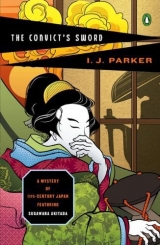
Текст книги "The Convict's Sword "
Автор книги: Ingrid J. Parker
Жанр:
Исторические детективы
сообщить о нарушении
Текущая страница: 21 (всего у книги 25 страниц)
Akitada frowned. “You’re missing the point. The case is not solved. Haseo was charged with killing his parents, possibly with this.” He took the sword off and placed it on the floor between them.
“Never,” said Tora. “Somebody else did and you’ll find the bastard. And then you’ll find his family and make that greedy Yasugi give back their property to them.”
And set Hiroko free. Akitada sighed. It was not that simple. Even if he found the real killer and located Haseo’s family, the government would thwart the return of name and land to his heirs by instantly wrapping the case in bureaucratic red tape and innumerable codicils. But he had always known that.
Tora’s priorities were different, and he now reminded Akitada of them. “I would help you, but I’d better go back to the market to ask more questions about Tomoe’s murder.”
Tomoe. She was connected, too. Hiroko had lied about their relationship. Had Tomoe perhaps been a witness to the crime? And if she knew the real killer of Haseo’s parents, might she have been killed to keep her from telling? But that could not be. Five years had passed. If she had been a threat to the killer, he would have got rid of her years ago, before the trial.
Tora was watching him. “Are you wondering how Matsue got hold of the sword?” he asked.
“No, I was thinking about your blind street singer. Matsue could have bought the sword. In five years anything might have happened. He took good care of it anyway.”
“Why do you think he was watching Tomoe?”
“Perhaps he liked her performance and was interested. She sang martial ballads and he was a swordsman.”
Tora snorted. “He hated her. I figured maybe she told him off when he got too bold. Some men hold a grudge about that sort of thing, and he had no respect for women.”
“Well, you said yourself, he did not kill her, whatever he thought of her. By the way, what about the coroner’s report?”
“What about it?”
“The coroner found evidence that she had been with a man.”
“The swine raped her first and then killed her. He’s a dead man if I get my hands on him!”
“Not so fast. Nobody has said anything about rape. She may have entertained a lover before the killer struck. Or she gave herself to the killer voluntarily.”
“She would never do such a thing. She lived like a nun. I should know.” Tora flushed and looked away.
So the rascal had tried. Akitada said dryly, “I see. I grant you it’s truly impressive that she should have turned down even your advances, but the fact is that neither you nor I know anything about her. There may have been a man in her life. There may have been a husband even. The coroner said she had given birth.”
“Amida. I never thought of that. She was so . . . alone. You just felt she needed someone in her life. What happened to her kids, do you think?”
“I have no idea.”
Tora sighed. “I’ve never met anyone like her before, you know, so helpless and so . . . stubborn. She never complained. She was a fighter. And for what? To be slashed to pieces by some beast. I bet he did rape her. Tomoe had a pretty figure.”
Akitada tried to remember the woman he had seen only once and then through the eyes of prejudice. “I should have listened to you,” he said. “And she should have accepted your offer of help.”
Tora said bitterly, “And I shouldn’t have spoiled it all by trying to sweet-talk her. She probably thought I was just like all the rest.” A brief silence fell as they weighed their culpability against the evil fate that had stalked Tomoe. Suddenly Tora said, “Wait a moment. The soothsayer in the market warned her to leave the city. She believed him but said she needed to earn a bit more money first. What for?”
“You shouldn’t believe soothsayers. One of them just gave Tamako a terrible fright. Such people do more harm than good.”
Tora’s eyes widened. “What did he say?”
“Some silly talk about Yori. The trouble is that during an epidemic, such dire predictions have a chance of coming true.”
Tora gulped and opened his mouth, but the door slid open, and they turned. Tamako peered in, her face strained. It seemed to Akitada that he had not seen her in a pleasant mood for weeks now. “Yes?” he asked, perhaps a little more irritably than he intended.
Her eyes flicked from his face to Tora’s. “I’m sorry,” she murmured. “I knew you had returned and wondered . . . but I did not mean to interrupt. Please continue your conversation.” She bowed and withdrew, closing the door behind her.
Akitada felt relieved and a little guilty. No doubt she had another complaint of a domestic nature. The unwelcome guests had probably caused a disruption in the smooth running of the household. “How are your friends today?” he asked.
“Fine. I’m to say thanks for the hospitality. Kinjiro mostly sleeps, but Mr. Chikamura has hobbled off to police headquarters to lay a complaint against his nephew’s friends.” Tora added morosely, “If they take the trouble to check the house, they’ll find the Scarecrow and Genzo.”
Akitada jumped up. “Heavens, I forgot about that. Kobe was out this morning, so I left a message about your adventure. He may be trying to see to me. I only came home to change. Soga has died of smallpox, and two senior officials found fault with me when they came to see who was running the ministry.”
“Soga has died?” Tora clapped his hands in glee. “That’s great news. Congratulations, sir. What a piece of luck!”
“You’d better keep those sentiments to yourself. I’m in enough trouble without having my retainers start to celebrate.”
Tamako apparently had taken care of her problem, so Akitada went to the small bathhouse, where he stripped off his dirty clothes, leaving them in an untidy pile on the floor. The wooden tub was covered with a lid, and the water inside was still warm. He sluiced himself off, and then immersed his body, feeling gradually refreshed after a sleepless and bruising night and the troubles of the morning.
He considered how best to investigate the Haseo case without losing his position in the ministry. Soga’s illness and death had given him a brief respite, but instead of being free from hostile oversight, he was once again under scrutiny for dereliction of duty.
He needed to visit the village where the crime had taken place. He must find and talk to witnesses, especially that nurse. What could have made the woman tell such a vicious and tragic lie?
Akitada saw no possibility of getting official leave, however brief, at a time when all the government offices were short of staff. But he could speak to Judge Masakane. He might even be able to read the trial transcript, learn precisely what the nurse claimed to have seen and heard, and find out what corroborating evidence there was, for surely there must have been something besides her word against Haseo’s.
He had no time for long deliberation and got out of the bath after only a few minutes, slipping on a light cotton house robe. On the way back, he thought to look in on Yori, but when he stopped outside his son’s room, he heard Tamako’s voice reading to him. Akitada frowned. The boy should be reading himself. More pampering. He was afraid he would just lose his temper again if he went in, so he went instead to change into a good robe, comb and retie his hair, and put on the prescribed headgear. On the way to the ministry, he stopped to have himself shaved by a barber who made a good living by offering his services to those who worked inside the Greater Palace.
His appearance met with Nakatoshi’s silent approval, but Sakae said rather cheekily, “A vast improvement, sir. My compliments.”
Akitada met this with a grunt and fled into Soga’s office, where he spent the subsequent hours dealing with routine paperwork. He had debated briefly whether he should move back to his own room—now occupied by Sakae. The two visitors had so obviously disapproved of his having assumed honors that did not belong to him. But he decided that efficiency would suffer and remained.
The afternoon passed much too slowly. There were no more surprise visits or “inspections” and no urgent problems to be solved, but it was not until sunset that Akitada could pay his visit to Judge Masakane.
Masakane lived in a modest villa south of the Greater Palace and received Akitada with cool courtesy. They were seated in the judge’s study overlooking a small garden rather similar to Akitada’s. The judge said bluntly, “I assume you’ve come about your retainer’s case. What was his name again?”
“Tora. But since his case has been postponed because of the epidemic, I came about something else. I trust you and your family have been spared?”
“I’m an old man and alone in this world. Death holds no fears for me. It is life that concerns me. There’s too little time for a man to leave a good name behind.”
Akitada said warmly, “No need to worry about that, Your Honor. You are praised by all as a fair and wise judge.”
He had meant the compliment, but Masakane drew back stiffly. “Don’t flatter me, young man, or I shall think you plan to damage that reputation.”
Akitada flushed. Young man—and that superior tone? How dare Masakane think he had come to influence his judgment! He bit his lip. No sense in showing his anger. He needed help, though not in the way Masakane expected. This would not be an easy interview after all.
“As I said, I’m not here about Tora,” he began and saw that Masakane relaxed slightly. “My visit concerns another case, one you tried five years ago. The accused was a man called Tomonari Haseo. Do you recall it?”
“Certainly. I am not senile yet. It was a sensational double murder. Are you going to question my verdict?”
The judge’s belligerence told Akitada that he still disliked and distrusted him. Anger stirred again. The old man was insufferably rude, and Akitada was fed up with the disrespect he had been shown by all and sundry lately. If the judge was already hostile, he had nothing to lose. He raised his chin and said rather sharply, “I was taught that justice requires us to question the truth. The man you condemned to exile is dead, but he was my friend and I’m alive to keep a promise. That is why I am here. Tomonari Haseo was falsely accused and the real murderer is free.”
Masakane’s eyes narrowed to slits. “You talk nonsense. At best you are carried away by false sentiment. At worst . . .”
Akitada interrupted, “I trust my record speaks for my integrity, sir. I must ask you to think before making rash accusations.”
The judge looked startled. He bent forward a little, as if he distrusted his hearing. “Are you correcting my manners?”
“I’m only pointing out that we are not going to get anywhere unless we both attempt to observe minimal courtesies, regardless of our private opinions.”
Masakane smiled thinly. “How foolish you are. I don’t want to get anywhere, as you put it. It is you who wants something from me.”
Akitada sighed in defeat. He rose and bowed. “In that case, forgive me for having troubled you.”
Masakane waved a thin, spotted hand. “Sit down. Sit down. I have nothing better to do. What do you want to know?”
Akitada sat. “I would really like to read the trial transcripts.”
“Impossible. They have been sealed, and you would need an order from the chancellor himself to unseal them.”
“Then I must rely on what you remember.” Akitada saw Masakane’s frown, and added quickly, “It was more than five years ago, and no doubt many witnesses appeared in so heinous a case. I know that the main witness was the accused man’s own nurse.”
“And what a witness! Distraught, of course. She suckled him and raised him through his childhood and now had to condemn him. But she served in his father’s house and she saw it all happen. This was a much stronger case than the one against your retainer. There was no doubt in anyone’s mind that the accused was guilty.”
“She claimed to have seen both murders done?”
“Yes.”
“But were there other witnesses?”
“Why worry about them? It is the nurse who is your problem.”
“I believe she lied.”
Masakane stared at Akitada. After a moment, he said, “I have heard that you pursue even the most far-fetched notions with incredible determination. Sometimes successfully. But this time you’re quite, quite wrong.”
“What about the other witnesses?”
Masakane pursed his lips. “Let me see. A maid testified that father and son had quarreled before. And a monk saw the murderer run toward the house with a terrible look on his face. Ah, yes. A local overlord offered your friend employment when he heard that he wished for independence, but he was turned down quite rudely. I think the young man said he knew of a better way to get what he wanted.”
“The local overlord would not by any chance be Yasugi?”
“Very clever. Yes, it was Yasugi. Of course he is the only man of influence in the area. The Tomonaris came down in the world as the Yasugi family rose. There was no love lost between them. All in all, Yasugi behaved rather well, I thought.”
“He may have had his reasons.”
Masakane frowned. “It doesn’t matter. His testimony was not needed. Anybody in the village could have told you that father and son did not get along.”
“What happened to Haseo’s wives and children?”
“I expect they went with the condemned. It’s customary.”
Akitada almost jumped up. “No, they did not. He was alone in Sadoshima. He left his three wives and six children behind.”
Masakane raised thin brows. “In that case the women may have remarried or returned to their families. Was there anything else?”
Akitada rose and bowed. “No, Your Honor. Thank you for your time. I hope you will forgive the rude intrusion.”
“Hmmph,” said Masakane.

Akitada was frustrated. He had exhausted the sources of information in the capital. Haseo’s hometown was the only place where he could learn about everybody’s movements on the day of the double murder and find out what had become of Haseo’s family. He firmly put aside the notion that he also wanted to see Lady Yasugi again.
When he got home, the gate opened to let out an elderly man accompanied by a young boy carrying a wooden case. The older man’s dark robe and the case identified him as a doctor. Seimei, his face tense with worry, was seeing them out.
Akitada wondered if Tora or one of his friends had taken a turn for the worse. Looking after the two figures, he asked, “Who needs a doctor?”
“Yori, sir.” Seimei’s voice was as bleak as his face.
“What? Yori? What’s the matter with him?”
Seimei hung his head without answering. With a sudden sense of dread, Akitada took him by the shoulders and shook him. “Speak, old man. What’s wrong?”
Seimei winced. “It could be smallpox, sir. Of course it is still early . . . and besides he is such a strong, healthy boy . . .”
But Akitada was already running toward the house.
CHAPTERTWENTY-ONE
SMOKE OVER TORIBENO

It was twilight in Yori’s room even though the sun had not set yet. Reed curtains had been lowered across the openings to the veranda and garden, and Yori was surrounded by low screens and blanket stands. Inside this cocoon the little patient lay under piles of silken quilts, ministered to by his mother and Seimei. The air was stagnant, warm, and heavy with the smell of pungent herbs.
Akitada pushed aside one of the blanket stands so roughly that it toppled and spilled the quilts and robes across the floor. Tamako jerked around and stared up at him with red-rimmed eyes.
“How is he?” Akitada asked harshly.
She shook her head and turned back to the child.
Akitada knelt beside his son. Yori was so smothered by bedding that only his eyes peered out at his father. The eyes were dull and feverish. Akitada pushed aside the quilt to touch the boy’s forehead. The child was burning with fever, yet his skin was dry as paper.
“Father, I’m so hot,” Yori whispered hoarsely. “I’m on fire.”
Akitada flung back the bedding. The little body looked small and forlorn among all the quilts. Someone had wrapped a thick layer of floss silk around the hips and lower abdomen. Yori started to shiver violently.
“Don’t uncover him.” Tamako’s voice was sharp. “The doctor said he must be kept warm at all times.” She tucked the blankets back around Yori.
“He is uncomfortable,” protested Akitada. “He needs air. And something cool to drink.” Yori whimpered and nodded.
“No. He mustn’t,” Tamako cried. “We must do as the doctor said. Nothing to drink. It’s our only hope.” And she pushed her husband aside and leaned protectively over the child.
Akitada felt helpless and frightened. Instinct made him shift the burden of responsibility. “Why was I not told?” he demanded.
“I tried to tell you twice, both yesterday and today. You were too busy.” Tamako’s voice was matter-of-fact, but he knew from her averted face and stiffly held back how deep her anger against him was.
“You certainly did not make yourself very plain in that case,” Akitada snapped. “You should have known that I expect to be informed of the illness of my only son.”
Tamako rose. She was white-faced and looked exhausted. It occurred to Akitada that she had probably sat up day and night with Yori. He recalled now that he had heard her reading to him earlier and was ashamed that he had blamed her for pampering the boy. Rising also, he extended a conciliatory hand, but she pushed it away. “You care nothing for your son or me,” she cried fiercely. “You only care for your work, and for solving your cursed crimes, and for other men’s women. Time and again I’ve begged you to protect us from the illness, and each time you’ve mocked my fears and reproved me. Now see what you have done!” She burst into tears and ran from the enclosure.
“Tamako!” Akitada started after her, but Yori began to cry and he went back to his son, knelt, and took him into his arms. “It isn’t true, Yori,” he murmured. “I do care very much for you. Are you feeling very bad?”
“Yes,” whispered Yori, putting his arms around his neck. “I love you.”
Akitada could not speak for a moment. Then he said, “Thank you. I love you, too. I’m sorry I’ve been so busy lately, but I’m here now. What do you want me to do?”
“Take the covers off again.”
“But the doctor said . . .”
“I don’t like the doctor,” wailed Yori. “I’m hot. And thirsty.”
So Akitada laid him back down and peeled back the quilts and the boy’s robe, and the silk floss wrapping until he lay quite naked. Yori closed his eyes then, but he held on to his father’s hand. Akitada gazed fearfully at the small body, so beautifully made, so sturdy and smooth, as yet unmarked by the red spots and pustules of the disease. He allowed himself to hope.
Seimei touched his shoulder and whispered, “Sir? He must be covered up. The doctor was quite specific about that.”
Akitada whispered back, “Oh, Seimei, he’s terribly hot. What’s wrong with giving him a little relief ? And how about some cool tea or water? He’s thirsty.”
“The idea is to make him hot to raise a sweat and break the fever. And he must not have any liquids. They will cause dysentery.”
Yori started to shiver and cry again.
“But he’ll burn up or die from thirst,” Akitada protested. Yori’s crying turned into a wail.
“Sir, you’re not being very helpful,” said Seimei sharply. “He must be kept quiet. Perhaps you had better come back a little later.”
Tamako reappeared and fell to her knees beside the sobbing child. She covered him and held him, rocking him in her arms like an infant until he stopped crying.
Akitada left quietly.
For the next ten days life stood still for Akitada. Very little intruded on his self-absorption, or rather, his total absorption in events over which he had no control. He sent a note to Nakatoshi to tell him that smallpox had struck his family and that he would not be able to come in. He did not contact Kobe and abandoned all thought of Haseo’s past and the murder of the blind woman. He stayed at home but did not exchange more than the barest civilities with those around him.
There was nothing for him to say or do. Decisions about Yori’s care were in the hands of others. Tamako was white-faced and determined, her comments to Akitada brief and cold. Seimei worked silently. Neither seemed to need any sleep. They remained with Yori day and night, while Akitada roamed the house and the garden, periodically passing through the sick-room to gaze helplessly at his writhing child. He kept hoping for a private moment when he might touch and hold Yori, perhaps to make him more comfortable, or to ease his misery by telling him stories, but Tamako’s hostile back seemed forever to interpose itself between him and his son.
Later, much later, he would blame himself for not ordering everyone out of the room, for not easing the boy’s fever and his agonizing thirst, but at the time he was so torn with guilt and uncertainty that his will had become paralyzed. Mostly he kept fear at bay with restless and pointless activities. He rearranged his books. He inspected the storehouse. He got out some tools and trimmed overgrown shrubs in the garden.
The telltale spots appeared and spread. Akitada reminded himself that many people survived, and that Yori had always been a strong and healthy boy, but the ice-cold lump in his stomach did not melt. That day he did an extraordinary thing and knelt in front of the household altar to pray to the small Buddha figurine. Since he did not believe, this effort came particularly hard, but by then his fear had grown too great, and he prostrated himself before the Buddha with the fervor of an ascetic. He offered his own for Yori’s life. The next morning Yori seemed better. The fever subsided and he rested more quietly for the first time in many days. But the rash festered and spread, from his face to his arms and chest, and then over his whole body. The child was in agony, unable to speak or swallow because the blisters and sores had invaded his mouth and throat. Akitada’s beautiful son became a swollen, suppurating monstrosity, and Akitada took the small Buddha statue from the altar and smashed it.
During this period, Akitada felt a great need to be with his son, yet could not bear to look at him. And so he would come, cast furtive glances in hopes of improvement, then sit miserably by for a few minutes as Seimei and Tamako, and sometimes the doctor, tended to the moaning child, only to leave again when his stomach twisted at the suffering. He was afraid now to touch his son, for even the small hands were grotesquely swollen and disfigured. The slightest contact caused him pain. He looked at Tamako and was ashamed. Her face was a weary mask, her lower lip swollen and bloodied from biting it whenever she had to handle the screaming Yori, yet she persisted. He marveled at her strength and his own weakness.
His inadequacy made him very humble. He asked Tamako if he might read to Yori. She nodded without looking at him. They had exchanged so few words since Yori’s illness began that they were like ill-met strangers. Akitada read to Yori without comprehending the stories and without response from the child. When Yori was awake, he stared with glazed eyes at the ceiling and whimpered a little now and then, but most of the time he seemed asleep or semicomatose. Akitada would pause and gaze at him, wondering if he was seeing death, and drop the book to rush from the room. Later it occurred to him that music might be more soothing. He brought his flute and sat, playing tune after tune, always ending with a lullaby Yori used to love as an infant, convincing himself that the sound eased the pain and put him to sleep.
The moments of hope were particularly dreadful: If the child had a more restful night, or took a few sips of rice gruel, or if the doctor did not express any unease, Akitada was filled with irrational joy. In fact, the doctor was a ceaselessly optimistic fellow whose many visits Akitada gladly paid for because they made him think—however briefly—that Yori was improving. But each hope was crushed, and each time death was closer and more certain, until even the most credulous father must abandon false expectations—and Akitada was not a credulous man.
Yori died quietly. He stopped crying, moaning, even whimpering, and became very still. Akitada and Tamako were in the room but did not know when he stopped breathing, having convinced themselves that he was only asleep. When Seimei told them, Akitada felt the pain slice through him so sharply that he gasped. He looked at Tamako and extended his hand—to comfort her or to be comforted, he did not know which. But Tamako flung herself across the small corpse and burst into a long wail. “Oh, oh, oh . . .”—just that, without cease—“oh, oh, oh . . .” Akitada lifted her from the dead child. He held her tightly, hoping that by holding on to each other they might find relief, but she fought free and ran from the room, still wailing in her grief.

Akitada neither wailed nor wept. He knew what must be done. He had arranged funerals before. Because of the epidemic, he could get only two elderly monks for the sutra readings and chants. The temple was apologetic: They had too many funerals to attend, and a number of their younger members had succumbed to the disease themselves. The yin-yang master designated the proper day, and casket, bearers, and materials for the pyre were purchased at enormous expense.
The family accompanied the small casket to Toribeno. The cremation ground lay on a wide plain southeast of the capital at the foot of the eastern mountains. They left the Sugawara residence at dawn and walked into the rising sun. Only Tamako rode in a sedan chair, borne by two villainous-looking men who had demanded a ransom in silver for the service. When they reached the outskirts of the city, the sun dimmed behind a heavy haze of grayish-white smoke which rose above Mount Toribe and spread like a blanket over the plain.
They crossed the river, and turned southward along its banks. The riverbed was partially exposed by the long drought; abandoned corpses lay there, and the remnants of small funeral pyres, some with only half-consumed corpses amongst the ashes. Most people could not afford funerals like Yori’s, especially not if they had lost several family members to the disease. Unpleasantly well-nourished dogs roamed about, baring their teeth at them as they passed, and a sickly smell drifted on the morning breeze.
Theirs was a very small cortege: just Yori’s parents, Seimei, and Tora. The others had stayed behind to guard the house in these uncertain times. The cook had taken to her heels days before, the moment she realized that the young master had smallpox.
They soon joined other funeral processions, some more elaborate, some even smaller than theirs. They passed several temples, all crowded and conducting services. Ahead stretched the thousands of stone grave markers of the capital’s cemetery.
Akitada saw all this with mindless detachment. Someone directed them to their site; someone else relieved them of their precious burden. It was placed on the pyre—a generous one, since Akitada had paid a huge bribe to the superintendent of the cemetery. The same two aged monks quavered their chants, while a heavily veiled Tamako placed Yori’s small possessions on the pyre: the lacquered sword Akitada had bought him for his New Year’s birthday, the book from which Tamako had read his favorite stories of legendary heroes, Seimei’s copy book full of strange Chinese characters, and some filled rice cakes Tora had searched the city for.
And then Akitada lit the wood with a burning pine torch.
They watched the flames catch, rise into the morning sky, watched the new white smoke ascend to join the drifting haze above—the smoke many believed to be the soul of the dead bound for the Western Paradise.
But Yori was too young to know what road to take. The heaviest burden for a parent is to know his small child is alone and helpless. His failure as a father gnawed at Akitada and he felt as hollow as a dead tree.
The wood crackled and hissed. The monks chanted. And gradually the smoky air assumed another, more choking smell.
Akitada thought of the fire, the heat of it, grieved that the small body which had suffered the burning fever should now be given to the flames. He closed his eyes and took shallow breaths.

That night Tamako came to Akitada’s room. He was awake when his door slid open, staring into a darkness so heavy that it burned his eyes as if it were the sun or a raging fire.
Her footsteps told him that she was barefoot, and he wondered what she wanted. He knew soon enough. She lifted his cover and slipped in beside him. Without uttering a word, she reached for him with hot, eager hands, peeling back his robe and pressing her body against him. She wore only a thin silk robe that parted in front.
He did not know what to do. A great pity for her seized him, and then he was disgusted with himself for responding to her lovemaking on this night of all nights. Tamako had never been this demanding, had never behaved with the wild abandonment of a public courtesan before. In all the years of their marriage, she had been a gentle and modest woman who took quiet pleasure in their physical encounters but never initiated them. Now she was clutching at him, seeking his mouth with hungry lips, and when he was ready, she pulled him onto her, grasping him with arms and thighs as if he might get away, meeting him almost violently, until she cried out her own fulfillment and slackened into abrupt lethargy.
Akitada finished, and rolled aside. He felt sick and was afraid because she lay so very still. “Tamako?” he asked, touching her temple through sweat-drenched hair.
She gave a single hoarse sob and was gone.
The sound of the door closing lingered in the darkness. The sharp scent of their lovemaking mingled with the smoky stench of Toribeno, which still clung to the funeral robe he had draped over a stand.
After weeks of coldness, his wife had come to him on the night of their son’s funeral. Why? Because she wished to replace the dead child with another as quickly as possible?
Akitada’s stomach heaved. He gagged on hot vomit and staggered into the garden.

The next morning, before sunrise and with most of the household still asleep, Akitada saddled his horse and left. Only Genba knew where he was headed, but he would pass the information on to the others.