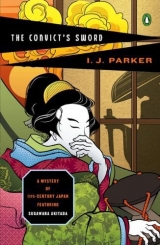
Текст книги "The Convict's Sword "
Автор книги: Ingrid J. Parker
Жанр:
Исторические детективы
сообщить о нарушении
Текущая страница: 13 (всего у книги 25 страниц)
“Oh,” Tamako cried, “I do try. It seems to me if you make a child hate learning, he’ll never make an effort, but if you show him how entertaining it can be, he’ll be much more open to instruction.”
“Nonsense,” snapped Akitada. “Such an attitude merely turns him into a weakling and a dawdler. He can look at pictures after he has practiced his characters. This trifling must stop.”
“We would have practiced writing,” Tamako said, “but there was very little paper left, the ink cake is almost gone, and a brush broke. I have sent Genba to get more.”
“Genba has more important things to do. How can this household be out of paper and ink? Yori?” The child looked at him. “Did you waste the paper and ruin the brushes?”
Yori’s eyes filled with tears. “I didn’t mean to, Father.”
Tired and with a pounding head, Akitada suddenly felt overwhelmed. “Why must I keep an eye on the smallest details of this household?” he demanded. “And where’s Seimei? Why is he not teaching the child? Heaven knows I am too busy to do everything myself.”
Tamako pulled the sobbing Yori into her arms, irritating her husband further. “Seimei was not well today. He was feverish. I made him lie down in his room.”
“Oh. That’s another matter,” Akitada conceded, wondering just how ill Seimei was.
Encouraged, Tamako added, “I worry about smallpox. What if he has it? Yori must not go near him until we’re certain it’s not.”
Akitada finally lost his temper completely. “I have told you before that there’s no truth to this imaginary epidemic. Don’t you think I would take precautions if I feared for your safety? Do you doubt my word in everything?”
Turning his back on them, he lit a small pottery lamp and stalked along the dark corridor to Seimei’s room. To his surprise, this was in darkness also. The old man was dozing, his thin frame wrapped in a quilt, his elbow propped on an armrest, and his head supported in his hand. He had not heard the sound of the sliding door or noticed the flicker of the oil lamp. Akitada sat down beside him. The room seemed excessively warm and stuffy because someone had closed the shutters to the outside. No wonder, he thought, that he is feverish in this hot room, wrapped up in layers of wadding-stuffed blankets. He reached out and touched the wrinkled hand. The skin felt hot and dry, and Seimei jerked awake.
“Oh,” he said, his voice hoarse and cracking, “you are home, sir. Sorry, but I must have dozed off for a moment.” He began to peel back the quilt and tried to get up. “Your tea? Shall I make it for you?” he quavered.
Akitada restrained him. “No, Seimei. I came to see how you are. My wife told me that you felt ill.”
Seimei shook his head. “It was nothing. I’m quite all right. Just a touch of tiredness, that’s all.” He swallowed and started to shake. “How cold it is all of a sudden,” he said through trembling lips.
Akitada was beginning to feel concerned. He touched the old man’s forehead and found it burning with fever. “You’re ill, old friend. You treat all of us for the slightest complaints, and yet you do not treat yourself. How is it that you didn’t read the symptoms and prescribe the correct remedy?”
“It is nothing,” Seimei said again.
Akitada looked around the room. It was as neat as only a man with lifelong habits of tidying up after others could keep it, but there was not a single sign of anyone else having visited with tokens of concern. No small brazier heating water for his tea stood by his side, no flask of wine, not even a water pitcher to refresh the feverish tongue.
A sudden and violent anger seized Akitada. Apparently the panic about smallpox had seized Tamako to such a degree that she had neglected a sick old man whose devotion to the family deserved her loving care. At least Yasugi had left his wife a maid before deserting her. The shock of this discovery made him physically ill.
He leaned forward and, raising the lamp, gently undid the front of Seimei’s robe to look for telltale spots, but there was nothing.
Seimei croaked, “No, not smallpox. I would not have stayed.”
“Then I would have had to tie you down, old man,” snapped Akitada. “What utter nonsense. You belong here. I’m glad it’s not the disease, but you’re quite feverish.” He carefully covered the shivering old man again and got up to bring Seimei’s medicine box to him. “I want you to tell me what medicines are indicated and how to prepare them.”
Seimei revived a little as he fingered through his box, pulling forth this twist of paper and that container of salve. Eventually he instructed Akitada in the preparation of an infusion and the addition of other ingredients to a bowl of watery rice gruel. Then he attempted to get up for a trip to the privy. Akitada caught him before he could stagger out the door and supported him to the outdoor convenience and back again. The trip exhausted Seimei and he agreed to be put to bed.
With Seimei settled in his blankets, Akitada left for the kitchen. Tamako hovered in the corridor outside Seimei’s room.
“How is he?” she asked.
Akitada said coldly, “Very sick, but you can relax. It’s not your dreaded smallpox,” and brushed past her.
“I’m glad it’s not smallpox,” she cried after him. “Where shall you eat your evening rice?”
His stomach twisted again at the thought that she would have let the old man die rather than expose herself and the child to the disease. “I shall eat with Seimei,” he said over his shoulder.
In the kitchen, the cook greeted him with complaints about the lack of foodstuffs and the absence of both Tora and Genba. He ignored her and instead barked commands about hot water and gruel at her.
The rest of the evening he spent tending to the old man. When Seimei had drunk his hot infusion of herbs, claiming that he felt great relief, he ate some of the gruel. Akitada had tasted this in the kitchen and almost choked on the bitterness. They sat together after that and Akitada told him about Lady Yasugi, but speaking was painful for Seimei and eventually Akitada offered to read to him instead. Seimei demurred, but then pointed to the “Sayings of the Sage,” a ragged and much-thumbed scroll he kept nearby. Master Kung’s brilliance notwithstanding, Seimei eventually dozed off, and Akitada put away the book and went to his own room.
He could not remember when he had felt this miserable. He was dazed from the headache and tiredness and deeply distressed. As he lay under his quilts, the words of the Great Sage kept passing through his mind. “A man who does not plan against the future will find disaster on his doorstep.” Tonight he had found disaster, and tomorrow morning he must speak to Tamako, to make clear to his wife, before it was too late, what he expected of the mistress of his household and the mother of his son. But even though her heartlessness had deeply offended him, he must be mindful that angry words would arouse resentment. He thought of the beautiful Lady Yasugi, who lived in constant fear of her husband. “Severity,” Master Kung advised, “must only be directed at oneself.”
CHAPTER THIRTEEN
THE STOREHOUSE

When Tora woke the first time, he thought he had the worst hangover of his life. The world gyrated blearily before his eyes, which hurt almost as much as his head, and when his stomach heaved, he rolled quickly to avoid vomiting all over himself. After that he passed out again.
The next return to reality began the same way, but the vomiting produced only dry heaves and he remained conscious. He put a hand to his throbbing head, touched sticky blood, and reconsidered his condition. An injury? Cautious investigation confirmed that he had a large wound on his scalp, and a lot of dried blood not only on his head, which was too tender to explore thoroughly, but also on his face and neck, and on some ragged clothes he seemed to be wearing. The clothes brought back memory.
He was lying on a dirt floor, propped against a wall inside a storage shed. Bars of sunlight fell through the spaces between the boards that formed the walls and roof. In a corner lay a pile of sacks and boxes. Otherwise the shack was empty. It was daytime, but probably not the same day he had fought Matsue. That bastard!
Wondering if he was a prisoner, he crawled to the door and stood. For a moment the shack spun madly while the floor heaved under his feet. Afraid of falling, he got back down on all fours. The door was not locked, but he was exhausted and crawled into the corner with the sacks, rested his aching head on them, and closed his eyes.
He must have dozed off, because he next felt someone shaking his arm.
“Tora? It’s me. Kinjiro.”
“Wha . . . oh.” He struggled to a sitting position. “What’s going on?” he managed.
“I brought you some water and a bit of food. How are you feeling?”
“Thanks. Not too bad,” Tora lied. He took the pitcher and drank it nearly empty. After that he felt a little better, but he did not want the food, though it looked like good rice and vegetables. Kinjiro gobbled it down hungrily.
“I guess I made a fool of myself,” Tora said bitterly.
“No, you didn’t. They’re talking about how good you were. You slipped, that’s all. Matsue shouldn’t have struck you like that.”
Tora was grateful. Really, there was hope for this kid. “So what now?” he asked. “I don’t guess I’ll get the job.”
“There was talk last night. Kata Sensei and Matsue Sensei arguing. I couldn’t hear all the words. Matsue Sensei doesn’t like you, but Kata Sensei was very impressed.”
“He can’t be too impressed after what happened,” said Tora. “Who brought me here?”
“Two of the students and me.”
“Thanks. What about the students?”
“They think you should stay.” Kinjiro grinned. “They figure they can learn to beat you. Matsue Sensei won’t waste his time on them.”
Tora snorted and touched his sore head. “I guess he’s done me an honor then. That makes me feel a lot better.”
“Matsue Sensei’s a bit fanatical about being the best. You want to wash? There’s a lot of blood on you.”
“Make myself presentable to express my thanks for the welcome, you mean? I don’t think I’ve got the strength yet to deal with all those students who’re planning to challenge me.”
Kinjiro laughed. “You’re funny. I like you.”
Tora reached across and tousled the boy’s hair. “I like you, too. Thanks for bringing the water and food.”
Kinjiro flushed. “It was nothing,” he said gruffly.
Tora eyed him thoughtfully. “Tell me about yourself while I try to stop my head from acting like it’s about to burst open like a ripe melon.”
“There’s nothing to tell. What you see is what I am.”
“Not much then. But in time, with some proper food, you may fill out.”
“Yeah. I’m not stupid. They feed me here.”
“And they didn’t at home?”
The boy spat. “Home!”
“No parents? No brothers and sisters?”
“I wish!” This was said with such venom that Tora raised his brows.
“Oh?”
“I don’t want to talk about it.” The boy moved impatiently. “What about you?”
“Oh, my family’s nothing special. They were peasants. We had a small bit of land at the end of the eastern highway. They’re all dead now.”
“How come?”
Tora said nothing for a moment, then, “They starved.”
“Starved? Farmers? You’d think a farmer wouldn’t starve.”
“They do when they have a few bad harvests and the tax collector takes all their rice for taxes. You can get through the winter gnawing a few roots and leaves left in the fields, but if your seed rice is gone, there’ll be no harvest the next year. But the tax man comes anyway, and if you can’t pay, he takes what you have and makes everyone work off the debt on one of the lord’s pet projects. In my case, I got to be a soldier. When I got back from fighting, they were all dead.”
“Oh.” Kinjiro thought about it, then said, “I’ve never been out of the capital. My father was a scribe. We lived in a nice house a few wards north of here.”
“A scribe? That’s a pretty good job, isn’t it? Practically a learned man. How come you end up here?”
“He died.”
“But . . . ?” Tora swallowed the rest of his question. The boy had turned his head and was plucking nervously at his shirt.
“I don’t care,” he said fiercely. “I can look after myself. I don’t need anybody. Someday I’ll show them all.”
“Is your mother dead, too?”
The boy kicked a heel viciously into the dirt. “No such luck! The bitch had better things to do. She got married again.”
Tora was appalled. After a moment, he said, “I guess her new husband didn’t want to adopt a whole family. What about brothers and sisters?”
“She kept my baby sister. And it wasn’t her new husband got rid of me. It was her. She tried to sell me to a post stable where they beat me every day. When I ran back home, she had to return the money. That made her mad and she said I had to get out. The filthy bitch.” His voice broke and he jumped up, kicked the door of the shack open, and disappeared.
The door clattered shut, and Tora stared at it. Poor kid. He had at least been a grown man when his parents died. Kinjiro’s mother was either heartless or without choice in the matter, and the boy was taking her rejection hard. No wonder he had joined a gang.
Tora rested a little more and was just making up his mind to walk home, when Kinjiro returned. “You’re in,” he cried. “Kata wants to talk to you about the job.” Before Tora could ask for details, he was gone again.
Tora got up and walked out of the shed. The bright sun blinded him, but most of the dizziness was gone. He found a well. Kneeling on the stone coping, he lowered the wooden bucket by its old rope and pulled up water. It took three more buckets before he had rid himself of most of the caked blood in his hair and on his skin. His skull seemed to be in one piece, though it hurt like the devil. He washed out his shirt in the last bucket and draped it over the fence behind the training school to dry. He would stay long enough to find out what the job entailed.
Wearing only his short pants and hoping that the old scars on his upper body would look more impressive than a ragged shirt, he walked into the training hall. Kata stood talking to some students and ignored him. Tora did not see Matsue and went to sit on the trunk. After a while, the boy showed up with a paper-wrapped bundle.
The thought of working for Kata was still tempting. Of course he would have to get his information quickly, before Kata decided to send him out on a burglary or hold-up. He had an uneasy feeling that he should have planned things better.
Thinking made Tora’s head hurt worse. He decided to go back to his shack and take a little nap, but as he was shuffling away, Kata called out, “Hey, you. Tora.”
Tora turned and said humbly, “Yes, Sensei?”
Kata dismissed the students, then said, “Come here.”
Tora obliged and submitted to a close inspection of his wound. Kata tsked and shook his head. “How do you feel?”
A little surprised by the solicitude, Tora managed a grin. “Like I’ve a beehive in my head and the bees are trying to get out.”
Kata chuckled. “Matsue shouldn’t have struck so hard, but it was an accident.”
Tora’s grin faded. “It was no accident.”
“These things happen,” said Kata vaguely. “Anyway, you can have a job helping me in the training hall. I’ve seen you handle a sword. How are you at kickfighting and wrestling?”
“Not so good, but I can beat anybody with a pole.”
“Really?” Kata waved to the boy. “Kinjiro, get two poles.”
Tora bit his lip. His head pounded like blazes every time he moved. But he accepted the bamboo pole and took up his position. It was a short bout. After a few turns, Kata stepped away. “Yes,” he said, “I can see you’re good. You can teach me a few things.” He tossed the pole to Kinjiro, went to pick up the paper-wrapped package, and thrust it at Tora. “Put these on. The boy’ll take you to a house where you can stay tonight.”
Tora was so astonished by all this that he made Kata a deep bow. The pain that shot through his head added a touch of unintended emotion to his expression of gratitude.
“Never mind,” said Kata. “You’ll be useful. Maybe later I’ll let you help with some other business. How do you feel about the police?”
Tora stepped back and glowered. “I won’t have anything to do with them.” His memory of Lieutenant Ihara made him embellish a bit. “Those crooked devils treat poor bastards like filth while the rich can do no wrong. Greedy merchants rob their customers, and then they turn around and rob their workers by sending us away without wages. And if we complain to a constable, he’ll lock us up and beat us half to death for making trouble.”
Kata nodded. “I know. Police brutality. I noticed the fresh stripes on your back. We feel like you do and protect each other. That means we don’t talk about our business to anyone outside the family. How do you feel about that?”
“It’s an excellent rule.”
Kata laughed and patted his shoulder. Then Kinjiro took Tora’s arm to pull him away. Tora was nearly blinded by the agony inside his skull.
Tora changed in the shed, putting on a pair of full cotton trousers and a plain blue shirt. The jacket had been made for a man who was both shorter and much fatter than Tora, but it was comfortable.
“I got the best,” Kinjiro informed him. “Old Gunzaemon buys his used clothes only from the best people. Got a nice selection. Lots of people dying this year.”
Tora grunted. The stick-fighting bout had made him sick again and he did not feel like talking. He did not feel like walking either and shuffled along glumly, until Kinjiro had to grab his elbow when he veered and almost fell into a ditch. “Here,” cried the boy impatiently, “watch where you’re going.”
They crossed Suzaku Avenue, turning into the business quarter, and soon passed the market.
Emerging from his haze of pain, Tora stopped.
“Kinjiro,” he asked, “did you ever come here with Kata?”
Kinjiro looked impatient. “Kata Sensei.”
“Sorry. Kata Sensei. I’m not at my best today.”
The boy relented a little. “Yes, I’m here a lot. Why?”
“I think I saw Kata once. At the tower.”
“Listening to the blind woman, I bet.”
“Yes. Do you know her?”
“I know everybody. She got murdered. Kata Sensei was in a terrible temper when he heard. We all stayed away from him.”
This was puzzling. Had something gone wrong with an order Kata had given? “Why was he mad?”
But Kinjiro clammed up. “You ask too many questions. Forget it.”
After a moment Tora tried again. “How many people work for him?”
The boy looked at him suspiciously. “Why do you want to know that?”
“An important man’s in more danger. I was wondering how best to guard him.”
“He’s important. We keep our eyes open and our mouths shut. You heard what he said.”
Tora nodded. If Kata had a big operation, he might take drastic steps to stop a blind female from talking about his activities. “Good. I’ll be useful then. Where are we going?”
“Just a place.”
Tora sighed inwardly. This was like dipping water out of the ocean with an acorn shell. He decided it was his turn to be resentful. “Sorry I asked,” he said huffily.
The boy gave him a sidelong glance. Tora compressed his lips and looked straight ahead. After a moment, the boy said, “It’s just a house. Kata’s borrowing it.”
Tora said nothing.
“What’s the matter?” the boy demanded.
“Never mind. I thought we were friends,” said Tora heavily, “but I see you don’t like me. You don’t trust me either. I’ll be better off working elsewhere.”
“Don’t say that,” the boy cried. “I didn’t mean it. It’s just . . . you’ll get in trouble if you know too much.”
Tora pointed to his head. “I feel awful and I’m just trying to learn about the job.”
“I’m sorry. I want to be your friend, Tora. Honestly.”
Tora looked up at the sky. “Hmm.”
The boy caught his sleeve. “Please, Tora. I don’t have any friends. The others treat me like a kid. We could help each other. I’d look out for you and you for me.”
“We . . . ll . . .”
“Please?”
“Friends trust each other.”
“I trust you.”
“All right. Let’s see if you do. If I’m going to work for Kata Sensei, I’d like to know as much as I can about him and his people.”
Kinjiro’s eyes flickered. “I don’t know everything. And we’re not supposed to talk.”
“I thought I was one of you now. See, you don’t trust me. Never mind.”
“What do you want to know?”
“How do you like the boss?”
“I’d die for him. He makes sure I get plenty to eat and sometimes he tells me I’ve done well. He’s like a father. He looks after us. He finds us places to stay, and buys our food and wine. And if we get hurt, he gets a doctor. He sent me for new clothes for you when I told him how bloody you were. We all belong to Kata Sensei.”
“What about the work—anybody ever get killed?”
Kinjiro hesitated. “You mean us? Not so far. A few got arrested. It beats starving in the streets.”
“Hmm. And what does Matsue Sensei do for the boss?”
“They’re friends. Matsue Sensei is a great sword fighter but he can be mean.”
“I know.” Tora touched his head and grimaced. “But you say they argue. And he doesn’t teach. Why does Kata need him?”
“I’m not sure. Sometimes I think Matsue Sensei can lay his hands on money. Or maybe he knows something about Kata Sensei.”
“Ah. When Kata Sensei lost his temper about the blind woman’s murder? Did he argue with Matsue about that?”
“Maybe. Kata Sensei liked her a lot, but Matsue Sensei hated her.”
Tora stared at Kinjiro. “Kata liked her? And Matsue hated her?”
“Matsue Sensei would not go near her. He’d just stare at her from a distance. Weird. Like he didn’t think she was really blind. Once Kata tried to make him talk to her. He got so angry he walked off. Matsue Sensei is very strange.”
“Right.” Tora lost interest. The long walk had been too much. He was so exhausted he could barely see where he was going.
He was spared racking his painful head for more questions when they reached the quarter of the Eighth Street Gate, a quiet and respectable neighborhood where the houses were old and solid. This time of day the streets were empty and the shop fronts closed. Apparently everybody was at their evening rice. The place they sought was at the end of a block, a large one storied house. It presented windowless walls to its neighbor and the side street, but had sliding doors and shutters in front.
It seemed a strange hideout for Kata’s thugs. Surely the neighbors would not keep quiet about the comings and goings of shady characters. Tora decided that it must be a temporary refuge. Criminals tended to move from place to place, though Tora had never known any to live so well.
Kinjiro gave four quick taps to the door. A panel slid open, and then the door slid back with a squeak, revealing a scruffy-looking individual who nodded to the boy and eyed Tora suspiciously.
In the dim light from some high windows, Kinjiro led Tora down a stone-paved hallway past the empty raised shop front and into an equally empty kitchen. Here a strange mix of aromas greeted them: food, both fresh and stale, sweat, smoke, and—all-pervasive—the clean scent of aged wood.
The boy lifted the lid of a rice cooker. A white cloud of steam escaped and filled the air with a rich smell. “You hungry yet?”
Tora sniffed. “I could eat something. Where is everybody?”
“They’ll come later. After work.” Kinjiro found two bowls and filled them with rice from the pot. He located a tray of salted vegetables, ladled them on top of the rice, then fished some pickled radish from a barrel on the floor. Handing Tora one of the bowls, he said, “Come,” and headed farther along the dark corridor.
Tora followed. They walked in the dusty footprints of others past an interior garden, and stepped up into the main room of the house. It had once been the best room of a prosperous merchant family. The wooden beams and walls had darkened over the years, and many stockinged feet had polished the raised wooden boards to a deep luster, now dulled by dirt and scuff marks. In one corner the floor was charred black. Someone had either lit an open fire there or spilled burning charcoal and left it. It was a miracle the house had not burned down. Spills and food stains marred the floor where it was not covered with the abandoned belongings of prior occupants. Clothing and bedding lay about in heaps wherever they had been kicked.
“Whose house is this?” Tora asked, surprised. “Where are the servants? The family?”
Kinjiro went out on a narrow veranda overlooking the small garden and sat down. “It belongs to Buntaro. He’s second in command. No servants. Just an old man.” He started eating with the greedy appetite of a growing boy.
It was much lighter outside than in the house and Tora looked curiously at the plants and small fish pond that filled the enclosed space. The fish in the pond were dead, bloated forms that floated on the surface, and the plants needed water. He sat down and looked dubiously at his food. He had not eaten for more than a day, but the sight of the dead fish made him feel queasy again. He took a small bite of the vegetables. It was good, and he tried some rice. “But there must have been women and servants once,” he said between mouthfuls.
“Don’t know. We haven’t been here long.” Kinjiro did not bother to empty his mouth but talked around the food. “There was nobody here but the old man when we came. The old man’s gone away on a trip.”
Tora had an uncomfortable feeling about the place. His encounter with the vicious Matsue had been bad enough. Now he was involved with a gang of thugs and thieves who would not think twice about killing him if they found out what he was up to. Though he was not precisely working for the police, the criminals would certainly see it that way.
And then there was a chance that the police might be tipped off by a neighbor and decide to raid this place. The guard was not at the door for nothing. If Tora, already a defendant in a murder case, were caught living with a gang so soon after his arrest, he would not have a chance in hell to prove his innocence. But it was a little late to back out now. He reminded himself that he was on the trail of Tomoe’s killer.
Kinjiro departed with his empty bowl and returned with a large pitcher of wine and two cups. Tora, who was making little headway with his food, refused the wine. His head pounded until he was nearly cross-eyed with the pain. What he needed was water. He watched the boy pour down several brimming cups in quick succession. “Are you allowed to drink all that?”
“Sure,” boasted Kinjiro, belching. “It’s the best. Kata Sensei gets it from one of his clients. Here! Try some.”
“I need water,” croaked Tora, staggering to his feet, “and the outhouse.”
Kinjiro got up. “I’ll show you.”
They passed down another dark corridor and through a back door into a fenced service area with several smaller buildings. Kinjiro pointed out the latrine, but Tora made straight for the well. When he reached it, he ran out of strength and sat down heavily. Kinjiro pulled up a pail of water, dipped a ladle in and offered it to Tora. “You don’t look too good,” he said needlessly.
Tora drank and handed the ladle back. “I’ll be all right in a minute,” he muttered, closing his eyes.
“Are you sure? Because I can’t stay.”
Tora’s eyes flew open. “You’re leaving?” he yelped. He had visions of a gang of bandits jumping on the strange intruder and asking questions later. “Who’s going to explain to the others what I’m doing here?”
Kinjiro narrowed his eyes. “You aren’t afraid, are you?”
Tora flushed. Of course he was afraid, but he could not disillusion his only ally. “Don’t be an idiot,” he snapped. “I want to get some sleep and I don’t want every fool who trails in to shake me awake because he’s never seen me before.”
“Oh.” The boy relaxed and grinned. “I’ll tell the guy at the door to warn them. See you in the morning then.”
Tora nodded and watched him disappear into the house. Actually, the situation was not without interest. He was alone in a robber’s den—well, alone except for the character at the street door, and he would hardly leave his post except for an emergency, such as a trip to the outhouse. Tora eyed the latrine and decided to use it himself.
When he emerged, he investigated the service yard. It was nearly dark by now. Wishing he had a lantern, Tora poked around in the large shed. It held household goods. He made out firewood, tools, spare buckets, a ragged broom, a coil of rope, a couple of braziers, a ladder, and an abandoned bathtub filled with sacks of beans, strings of onions, root vegetables, and a lot of other unidentifiable household goods.
A storehouse stood in the middle of the yard. It was the most substantial of the outbuildings, covered with plaster and roofed with tiles. Storehouses protected family valuables from the fires that often consumed the wooden dwellings, and this one was securely locked. No doubt the gang kept its ill-gotten gains in it.
Night was falling rapidly and already the unfamiliar place was full of black shadows and eerie sounds. Something knocked and something else scrabbled. When Tora thought he heard a groan, he retreated into the house.
It was even darker there. Suppressing irrational fears about ghosts and goblins, Tora felt his way down the dark corridor to the main room, where he could barely make out the piles of bedding. Helping himself to one of the quilts, he curled up in a corner and went to sleep.
He slept fitfully because he was nervous and because his head bothered him. At one point he thought he heard voices and steps, but nobody came to disturb him. Toward morning he fell into a deeper sleep and did not wake until well after daylight. To his surprise, he was still alone.
He sat up and gave a tentative shout, but no one appeared. After rolling up his bedding and tossing it back on the pile, he went to take a look around, but the rest of the house was as empty as the main room. Even the guard had disappeared.
This last discovery made Tora very uncomfortable. Where had the guard gone? And why? And why had he been left behind? He could not rid himself of a sense of impending disaster. Did they expect a raid? Perhaps he had been left to be arrested for some crime the others had committed during the night. He listened for the pounding boots and whistles of police constables, but all remained still.