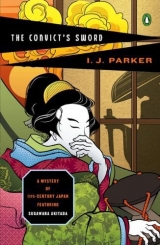
Текст книги "The Convict's Sword "
Автор книги: Ingrid J. Parker
Жанр:
Исторические детективы
сообщить о нарушении
Текущая страница: 19 (всего у книги 25 страниц)
He headed for the kitchen, where he had the cook fix him a snack. After eating, he changed into comfortable old clothes, slipped his identity papers in his sleeve, and fastened his sword to his belt. Then he went in search of Genba.

Four hours later, right after the bell from the palace had sounded the hour of the rat, a loud knocking sounded on the gate of the Sugawara residence. Seimei, who had been dozing in the front of the house, was instantly up, his heart pounding with anxiety.
When he stepped into the courtyard, he saw that the night was very dark. The knocking was more impatient than before, and a man’s voice called out. Seimei answered, “Coming!” With shaking hands he lit a lantern and hobbled barefoot across the gravel to lift the heavy latch and peer out.
When the gate swung open, he saw three ragged people, swaying slightly with their arms around each other’s shoulders. He almost slammed the gate shut again, thinking them drunk or, heaven forbid, raving with smallpox. But he raised the lantern for a better look and recognized the tall fellow in the middle. At least the bloody, filthy creature grinned at him with familiar white and perfect teeth. “Tora?” Seimei gasped.
“I brought a couple of friends,” Tora said. “Hope the master won’t mind.”
The friends looked, if anything, worse and thoroughly disreputable to boot. One was a ragged boy, small and half-starved looking, the other a foul-smelling old man who seemed to be gasping his last breath. Pity for their condition overruled other considerations. “Come in, come in,” cried Seimei, throwing the gate wide. “Oh, the master will be so glad you’re back, Tora. He and Genba have gone out to look for you.”
They staggered in. Tora let go of the other two and turned. “I’d better go back then,” he said unenthusiastically.
“Certainly not,” Seimei snapped, slamming the gate shut and latching it. “What is the matter with your leg?”
“Sword cut.” Tora stumbled to the well and dropped down on the coping. “Meet Mr. Chikamura and Kinjiro, Seimei.”
The old man sagged to the ground. Seimei, aghast at their condition, ran from one to the other in a distracted manner, but managed to get all three to his own room, where he scurried back and forth some more, looking for salves, bandages, herbs, and someone to brew a strengthening tea for old Mr. Chikamura. In between his mutterings, he managed to establish that Tora had been wounded in several places in a number of fights and accidents, that Kinjiro had been beaten and was badly bruised, and that the old man had nearly died of thirst and starvation while locked up for days in a hot storehouse. For Seimei that was enough. His mind was on treatments, not on the three bags filled with clinking coins or the sword that Tora treated so tenderly.
When his patients had been cleaned up and bandaged, Seimei went to the kitchen and woke the cook to brew tea and heat some food.

Akitada and Genba found Kata’s training school locked up and the neighborhood deserted. They went in search of the warden of the quarter. The man was asleep and ill-tempered at being woken. He knew nothing about anyone called Tora and there had been no trouble in his quarter. Akitada did not necessarily believe that, because the man also insisted that Kata ran a respectable business, but there was nothing else he could do here.
They went next to the house of the stonemason Shigehira, on the theory that Tora might have gone there to ask more questions about Tomoe’s visitors. Here, too, everyone was asleep. The wife came to the door and shouted abuse through a crack. When Akitada asked to speak to her, she threatened, “Go away, or we’ll call the warden.”
Genba’s booming voice cut in. “Woman, open up this instant. Lord Sugawara wants to speak to you and your husband.”
The door slid back far enough for a suspicious eye to peer out at them. After a moment, she opened it fully. Her husband hovered timidly behind her. She did not invite them in but stood on the threshold and demanded, “What is it then? It’s the middle of the night, and I’m sick of being bothered about that slut. We’re hardworking decent people.”
Genba growled, “Mind your tongue, woman.”
She shot him a glance, taking in his size and bulk, and clamped her lips together.
“Mrs. Shigehira,” Akitada said, “we’re looking for Tora. Was he here recently?”
“Him?” She folded her arms across her broad chest and stuck out her chin. “No. We don’t deal with murderers. Stinking garbage!”
Genba, who was usually the gentlest of men, now stepped forward and bent to push his large face into hers. “Woman,” he growled, “I’ve warned you. One more insult like that and you’ll wish you’d not been born.”
She backed away, stepping on her husband’s toes. “Well,” she cried shrilly, “I saw him with the knife and I smelled him, didn’t I?”
Genba raised his fist, but Akitada pulled him back. “Just a moment,” he said. “What do you mean, you smelled him? When was that?”
She got some of her nastiness back. “When we broke in and saw him standing over her corpse, that’s when. There was a bad smell and he had the bloody knife. And now he’s loose to kill more people. What’s the world coming to? The nobles cover up for their own and harass the poor working man. But the gods know. Oh, yes, the gods know. They sent the sickness to punish them. Beware of the wrath of the gods!”
Genba muttered angrily, but Akitada raised his hand to silence him. “Never mind that,” he said to the woman. “What sort of smell was it?”
“Garbage. Rotten food. Filth.”
“Ah.” Akitada smiled at her. “Thank you. That was very helpful. Is there perhaps anything else you have remembered? Such as who was spying on Tomoe?”
She frowned. “Spying on her?”
“Someone had been watching her through the cracks in her back door. She knew about it, because she glued paper strips to the inside.”
The woman gaped. “Those? I thought that was to keep the cold out.”
“No. The man, or woman, simply made a new spy hole through the paper.”
She swung around to her husband. “You piece of shit. So, that’s what you’ve been up to every night, ogling her through the cracks in the door. And telling me you’re just going out for a pee.” He protested his innocence, then raised his arms in front of his face as she laid into him with feet and fists, shouting abuse. The stonemason was a big man, and his trade had made him strong, but under the onslaught of his fat and unattractive wife, he cowered against the wall and whimpered denials.
“Pitiful,” said Genba disgustedly.
Akitada considered. The mason could have killed his lodger—or perhaps the wife had killed her in a jealous rage, and the coward was too afraid to speak—but on the whole he was inclined to think that the Shigehiros were innocent of anything except cruel abandonment of the blind woman to her murderer. And now there was the wife’s puzzling mention of the stench. Tora had always been very clean in his habits.
In any case, they would not get any more information here. Akitada took Genba’s arm and pulled him away.
“Where to now?” Genba asked, as they walked away through the dark, silent streets.
Akitada shook his head in frustration. “I have no idea. It’s too late to knock on people’s doors and the market has closed down because of the disease. Where do criminals hole up at night?”
“They work at night and sleep by day. In abandoned houses, in temples, under gates, and sometimes in the house of a comrade.”
“We could check the charity hospitals, but I would rather not risk that unless we have some information that he’s there. Let’s go home and see what we can do in the morning with the help of the police.”
At that moment, several dark figures detached themselves from the shadows and jumped them. Akitada, who had only caught a sound and brief glimpse of their attackers, was thrown facedown in the dirt. Someone knelt on his back, cut the sword off his belt, and hissed into his ear, “Your money or you’re dead.” Akitada was conscious of a strong smell of garlic and furious at himself for letting a mere footpad disarm him so easily.
Curses, the sounds of kicks and moans, and Genba’s roar told Akitada that the much bigger Genba had to deal with more than one attacker. Akitada tried to unseat the man on his back by bucking upward and rolling. A foolish effort! His instant reward was a blindingly painful blow to the head with his own sword. At this point it seemed wisest to pretend unconsciousness, and he let himself go limp. His attacker rolled him on his back and searched his clothing. Akitada was dimly aware that Genba had fallen ominously silent. He could hear the robbers muttering to each other. Then a whistle sounded not far away, and in a moment they were gone. Akitada sat up. Genba was lying motionless a few feet away. He crawled over to him.
“Genba?” It was too dark to see much, but there was blood on Genba’s face. Helpless fury filled Akitada. The police were completely inadequate to the conditions prevailing in the capital—his capital. Nobody was safe in the streets any longer.
Genba stirred under his probing fingers. “Wha—where . . . ?” He moaned.
“We’ve been attacked by robbers. Where are you wounded?”
Genba sat up slowly and felt himself. “By dose seebs to be broken. Thass all. I’b sorry, sir. It happe’d too fast.”
“Never mind. I know.” Akitada got to his feet and felt the lump on his head. At least it was not another black eye. Of course, the string of coppers and handful of silver coins he had carried were gone. More importantly, he had lost the Sugawara sword, a family heirloom. A fresh fury seized him. He would get it back, whatever it took.
A light appeared in the distance, and a large group of people approached. Akitada quickly pulled Genba into the dark recess that had hidden their attackers. The man in front carried a burning pine torch before a silent group of shuffling, shadowy creatures. In the light of the smoking, spluttering torch, the leader’s robe was a blaze of red against the column of black ghostlike shapes that followed.
Akitada stepped into their path. For a moment the torch swung violently, then a sword pointed at his throat. Akitada blinked against the brightness but stood firm.
“Who are you and what is your business here?” barked the man in red.
“I’m the official Sugawara Akitada. My retainer and I have just been attacked and robbed.”
The torch came a little closer until Akitada could feel its heat on his face, but the sword was withdrawn.
“Sorry, sir. It’s not safe in this area after dark. How many of them were there?”
“Four, I think. They beat us and took our money and my sword. When they heard a whistle—yours?—they ran. Please take the torch out of my face.”
The policeman obeyed, and after a moment Akitada could see that he had been speaking to a middle-aged sergeant who looked tired and unenthusiastic. The dark figures behind him were some of the sweepers he had seen earlier at police headquarters. And that gave Akitada an idea.
“How many sweepers did you bring with you?”
“Fifteen. Why?”
Akitada scanned the dark figures behind him. “I make it eleven now. What happened to the other four?”
The sergeant turned and counted. He cursed. “The lazy bastards have run off again.”
“You’re missing four men, and we were attacked by four,” Akitada pointed out.
The sergeant looked blank, then cursed again, more violently this time. He marched down the line of his followers. “All right. I want answers. Who saw the bastards leave and when?”
Nobody spoke.
“If you don’t tell me, I’ll have every last one of you curs whipped and see to it that you get no pay.”
A ragged individual stepped forward. “They were some of those from the jail. They took off just a few streets back. I think this is their neighborhood.”
“Show me!”
They all trooped behind the sweeper, who eventually stopped and pointed down an alley. “They ran down there.”
Akitada murmured to the sergeant, “Tell your patrol that there will be a reward for the man who finds the four who robbed us. Promise him two pieces of silver.”
The policeman drew himself up. “There’s no need for that. They will obey my orders.”
“Good, but it may make them more eager.”
The man passed along the offer and divided his sweepers into groups of three or four. They would spread out over a four-block area and call out if they found anything suspicious.
Akitada and Genba waited impatiently with the sergeant and one constable. Shortly there was a shout, and they ran to a house where two sweepers stood watch. One of them pointed to a neighboring house. “The old woman over there says four men went in a little while ago.”
“Secure the back,” commanded the sergeant, then blew his whistle. The other sweepers assembled. “All right. We’re raiding the place. Be ready to defend yourselves. They’re armed.”
They kicked in the front door and poured into the house. Shouts, thumps, and the sounds of breaking furniture came from inside. Akitada waited a moment, then borrowed the sergeant’s sword and followed with Genba. They walked into chaos. Sweepers were fighting sweepers swinging cudgels and metal prongs, the two policemen were shouting orders nobody paid attention to, and several characters were slipping away toward the rear of the house. Akitada and Genba skirted the combatants and went after them. Whoever was supposed to secure the back had ignored the order.
Three men were walking rapidly down a dark alley away from the house. Akitada and Genba caught up with them. Two of the men were unarmed, but the third had a sword.
“Halt!” shouted Akitada. “You’re under arrest.”
Lights came on in a house nearby. The two unarmed men immediately bolted, but the tall one with the sword turned to face them.
To Akitada’s surprise, he was Haseo’s double. In the dim light and with the sword in his hand, the resemblance was eerie. Akitada gasped, “Who are you?”
“None of your business, dog official.” The other man bared his teeth and raised his sword threateningly. A window opened in the house, and a man stuck out his head. When he saw armed men, he withdrew it quickly and slammed the window shut.
Akitada had got a good look at his opponent. Something about his stance and his sword hand was not right. Then he saw that, unlike Haseo, this man was left-handed. Or rather, he was using his left hand because his right was wounded. A thick bloodstained bandage covered most of his forearm.
“That is my sword,” Akitada snapped. “You attacked me and stole it.”
“You’re a liar. I’ve no need to steal swords,” said the other.
On second thought, the man who had taken the sword had certainly had the use of both hands. It was an impasse. Akitada wanted his sword but he also wanted to know if this man was related to Haseo. “You look like a man I once knew,” he said. “His name was Haseo.”
The other man’s face froze. His sword arm dropped to his side and the sword slid from his hand. He took a couple of steps backwards, then turned and ran.
Genba went to pick up the sword. “It’s not yours, sir. Funny. For a moment I thought he’d attack. I guess he just didn’t trust himself with his left hand,” he said.
Akitada went to inspect it. It was an ordinary weapon, the kind a military officer might be issued. Feeling both foolish and disappointed, he pushed it in his belt and said, “Somehow I don’t think that was the reason, but his reaction was certainly strange.”
They returned to the raided house, where the sergeant had given up the uneven battle and was gathering his few remaining sweepers. “No sign of your sword, sir,” he said in a disgusted voice, when Akitada returned his weapon. “We’ll let you know if it turns up.”
Akitada doubted it and told Genba, “Come, we’d better go home before something else happens.”
CHAPTER NINETEEN
HASEO’S SWORD

It was nearly dawn when they reached home, but lights were blazing in the Sugawara residence. The gate was opened by the cook, a woman who liked her sleep and certainly never bothered with gates.
She was in a temper. After a perfunctory bow to her master, she told Genba, “I don’t know what Tora can be thinking of, arriving in the middle of the night with two sick strangers, and demanding that I cook for them. And you look terrible, too.”
Akitada, who was already crossing the courtyard to the house, swung around. “Tora’s back?”
When she nodded, they ran into the house, too relieved to consider the rest of the cook’s speech.
Tamako met her husband in the corridor. The meeting reminded Akitada unpleasantly of an earlier one when she had thought that Seimei might have smallpox. She held a lamp, and in the flickering light her eyes glittered.
“How could you permit this?” she cried, her voice shrill with panic. “Cook says Seimei admitted sick strangers to this house.”
Akitada was also uneasy about these unexpected guests, but he tried to calm her. Putting a hand on her shoulder, he said, “I doubt there’s any need for concern. Tora wouldn’t bring anyone who has smallpox. Where are they?”
She stepped back, letting his hand drop away. “In Seimei’s room. He’s treating them. You must make them go away. There are charity hospitals.”
All was quiet in Seimei’s room, but a thin line of light showed around the door. Akitada cleared his throat.
The door opened immediately and Seimei peered out.
“Oh, it’s you, sir,” he whispered. “Returned safely, may the gods be thanked.”
Akitada stepped in and saw three sleeping figures under quilted covers. He found Tora and gently shook his shoulder.
Seimei had followed him. “He was wounded in a sword fight,” he said anxiously.
Tora stirred, blinked against the light and slowly sat up, rubbing his face. “Ah, you’re back, sir,” he said with a yawn. “I meant to go looking for you, but Seimei wouldn’t let me.” He yawned again. “And the truth is, it’s been a long day and night.”
“I’m sorry to wake you.” Akitada squatted beside him. “How badly are you hurt?”
Tora grinned and whipped back the cover to reveal a thickly bandaged thigh. “Just a flesh wound. Seimei cleaned it and put some stinking salve on it. Feels better already.”
“And the others? Lady Sugawara is worried about smallpox.”
“They’ve just been knocked about a bit. The kid, Kinjiro, saved my life. The old man was locked up without food and water for days, but Seimei says he’ll come around.”
“Good.” Akitada hesitated. “Do you feel like talking now, or would you rather rest first?”
“Now. I’ve got to tell you. You’ll never believe it. That sword the swordsmith Sukenari lost? Matsue had it all along. And a lot of gold and silver besides.” Tora fumbled in his bedding and produced the sword.
Akitada glanced at it and laid it aside. “But what about the murder? Did you find out who killed the blind woman?”
Tora’s face fell. “No. I know who didn’t kill her. I figured it was Kata, but she was his good luck charm and he thinks his business is doomed now.” He gave a dry chuckle. “He may be right. It will be. He’s a gang boss.”
Genba came in and crouched on Tora’s other side. “How are you, brother?” he asked anxiously.
“I’ll do. What happened to your nose?”
“I put it where it didn’t belong.” Genba grinned. “Well, did you have any luck?”
Akitada said, “Apparently not. At least the court is not in session at the moment. The sickness has given us extra time. That reminds me. I’d better explain to my wife about our guests.”
Tamako still hovered in the darkness of the corridor. Akitada closed the door behind him and said, “They don’t have smallpox. Just assorted wounds and bruises.”
“Thank heaven.” She came a little closer. “You are quite sure?”
He was not, could not be certain that they did not have the seeds of the sickness inside them, but he said “yes” as firmly as he could.
“But to bring strangers here in the middle of the night. What can Tora be thinking of ?”
“Since Tora has some serious wounds and lost a good deal of blood, I thought I’d ask for explanations later. He says the boy saved his life.”
“Oh.” She brushed a hand across her face, as if sweeping away the fears that had clouded her usual consideration for others. “How badly is he hurt?”
“I imagine he’ll be fine in a day or so.”
“I’m glad. Who are the others?”
“I know nothing about them, but they’re our guests until they can care for themselves. We must honor Tora’s word.”
“Yes.” It was dim in the corridor, but he thought he saw her flush. “Yori is . . . I’ll get a room ready for them.” She slipped away before he could thank her or wonder what she had started to say.
When Akitada returned to the others, Genba was pressing a smelly poultice to his nose and blinking watery eyes. Akitada grinned and went to look at the two strangers. The old man was asleep, curled up under his covers, and Akitada had to lift the quilt to see his face. He looked sick and fragile and vaguely familiar. The boy, a scrawny creature of twelve or thirteen, was awake and staring up at him.
“I’m Sugawara Akitada,” said Akitada with a smile. “I understand you did Tora a great service.”
“It was nothing. Tora told me about you. He thinks you’re one of the heavenly generals come back to earth.”
Akitada chuckled. “I doubt even Tora would accuse me of that. Do you have a family, Kinjiro?”
“No.” The boy scowled and sat up. “And you might as well know I’ve been working for Kata. Collecting his dues from the merchants every week. Don’t worry. I won’t stay long.” He said it defiantly, as if he expected Akitada would throw him out of the house.
“Kata was running a protection racket,” Tora said helpfully.
“Oh, I see.” Akitada sighed. The boy was a member of a criminal gang. He hoped Tamako would not find out. “I trust you’ve left Kata’s employ.”
Tora said, “He did. He’s a good kid. Couldn’t help himself. His father’s dead and his mother threw him out.”
“I can speak for myself,” muttered Kinjiro.
Akitada looked at his thin body and sharp features. Kinjiro was at the age when a child just begins to want to be a man, and this child had been plunged into the worst kind of adulthood before he was ready. He said a little more warmly, “I’m very sorry for your troubles, Kinjiro. Since Tora vouches for you, you’re welcome here and I will do my best to help you make a better start.”
“He wants to be a scribe like his father,” suggested Tora.
The boy swung around angrily. “I said . . .” But he did not finish. Instead he turned back to Akitada. “My father taught me to write, sir. I’m not very good yet. I think it would please him if I became what he was. If you could help me find a teacher, I’d work for you for nothing—for the rest of my life.”
Akitada was moved and amused by the offer. “Well, we must try to accommodate you then,” he said with a smile. “Now get some rest.”
Tora looked tired and in pain, but was blessedly alive. Akitada sat beside him and said impulsively, “Thank heaven you’re back with us. I was so worried.”
Tora grinned. “I know. I saw your face when you came in.”
They smiled at each other, while Seimei busied himself with Genba’s nose, and Kinjiro looked away.
“The sword I brought back,” Tora said after a moment. “Will you look at it? I think it’s the Sukenari sword. I wonder why Matsue had it.”
Akitada frowned. “Who’s Matsue?”
“Oh, didn’t I say? He’s the guy we’re looking for. The one that looks like Haseo. Only not up close. He’s Kata’s partner and a master sword fighter. He wounded me, but I cut off his fingers so he won’t ever fight again. He’s a nasty bastard. Enjoys hurting people.” Tora grimaced and rubbed his head.
Akitada stared at him. “You surprise me. I met him tonight. He acted very fierce in spite of his wounded hand, until I mentioned Haseo. Then he panicked. There must be some relationship between them.”
“There is. His real name’s Sangoro. There were papers in his trunk. Sword-fighting certificates mostly, and a couple of other things. He’s got a farm in Tsuzuki district. But I found another paper that had the word ‘Utsunomiya’ on it. I was going to give it to you, but they caught me before I could get home, and Matsue snatched it back. He was livid. Like I’d caught him in some crime or something.”
“They caught you? You mean Kata’s gang?”
Tora nodded. “That snake of a beggar from the market told them I was a spy for the police. When Matsue found his paper on me, I figured it was all over. They meant to kill me. Kinjiro saved my life by helping me get away.”
“You took a terrible and foolish risk.”
Tora nodded. “I know. But I did get the goods on Matsue.” Knowing Tora’s limited reading skills, Akitada wished he had the piece of paper Tora had found. He sighed and looked at the sword. “It seems to be the right sword,” he said doubtfully.
“Look at the tong.”
Akitada unfastened the blade and read Sukenari’s name and the date. He also saw faint traces of blood. “Yes,” he said, “you’re quite right. Sukenari will be very glad to have it back. It needs cleaning.”
“I’ll get some oil in a moment. It’s a very fine blade. Sliced right through Matsue’s sword hand.”
Kinjiro piped up, “You should’ve killed him. Real fighters always fight to the death. Matsue would’ve killed you.”
“If you prevailed against a great swordsman, Tora, then the gods were truly in it,” said Akitada. “I must give them my special thanks.”
The boy said, “You’re very lucky to have a man like Tora, sir.”
“I know.”
“Pah.” Tora looked embarrassed. “It was the spirit in the sword. Besides, he wasn’t such a great swordsman after all to lose to a mere soldier.”
The door opened and Tamako came in, followed by her maid. They carried trays of food and flasks of wine. Akitada jumped up. “Thank you, but we can serve ourselves,” he said, hoping the women would leave quickly.
Tamako peered over his shoulder. “Oh, Tora,” she cried, “how very sorry I am that you have been wounded.”
Tora covered his bloody bandage and tried to make her a bow. “It’s just a little scratch, my lady.”
“If you feel at all feverish, you must let me know. I have some herbs that are supposed to be particularly good when a wound becomes infected.” She passed the tray to Akitada. “Please make our guests welcome.”
The maid put down the wine, and the two women left.
“The old man seems very familiar,” Akitada said, setting the tray on the floor and nodding toward the sleeper.
“Mr. Chikamura says he knows you.” Tora reached and helped himself to a bowl of stewed fish and vegetables.
“Mr. Chikamura?” cried Akitada in surprise.
“Who’s calling?” muttered the old man and sat up slowly. He blinked, rubbed his eyes and broke into a toothless smile. “My lord,” he said. “What great kindness and honor you show a poor old man! You won’t believe it, but that depraved nephew of mine came back with his villains and they locked me up in my own storehouse because I threatened them with the police. I thought I was a dead man. I’d just about given up and assigned my soul to Amida, when Tora rescued me. May Amida bless both of you.” Wheezing with the effort, he got on his knees and knocked his head on the floor a few times.
Akitada said quickly, “Please don’t exert yourself. I’m very sorry for your ordeal and will see to it that your nephew is locked up instead. Now make yourself comfortable. Here is food. Come Seimei, and you too, Kinjiro.”
Mr. Chikamura crawled closer and accepted a bowl of rice from Kinjiro, “No need to bother about Buntaro,” he told Akitada. “Tora killed him.”
Akitada’s jaw sagged. He looked at Tora. “You killed a man?”
“He killed two,” Kinjiro corrected proudly. “He tricked the Scarecrow—that’s Buntaro—to slash Genzo’s throat from ear to ear, and then he took Genzo’s knife and rammed it all the way into the Scarecrow’s chest. They bled buckets of blood on the floor.”
“Heavens,” murmured Akitada. “You have been busy, Tora.”
“He’s a great warrior,” cried Mr. Chikamura, who had eaten with good appetite and was becoming talkative. “After he fought Matsue, he went out to get rid of my nosy neighbor, and then they put me on a ladder, along with the bags of money, and carried me most of the way. When some constables tried to stop us, they told them I was dead from smallpox and they were gonna take me to Toribeno.” Mr. Chikamura emptied a cup of wine and giggled. “The constables just backed away and covered their noses.” He held out his cup, drank down the refill, and continued, “This smallpox—they say it flies through the air and if your Karma is bad, it’ll enter your body. Maybe they should beat a drum to scare the flying devils away.”
“We must hope that we’re safe,” said Akitada with a smile, but he was concerned. Seimei passed around more food and poured wine for Akitada and Tora, but he only gave tea to Kinjiro, who drank very little and ate nothing.
Akitada saw that Tora looked tired and drawn. He felt guilty but asked, “Did you learn anything about the murdered woman?”
Tora made a face. “Not much. She may have been Kata’s good luck charm, but Matsue hated her. Kinjiro says he used to watch her in the market.” The boy nodded listlessly. “I’d made up my mind to kill the bastard for Tomoe’s murder, but he said he didn’t do it.”
Akitada raised his brows. “And you believed that?”
“I’d just cut off his sword hand. He figured he was a dead man, so why lie?”
“And nothing else turned up?”
Tora shook his head.
Akitada sighed. “All this trouble, and we’re back where we started.” He got up. “I’ve plagued you enough for tonight. We’ll talk again tomorrow, and I’ll see to Sukenari’s sword. Get some sleep now, Tora.”
Mr. Chikamura had listened and now piped up, “That sword is Matsue’s. He told Buntaro it belonged to his family, and he’s the last of them. Everybody else is dead.”
Tora said tiredly, “Then he lied,” and lay down and closed his eyes.
In Akitada’s room a candle shed unsteady light on his desk and shelves of books. The doors to the garden were open, the blackness beyond silent and unfathomable. Tamako had spread out his bedding for him. He was not sure whether to be grateful or take it as a signal that he was not welcome in her room. He laid a square of cotton across his desk, placed Sukenari’s sword on it, and got out the cleaning materials. His father had kept these in a fine old sandalwood box and had taken pains to teach Akitada to care for swords. Sometimes it surprised Akitada that a scholar like the elder Sugawara had never forgotten respect for the military traditions of their ancestors. In later years he had come to be grateful for his father’s teachings, though he would never feel love for his stern and cold parent. Even now, as he laid out the stoppered bottle of clove oil, the small silk bag containing the fine whetstone dust, the batch of thick cleaning papers, and the small picks and mallets, he cringed inwardly at the memories of his boyhood.