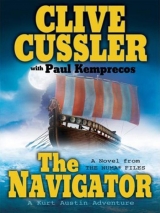
Текст книги "The Navigator"
Автор книги: Clive Cussler
Жанр:
Морские приключения
сообщить о нарушении
Текущая страница: 5 (всего у книги 27 страниц)
Chapter 8
THE CONTAINERSHIP Ocean Adventurecould hold nearly two thousand cargo containers, but even at seven thousand tons and a length of five hundred feet it was a pygmy compared with newer box ships that were as long as three football fields laid end to end. The finer points of spatial relativism were lost on Carina Mechadi as she strode along the ship’s long deck huddled against the bone-chilling rawness of the North Atlantic.
Since boarding at Salerno, Carina had arisen early each morning and descended from her cabin on the third level of the bridge house to go on a brisk walk before breakfast. Her compulsion was fueled by an unnecessary obsession with keeping her lithe figure in shape and to sooth her impatience at reaching her destination. The number of laps varied according to the weather, which ranged from raw dampness to the bitingly cold air off the coast of Newfoundland.
The Ocean Adventureinspired little of the romance immortalized by Joseph Conrad’s tales of the doughty tramp steamers that plied the world’s oceans in a bygone age. The ship was a seagoing platform that carried steel container units twenty feet long by about eight feet tall. They were stacked six high and covered most of the deck, except for fore and aft, and narrow aisles on either side. Hundreds more containers were stored belowdecks.
As Carina made her way along the starboard rail, she recalled the chain of events that had brought her to a ship plowing its way across the Atlantic. The murder of Ali Babbas some years before in Baghdad had shocked but not surprised her. Violence always lurked behind the scenes in the high-stakes trade in illegal antiquities. It was a shadowy world where enormous sums of money flowed and gentlemen were rarely found. Ali had probably double-crossed the wrong person.
She had mourned his death nonetheless. Without Ali, it was doubtful she would ever recover the lost cache of antiques. Ali had been the middleman who moved stolen goods to market. He had committed nothing to paper. The names of his buyers and sellers had been in his head. With the sleazy dealer out of the picture, the antiquities she had sought had been scattered to the four winds.
Carina had had plenty to keep her busy once she left Iraq and returned to her UNESCO office in Paris. Months after leaving Baghdad, she’d been was on the trail of a rare Etruscan statue when Auguste Benoir visited her office and presented his card. Benoir was a prim, perfidious man who reminded Carina of Agatha Christie’s fictitious detective Hercule Poirot.
Benoir was a partner in a prestigious Paris law firm, and he got right to the point. “My firm has been retained to represent the Baltazar Foundation,” he said. “Mr. Baltazar is a wealthy businessman and philanthropist. He was quite saddened when he heard about the looting of the BaghdadMuseum. Mr. Baltazar had read an article describing your efforts to find a cache of stolen antiquities, and he is hopeful that with funding from his foundation you could devote your talents to restoring these objects to the Iraqi collection.”
“That’s very kind of Mr. Baltazar,” Carina had replied. “However, I believe I can be more valuable working with a worldwide organization like UNESCO.”
“Forgive me for not being clear about Mr. Baltazar’s proposition. You would not be required to leave UNESCO.”
Carina glanced at the folders piled up on her desk. “As you can see, I am buried in UNESCO work.”
“Understandable.” Benoir produced a single sheet of paper from his briefcase. “This is the agreement that is being proposed. The foundation would donate an ongoing grant in a bank of your choice. You could draw on the bank account at any time for any purpose, with one stipulation: The money must be spent to recover the Iraqi artifacts. There is no current limit on the funds available.”
Suddenly interested, Carina considered the offer. “Mr. Baltazar is most generous.”
Benoir beamed. “Well, Mademoiselle Mechadi?”
Carina was in a quandary. She was balancing several UNESCO assignments, but she couldn’t let a chance like this pass. She scanned the agreement. “Let me study this proposal and I’ll call you tomorrow with my answer.”
The next day she called Benoir and told him her answer was yes. In her UNESCO job, Carina had worked with governments, international police, museum people, and archaeology experts, but the possibilities of unlimited funding opened up whole new worlds. With wads of cash in her hand, she would be able to buy access to the unsavory characters who populated the antiquities trade. And so it was. Soon she developed an effective network of police and underworld informants who often gave her leads on antiquities missing from countries other than Iraq.
One of her more reliable sources was a crooked Egyptian army officer she knew only as the Colonel. Less than a week before, he had called her out of the blue with the news that the cache of Iraqi objects she had been looking for was being put up for sale by a petty thief named Hassan. She told the officer that she would see him within forty-eight hours, wired him a deposit, and told him to make the buy sight unseen.
The agreement with the Baltazar Foundation required that she keep it informed of immediate developments. She called Benoir with the news about Hassan, and Benoir said he would pass the news along. Before flying to Cairo, she called Professor Nasir in Baghdad and told him that she was close to recovering the cache.
Nasir was delighted, but conditions were still chaotic in Iraq and he was worried about the safety of the collection. He was trying to find funds to set up an efficient record-keeping system for the museum’s existing collection. Nasir enthusiastically embraced Carina’s suggestion that the artifacts be used to leverage donations. He would sign a waiver allowing her to keep the artifacts temporarily in her possession and would contact the Iraqi embassy in Washington to alert the diplomatic staff to the possibility of a tour.
Events moved quickly when she got to Egypt. Over lunch at the Nile Sheraton Hotel, the Colonel said he had already acquired the collection. He gallantly bought her lunch after she had paid him his full fee. That night, in a warehouse on the docks of Port Said, she had waited with growing excitement for the truck that pulled in shortly after midnight.
The artifacts in the truck were covered with dirt, but they were in more or less decent condition. She did a quick inventory by flashlight, writing down a description and number for each item. One of the larger pieces was a tall statue of a man wearing a kilt and conical cap. The bronze surface was caked from grime from the bearded face to the cat at the feet of the figure. The statue didn’t appear on her original artifact list, but a wrinkled paper tag affixed to one arm by a string identified the work as the Navigator. After spreading more of Baltazar’s wealth around the waterfront and the customs office, she had the load put on a freighter that was leaving for Italy.
Flying ahead of the freighter to Salerno, she arranged for the trans-shipment of the cargo to the United States on the Ocean Adventure,and, during the nervous wait, she nailed down the tour plans with Nasir and the embassy. When the freighter finally arrived, she called Benoir and told him she had taken possession of the antiquities in preparation for a tour. He sounded strangely disappointed but called back later, saying he had consulted with Baltazar, who congratulated her on the find. Carina decided not to let the artifacts out of her sight again and had booked a cabin on the containership.
She stopped during her walk now and peered down an alley between stacks to make sure that the blue-painted container was still there. She continued on to the bow, where a blast of icy air hit her as she stepped out onto the open deck.
The captain had told her over dinner the night before that the ship’s cruising speed was eighteen knots. He would reduce that as they neared Newfoundland and entered the area known as “Iceberg Alley.” The warning made her more curious than fearful.
She paused at the bow to look for icebergs. Only trunk-sized chunks floated in the gray sea. Several layers of clothing were still not enough to keep the icy fingers of wind from tickling her ribs. Hot coffee and scrambled eggs would be waiting in the mess hall. She turned her back to the open sea and headed along the ship’s port side.
Carina was about two-thirds of the way to the bridge when she heard a beating sound above the swash of the hull through the sea. She looked up and saw a pair of helicopters flying close together a couple of hundred feet above water level. They were rapidly approaching the ship. No markings of any kind were visible on the black fuselages.
Carina was surprised at their sudden appearance. The ship was a hundred miles from land. She remembered the captain’s mention of oil and gas rigs in the area. The helicopters must belong to a drilling platform.
The helicopters buzzed the ship barely above mast level, banked around in a tight formation, and circled the moving vessel like birds of prey in an ever-tightening spiral before disappearing out of the line of sight. The sound of spinning rotors faded. The helicopters evidently had landed on top of the container stacks.
Carina was sure she’d learn the identity of the visitors when she got to the mess hall. She resumed her walk, only to suddenly stop in her tracks. Ahead of her, a figure dropped down from a container stack at the end of a rope and landed on the deck. Three more figures rappelled down the rope and stood in her way. Masks hid their faces except for the eyes. They were dressed in tight-fitting black uniforms and armed with short-barreled automatic weapons.
Carina turned and ran, but four more armed figures had descended from the stacks behind her, and they closed in on her. One of the strangers grabbed her by the arm and spun her around, and her wrists were roughly tied behind her back with duct tape.
She was shoved in the direction of the bridge house and a gun muzzle was jabbed hard between the shoulder blades. More figures were coming in their direction. Carina recognized two Filipino crewmen. She saw their smiling faces and the situation became crystal clear. The Filipinos were working with the hijackers.
The raiding party split up into two groups. One crewman set out toward the bridge house with four hijackers. The other man led the way along the deck. The whole operation had been conducted in silence. These men knew what they were doing and what they wanted, Carina thought. But she was dumbfounded when the crewman directed her to the container box holding her artifacts and rapped his gloved knuckles on the metal surface.
The container door was hemmed in by other boxes. A hijacker opened a metal suitcase and removed a torch and oxygen tank. He assembled the torch, ignited the flame, and adjusted it to a fine point. He donned a pair of goggles to protect his eyes from the shower of sparks and methodically began to cut a hole in the side of the container.
An involuntary cry of protest escaped Carina’s lips. Her outburst brought an instant response. One of her captors grabbed her arms and kicked her in the ankle at the same time. Catrina, having lost her footing and unable to use her arms to break her fall, hit the deck. Her forehead smashed against a hard surface and she blacked out.
When she regained consciousness, she was lying on her back in semidarkness. Her head throbbed with pain. She rolled over on her side and saw that she was wedged between two wooden cartons inside the container. Light streamed into the space from a rectangular hole framed by ragged edges from the cutting torch.
She tried to stand, but it was difficult to get her feet under her with her hands bound behind her back, and the effort made her dizzy. As she lay on the cold steel floor with her chest heaving from exertion, she saw a shadow against the crates. A man peered in at her through the hole. His face was slightly plump around the cheeks, but the round eyes that stared out of the cherubic face had a demonic intensity.
Carina’s blood ran cold. It was one of the most frightening faces she had ever seen.
Her expression must have mirrored her thoughts because the man smiled.
Carina was almost grateful when she passed out again.
Chapter 9
THE ORANGE-AND-WHITE HERCULES 130HC long-range surveillance aircraft had taken off at dawn from St. John’s and headed east on a seven-hour flight for the International Ice Patrol. Cruising at three hundred fifty miles an hour, the high-wing aircraft would cover a thirty-thousand-square-mile expanse of ocean before its patrol ended.
The Coast Guardsman at the plane’s radar console was daydreaming about his upcoming date with a young Newfoundland woman. He was working on a plan to get her into bed when he saw the suspicious blip on the plane’s radar screen.
Training set in. The radarman put aside his prurient thoughts and focused on the radar screen. The four-engine turboprop carried radar that looked forward and sideways. The side-looking radar, or SLR, had picked up the large object in the water around twenty miles to the north.
Iceberg detection had come a long way since 1912, when the ice patrol was created to prevent a repeat of the Titanicdisaster. Despite the technological advances, identification is considered more of an art than a science.
The radarman tried to decide whether the object was an iceberg or an anchored fishing boat. A smooth-edged moving target would denote a vessel. The blip was almost stationary and showed no sign of a wake. His practiced eye picked out the radar shadow, where there was no radar return on the far side of the target, a phenomenon that indicated that the target was taller than a ship.
Iceberg.
He notified the cockpit of the sighting and its location, and the plane veered off on a northerly course change.
The fog hanging over the ocean surface prevented visual identification until the very last minute. The plane dropped down until it was several hundred feet above the water. The mists cleared to reveal an iceberg with a tall, narrow pinnacle at one end. Then the fog closed in again. The brief glimpse was all that was needed.
The plane sent the iceberg data to the ice patrol’s operations center in Groton, Connecticut. There, a computer figured out the iceberg’s probable drift. A warning was broadcast over the radio as a bulletin to the maritime community. The report was picked up by a Provincial Airlines Beech Super King that had been patrolling the Grand Banks under contract to the offshore drilling industry.
The two-engine plane homed in on the broadcast coordinates. The fog was clearing, and the plane found its target with no trouble. After making a couple of low-altitude passes, the plane radioed a confirmation of the sighting to the drilling platforms and vessels in the vicinity.
THE Leif Erikssonhad been cruising at a lazy meander when the vessel received the urgent message. Immediately, the ship’s twin ten-thousand-horsepower diesels flexed their muscles in a noisy display of power. Leaving a creamy wake in the gray seas, the vessel raced off like a motorcycle cop chasing a speeder.
Austin had been in the bridge poring over a chart with Zavala when the report came on over the radio’s speaker.
“Our missing Moby?” Austin asked the captain.
“Could be,” Dawe said. “She fits the description. We should know soon enough.”
Dawe ordered the ship’s engine room to cut speed. Cottony wisps of fog were curling around the ship’s plunging bow. Within minutes, a colorless miasma wrapped the ship like a wet dishcloth. Visibility was reduced to spitting distance. The ship groped its way along relying entirely on its electronic eyes.
The captain kept close tabs on the radar screen and called out commands from time to time for the helmsman to adjust course. The ship was moving at a crawl, and the tension on the bridge was thicker than clam chowder. The ship was traveling through the haunted waters near the grave of the Titanic. Even with electronics that could pinpoint a toy boat in a rain puddle, ship collisions with ice were not uncommon, and sometimes fatal.
The captain emitted a cryptic grunt and looked up from the radar screen.
He grinned and said, “Did I ever tell you what a Newfie uses for mosquito repellant?”
“A shotgun,” Zavala said.
“The mosquito will crash when you shoot out its landing lights,” Austin added.
“Guess you heard that one. Don’t worry; we’ll make Newfies out of you yet.”
With the tension broken, the captain turned his attention back to the radar screen. “Fog’s let up a bit. Keep an eye out. Any second now.”
Austin scanned the grayness. “We’ve got company,” he said, breaking the cathedral quietness on the bridge.
The ghostly outlines of an enormous iceberg loomed ahead like something in a dream. Within seconds, the mountain of ice became more solid and less spectral. The berg angled up from one end to a lofty pinnacle that rose as high as a fifteen-story building. A stray shaft of sunlight had penetrated the fog. Under the glare of the heavenly spotlight, the berg glowed with a bone white sheen except for the sky blue crevasses where the refrozen meltwaters were free of bubbles that reflected white light.
The captain slapped Austin and Zavala on the back. “Grab your harpoons, boys. We’ve found Moby-Berg.” He gazed in rapture at the enormous berg. “Real pretty, eh?”
“Quite the little ice cube,” Austin said. “And we’re only seeing about an eighth of the berg above water.”
“There’s must be enough ice there for a billion margaritas,” Zavala said with undisguised awe.
Dawe said, “She’s a castle berg. Like the one that sunk the Titanic. The average berg in this neighborhood runs a couple of hundred thousand tons and maybe two hundred feet in length. This one is around three hundred feet plus and maybe five hundred thousand tons. The Titaniciceberg was only around two hundred fifty thousand tons.”
The captain ordered the helmsman to circle the berg, coming no closer than one hundred feet. “We’ve got to be extra careful,” he explained.
“Those projections poking from the water look as if they could scrape the barnacles off our hull,” Austin said.
The captain kept a level gaze on the berg. “It’s the obstructions we can’tsee that I worry about. Those blue cracks are weak spots. A gigantic piece of ice could break off at any time and the splash alone could sink us.” Dawe flashed a quick grin. “Still glad you hooked a ride with us?”
Nodding in agreement, Austin tried to absorb the deadly beauty of the majestic ice mountain.
Zavala had shed all his reservations about the trip and stared spellbound at the huge berg. “Fantastic!” he said.
“Glad to hear that, my friends, because his baby belongs to you. A NUMA ship helped me out of a jam some years ago. This is my way of paying you back. The ship’s owners say liability won’t be a problem as long as you sign on as temporary members of the crew, which you’ve already done. You showed yourself to be naturals rounding up bergy bits.”
Dawe had let his guests lend a hand lassoing the smaller bergs, loosely misnamed after the fast-food specialty. Their teamwork and the way they quickly picked up the technique had impressed him.
“Those bergy bits were the size of houses,” Austin said. “That thing out there is as big as the Watergate complex.”
“The principle’s the same. Spot ’em. Encircle ’em, rope ’em, and tow ’em. I’ll be watching over your shoulder in case you get into trouble. Get into your foul weather gear. Meet you on deck.”
Austin and Zavala grinned like kids getting their first two-wheeled bike. They thanked the captain and headed to their cabin. They pulled on extra layers of warm clothing and slipped into full suits of bright orange foul weather gear. By the time they stepped out onto the open, the wind had picked up. The patched surface of the sea was as rough as alligator skin.
The captain watched closely as the two men worked with the crew to shackle together twelve-hundred-foot-long sections of eight-inch-thick polypropylene towrope. The towrope was attached to a cylindrical bollard on the aft deck and was paid out through a wide opening in the stern rail. An orange buoy was attached to the free-floating end. Austin used a portable radio to contact the bridge to say all was ready.
The ship moved in a big circle, staying about two hundred feet away from the berg, stopping to allow the crew to shackle sections to the towline.
When the Erikssoncame back to its starting point, a crewman grappled the buoy end floating in the water and hauled it on deck. Austin directed the seamen to attach a wire towline to keep the rope low in the water. The line might slip off the slippery surface of the berg otherwise. The captain inspected the setup.
“Good job,” Dawe said. “Now comes the fun part.”
He led Austin and Zavala back up to the bridge. About half a mile of open water separated the ship and the berg; Dawe considered this the minimum distance for safe towing.
“I’ll let you take over from here,” Austin said.
He knew that this was no place for an amateur. Towed bergs have been known to turn over, and there was always the danger of the towline being tangled in the propellers.
Under the captain’s direction, the ship increased power. The towline went taut. The water behind the boat boiled in a white, foamy patch. The berg reluctantly overcame the inertia holding it in place. The huge ice mountain became unstuck from the sea, and they began to make slow headway. It might take hours to reach a speed of a single knot.
With the iceberg under tow, Austin excused himself and came back from his cabin a few minutes later. He presented a cardboard box to the captain. Dawe opened the box and his mouth widened in a grin. He lifted a broad-brimmed Stetson from the box and placed the cowboy hat on his head.
“A little large, but I can stuff newspaper inside to make it fit. Thanks, guys.”
“Consider it a small token of appreciation for having us on board,” Austin said.
Zavala was staring at the iceberg, which dwarfed the ship. “What are we going to do with that thing?”
“We’ll tow it to a current that will take it away from the oil rig. It could take a few days.”
“Captain—”The radarman called Dawe over to the radar monitor. “I’ve been tracking a target. Looks like it’s heading toward the Great Northern.”
The radar man had drawn three Xs with a grease pencil on a transparent plastic overlay and connected them to show the object’s course and time. The captain took a straightedge and lined it up with the markings.
“This isn’t good,” he murmured. “We’ve got a ship on a straight-line course for the oil rig. Moving fast, too.”
He radioed the Great Northern platform. The oil rig’s radar operator had spotted the oncoming ship and had tried to contact it. No one answered. He was about to call the Leif Erikssonwhen Dawe hailed him.
“We’re getting a little worried,” the radarman said. “She’s headed right down our throat.”
“That’s what it looks like,” Dawe said. “I figure she’s about ten miles out.”
“Too damn close.”
“We’ll dump the berg we’re towing and try to make an intercept. How long will it take to move the rig off the wellhead?”
“We’ve already started, but that ship could get here first if it stays at its present speed.”
“Keep trying to make radio contact. We’ll wave her off.” He turned to Austin and Zavala.
“Sorry, guys, but we’ll have to cut your berg loose.”
Austin had been listening to the radio exchange. He pulled on his foul weather top and clamped the cap down on his head. Zavala followed suit.
The release procedure was the reverse of the lassoing. The deck team detached the buoyed end of the rope to let it float free. Dawe maneuvered the ship back around the iceberg, and the crew reeled in the thousands of feet of line. When the last foot of line was on deck and pulled safely away from the propellers, the captain gave the order to move out at full speed.
Zavala stayed on deck wrapping up and Austin returned to the bridge. The microphone was clutched in the captain’s hand. “Still no luck?” Austin said.
Dawe shook his head. He looked worried, and he had clearly lost his patience. “We should be alongside those idiots before long.”
The captain went over to the radar screen. Another X had been drawn and connected to the previous course line. A second, intercepting course line had been drawn for the Eriksson.
“What are the chances the rig could sustain a direct hit?” Austin said.
“Not good. Great Northern is a semisubmersible rig. The legs offer some protection but nothing like the Hibernia platform, which is anchored in the bottom and protected by a thick concrete barrier.”
Austin was familiar with drilling platforms from his North Sea days. He knew that a semisubmersible rig is more of ship than a platform, used mostly for deep water. Four legs rest on pontoons that act as a hull. The platform is designed to be towed through the water, although some rigs can move on their own power. Once the rig is on a drilling site, the pontoons are flooded. Several massive anchors hold the rig in place.
“How many workers are on the platform?” Austin asked.
“It’s got accommodations for two hundred thirty.”
“Will they have time to move out of harm’s way?”
“They’re pulling anchors, and the service boats will start towing soon, but the rig is geared to move out of the path of slow-moving bergs that get past the ice patrol. They’re not built to dodge a runaway ship.”
Austin wasn’t so sure of the captain’s use of the term runaway,which implied that the vessel was out of control. His own impression was that this ship was very muchin control and that it was being aimed directly at the Great Northern rig.
A sharp-eyed crewman pointed to the sea off the starboard bow. “I see her.”
Austin borrowed the crewman’s binoculars and adjusted the focus knob until the profile of a containership came into view. He could make out the tall letters painted on the red hull that identified the ship as belonging to a company called Oceanus Lines. Painted in white letters on the ship’s great flaring bow was the name: OCEAN ADVENTURE.
THE SHIPS moved abreast on a parallel course about a quarter of a mile apart. The Erikssonblinked its lights and blasted its horn to attract the ship’s attention. The Adventureplowed through the sea without slowing. The captain ordered the crew to keep trying to make contact visually or over the radio.
The oil rig was coming into view. The platform squatted on the sea like a four-legged water bug. Its most prominent features were a towering oil derrick and a disk-shaped helicopter pad.
“Does the rig have a chopper?” Austin asked the captain.
“On its way back from making a hospital run. Too late to do an air evacuation, anyhow.”
“I wasn’t thinking about evacuation. Maybe the chopper could put someone aboard the ship.”
“There won’t be time. The best it will be able to do is pick up some survivors, if there are any.”
Austin raised the glasses. “Don’t bring out the body bags just yet,” he said. “Maybe there’s still a chance to save the rig.”
“ Impossible!The platform will sink like a stone when the ship slams into it.”
“Take a look around midships,” Austin said. “Tell me what you see.”
The captain peered through the lenses. “There’s a gangway hanging down almost to the waterline.”
Austin outlined his plan.
“That’s crazy, Kurt. Too dangerous. You and Joe could be killed.”
Austin gave Dawe a tight smile. “No offense, Captain, but if your Newfie jokes didn’t kill us, nothingwill.”
The captain gazed at Austin’s determined face and his expression of utmost confidence. If anyone could pull off the impossible, it would be this American and his friend.
“All right,” Dawe said. “I’ll give you everything you need.”
Austin slipped into his foul weather jacket, yanked up the zipper, and headed down to the deck to fill Zavala in. Zavala knew his friend well enough not to be surprised at the audacity or the risk of Austin’s idea.
“Pretty simple scheme when you think about it,” Zavala said. “The odds aren’t the greatest.”
“Slightly better than a snowball’s chance in hell by my reckoning.”
“Can’t get much better than that. The execution could be a little tricky.”
A pained expression came to Austin’s rugged face. “I’d prefer it if we didn’t use the word execution.”
“An unfortunate slip of the tongue. What does Captain Dawe think of your idea?”
“He thinks we’d be crazy.”
Zavala fixed his eyes on the massive containership plowing through the gray seas on a parallel course and his agile mind calculated speed, direction, and water conditions.
“The captain’s right, Kurt,” Zavala said. “We arecrazy.”
“Then I assume you’re in.”
Zavala nodded. “Hell, yes. I was bored lassoing icebergs.”
“Thanks, Joe. The way I see this thing, it all comes down to risk assessment versus reward.”
Zavala understood exactly what Austin was getting at. “How many guys are on the oil rig?”
“Captain says two hundred plus, in addition to those on the ship.”
“The math seems pretty simple. The risk is high but not insurmountable, and we might be able to save more than two hundred lives.”
“That’s the way I look at it,” Austin said. He slipped on a flotation vest and tossed another to Zavala. They sealed the deal with a firm handshake. Austin gave a thumbs-up to the captain, who’d been watching their discussion from the bridge.
UNDER CAPTAIN DAWE’S tight command, the ship came around and stopped at an angle to the wind that would allow Austin and Zavala to launch the bright red, sixteen-foot inflatable boat on the lee side of the ship. The ship cut the full impact of the wind, but the boat still tossed on the mounding seas like a rubber duck in a bathtub.
Austin was fitted out with a pocket radio attached to a hands-free microphone and earpiece. Captain Dawe would keep him up to date on the progress of the oil rig’s anchor-hauling crews. If the platform got all its anchors up in time to move out of the way of the oncoming ship, or if there were any deviation in the ship’s course, he would call Austin, who could then abort his plan. If the ship–platform collision seemed imminent, Austin could go from there.