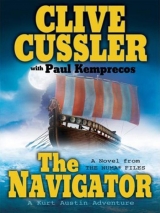
Текст книги "The Navigator"
Автор книги: Clive Cussler
Жанр:
Морские приключения
сообщить о нарушении
Текущая страница: 7 (всего у книги 27 страниц)
At the last instant, the ship’s bow moved slightly more to starboard. There was a tortured scraping of metal on metal as the side of the ship grazed the leg. The platform was free of its anchors, and, instead of resisting, which would have spelled its doom, the rig gave way to the force of the impact.
The oil platform rocked from the blow, then slowly stabilized and continued moving out of the danger zone.
A ship’s horn was blowing madly. The Leif Erikssonhad been keeping him company.
Zavala’s voice came over his earpiece.
“That’s one way to scrape the barnacles off your hull. What do you do for an encore?”
“That’s easy,” Austin said. “I’m going to make a dinner date with a beautiful woman.”
Chapter 13
THE ASSISTANT LIBRARIAN IN the archives division of the American Philosophical Society in Philadelphia was a slightly built young woman named Angela Worth. Day after day spent hoisting cases filled with documents and files had given her strength that would have been the envy of a professional arm wrestler.
With little apparent effort Angela slid a heavy plastic container off a shelf and placed it on a cart. She wheeled the cart out of the manuscript vault into a reading room. A man in his midthirties sat at a long library table, his fingers tapping at a laptop computer. The table was piled high with files, papers, and documents.
She set the file box on the table. “Bet you didn’t know there was so much historical material about artichokes.”
“Fine with me,” said the man, a writer whose name was Norman Stocker. “My contract calls for a fifty-thousand-word manuscript.”
“I don’t know much about the publishing business, but would anyone want to read that much about artichokes?”
“My editorthinks so. These single-subject historical books on everyday things are a trend in the publishing biz. Cod. Salt. Tomatoes. Mushrooms. You name it. The trick is to show how your given subject changed the world and saved mankind. You’ve got it made if you can mix in some sex.”
“Sexy artichokes?”
Stocker opened a file folder containing copies of old manuscripts. “Sixteenth-century Europe. Only men are allowed to eat artichokes, which are considered to enhance sexual power.” He opened another folder and slipped out a photograph of a pretty young blond woman wearing a bathing suit. “Marilyn Monroe. 1947. California’s first Artichoke Queen.”
Angela lifted the box off the cart and deposited it on the table. She blew a strand of long blond hair off her face. “Can’t wait to see Artichoke: The Movie.”
“I’ll get you a ticket to the Hollywood premiere.”
Angela smiled and told Stocker to let her know when he wanted to get rid of the files. Stocker opened the box and dug into the contents.
Writing books on commodities wouldn’t have been his first choice, but the pay wasn’t bad, the travel could be interesting, and the books gave him visibility. As long as he wrote, he didn’t have to teach to pay his bills. He rationalized that as a subject, artichokes were better than kumquats.
Stocker had come to the American Philosophical Society to look for the type of obscure anecdotes that could spice up an otherwise dry topic. The Georgian-style building that housed the society’s library around the corner from Independence Hall in Philadelphia was one of the nation’s major repositories of manuscripts on many scientific disciplines from the 1500s to the present.
The organization had been founded in 1745 by an amateur scientist named Benjamin Franklin. Franklin and his friends wanted to make the United States independent in the fields of manufacturing, transportation, and agriculture. The society’s early members included doctors, lawyers, clergy, and artisans, as well as presidents Jefferson and Washington.
Stocker was riffling through the carton when his fingers touched a hard surface. He pulled out an envelope that contained a box bound in maroon-and-gold animal skin. Inside the box was a thick packet of crackly paper tied with a black ribbon that had been sealed at some point. The wax seal had since been broken. He untied the ribbon and peeled off the blank cover sheet to reveal words written in a tight longhand that identified the contents as a treatise on the cultivation of artichokes.
The material was an unexciting recitation of growing seasons, fertilizer and harvest times, with a few recipes scattered among the pages. One sheet of parchment was marked with Xs and wavy lines and several words of script in an unknown language. On the bottom of the packet was a thick cardboard sheet perforated with dozens of small rectangular holes.
The assistant librarian was passing by the writer’s table with a load of books. He waved her over.
“Find something of interest in that last box?” she said.
“I don’t know how interesting it is, but it’s certainly old.”
Angela examined the hidebound box, and then she went through the pages from top to bottom. The handwriting looked familiar. She went to the stacks and came back with a book on the American Revolution. She opened the volume to a photo of the Declaration of Independence and held one of the papers next to the page. The similarity of the flowing, tightly written script on both samples was remarkable.
“Notice anything?” Angela said.
“The handwriting is practically identical,” Stocker said.
“It shouldbe. Both these documents were written by the same person.”
“Jefferson? It can’tbe.”
“Why not? Jefferson was a gentleman farmer, a scientist, and a meticulous keeper of records. Look here, in the corner of the title page. Those tiny letters are TJ.”
“This is great! There isn’t much here that would interest the average reader, but the fact that a Jefferson document on artichokes ended up with all this other stuff is worth at least a couple of paragraphs.”
Angela wrinkled her brow. “It must have landed here by mistake.”
“How could someone misfile original Jeffersonian material?”
“The society has an incredible filing system. But we’ve got eight million manuscripts and more than three hundred thousand volumes and bound periodicals. My guess is that someone saw the title, didn’t notice who had written the treatise, and tossed it in with the other agricultural material.”
He handed over the diagram. “This was in the file. It looks like a garden that was laid out by a drunk.”
The assistant librarian glanced at the diagram, then picked up the perforated cardboard and held it to the light. An idea occurred to her. “Let me know when you’re through. I’ll want to make sure that it goes back in with the other Jefferson material.”
She returned to her desk. As she worked, she glanced impatiently from time to time at the writer’s table. It was near closing when he stood and stretched and slid the laptop into its bag. She hurried over.
“Sorry for the mess,” he said.
“Not a problem. I’ll take care of everything,” she said.
She waited for the other patrons to leave and took the Jefferson file over to her desk. Under the light of her desk lamp, she placed the cardboard on top of the first page of writing. Individual letters showed through the small rectangles.
Angela was a crossword buff and had read a number of books on codes and ciphers. She was sure that what she held in her hand was a cipher grille. The grille would be placed over a blank sheet of paper. The message would be written in the holes by letter. Innocent-looking sentences would be built around the letters. The person on the receiving end would place an identical grille over the message and the words would pop out.
She tried the grille on a number of pages, but all she got was gibberish. She suspected that there was another level of encryption that was far beyond her amateur skill to decipher. She turned her attention to the parchment with the wavy lines and Xs. She stared at the words accompanying the strange markings and then called up a lexicon site on her computer. She sometimes went to the research site as a cheat to find obscure words that were used in the crossword puzzles.
Angela typed the words from the parchment onto the site’s search function and hit the ENTER key. There was no immediate translation, but the site referred her to its ancient-language section. She requested a translation once more and this time the program responded with an answer that both startled and puzzled her.
She ran off a printout and copied it, along with the Jefferson material. Leaving the copies in her drawer, she gathered up the original files and walked down the hallway to her supervisor’s office.
Angela’s boss was a middle-aged professional named Helen Woolsey. She looked up from her desk and smiled when she saw her younger protégée.
“Working late?” she said.
“Not exactly. I came across something unusual and thought you might be interested.” She handed the packet over.
As the librarian examined the papers, Angela explained her theory about its authorship.
The librarian let out a low whistle. “It gives me a thrill just to touch something that Jefferson held in his hand. This is an incrediblefind.”
“I thinkit is,” Angela said. “I’m just guessing that Jefferson encoded a message in those papers. Jefferson was an accomplished cryptographer. Some of the systems he devised were used decades after he died.”
“Obviously, it was sensitive material he didn’t want made public.”
“There’s more,” Angela said. She handed over the printout from the language website.
The librarian studied the sheet for a moment. “Is this website reliable?” she said.
“I’ve always found it to be,” Angela said.
The librarian tapped the Jefferson packet with her long fingernail. “Does your writer friend know the significance of this material?”
“He knows the Jefferson connection,” Angela said. “But he thinks it’s what it seems to be, a manual on how to grow artichokes.”
The librarian shook her head. “This isn’t the first time Jefferson’s papers have gone astray. He lost some ethnological material having to do with the American Indians, and many of the documents he willed to various institutions simply vanished. Did you come up with even a suggestionof what’s in here?”
“Not a clue. This needs a code-breaking computer and a cryptologist who knows how to use it. I have a friend at the National Security Agency who may be able to help.”
“Wonderful,” the librarian said. “But before we contact him I’d better run this by the society’s board of directors. We’ll keep this discovery between the two of us for the time being. This could mean a lot to the society if it’s authentic, but we don’t want to be embarrassed if it turns out to be a fake.”
Angela agreed with the need for secrecy, but she suspected that her boss wanted the opportunity to take full credit if the material proved to be an historical blockbuster. The librarian wasn’t the only one who harbored ambitions. Angela didn’t want to be an assistant for the rest of her life.
She nodded in agreement. “I will do everything I can to honor Mr. Jefferson’s apparent wish for discretion.”
“Very good,” the librarian said. She opened a desk drawer, slid the file in, and shut the drawer. “This goes under lock and key until I can talk to the board. If this is a go, I’ll see you’re recognized for the find, of course.”
Of course. You’ll hog the limelight unless it’s a fraud, then you’ll blame me.
Angela’s smile disguised her seditious thoughts. She stood and said, “Thank you, Ms. Woolsey.”
The librarian smiled and went back to her papers. The discussion was over. As Angela said good night and closed the door behind her, the librarian opened the drawer and removed the Jefferson file. She consulted her address book for a phone number.
She felt a thrill of excitement as she punched out the number. It was the first time that she had used it. She had been given the number by a member of the board of directors, since deceased, who had recognized her cold ambition and asked if she would like to take over a job he was no longer able to handle because of his failing health. She would work for an eccentric individual with a fascination for certain subjects. She had only to keep her eyes and ears open for discussion of these topics, at which time she would be required to make a phone call.
The money arrangement was quite generous for virtually no work, and she had used it to furnish her apartment and buy a secondhand BMW. She was pleased to earn her pay at last. She was disappointed to hear a recorded voice which told her to leave a message. She gave the recorder a brief summary of the Jefferson findings and hung up. She experienced a moment of panic when she realized that the call may have ended her service to the unknown paymaster. But after a moment’s reflection, she concluded with a smile that the Jefferson file could start her off on a new and lucrative career as well.
She would not have been as sanguine had she known that her call could have far more lethal repercussions. Nor would she have been pleased to know that in another part of the American Philosophical Society building, her assistant sat at her desk making a phone call of her own.
Chapter 14
AUSTIN WAS HAVING HIS RIBS bandaged by a ship’s officer who doubled as a medical technician when the sick bay door opened and Captain Lange walked in with Carina on his arm.
“I found this young lady wandering about the ship,” Lange said to Austin, who was sitting on an examining table. “She tells me a knight in shining armor saved her life.”
“My armor has a few chinks in it,” Austin said. In addition to his creased rib, his face was bruised and knuckles were lacerated from the battering he’d suffered during his climb up the pilot’s ladder.
“I’m very sorry about your injuries,” Carina said.
Carina’s face was swollen where the crewman named Juan had punched her. Even with her lopsided jaw, Carina was a striking woman. She was long-legged and slender, and had a head-turning physical presence about her. Her cinnamon-and-cream complexion set off bright blue eyes under perfectly arched brows. Shoulder-length sable hair was tied back away from her face.
“Thanks,” Austin said, “it’s just a scratch. The bullet only grazed me. I’m more concerned about you.”
“You’re very kind. I put a cold compress on my face and that reduced the swelling. The inside of my mouth is a little raw, but my teeth are intact.”
“I’m greatly relieved. You’ll need your all teeth when we have dinner together.”
Carina displayed a crooked smile. “We haven’t even been properly introduced, Mr. Austin.”
Austin extended his hand. “Please call me Kurt, Miss Mechadi.”
“Very well, Kurt. Call me Carina. How did you know my name?”
“This gentleman, who is doing such a fine job patching me up, said that you were a passenger on the ship, and that you’re with the United Nations. Beyond those sketchy details, you are a mystery, Carina.”
“Not mysterious at all. I’m an investigator with UNESCO. My job is to track down stolen antiquities. If anyoneis a mystery, it is Kurt Austin. You’re the one who rose from the sea like a merman and saved the ship and the oil platform after you rescued me.”
“The captain deserves most of the credit. He steered the ship away from the rig. If I had been at the helm, we’d all be picking crude oil out of our front teeth.”
“Kurt is being far too modest,” Lange admonished. “He freed me and my crew. While I steered the ship, he fought off the hijackers and saved a piece from your cargo.”
Carina’s face lit up. “You saved the Navigator?”
Austin nodded. “There’s a large object wrapped in canvas sitting on the deck. Might be your statue.”
“I’ll have it moved immediately to a safe place,” Lange said. He called the bridge on his pocket radio and ordered his first mate to round up a work crew.
The mate said that a Coast Guard cutter was on its way and that the shipowners’ representatives were flying in. The captain excused himself and the medical technician went with him, after handing Austin some painkillers.
“I’m curious,” Austin said. “What’s so special about the Navigator?”
“That is what’s so odd,” Carina said with furrowed brow. “The statue is not terribly valuable and may even be a fake.”
“In that case, let’s talk about things we doknow about. Like our dinner date.”
“How could I forget your unexpected invitation, especially after your sudden appearance? But first tell me where on earth you came from.”
“Not on earth. On the sea.I was in the neighborhood lassoing icebergs.”
Carina glanced at Austin’s broad shoulders. She wouldn’t have been surprised if he wrestledicebergs. She assumed he was joking until he explained what he had been doing on the Leif Eriksson.
Carina had encountered scores of memorable men in the course of travels around the world, But Austin was truly unique. He had risked his life to save hundreds of people and property worth millions of dollars, fought off hijackers, even killing one of them to rescue her. Yet he was flirting like an impetuous schoolboy. Her eyes roamed over his hard, tanned body. From the looks of the pale scars marking his bronze skin, this wasn’t the first time he had put himself in danger and had paid a price for it.
Carina reached out to touch a circular scar on Austin’s prominent right bicep. She was about to ask if it were a gunshot wound, but, just then, the door opened and a slender, dark-complexioned man stepped into the sick bay.
Joe Zavala’s eyes widened in surprise, and then his lips turned up at the corners in his trademark half smile. He had heard that Austin was being treated for a wound. No one had told him about the lovely young woman who seemed to be caressing his friend’s arm.
“I stopped by to see how you were doing,” Zavala said. “From the looks of things, you’re doing pretty well.”
“Carina, this gentleman is Joe Zavala, my friend and colleague. We’re both with the National Underwater and Marine Agency. Joe piloted the boat that brought me over to the ship. Don’t be alarmed by his piratical looks. He’s quite harmless.”
“Nice to meet you, Carina.” Zavala gestured at Austin’s bandage. “Are you okay? You both look a little banged-up.”
“Yes, we’re quite the couple.” Carina said. She blushed at the implication in her comment and removed her hand from Austin’s arm.
Austin went to her rescue and brought the conversation back to himself. “I’m a little stiff around the ribs. Bad bruising, and scrapes in a few other places.”
“Nothing a shot or two of tequila wouldn’t help,” Zavala said.
“I can see you are in good hands,” Carina said. “If you don’t mind, I’ll go see how the crew is doing with my statue. Thanks again for all you have done.”
Zavala gazed at the door after it had closed behind Carina and let out a whooping laugh that was uncharacteristic of his usual quiet-spoken demeanor.
“Only Kurt Austin could find an angel like Miss Mechadi out here in the fogbound reaches of Iceberg Alley. And they call mea Romeo.”
Austin rolled his eyes. He slid off the table, pulled on a borrowed blue denim work shirt and buttoned up the front.
“Captain Dawe holding up okay?”
“He’s reached the end of his joke repertoire and has begun to recycle old ones.”
“Sorry about that, old pal.”
“He says he’ll stand by another day, but then he’s got to go chase Moby-Berg. So you’re not off the hook yet.”
“How’d you get aboard? Last I knew, the pilot’s ladder was cut.”
“They must have dug up a spare. You had a tough time climbing on board. What happened?”
“I’ll lay out the whole sordid tale over a cup of coffee.”
They headed for the mess hall, where they poured themselves steaming mugs of coffee and devoured a couple of tall pastrami sandwiches on pumpernickel. Starting with the close call boarding the Ocean Adventure,Austin gave Zavala a detailed account of his exploits on the containership.
“Someone went through a lot of expense and trouble to steal this statue,” Zavala said, after pursing his lips in a low whistle.
“Seems that way. It takes money to buy helicopters and organization to mount a hijacking at sea. Not to mention the connections needed to put a couple of moles on board to welcome the hijackers.”
“They could have simply stolen the statue and run for it,” Zavala said. “Why destroy the ship and the oil rig?”
“By getting rid of the ship, they eliminate evidence and witnesses. The oil rig was simply a means to an end. It has a certain clinical neatness about it. The sea claims all.”
Zavala slowly shook his head. “What kind of a mind would think up a bloodthirsty scheme like that?”
“A very cold and calculating one,” Austin said. “The choppers must have come from an ocean launchpad. We’re within helicopter range of land, but the coast is pretty rugged. I can’t see them flying any great distance with a heavy weight hanging at the end of a rope.”
“A water-launched attack on a moving target makes the most sense,” Zavala agreed.
“Which means we may be wasting time,” Austin said. “They could still be in the area.”
“Unfortunately, there’s no air support on this ship,” Zavala said.
Austin cocked his head in thought. “I remember Captain Dawe saying that a helicopter was due back on the rig. Let’s go see if it’s arrived.”
He chugged down a painkiller with a final swallow of coffee and led the way out of the mess hall. Captain Lange welcomed them on the bridge. Austin borrowed a pair of binoculars and pointed them at the oil rig. He could see a helicopter on the oil platform.
“This is quite a vantage point, “Austin said. “Did you see what direction the hijackers flew in from?”
“Unfortunately, no. It happened very fast.” Lange’s face flushed with anger at the recollection.
“What do you know about the two Filipino crewmen who were working with the hijackers?” Austin said.
“They were vetted through the usual hiring practices,” Lange said. “There was nothing in their records to indicate that they were pirates.”
“It’s possible that the men who shipped on board weren’t the real owners of the papers,” Zavala said.
“What do you mean?”
“They either stole the papers from the real crewmen or killed to get them,” Zavala said.
“In which case, we can add two more murders to this gang’s list of crimes.” Austin said.
The captain swore softly in German. “You know, sometimes when you’re up here, guiding this big ship across the ocean, you feel like King Neptune.” He shook his jowls. “Then something like this happens and you see how impotent you really are. I would much rather deal with the sea than with monsters of my own species.”
Austin knew from experience exactly what the captain was talking about, but they would have to postpone their philosophical discussion to another time. “I wondered if you would mind getting in touch with the oil platform operators,” he said. He told the captain what he and Zavala had in mind.
Lange got on the radio immediately. The rig operators were hesitant to send the helicopter over at first but changed their mind when Lange said the request was coming from the man who had saved the platform and its crew from destruction.
Twenty minutes later, the helicopter lifted off from the rig and flew the short distance to the containership. The chopper touched down on the wide foredeck. Austin and Zavala ran under the still-spinning rotors. The aircraft was airborne a moment later. They had barely adjusted their intercoms when the pilot said, “Where to, gents?”
The hijackers had a big head start, which meant that it was unlikely they would be anywhere near the ship. Austin asked the pilot, whose name was Riley, to head in any direction for five miles, then go into a low-altitude expanding spiral with the ship at its center.
Riley gave him a thumbs-up and flew the helicopter due west at about a hundred miles an hour.
“What are we looking for?” Riley said.
“Anything big enough to hold two choppers,” Austin replied.
Riley gave another thumbs-up. “I got ya.”
Several minutes later he put the helicopter into a banking turn and made the first circle. The fog had cleared and visibility was two to three miles. They saw a handful of fishing boats and big chunks of ice, including one which might have been Moby-Berg. The only large ship was a freighter. Its deck was too small to hold two copters and was obstructed by cranes that would have made takeoff and landing impossible.
Austin asked the pilot to make two more circles. On the second circuit, they saw a big vessel silhouetted against the ocean sheen.
“Ore carrier,” said Zavala from the backseat.
The helicopter dropped to an altitude of a few hundred feet and paced the black-hulled ship. Rectangular hatch covers that covered ore-storage holds were evenly spaced on the long deck between the tall crew house at one end and the high, raised bow at the other.
“What do you think?” Austin asked the pilot.
“Hell. It’d be easy to land a chopper on that deck,” Riley said. “It’s like an aircraft carrier.”
Zavala agreed. “If you wanted to hide something, there’d be plenty of room in those cargo holds.”
“Hafta modify a few things,” Riley said. “No big deal.”
Austin asked the pilot to check out the ship’s name.
The helicopter flew over the ship’s wake, offering a clear view of the big white letters on the transom: SEA KING
The ship was registered in Nicosia, Cyprus. There was a logo of what looked like a bull’s head next to the name.
Austin had seen enough. “Let’s head home.”
The chopper wheeled around and the vessel faded into the haze.
As the whup-whupof the rotors faded, a pair of pale round eyes watched from the bridge until the helicopter shrunk to the size of a mosquito. Adriano lowered the binoculars, a tight smile on his lips. The helicopter had come close enough to give him a clear view of the face in the cockpit window.
The hunter had become the hunted.
AS THE OIL PLATFORM helicopter approached the containership, a Coast Guard cutter could be seen anchored a short distance away. The pilot put the helicopter down on the deck of the containership. When Austin and Zavala stepped out of the aircraft, Captain Lange was waiting for them. He said the Coast Guard had sent over an investigatory team to start interviewing witnesses.
Austin was going on sheer nerve power. His brain was fried. His rib cage throbbed. The last thing he wanted to deal with was a tedious interrogation. A good night’s sleep would be preferable. He knew that the Coast Guard would bring a fresh perspective to the crazy events of the day, but he was just plain weary.
The Coast Guard lieutenant who conducted the investigation in the recreation room was businesslike and efficient. He drew statements from Austin and the others, and said he would work his way through the rest of the crew. Austin must have winced with pain more than once, because the lieutenant suggested that he should have his wound properly tended to in a hospital. The captain said the oil rig helicopter could run him back to the mainland in the morning.
Carina asked if she could go with him. She said she wanted to attend a reception in Washington the next evening and wouldn’t worry about her cargo with the Coast Guard cutter escorting the ship. Zavala wanted to get back to prepare for his trip to Istanbul. Austin called Captain Dawe and said they would have to take a rain check on the hunt for Moby-Berg.
“I’m disappointed,” Dawe said. “I’ll have some new jokes when you come back.”
“I can’t wait.” Austin said.