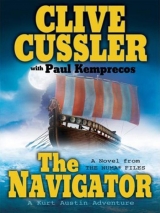
Текст книги "The Navigator"
Автор книги: Clive Cussler
Жанр:
Морские приключения
сообщить о нарушении
Текущая страница: 2 (всего у книги 27 страниц)
All was quiet. The cries of pain and agony and the clash of weapons had faded. There was only the soft ripple of water along the riverbank, which was littered with the dead. He went from body to body, ignoring gold ornaments in favor of more-useful items.
He was bending over to pick up more booty when he heard a pitiful meow. The soggy mass of yellowish orange fur had its claws dug into a charred board. The hunter had never seen a cat before, and, for a moment, he considered killing it. But he relented and instead wrapped the animal in a soft leather cloth.
When he could carry no more, he stole away, leaving only his footprints in the sand.
THE WHITE HOUSE, 1809
THE EXECUTIVE MANSION ON Pennsylvania Avenuewas dark except for the study, where a crackling fire in the hearth kept the winter chill at bay. The flickering yellow firelight bathed the high-nosed profile of the man who sat at a desk, humming as he worked.
Thomas Jefferson glanced at the wall clock with the bright blue-gray eyes whose intensity often startled those who met him for the first time. It was two in the morning; he usually retired at ten. He had been working in the study since six o’clock in the evening, having risen at dawn.
The president had taken his afternoon ride around Washington on his favorite horse, Eagle, and still wore his riding clothes: a comfortable, worn brown jacket, red waistcoat, corduroy pants, and woolen socks. He had exchanged his riding boots for the slippers without heels that had shocked foreign envoys who’d expected more-regal footwear gracing the presidential feet.
The president’s long arm reached out to a cabinet. The doors flew open at the touch of his finger, a feature that appealed to Jefferson’s love of gadgetry. Stacked neatly inside the cabinet were a cut-glass goblet, a decanter filled with French red wine, a plate of cakes, and a night candle used to navigate the corridors back to his bedroom. He poured half a glass of wine, held it dreamily to the light, and took a sip that brought back fond memories of Paris.
Tomorrow could not come too soon. Within hours, the onerous burden of office would be shifted to the narrow but capable shoulders of his friend James Madison.
He savored another sip and returned to the papers spread out on his desk. Written in the same flowing hand that had penned the Declaration of Independence were specimens, arranged in columns, of more than fifty Indian vocabularies collected over a thirty-year period.
Jefferson had long been obsessed with the question of how the Indians came to North America and had spent years compiling lists of words commonly used in Indian languages and dialects. His theory was that similarities between words from the Old and New World might offer a clue to the Indians’ origin.
Jefferson had shamelessly exercised his presidential power in pursuit of his obsession. He had once invited five Cherokee chiefs to a White House reception and quizzed them about their language. He had instructed Meriwether Lewis to collect vocabularies from the Indians the explorer encountered on his historic journey to the Pacific Ocean.
The book Jefferson planned to write on the origins of the Indian would be the culmination of his intellectual career. The tumultuous events of his second term had temporarily stalled the project, and he had put off sending the lists to the printer until he could write digests of the reams of new material Lewis and Clark had brought back from their trek.
Vowing to tend to the task as soon as he was back at Monticello, he stacked the papers into a neat pile, tied it with string, and placed it with the other vocabularies and stationery in a sturdy trunk. It would be transported with his belongings to the James River and loaded onto a boat that would take his baggage to Monticello. He placed the last packet of documents in the trunk and snapped the cover shut.
His desk was clear now except for a pewter box that had his name embossed on the lid. The president opened the box and removed a rectangular piece of vellum about ten by twelve inches in size. He held the soft animal hide close to an oil lamp. The pebbled surface was covered with strange writing, wavy lines, and Xs. One edge was ragged.
He had acquired the vellum in 1791. He and his Virginia neighbor “Jemmy” Madison had ridden on horseback to Long Island, New York, to meet some impoverished remnants of the Unkechaug tribe. Jefferson had hoped to find someone who knew the ancient languages of the Algonquin tribe, and, in fact, three elderly women could still speak the old language. Jefferson had compiled a glossary from them that he hoped would help prove his thesis about the European origin of the Indians.
The chief of the tribe had presented Jefferson with the vellum, saying it had been passed down from generation to generation. Touched by the gesture, Jefferson had asked a rich landowner and fellow signer of the Declaration to provide for the Indians.
Looking at the vellum now, an idea occurred to him. He took it over to a table, where a horizontal wooden easel had two pens suspended from a framework that allowed them to move simultaneously. Jefferson regularly used this copying machine, known as a polygraph, for his voluminous correspondence.
He copied the vellum markings and added notes asking the recipient to identify the language in which the words were written. Then he addressed and sealed the envelopes and placed them in a basket for outgoing mail.
The Unkechaug word lists were packed with the other papers in the trunk. Jefferson wanted to keep the vellum close, and he placed it back in the box. He would carry the box in his saddlebags on the ride to Monticello. He glanced at the wall clock again, drained his wineglass, and rose from his chair.
At the age of sixty-five, Jefferson hadn’t an ounce of surplus flesh on his farmer’s body. His thick hair was going from reddish blond to sandy gray as he aged. With his square-shouldered, musket-barrel posture and six-foot-two-inch height, he would always be an imposing figure. Inflammatory arthritis was making inroads, but, after he worked the stiffness out of his limbs, his movements were flexible and easy, and he moved with the grace of a younger man.
He lit his night candle and made his way along the silent White House corridors to his bedroom.
Up at dawn, he rode to the new president’s inauguration with his usual lack of pomp and ceremony. With a touch of his hat, he simply galloped past the waiting cavalry escort, dismounted near the Capitol, and hitched his horse to a picket fence. He sat with the public during the inauguration. Later, he paid a farewell visit at the White House. At the inaugural ball he danced with Dolley Madison.
The next day he finished packing, making certain in particular that the trunk with his Indian material was on the wagon that would take it to the James River. Setting off on horseback for Monticello, he rode eight hours through a driving snowstorm in his eagerness to resume life as a country gentleman.
The watcher stood in the shadow of a snow-covered oak tree near the edge of the James River, where several cargo boats were tied up for the night. Raucous laughter emanated from a nearby tavern. The voices were growing louder, and he judged from personal experience that the boat crews had reached the last stage before drinking themselves senseless.
He emerged from the protection of darkness and made his way over the snow-covered ground to a boat that was outlined faintly in the flickering light of its stern lantern. The fifty-foot-long bateau was a narrow, flat-bottomed craft designed to move tobacco along the river.
He stood on shore and called out, receiving no answer. Enticed by the prospects of drink, a warm fire, and female company, the captain had gone ashore with the two pole men who worked the riverboat. Crime was practically unknown in this remote part of the river, and none of the boats felt the need to leave crew aboard on this cold night.
The watcher padded up the ramp and used the lamp hanging from the stern to light his way as he ducked under an arched awning covering the central part of the deck. The awning sheltered more than two dozen bundles stenciled with the initials TJ . He set the light down and began to go through the baggage and boxes.
He pried a trunk open with a knife and pulled out a handful of the papers neatly packed inside. As he’d been instructed, he stuffed the papers into a large sack and threw a handful onto the riverbank. He tossed more papers into the river, where they drifted out of sight on the swift currents.
The man grinned at his accomplishment. With a quick glance toward the noisy tavern, he crept silently down the gangway onto the riverbank and melted like a ghost into the darkness.
SOON AFTER, Jefferson was returning to Monticello with friends and saw his house slaves unloading boxes from a wagon drawn close to the mansion’s columned entrance. As he rode closer, he recognized a stocky, bearded figure as the captain of the James River boat carrying his baggage from Washington.
He dismounted and strode to the wagon, but, in his excitement at seeing his baggage arrive, he didn’t notice the boatman’s stricken expression. He rapped his knuckles on the side of the wagon. “Good work, Captain. All arrived safe and sound, I see.”
The captain’s round face crumpled like an overripe pumpkin. “Not all, I’m sorry to say, sir,” he mumbled.
“What do you mean?”
The captain seemed to shrink into himself. Jefferson towered over the riverman by several inches and would have been a formidable figure even if he hadn’t been the former president of the United States. He seemed to bore holes right through the hapless captain with eyes almost luminous in their intensity.
As the riverman told his story, he wrung his hat so tight it was a wonder that he didn’t tear it into pieces.
Jefferson’s trunk had been vandalized on the last leg of the boat’s journey while ascending the river above Richmond. The thief had boarded the boat while it was tied up and the crew was sleeping on shore, the captain said. A trunk had been emptied. The captain handed Jefferson some mud-smeared papers, explaining that they had been found on the riverbank.
Jefferson stared at the wet wad in his hand.
Barely able to get the words out, he said, “Nothing else stolen?”
“No, sir.” The captain brightened at the opportunity to point out the silver lining. “Only the one trunk.”
Only the one trunk.
The words echoed in Jefferson’s ears as if they were being spoken in a cave.
“Tell me where you found this,” he demanded.
Moments later, Jefferson and his friends galloped off, and rode until they came to the river, then fanned out along both sides. After an intensive search, they fished out some papers that had floated ashore. Except for a few sheets, the mud-caked specimens of Indian vocabularies were water-damaged beyond use.
Later that summer, a petty thief and drunk was arrested and charged with the crime. The man claimed he had been hired by a stranger to steal the papers and pretend they were destroyed.
Jefferson was glad the culprit had been caught and might be hanged. He took no interest in the man’s fate. The scoundrel had caused him an irreparable loss. Jefferson had more pressing problems, such as tending his long-neglected fields and trying to figure out how to pay his mounting debts.
That was all changed months later when a letter arrived in the mail.
Jefferson had received several replies from the notes he had mailed from the White House to members of the Philosophical Society. All expressed their puzzlement at the word lists Jefferson had transcribed from the vellum. Except for one.
Professor Holmberg was a linguist at OxfordUniversity. He apologized for not answering Jefferson sooner but he had been traveling in North Africa. He knew exactly what language the words were written in and enclosed translations.
Jefferson’s eyes widened as he read Holmberg’s findings. With the letter in hand, he roamed his library and plucked volume after volume from his bookshelves. History. Language. Religion.
He spent the next several hours reading and making notes. When he had pushed away the last book, he sat back in his chair, tented his fingers, and stared into space. After a moment lost in thought, Jefferson silently mouthed a familar name.
Meriwether Lewis.
FATE HAD NOT dealt kindly with the man who had led the expedition that opened the floodgates of the American West to United States expansion.
Lewis was a man of extraordinary talents. Jefferson had been aware of his fellow Virginian’s qualities when he’d asked Lewis to lead the exploratory expedition to the PacificCoast in 1803.
Educated, intrepid, versed in the sciences, tough physically, Lewis was an outdoorsman familiar with Indian customs, and possessed of a sterling character. He’d been a well-respected army captain before he had come to work for Jefferson in the White House, where he added diplomacy, statesmanship, and politics to his quiver of talents.
The expedition had been successful beyond belief. After Lewis returned to Washington in 1806 with William Clark, the expedition’s coleader, Jefferson appointed him as governor of the LouisianaTerritory.
Lewis had reason to wonder, however, whether the appointment was a reward or a punishment. Even with all his talents and energy, Lewis had a hard time trying to tame the wild frontier. The explorer’s political enemies were relentless.
One night, after Lewis had spent another wearying day dealing with charges that he’d spent government money on a fur company in which he had an interest, he saw a sealed packet on his desk and immediately recognized Jefferson’s handwriting. Lewis had a smile on his hawk-nosed face as he slid a knife blade under the seal and carefully unwrapped the stiff paper that enclosed a stack of documents. The note inside said:
My Dear Mr. Lewis. Your gardens might benefit from the information contained within. TJ
The next page was entitled “The Cultivation of Artichokes.” The pages contained a detailed treatise, complete with planting tables and a garden diagram.
He spread the contents of the packet on his desktop, his brow wrinkled in puzzlement. Lewis knew of Jefferson’s interest in gardening, but it seemed strange that he would take the trouble to send information on artichoke cultivation halfway across the continent. He must have known that Lewis’s crushing responsibilities left no time for gardening.
Then the light of comprehension dawned on Lewis’s long face and his pulse quickened. He pawed through the shelves of a cabinet where he had stored the reports from the Lewis and Clark expedition and found what he was looking for within minutes.
Sandwiched between two bundles of documents was a sheet of heavy paper, which he extracted and held up to the light. The sheet was perforated with dozens of small rectangular holes, and, with trembling fingers, he placed the matrix over the first written page in the artichoke file and copied the letters that showed through the holes onto a separate sheet of paper.
When Jefferson had conceived the idea for the Pacific expedition, he knew that Lewis would be in a diplomatically sensitive position exploring territory held by France and Spain. Behind Jefferson’s sphinxlike imperturbability was a mind as devious as any to be found in the courts and palaces of Europe. In corresponding with his minister to France, he had often used a cipher, which he described as “a mask when we need it.”
While Lewis was in Philadelphia preparing for his journey with leading scientists from the Philosophical Society, Jefferson sent him a cipher he had worked up for the expedition. He based the encryption method on the Vigenere cipher widely used in Europe. The system involved an alphanumeric table and was unlocked with a key word.
Artichokes.
It had not been necessary to use the cipher during the expedition, which was why Lewis had been baffled at seeing it utilized. Casting questions aside now, he attacked the enciphered message with the enthusiasm he brought to all challenges. As he deciphered each letter from the gibberish, the words began to form before his eyes.
Dear Mr. Lewis: I hope this missive finds you well. I have taken the liberty of submitting this report to you in the enciphered form upon which we had agreed, with the goal that it should be for your eyes only, and for your sole disposition. I fear that the information enclosed, whether true or not, would excite certain passions, cause men to go into territory where they were ill-prepared to survive, and create problems with the Indians. I understood that you are fully engaged in the formidable task of placing a harness on the Louisiana stallion, but plead your assistance in resolving this matter.
Y’r ob’d’nt s’v’nt, TJ
Lewis deciphered the balance of the encrypted message. Then he went back to the garden diagram. The lines, Xs, circles, and words penned in an ancient language began to make sense of sorts. He was looking at a map—and something about it struck him as familiar. He pawed through dozens of his charts and documents and found what he was looking for.
Taking up pen and paper, he wrote a brief note. He thanked Jefferson for his gardening advice, and said he had located an ideal spot for his crop to flourish, then he told Jefferson that he would discuss gardening when he came to Washington to clear his name. Lewis planned to start down the Mississippi River early in September 1809. He would let Jefferson know when he had arrived in Washington.
It was not to be. Late that fall, Jefferson received a note from a Major Neelly saying that Lewis had died of gunshot wounds on the Natchez Trace wilderness road. He was only thirty-five.
The loss of the talented young man was incomprehensible to Jefferson. It almost seemed as if an ancient curse hovered over the Indian vocabularies. Several weeks later, Major Neelly arrived at Monticello with Lewis’s young slave. While Neelly was cleaning up from his ride, the slave timidly handed Jefferson a packet and whispered a message.
Instructing his staff that he not be disturbed, Jefferson locked himself in his study and studied the packet’s contents. Then he compiled a thorough written analysis of the events leading to Lewis’s death. The dawn’s light was streaming through the windows as he summed up the synopsis in a single underlined word.
Conspiracy.
What if his Indian word lists had been stolen,as the thief had claimed? What if someone knew that Jefferson’s research held the key to an age-old secret? What if the death of Lewis were not a suicide but murder?
Jefferson spent several more days working in his study. When he emerged, brandishing a list of instructions for his staff, he seemed like a man possessed. One night, under cover of darkness, he rode off on his horse, followed in a wagon by his most trusted slaves. Weeks later, they returned, looking tired and disheveled, but there was a glint of triumph in Jefferson’s eye.
He considered the implications of his discovery. He had done everything in his power to keep the United States from being contaminated by the deadly alliance of church and state that had spawned the religious wars which had raged on the continent. He feared that if this information were made public it could shake the foundations of the young country and even destroy the fledgling republic he had helped create.
Without pausing to clean up or change, Jefferson plunged into his study and penned a long letter to his old friend and sometimes nemesis, John Adams. As he sealed the envelope, a smile crossed his weary face.
He could play at the conspiracy game as well as anyone.
Chapter 1
BAGHDAD, IRAQ, 2003
CARINA MECHADI WAS INCANDESCENT with rage. The young Italian woman threw off sparks like a Roman candle as she surveyed the rubble that littered the administrative offices of the IraqiNationalMuseum. Cabinets had been overturned. Files were scattered as if they’d been caught up in a whirlwind. Desks and chairs had been smashed to splinters. The vindictiveness of the destruction was appalling.
Carina unleashed a withering outburst that dissected the parentage, sexual orientation, and prowess of the vandals who had wreaked such senseless havoc.
The wave of blue language washed over the young U.S. Marine corporal who had been hovering protectively nearby cradling an M4 carbine in his arms. The only two Italian words the marine knew were pepperoniand pizza.He didn’t need a lexicon to tell him that he’d witnessed a display of razor-edged invective worthy of a longshoreman with a sore back.
The muscular language was all the more amazing considering its source. Carina was a foot shorter than the marine. The battle gear the military people had insisted she wear made the slender woman appear even smaller. She looked like a turtle too small for its shell in the borrowed flak jacket. The desert-camouflage uniform was meant for a small man. The helmet that concealed her long sable hair sat so low it almost hid her cornflower blue eyes.
Carina noticed the marine’s astonished grin. She blushed with embarrassment and brought her tirade to a halt. “Sorry about that.”
“No problem, ma’am,” the corporal said. “You ever want to be a drill instructor, the Marine Corps would be glad to have you.”
The heat faded from her dusky face. Full lips that seemed better suited for seduction than for swearing widened in a broad smile that revealed perfect white teeth. With the fire in her words extinguished, her voice was low and cool. Speaking with a slight accent, she said, “Thank you for the offer, Corporal O’Leary.” She glanced at the rubble at her feet. “As you can see, I’m quite passionate when it comes to this sort of thing.”
“Don’t blame you for being pissed—” The marine’s cheeks flushed and he glanced away. “Excuse me, I mean for being mad,ma’am. Hell of a mess.”
Saddam Hussein’s elite Republican Guard had set up a defensive position in the eleven-acre museum complex in the heart of Baghdad on the western bank of the Tigris. The Iraqi troops had run for their lives in the face of the American advance, leaving the museum unguarded for thirty-six hours. Hundreds of plunderers had rampaged through the complex until they were chased out by the senior staff.
The Republican Guards had shed their uniforms and burned piles of identity cards in their hurry to return to civilian life. In a last gasp of defiance, someone had scrawled DEATH TO ALL AMERICANS on a courtyard wall.
“We’ve seen all we need to see here,” Carina said with a grimace.
With Corporal O’Leary trailing a few paces behind, she plodded out of the administrative offices. Her leaden-footed gait was only partly the fault of the army boots on her feet. She was weighed down by a feeling of dread at what she would find, or notfind, in the public gallery, where the museum’s prize holdings were exhibited in more than five hundred display cases.
The walk down the long central corridor only served to heighten her fears. A number of sarcophagi had been cracked open and statues decapitated.
Carina set foot in the first gallery and the air involuntarily escaped from her lungs. She wandered from room to room as if in a daze. Every case looked as if it had been vacuumed clean.
She entered a gallery that had held Babylonian artifacts. A portly, middle-aged man was bent over a smashed cabinet. Standing next to him was a young Iraqi, who raised his AK-47 when they entered.
The marine brought the carbine to his shoulder.
The heavyset man looked up and stared through thick lenses at the marine. There was disdain rather than fear in his eyes. His glance shifted to Carina and his face lit up in a fourteen-karat smile.
“My dear Miss Mechadi,” he said with undisguised warmth.
“Hello, Dr. Nasir. Glad to see that you’re all right.” Carina turned to the marine. “Corporal, this is Mohammed Jassim Nasir. He’s senior curator here at the museum.”
The marine lowered his weapon. After a pause to show that he had not been intimidated by the American, the Iraqi did the same with his gun. They continued to eye each other warily.
Nasir came over to clasp Carina’s hands in his. “You shouldn’t have come so soon. It is still dangerous.”
“ Youare here, professor.”
“Of course. This institution has been my lifeblood.”
“I understand completely,” Carina said. “But the area around the museum is secure.” She nodded toward her marine escort. “Besides, Corporal O’Leary is keeping close watch on me.”
Nasir’s brow clouded over. “I hope this gentlemanis a better guard than his friends were. If not for my brave colleagues the disaster would have been total.”
Carina understood Nasir’s anger. The American troops arrived four days after the museum’s curators had told the commanders about the looting. Carina had tried desperately to have them move in sooner. She had waved the UNESCO identification card hanging around her neck under the noses of the American officers only to be told that the situation was too fluid and dangerous.
Carina saw no use arguing over who was to blame. The damage had already been done. “I’ve talked to the Americans,” she said. “They said there would have been a bloody battle if they came in earlier.”
Nasir shot a drop-dead glance in the marine’s direction. “I understand. They were too busy guarding the oil wells.” The unsympathetic expression on his nut-brown face suggested that he would have preferred bloodshed to looting.
“I’m as sickened as you are,” she said. “This is terrible.”
“Well, it’s not as bad as it seems here,” Nasir said with unexpected optimism. “The artifacts taken from this case were minor items. Fortunately, the museum had put together a contingency plan after the 1991 invasion. The curators moved most of the artifacts to safe rooms known only to the five most senior museum officers.”
“That’s wonderful, Professor!”
Nasir’s sunny mood was short-lived. He tugged fretfully at his beard. “I wish the rest of the news were as good,” he said with a doleful note in his voice. “Other parts of the museum did not fare as well. The thieves looted the greatest treasures of Mesopotamia. They took the sacred vase and the mask of Warka, the Bassetki statue, the ivory of the lioness attacking the Nubian, and the twin copper bulls.”
“Those objects are priceless!”
“Unlike the petty thieves we chased out of the museum, the people who removed the more-valuable antiquities were sophisticated. They bypassed the Black Obelisk, for instance.”
“They must have known that the original is in the Louvre.”
Nasir’s lips tightened in a grim smile. “They didn’t touch anycopies. They were very organized and selective. Come, I’ll show you.”
Nasir led the way to the aboveground storage rooms. The shelves lining the walls were empty. Dozens of jars, vessels, and shards littered the floor. Carina kicked away an army uniform.
“The Republican Guards spent time here as well,” she said. “Any idea of how much is missing?”
“It will take years to assess the loss. I’m estimating around three thousand or so pieces gone. I wish I could say that was the worst of it.”
They walked into a gallery that displayed Roman antiquities. The professor pushed aside a corner shelf to reveal a hidden door whose glass paneling had been smashed and steel grate bent back. He fumbled in his pocket for a candle and a cigarette lighter. They descended the narrow set of stairs to metal doors that were wide-open, with no sign of forced entry. A wall sealed the space beyond the door. The concrete bricks had been pried away to make a large opening.
They climbed through the opening into a hot and airless room. An acrid stench assaulted their nostrils. Footprints on the dusty floor had been cordoned off with yellow tape placed at the crime scene by a team of investigators.
Carina glanced around. “Where are we?”
“The basement storage area. There are five rooms down here. Few people in the museum even know this place exists. That’s why we thought the collection was safe. We were wrong, as you can see.”
He moved the candle in an arc. Its yellow light fell upon dozens of plastic fishing boxes thrown willy-nilly around the room.
“I’ve never seen such absolute chaos,” Carina whispered.
“The boxes held cylinder seals, beads, coins, glass bottles, amulets, and jewelry. Thousands of items are missing.” He brought the candle over to dozens of larger plastic boxes that lined the walls. “They didn’t bother with these. Apparently, they knew they were empty.”
Corporal O’Leary surveyed the wreckage with a street fighter’s eye for entrances and exits. “If you don’t mind my asking sir, how’d they know how to find this place?”
Nasir’s heavy features drooped and he gave a glum nod of his head. “You Americans aren’t the only ones who have reason to be embarrassed. We suspect someone on our staff with intimate knowledge of the museum alerted the thieves to this room. We have fingerprinted our staff, except for the head of security, who has not come back to reclaim his job.”
“I was wondering why I didn’t see any evidence of the door being forced,” Carina said.
“The thieves came into the basement the same way we did, but they had forgotten torches or never expected they would need them.” He picked up a piece of burned rubber foam. “They used this material from upstairs for torchlight. The stuff burns quickly and the fumes would have been terrible. We found a set of keys on the floor. They probably dropped the keys and couldn’t find them. They missed thirty cabinets with our best cylinder seals and tens of thousands of gold and silver coins. I’d guess about ten thousand excavated artifacts are missing. Hundreds of boxes were left intact, praise Allah.”
They filed through a doorway into a larger space filled with antiquities of every size and shape. “These are objects that were given a preliminary identification and were to be absorbed into the main collection as work allowed. Some have been stored here for years.”
“The footprints lead in here,” Carina said.