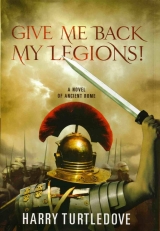
Текст книги "Give me back my Legions!"
Автор книги: Harry Norman Turtledove
Жанр:
История
сообщить о нарушении
Текущая страница: 9 (всего у книги 21 страниц)
“Yes. Indeed.” Varus’ mouth got tighter yet. A clever slave could get back at his master, as the Greek had just proved. Augustal prefect of Egypt was the most important administrative post in the Empire – after the one Augustus held himself, of course. It was also the post Varus had craved after governing Syria. And it was the post his wife’s great-uncle had chosen not to give him.
“I have to do the best I can where Augustus decided to send me,” Varus said. “The decision was his.” Everything in the Empire was Augustus’ to give or to withhold as he saw fit. That was what winning all those civil wars meant. Oh, he’d built up a fine Republican facade to operate behind, but it was a facade, as anyone with eyes to see knew.
Aristocles sighed. “If only the Pannonians hadn’t rebelled . . .”
“If, if, if,” Varus said, not because the pedisequuswas wrong but because he was right. If Tiberius weren’t putting down the rising within the Empire’s borders, he would hold this post now. And if stern, unsmiling Tiberius were whipping the Germans into line, Augustus might well have sent Varus to Egypt.
Had Augustus sent Varus there, Aristocles would have gone along. The Greek sighed again, this time on a more resigned note. “Oh, well. What can you do, eh, your Excellency?”
That question looked for the answer, Not a thing.But Varus surprised his slave: “If I’m to make this a Roman province, I willmake it a Roman province. The better the notion the natives have of what’s expected of them, the better Roman subjects they’ll make.”
“Er – yes.” Aristocles blinked. No, he hadn’t been looking for that or anything like that. “May your efforts be crowned with success.”
“I hope they will. I think they will. Centuries from now, I hope this will be as much Roman land as, say, Spain or Cisalpine Gaul. We’ll need hard work to make that happen, but I don’t believe any Roman here fears hard work,” Varus said.
Plenty of legionaries worked no harder than they had to. Varus took that for granted; legionaries were men like any others, but he also took for granted that their superiors would keep them working hard enough to do what needed doing. What else were officers for?
In his mind’s eye, Varus saw towns growing out of legionary encampments in Germany, as they’d done so many other places in the Empire. He saw gleaming marble temples to Rome’s gods – and to Germany’s, for, Druids and Jews aside, the Romans didn’t meddle with religion. He saw bathhouses and colonnaded market squares where citizens in togas talked over the latest news. He saw amphitheaters for chariot races and gladiatorial games and beast shows. He saw theaters where the locals could watch Plautus and Terence and mime shows. He saw schools and shoemakers, millers and scribes.
It could happen. It would happen, once the Germans got used to the idea of being part of something larger than themselves. What would stop it then? Nothing he could see.
True, the Germans still nailed the heads of men they’d slain to trees, as an offering to the spirits inside. But the Gauls had done the same thing till Caesar conquered them. For that matter, the untamed tribes in Britannia and Hibernia still did. The ones within the Empire’s borders were surprisingly civilized these days.
The Germans could be, too. All they needed was a firm hand and a little time.
VIII
Arminius had found himself another forest-screened vantage point from which to watch the Romans encroach on Germany. This one didn’t lie hard by the Rhine – the border between Germany and Gaul since Caesar checked the Germans’ westward wandering. This one was in the heart of his own folk’s fatherland. Now that spring had returned, so had the storks, rebuilding their old nests in dead trees. And so had the Romans, rebuilding their old encampment at Mindenum.
This time, Sigimerus had come with Arminius for a firsthand look at the men who aimed to despoil the Germans of their freedom. What Arminius’ father saw impressed him – against his will, but it did. Arminius understood that grudging respect; it was a large part of what he felt about the Romans, too.
“They work hard, don’t they?” Sigimerus said. “And they work fast.”
“So they do, both,” Arminius agreed.
His father scowled. “If you go behind a tree to ease yourself and them come back to watch them again, the palisade will have grown some while you were pissing.”
“They wouldn’t be so dangerous if they didn’t have a good notion of what they were doing,” Arminius said. “They’ve conquered many other folk. They know how to go about it. If they don’t make any mistakes, I fear they’ll win here, too. They’re winning in Pannonia, no matter how-strong and how stubborn the rebels are there.”
“And you helped them.” Sigimerus sounded reproachful.
“I did.” Arminius nodded. “One man more or less made no difference in how the war would have turned out.”
“A hero -” his father began.
“No.” Arminius cut him off, even if that was rude. “One of the things I learned is that heroes don’t matter much, not the way they fight. Their soldiers might as well be farmers or potters. Everyone has his particular job to do, and he does it, and their armies mostly win.”
“Not here, by the gods!” Sigimerus exclaimed. “We’ve taken plenty of Roman heads.”
“I know, Father,” Arminius said gently. “But they’ve won their share of fights, too. If they hadn’t, would they be running up this encampment again? It’s a long way from the Rhine to here.”
“Isn’t it, though?” Sigimerus sounded glum. Arminius couldn’t blame him. Roman matter-of-factness at work had a daunting quality to it. The Romans went about their business no matter what, as if convinced nothing could withstand them as long as they kept at it. No, not as if: they wereconvinced of that. Arminius’ hitch as an auxiliary had taught him as much, along with many other things.
Here, some Romans felled trees. Others trimmed them. Others hoisted them into position on the palisade. Others dug a trench around the ring of sharpened tree trunks. Others took the spoil from the diggers’ work and shaped it into a rampart. And still others stood to arms, ready to ward the laboring legionaries against surprise attack.
“How canwe stop them?” Sigimerus seemed gloomier still. “They’re like ants or bees, aren’t they? A big hive of Romans . . .” He ruefully shook his head.
“They can sting, all right,” Arminius said. “But you put your finger on it yourself – so can we. Somehow, we have to arrange it so we meet them on ground that gives us the edge. Then . . . we strike!”
“That sounds good, son. But a lot of things that sound good aren’t so easy to bring off,” Sigimerus said. “Just look at the swinehounds. They’re ready for anything. You can tell. They’d almost thank us for wading into them. It’d give them the chance to make us sorry we were ever born.”
“Too right. I remember an ambush in Pannonia. The Pannonians thought they were ambushing us while we made camp, but it turned out to work the other way around,” Arminius said. “Minucius – the military tribune who led us – picked a spot near some woods, so the enemy could gather there and think he was safe. But we figured they were in there, and we were out in the open, so we had plenty of room to deploy when they showed themselves. Oh, we made them pay!” He smiled at the memory – he’d fought well and his side had won, even if it was also the Romans’ side.
His father’s expression came closer to despair. “If they always take such pains, how will we ever beat them?”
“I said it before – they have to make a mistake,” Arminius answered. “They aren’t gods, Father. They’re men, and little men at that. They make mistakes all the time, just like us. We have to get them to make the kind of mistake that serves our need.”
“Yes, you said that before, too.” Sigimerus sounded like a man talking to a young, foolish son, trying to get him to see his foolishness. “What you haven’t told me is how you propose to do it.”
“I haven’t told you how because I don’t know.” Arminius sounded like the young, foolish son, admitting what he would sooner deny. “But there has to be a way.”
“Why?” Sigimerus asked relentlessly. “You want the Romans to be stupid, and you’ve just spent all this time explaining to me how clever they are. Clever people are clever because they mostly don’t do stupid things.”
“Mostly!” Arminius seized on the word like a drowning man grabbing hold of a log. “That doesn’t mean they’re perfect. They aren’t! No one is smart all the time.”
“No one is smart all the time,” his father agreed. But he wasn’t looking at the Romans as they built their fortress-camp right in the middle of Germany. No – he was looking straight at Arminius.
The younger man’s cheeks and ears might have caught fire. “We canbeat them,” Arminius insisted. “We have to beat them. If we let them go on the way they’re going, they willenslave us.” He stuck out his chin in defiance: of Sigimerus, of the Romans, of everything in the world that dared opposed his will. “Go ahead. Tell me I’m wrong.”
Sigimerus sighed. But this time he looked at the Roman soldiers chopping and sawing and hauling and digging and building. He sighed again. His face said a great many things, none of them happy. All he said, though, was, “If we try and we fail, Germany wears the chains of slavery forever.”
“She wears them if we don’t try, too,” Arminius answered. “She’s bound to wear them then. But if we fight and win, she’s free, free forever!”
His father looked at the Romans once more. This time, he said not a word.
Quinctilius Varus didn’t like to sit up when he dined, but even a chair with a back was a luxury in Mindenum. A couch – a whole set of couches – would have made these bluff, straightforward soldiers grumble. Varus knew that, no matter how little he cared for it. He also knew he had to get along with the officers. It was not only that they were the men who carried out his orders. If he didn’t stay on good terms with them, he had no one but his slaves to talk to. In this straitened place, that wasn’t enough.
Under the chief cook’s watchful and anxious eyes, two kitchen slaves – hulking Germans – carried a covered silver tray into the tent doing duty for a dining hall and set it on the table. One of them protected his hand with a big of rag as he grabbed the cover’s handle and pulled it off. Steam and savory smells filled the tent. Varus and the other diners exclaimed in delight. A couple of the soldiers even clapped their hands. What could you expect from such people?
Relief in his voice, the cook said, “Roast boar, your Excellencies, with forest mushrooms, on a bed of cabbage and turnips.”
“I’d never get bored with that,” Lucius Eggius called out.
For a moment, Varus heard it as a hungry man’s commonplace. Then he caught the pun. He sent Eggius a look half respectful, half reproachful. Was the wordplay just luck, or was there more to the officer than met the eye?
Varus decided he didn’t have to worry about it now. He was the highest-ranking man here, so he was entitled to feed himself first and take the choicest gobbet. He did, seizing a smoking chunk of pork generously outlined with dripping fat. His mouth watered.
It tasted as good as it looked and smelled. Varus could imagine no higher praise. Smiling, chewing, he nodded to the cook. That worthy bowed in delight.
Vala Numonius chose next. The cavalry commander’s right hand closed on a slice even bigger and fatter than Varus’. “Good,” Numonius said with his mouth full. “Wonderful!” The cook beamed.
One by one, in order of rank, the Roman officers fed themselves. “Begging your pardon, friends,” one of them said as he took food with his left hand.
“We know you, Sinistrus,” Varus said. The nickname told how thoroughly left-handed the legionary was. His right hand was as clumsy and useless as most people’s left – good only for wiping himself. Varus had known a few other men like that. They always apologized when they fed themselves with what was usually the wrong hand.
The mushrooms were different from the familiar Italian varieties, and also different from the ones Varus had eaten in Syria. Not better or worse, the governor judged, but different. One of the officers spoke to the cook: “You tried these out on beasts before you tried them on us, right?”
“Oh, yes, sir!” the cook said, so quickly that the legionaries laughed.
“Some good news, anyway.” Lucius Eggius’ voice was dry. The Roman officers laughed again. So did Quinctilius Varus. He liked mushrooms, but he also knew you could make mistakes with them. And a mistake with a mushroom was much too likely to be the last mistake you ever made.
Another officer raised a winecup. “Here’s to putting Germany under our thumb once and for all!”
Varus was glad to drink to that toast. The rest of the diners followed his lead. All the same, he heard somebody mutter, “What I’d really like is to put Germany behind me!”
He looked around, trying to make out who’d spoken. But he couldn’t. He didn’t recognize the voice, and no one’s face gave him away. Besides, how angry could he get? He would have liked nothing better than going back to Gaul, going back to Italy, going anywhere but here.
No matter what he would have liked, he had to stay. “By the gods, gentlemen, we will whip this province into shape!” he declared. “And if we have to resort to the lash, that’s what we’ll do. The Germans need to know who their rightful masters are.”
“Hear, hear!” Several officers loudly supported him. Others, though, sat quietly, as if trying to pretend they hadn’t heard what he said. Most of the ones who made a point of agreeing had come north with him the year before. Most of the ones who stayed quiet had been fighting the Germans longer than that.
Were the newcomers too hopeful? Am I too hopeful?Varus wondered. Or were the veterans of this frontier jaded and frustrated because things here hadn’t gone better? Quinctilius Varus decided it had to be the latter. The Germans had stayed pretty quiet even though he’d started accustoming them to taxation. Why wouldn’tthey turn into proper Roman subjects if he kept on traveling the road he’d begun?
And he was sure Augustus wouldn’t have sent him up here if the job weren’t doable. If anyone had ever had an instinct for such things, Augustus was the man. The veterans had made a hash of things, that was all, and so they built the Germans up to be bigger and fiercer and stubborner than they really were.
He’d made progress. He would make more. If Augustus thought he could do it, he did, too.
Sometimes the Germans would attack a Roman army without the slightest hesitation. Sometimes a couple of Roman soldiers could amble through the countryside and get nothing but friendly treatment. You never could tell.
Caldus Caelius and two or three buddies were ambling through the countryside now. The legionaries weren’t stupid about it. They’d told their friends back at Mindenum where they were going. If anything happened to them, the legionaries would make the barbarians pay.
And the Germans around Mindenum had figured that out. Knocking off a Roman soldier here was more expensive than it was worth. Caelius and his friends wore helmets, and swords on their belts – you didn’t want to beg the Germans to jump you – but he wasn’t what you’d call anxious.
Hard to worry about anything with spring burgeoning all around. New bright grass pushed up out of the ground. New shiny leaves were on all the trees that weren’t conifers – and in weather like this, mild and mostly sunny, you could ignore the gloomy needles on the pines and spruces. Flowers blazed across the meadows like stars in the night sky. The air smelled sweet and green.
Birds sang in the trees, throwing out music for anyone who walked by. “Germany wouldn’t be a bad place,” Caelius remarked, listening to a blackbird’s clear notes, “if it stayed this way the year around.”
He came from a farming village south of Neapolis, down near the toe of the boot. He knew the difference between summer and winter there: winter was the rainy season, and it did get cooler than the blazing summer heat. But it rarely snowed, and far fewer trees lost their leaves than they did here. Life down there had a more even pace. He missed it.
One of his friends peered into the woods. “Germany wouldn’t be a bad place,” the other legionary said, “if it didn’t have Germans in it.”
All the other Romans laughed. Caelius wondered why. “You’ve got that right, Sextus,” he said. “Only way to get rid of them is to kill ‘em all, though.”
“Don’t remind me,” Sextus said. “And how many of us would they bump off before we finished with ‘em?”
The sun ducked behind a cloud. Some of the brightness would have gone out of the day even if it hadn’t. “Too stinking many,” Caelius said. “They’re tough – no two ways about it.”
A rabbit bounded across the trail and disappeared into tall grass. Sextus pointed after it. “The barbarians hide just like that, the buggers.”
“There’s a difference,” Caelius said.
“What’s that?” His friend liked being contradicted no more than any other mortal.
“When rabbits hide, they don’t take along spears and swords and bows,” Caldus Caelius said.
Sextus grunted. “Well, so they don’t. And all kinds of things eat them. I wish something would eat up the Germans.”
A local, wrapped in his cloak, rounded a stand of trees up ahead. “Watch your mouths, boys,” Caelius said quietly. “Some of these bastards know Latin. We don’t want to be calling them dogs to their faces.”
“Why not?” another legionary demanded. “It’s what they are.”
“But the officers’ll have our guts for sandal straps if we start a fight for no reason,” Caelius said. The other soldier, a younger man – not that Caelius was very old – muttered under his breath but subsided. Caelius showed the German up ahead a raised, empty right hand.
Slowly, the native returned the gesture. Even more slowly, he came toward the Romans. He was tall and proud and skinny. His cloak had a bronze clasp in the shape of a beast. The creature’s eye was of stone, or perhaps glass paste. That said the German was a man of some substance, though probably not a chief. A real leader would have had a gold or silver clasp for his cloak, and would have worn breeks under it, too. This fellow’s hairy shanks stuck out below the bottom of his cloak. His spear was made for thrusting; it was longer and stouter than the javelins Caelius and his friends used.
“We have no quarrel with you,” Caelius said in Latin. Then he said what he hoped was the same thing, using his scraps of the Germans’ language.
“No? Then go back where you came from.” The barbarian’s Latin wasn’t much better than Caelius’ command of his language. He looked at his spear. He looked at the Romans. Several of them and one of him. If he started a fight, he’d regret it – but not for long. And he’d never do anything else that stupid afterwards. With a sigh, he nodded. “I have no quarrel with you – now.”
Caldus Caelius gave his pal a look that said, See? He might have understood you after all.The one the other Roman returned said something like, Yes, Mother.They grinned at each other. Caelius gave his attention back to the German. “There’s a little village down this path, isn’t there?” he said.
“Why you want to know?” From the anger and alarm in the native’s voice, he was wondering whether the legionaries aim to burn the place first and then rape the women or the other way round.
“I thought maybe we’d buy some of that, uh, beer you people brew,” Caelius answered. He liked wine better – what Roman in his right mind wouldn’t? By all the signs, the Germans liked wine better, too, when they could get it. But all the wine that came to Mindenum started from Vetera. There was usually enough to give each legionary his fair share, but not enough to get drunk on. And so ... Beer would do.
“Ach”the German said: a deep, guttural noise. He nodded again, visibly relaxing. “Yes, there is a village. Yes, there is beer.”
“Good. That’s good.” Caldus Caelius turned to the other Romans. “Come on, boys.”
They sidled past the German. Both they and he stepped out of the path while they did it, so neither side admitted to giving way to the other. Caelius had done that dance of pride before. If you respected a German’s manhood, he wouldn’t feel he had to prove it to you.
Most of the time, anyway.
Caelius looked back over his shoulder once, to make sure the barbarian wasn’t trying to get cute. The German was looking back at the Romans. Their eyes met – locked. Slowly and deliberately, Caelius nodded. So did the German. They both looked away.
“Trouble?” Sextus asked.
“Nah,” Caelius said after a moment’s pause for thought. “Not now, anyhow. He was just . . . checking, you know? Same as me.”
Sextus nodded. “Sure. My neck’s on a swivel every time we leave the encampment.”
“You aren’t the only one,” Caldus Caelius assured him.
The village, such as it was, lay not quite half a mile down the path. Five or six farmhouses stood close together in the middle of the fields the natives worked. Caelius didn’t sneer at it that much. He’d seen cities, sure, but he’d grown up in a place not a whole lot bigger than this one.
Watching the Germans hoeing and planting at this season instead of harvesting still startled him. But what could you expect in a land where it rained in the summertime?
Women tended the vegetable plots, the way they would have in Italy. A lot of the vegetables were familiar, too: onions, lettuces, the indispensable turnips and beets. But the Germans had never heard of garlic. Fools that they were, barbarians that they were, they thought it smelled bad. They grew some roots and leaves the Romans didn’t use back home. Caldus Caelius had tried a few of them. He supposed he could eat them again if he had to, but hoped he wouldn’t have to.
The legionaries didn’t try to get fresh with the gardening women. The Germans hated unwelcome advances at least as much as Italians would have. One squeal from a girl and all the barbarians out in the fields would have come running with mattocks and adzes and whatever else they had out there.
A gray-haired man, bent and stiff with age as old men always were, hobbled out of one of the farmhouses leaning on a stick. Caelius eyed it: it was carved from top to bottom with little animals and men hunting. Clever work, if you had the time to sit down and do it.
Like a lizard, the old-timer soaked up sunshine. He stretched and straightened a little. Scars seamed his arms and legs; he’d seen his share of fighting and then some back in the day. A cataract clouded one of his eyes. The other had stayed clear.
“Pax,” he said to the Romans. Not only his accent but two missing upper front teeth made his voice mushy.
“Pax,”Caelius answered. The old man cupped his free hand behind his ear. “Peace,” the legionary repeated, louder this time.
Still in Latin, the old man went on, “You come for the beer, yes?” He could make himself understood, all right. How much of his fighting had been against the Romans, how much against Germans from other tribes or from this one? Some questions might be better left unasked.
Besides, the barbarian’s query needed answering. “That’s right,” Caldus Caelius said eagerly. The other legionaries seemed happy enough to let him do the talking, but they added smiling nods.
“You have silver?” the graybeard went on.
“Sure do.” Caelius dug a denarius out of his belt pouch. His friends could pay their share later. No matter how much he drank, he wouldn’t forget that they owed him: a denarius was close to a day’s salary for him.
“Ach.”The old man made that guttural noise Germans liked. He held the denarius out at arm’s length so he could examine it with his good eye. The silver coin shone in the sun. He was looking at the reverse, because Caelius could see Augustus’ right-facing profile on the other side. A slow smile spread across the barbarian’s face. “It is good.”
“Sure,” Caelius said. A denarius might be worth a good bit to him, but it was worth a lot more to the native. Since the Germans didn’t mint their own money, they made a big deal of the coins they got from the Romans.
The German said something in his own language. Caelius thought it meant something like Bring it out– I’ve got the cash.That was about as far as his knowledge of the Germans’ tongue stretched.
Two women close by left off gardening and went into the farmhouse. One of them rolled out a good-sized oaken barrel – the barbarians often preferred barrels where Romans would have used pottery. The other woman carried earthenware cups and a dipper carved from wood. She handed each legionary a cup.
“Thank you,” Caelius said in her language. She blinked, then smiled at him. She wasn’t pretty, and she was at least fifteen years older than he was, but the smile turned her from a crone to somebody who might be a nice person.
Down into the barrel went the dipper. The woman who’d handed Caelius his cup filled it for him. “Your health,” she said.
“Thanks,” he said again. The Roman salute was the same, though he thought it sounded better in Latin. A Greek doctor attached to the legion had once told him Greeks said the same thing, too. That was pretty funny, when you got right down to it.
He drank. As soon as he tasted the stuff, he had to remind himself not to screw up his face. However much he wished beer were sweet like wine, it wasn’t. You couldn’t do anything about that. But if you drank enough, beer would do something to you.
“I’ve been up on – over, I mean – this miserable frontier too long,” Sextus said. “Gods help me, I’m starting to like beer.”
“Tell the doctor’s helpers next sick call,” Caldus Caelius said. “Maybe they can cure you.” Then he laughed. “If you like it enough to drink a lot, you willneed to see the doctor’s helpers at sick call.”
“So what?” Sextus said. “I’ll be happy while I’m drinking, and that’s what counts.” He dipped his mug full again, then started emptying it.
Caldus Caelius filled his mug again, too. Why not? They were off duty. They might get teased for coming back to the encampment drunk, but they wouldn’t get in trouble.
“You know,” another Roman said, “when you look at ‘em the right way, these German gals aren’t so ugly. They’ve got a lot to hold on to, you know what I mean?” He eyed the girl who’d rolled out the barrel.
Caelius hadn’t drunk himself stupid yet – not that stupid, anyhow. “Careful,” he said. “You don’t want to get too pushy with them, or you’ll bring their menfolk down on us. They like maidens here, same as we do.”
“I know, I know,” the other legionary replied. “For some silver, though, I bet I can get her to go down on her knees for me, or else take it up the rear.”
“If she says no, don’t pester her.” Caelius jerked his chin toward the fields. “We’re outnumbered, remember.”
“Sure, sure,” Sextus said in a way that meant he was paying as little attention as he could. Caldus Caelius and the rest of the legionaries looked at one another. Caelius wondered if they’d have to knock Sextus over the head and drag him back to Mindenum. If he stirred up trouble, that might be the smartest thing the other Romans could do. They’d come for a good time, not to fire the barbarians up against them.
Sextus drew a denarius from his belt pouch. Holding it out in the palm of his hand, he went up to the German girl. She was within a thumb’s breadth of being as tall as he was, and almost as wide through the shoulders. She did have good teeth and a swelling bosom.
Sextus knew even less of the Germans’ language than Caldus Caelius did. He used such rags as he had, as well as some gestures that left next to nothing to the imagination. The girl said something to her older friend. Caelius couldn’t follow it, but they both got the giggles.
“Well, sweetheart?” Sextus asked in Latin.
Instead of slapping him or turning away and walking off in a huff, she led him to one of the farmhouses. When they came out a few minutes later, he wore a sated smirk while she proudly showed the denarius to the other woman.
“Your lucky day,” Caelius said. Sextus’ smirk got wider.
“Hey, if she’ll do him, maybe she’ll do me, too,” another legionary said. He too produced a coin. This time, the negotiations were swifter – the young woman knew what he wanted from her. She gave it to him, too. He was grinning like a fool when he came out of the wattle-and-daub hut. “She’s good,” he declared. “By Priapus, she’s mighty good!”
Caelius went next himself. As long as it was business, as long as the barbarians weren’t getting upset, why not? If he had the chance, he’d grab it. A denarius was more than he would have paid back at Vetera, but so what? He couldn’t think of anything else he’d sooner spend his money on, even beer.
“Lots of silver,” the girl said happily when she took his coin. By the time the day ended, she might become the richest person in the little village. The inside of the farmhouse was gloomy. Caelius stood there while she dropped down in front of him. He set a hand on the back of her head, urging her on. She didn’t need much urging. Neither did he – he spent himself in nothing flat. She spat on the hard dirt floor. He helped her up. They went outside together.
She ended up satisfying all the Romans. They emptied the barrel of beer, too. As Caelius none too steadily made his way back toward the encampment, he couldn’t remember a day he’d enjoyed more.
Arminius stared at the handful of silver the village girl showed him. “Did you people butcher a Roman to get this?” he asked her. “If you did, I hope you hid his body so the legionaries never found out how he died. If one of them gets killed, they avenge themselves on many. Thev – ”
He broke off, because she was laughing at him. “We didn’t kill anybody,” she said. Then she told him exactly how she’d earned the denarii. “They pay so much for so little! Look at all this silver! I never thought I would have so much in my whole life, and it didn’t even take an hour.”
He knew what prostitutes were. He’d used a couple himself, to slake his lusts while he served among the Roman auxiliaries. Up till now, Germany had known little of such notions, probably because so few coins circulated here. But if the country came under Roman rule, if money spread here till it was as widely used as anywhere else in the Empire . . . how many girls like this one would there be?