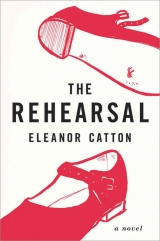
Текст книги "Rehearsal"
Автор книги: Eleanor Catton
Соавторы: Eleanor Catton
Жанр:
Новелла
сообщить о нарушении
Текущая страница: 14 (всего у книги 19 страниц)
When his scene was over he had returned to the wings to seek her out, but she had disappeared.
“There was somebody watching,” he had said later to the boy Felix, as in their dressing rooms they wiggled out of their costumes and returned their wigs to the faceless polystyrene heads that lined the top of the dresser. “From the wings. She must have come in by the players’ door. I guess it was open.”
“Did you tell her to get out?” Felix said, not really interested. He was unlacing his bodice aggressively, and Stanley heard the worn and dirty laces rip.
“She disappeared,” Stanley said, watching as Felix saw his mistake and swore under his breath. “I guess it’s just weird when people watch from the wings and we don’t know it. It’s like an unfair advantage. If someone had crept in through the foyer and was watching in the stalls I wouldn’t have cared.”
Isolde was sitting on the slat bench underneath the ginkgo tree. She was wearing her Abbey Grange school uniform, and was swinging her legs slightly as she flicked the pages of a dog-eared novel, curving her body over the book with her hair falling free about her face. As he approached he saw more clearly now how pretty she was, with full cheeks and a pouting mouth and a slender upturned nose that she was stroking absently with one finger as she read. As Stanley neared her she looked up and gave a puzzled start as she recognized him.
“It’s you,” Stanley said. “From the wings.”
“Oh, yeah,” the girl said, and drew her lower lip underneath her front teeth. She looked up at him uncertainly, like a puppy waiting to be admonished.
“You made me miss my cue,” Stanley said, and then they both blushed at his rudeness.
“Sorry,” Isolde said. “I heard the drum and I just followed the sound. I guess I just wandered in.”
There was a little pause.
“It was only a rehearsal,” Stanley said at last. She nodded politely and pressed her lips together in a kind of apologetic smile. Stanley pointed at her music case to change the subject. “What do you play?”
“Alto saxophone,” Isolde said. “My teacher’s studio is up there.”
“She must be rich, to afford a studio here,” Stanley said. “The rent is insane. I know because the Drama Institute were going to buy out way more of these buildings than they actually did, but it was too expensive.” He was growing hot with embarrassment now, the unease spreading like a scarlet ink-stain over his chest and into the stippled hollow of his throat. He knew that it would be visible above the open collar of his shirt, spreading up to his chin like an old-fashioned ruff. He wished he had not sought this girl out, that he had walked past her without speaking, maybe even given her a calm and cryptic nod.
“I don’t know if she’s rich,” Isolde said.
“Are you any good?” Stanley asked.
As soon as he said it he felt ashamed at having asked such an unanswerable question of this round-faced, blinking girl. He hoped she would not ask him the same question back. But Isolde only said, “I’m sitting Grade Eight,” and shrugged to show that the question didn’t much matter to her anyway.
“I hear you guys sometimes,” Stanley said. “Well, probably not you specifically, but the music travels down to where we are.”
“Yeah, I hear you guys sometimes too,” Isolde said, inexplicably blushing now too. “Mostly drums and shouting.”
“And screaming probably,” Stanley said, trying to make a joke out of it, but Isolde just smiled and said, “No, I’ve never heard screaming.”
“Okay,” said Stanley, flapping his arms. “Well, I guess I’ll see you around.” He had meant it to sound aloof, but instead it sounded expectant, as if he were anticipating another chance meeting. He looked away from her to show he didn’t care, out over the cobbles at the pigeons and the banked rim of litter framing the courtyard with a little crust of silver and white.
“Okay,” Isolde said, giving him a curious look. She made no move to take up her novel again, and followed him with her eyes as he stumbled away from her and across the quad, the bag of props slipping from under his arm.
June
“Stanley,” the Head of Acting said, “I want you to become your father.”
Stanley nodded tentatively. He was standing with his legs slightly apart and his hands behind his back. All the other students were sitting on the floor and looking up at him, hugging their knees tight against their ribs.
“This is a question-and-answer session,” the Head of Acting said, smoothing the page in front of him calmly with the flat of his hand. He was sitting at a desk to one side, his legs crossed at the knee, one bare white foot rotating slowly to relax the ankle joint. “We are going to start asking questions of you, addressing you directly as if you really are your father. I want you to stay in character for the next half hour. If you don’t know the real answer to any questions asked of you, then make them up. Don’t worry if you have to lie, just don’t break character.”
Stanley nodded again. He looked down for a moment, drew a breath, and then looked up again with his father’s wry twitching smile. He spread out his hands and said, “Hit me,” and all at once he was guiltless and unapologetic and mischievous.
“How well do you know your son Stanley?” the Head of Acting asked first.
Stanley raised his eyebrows and smiled. “He’s a good kid. We swap dirty jokes, that’s our thing. We get along fine.”
“What kind of dirty jokes?”
“Oh, we try and shock each other, back and forth. It’s just a game we play.” Stanley smiled again and looked at the Head of Acting coolly, as if he could see right through him, as if all of the Head of Acting’s wants and fears and hopes and faults were laid bare to him. The Head of Acting looked impassively back.
“Tell me one of the jokes that you’ve told your son,” he said.
“What’s the best thing about sleeping with a minor?”
“I don’t know,” said the Head of Acting politely.
“Getting paid eight dollars an hour for babysitting.”
There is a smothered giggle from one of the students on the floor. Stanley turned to flash him a smile. “Good, eh?” he said, twisting both wrists around to shake out his cuffs the way his father often did. “But it’s getting harder and harder to come up with anything original. I have my secretary look them up for me. Best job she’s ever had, she reckons.”
There was another ripple of laughter from the floor. Stanley grinned and drew himself up a little higher, placing both hands on his stomach and stroking the fabric of his shirt downward again and again. He contrived to make the movement look almost absentminded.
“Tell me one of the jokes that Stanley has told you,” the Head of Acting said.
Stanley paused and thought for a moment. “Can’t recall, sorry,” he said at last.
“Would you say you have a good relationship with Stanley?”
“We don’t see each other that often,” Stanley said, “but he’s a good kid. Good sense of humor. A bit sensitive maybe, but that isn’t going to hold him back. We get along fine.”
“What’s your son good at?”
“Stanley?” Stanley said, buying time the way his father would buy time. “He’s pretty well liked everywhere he goes, I think. He did well to get into drama school. Is he a good actor? I don’t know. You could probably tell me that.”
“So what would you say he was good at?”
“The arts,” Stanley said doubtfully, thinking hard. “He’s a romantic. He got that from me. He sure as hell didn’t get it from Roger.”
“Is Roger his stepfather?”
“Yes.”
“What’s he like?”
“Mild,” said Stanley. “Laughs even if he doesn’t think it’s funny. Runs out of things to say and then looks frightened, tries to escape. Sure he’s a nice man though. I wouldn’t marry him. But he’s a nice man.”
“Is he a good father to your son?”
“He’s a good stepfather to my son.”
“All right,” the Head of Acting said, turning to include the rest of the group huddled at Stanley’s feet. “Let’s open up the floor. Any of you can start asking Stanley’s father questions. Anything you like.”
“Do you see yourself in Stanley?” called out a girl in the front row.
“He’s a little more careful than I was at his age perhaps. He’s an innocent kid. I wasn’t as innocent as he is.”
“Do you think he’s still a virgin?” This was from one of the tousled boys in the back. The Head of Acting looked around sharply, but Stanley didn’t flinch. He shrugged and smiled.
“There’s a certain manner about him,” he said. “Something unspoiled. I couldn’t say. Wouldn’t want to say.”
“What’s the worst thing about him? His worst fault?”
Stanley looked down at the floor and drew his lips between his teeth to think. “Trusting people too much,” he said at last. “Trusting people who aren’t worthy of being trusted.”
“Have you told him that’s what you think?”
“No,” Stanley said. He flapped his arm irritably. “What would be the point of that? He needs to make mistakes or he’ll never get anywhere. And that’s not the sort of father I am.” He tossed his head impatiently and twitched out his cuffs again.
“What do you think Stanley thinks of you?”
“I think that underneath it all I disappoint him,” Stanley said. “He’s disappointed and he’s angry because on one level he really wants to rebel against me. He wants to tear down everything I stand for, make me see myself for what I am, but he can’t. I’m not that person in his life. He doesn’t need to rebel against me, because I’m not the one who makes the rules. I’m just the outsider, the man who turns up every now and again. If he tried to really rebel against me I’d just laugh at him. I think he resents me for that. It’s a disappointment to him.”
“You can see all that?” asked one of the boys from the floor with a pointed skepticism, as if to imply that Stanley wasn’t quite remembering the rules of the exercise. The Head of Acting was sitting back with his arms folded, watching Stanley intently with narrowed eyes.
“Yes,” Stanley said simply. He spread his hands again. “I’m a psychologist. It’s my job to see things.”
August
“We’ve got information!” the boy Marcus was crying out when Stanley slipped into the rehearsal room and took his seat on the floor. “Polly had a friend of a friend who was the abused girl’s best friend, and she knew basically everything. We interviewed her and wrote everything down!” He waved a little notebook in the air, flushed with his own success.
“What’s some of the stuff?” somebody called out.
“Like, he was her music teacher,” Marcus said, flipping open his notebook in excitement, “and she took private woodwind tutorials with him, for alto sax. And when they drove anywhere she used to lie on the floor in the backseat with a rug over her. And in his spare time he painted in oils, just as a hobby, only he never painted her because it would be evidence and he wasn’t that stupid. But he wanted to, he said, God he wanted to, because when she came all the blue-map veins on her sternum and her throat would all come up, rise to the surface of her skin just for an instant, and he always said that if he could capture her at just that moment, it would be the best thing in the world he had ever done. He knew it instinctively. They had a joke that he could do a series of paintings, an exhibition. He said he had never seen anything like it, someone who changed so much in that split-second instant, as they came. It was his favorite thing about her.”
Marcus flipped through his notebook, turning over the pages.
“Oh, there’s so much,” he said, bouncing on the balls of his feet. “We can use all of it. It’s so good, and there’s so much. We should buy this girl a present to say thank you. Polly knows her through orchestra.”
“We’ll make sure to get her complimentary tickets for opening night,” Felix said, already making a note on the side of his jotter. “And a voucher for nibbles.”
“Read out the rest,” someone called out. “Read out everything.”
August
Near the end of the first-year calendar was an underlined event described simply as “the Outing” and carefully timetabled so that the first-, second– and third-year actors were all required to participate together. The actors all assembled in the gymnasium, the second– and third-years smug and aloof in the security of having performed the exercise before.
The sixty-odd students were each assigned by the Head of Acting a part from a play. He had appointed the parts carefully, choosing students who bore a temperamental or physiological likeness to the characters he knew so well, and he smiled as he read each name off the long list he had penned into his notebook. “Henry, I’d like you to play Torvald,” he said. “I’m looking forward to seeing your Torvald. I’m guessing it’s going to be a very interesting mix”—as if Henry and Torvald were transparent overlays that could be placed upon each other to form an amalgam, a newer, brighter image that would be better and more vibrant than either the boy or the man on his own.
“Claire,” he was saying now, and turning to one of the third-years perched on the edge of the crowd. “I’ve chosen Susan from A Bed Among the Lentils for you. You’re playing out of your age range a bit, but I think you’ll manage beautifully.”
The rules of the exercise were relatively simple. The students were asked to leave the grounds of the Institute and disperse into the four city blocks that surrounded the Institute buildings. They had to remain in character for two hours. They were to be let out in small staggered batches, one batch leaving as another returned, over a period of three days. The tutors and the off-duty actors would be patrolling the city blocks, appearing to perform ordinary activities, like shopping and ordering coffee and jogging and meeting each other on the street to talk, but all the while observing the actors as they performed.
Dora. Septimus. Martha. Bo. The list went on. Stanley looked out the window and allowed his mind to wander, and soon found that he couldn’t distinguish the names of the characters from the names of the students assigned to become them.
“Stanley,” the Head of Acting called, jolting him out of his reverie. He looked up, but the Head of Acting wasn’t addressing him. “Stanley from A Streetcar Named Desire,” he was saying, and a student on the floor was nodding vigorously and scribbling down the name of the role in the margin of his exercise book. Stanley sighed and looked down at his hands.
“I know that some of these roles are easier than others,” the Head of Acting said, “and with some of these characters it’s hard to imagine them out of the context of the play. But remember that every performance is an interpretation. You can be as imaginative as you like. It’s up to you what you want to wear, whether you want to try an accent, whether you want to change your appearance to better suit your role.”
Stanley’s gaze slid sideways to the Head of Movement, standing like a patient shadow behind the Head of Acting, his ankles together and his heels against the wall. He was smiling faintly and nodding his head, but the movement looked automatic, like a weighted pendulum keeping indulgent time behind a pane of glass. He saw the Head of Movement wink at one of the students on the floor, and turned his head quickly to follow his gaze and seek out the recipient of the wink. He was too late to tell. He looked back at the Head of Movement and saw him smile and look carefully down at the floor.
The Head of Acting had reached the first-year group, and all around him his classmates were being branded one by one. Harry Bagley. George. Moss. Irene.
Stanley was assigned the part of Joe Pitt. “Read the play first,” the Head of Acting advised, and smiled a tiny smile before returning to his list. Somebody in the crowd giggled faintly and Stanley blushed, wondering what sort of person Joe Pitt was. He wrote the name on a fresh page of his organizer and then tucked the book into his bag.
August
“How long are you in town for?” Stanley asked after they had ordered. His father was busy scratching something into his electronic notebook and he didn’t answer immediately. He stabbed at the screen, folded the notebook away, and shook out his cuffs.
“Sorry, champ,” he said. “You said?”
“How long are you down for?”
“Just the weekend. I’m speaking at the conference tomorrow and then we fly out. I’ve got a joke for you. What’s the difference between acne and a Catholic priest?”
“I don’t know,” said Stanley.
“Acne only comes on your face after puberty.”
“Dad, that’s revolting,” Stanley said. He thought, A taboo is something that’s forbidden because it’s sacred.
His father held up his hands in surrender. “Too far?”
“Yes,” Stanley said. Or because it’s disgusting. He scowled despite himself and took a drink of water.
“Tell me about you, then,” his father said. “Tell me about drama school. Oh! I forgot—I’ve got something for you. I cut it out of the newspaper this morning.” He thumbed through his briefcase until he found a wad of newspaper, folded in eighths. He passed it across the table to Stanley and hummed merrily as he waited for Stanley to read it.
The headline read Girl’s Death “Terrible Waste.” The article was brief.
“You know the girl?” his father said when he’d finished. He was expectant, his eyes the gleeful half-moons of the laughing Comedy mask in the foyer of the Institute.
Stanley looked at the article again, and swallowed. “You’re going to tell me that this was the million-dollar girl.”
His father laughed. “Stanley,” he said, “this was the million-dollar girl. Did you know her?”
“What if I did?” Stanley said. “What if I did, and this was how I found out, and you’ve just been horribly insensitive to both of us?”
Stanley’s father reached across to twitch the page out of Stanley’s hands. “It’s just a bit of fun,” he said, tucking the wad back into his briefcase. “I thought you’d laugh. Don’t look at me like that.”
He shook his finger playfully at Stanley, and reached for his tumbler. “Anyway, if you did know her,” he said, “then I’d be congratulating you, because you’d have picked her from the start and you’d have taken out a policy.”
“That girl is a real person somewhere,” Stanley said.
“That girl is a corpse somewhere,” his father corrected. He gave Stanley a stern critical look, as if gravely disappointed and seeing him truly for the first time. He said, “I really thought you’d laugh.”
ELEVEN
Monday
The catchment area for Abbey Grange is wide and economically diverse. It is close enough to the city center to touch some of the wealthier areas, but covers several suburbs of middling value and a few streets at its nether edge that properly belong in the backwater suburbs, wide crawling streets with vast gutters and unkempt grass.
The poorer girls who work part-time in fast-food and clothing chain stores are able to effect something of a moral victory over the girls who receive an allowance from their parents and don’t have to work for cash. When the less wealthy girls visit the white and shining houses of the rich they always come armed with a strong sense of entitlement, opening the fridge and changing the channel and taking long delicious showers in the morning, always with a guiltless and even pious sense of righting some dreadful inequality in the world. It is almost a noble thing to cajole and thieve half a bag of crisps from a girl whose pantry is lit by angled halogen bulbs anchored to a chrome bar: it is not a burglary but a form of just redistribution, a restoration of a kind of balance. So the poorer girls tell themselves, as they close their salty fists around their next mouthful and remark out loud that they are rostered on to work the late shift at the candy bar tonight.
The richer girls are made to feel ashamed of their parents’ wealth by these subtle insidious means, and so they begin to overcompensate in justifying the incremented luxuries of their lives, defending each indulgence in terms of sole necessity. “We have to have fresh stone fruit because of Mum’s diet plan,” they say, or, “I have to have my own car because Dad’s away on business so much,” or, “We only had the spa put in because Dad’s got a bad back.” The repeated validations become their mantra, and soon the richer girls begin to believe the things they are compelled by shame to say. They come to believe that their needs are simply keener, more specialized, more urgent than the needs of the girls who queue outside the chippy and tuck the greasy package down their shirts for the walk home. They do not regard themselves as privileged and fortunate. They regard themselves as people whose needs are aptly and deservedly met, and if you were to call them wealthy they would raise their eyebrows and blink, and say, “Well, it’s not like we’re starving or anything, but we’re definitely not rich.”
This stubborn dance of entitlement, aggressive and defensive, does mark a real fear in the collective mind of the Abbey Grange girls who have moved through the years of high school in an unchanging, unitary pack. Always they fear that one of them might at any time burst out and eclipse the others, that the group might suddenly and irreparably be plunged into her shadow, that the tacit allegiance to fairness and middling equality held by them all might come to nothing after all. In a group their economic differences even out to an ordinary average, and their combined mediocrity becomes something a little like power, each of them with a specialized function that defines her territory within the whole. But if one of them should burst out and shine, the remaining girls would wither. They are mindful of the threat, clinging to each other’s elbows and clustering bluishly in the corridor and reining in any girl who threatens independence—any girl who looks as if she might one day break free and have no need of the rest.
It is just such a group that Victoria rent apart and destroyed when she peeled off to pursue a love affair in such a selfish, secret way. In usual practice, boys are privately met and managed but always remain the collective property of the group: afterward, a girl might talk only to her best friend—or perhaps a close few, according to her own network of allegiances and feuds—but it is at least accepted that she will tell somebody, that the boy will remain an object beyond the myriad confidences of the group, a thing to discuss but never confide in, never to trust. Victoria’s violation of these rules is crippling and total. To have conducted an entire relationship in secret, to have invented commitments and appointments and, above all, to have trusted in Mr. Saladin over this nuggeted faction of girls who depend so utterly upon togetherness: her betrayal weakens the kaleidoscope stronghold of the group, leeches everything of joy and meaning, punctures every illusion of unity and might. The girls begin to shrink away from each other. Even the St. Sylvester boys seem tame and foolish, like dress-up soldiers waving cardboard swords.
“It isn’t fair,” is what the girls are thinking, all the left-behind eclipsed girls who squat in the dark of Victoria’s shadow and stew. “What she stole from us. It isn’t fair.”
Monday
Isolde wonders whether what she is feeling is merely a kind of worship, a fascinated admiration of an older girl such as she once bestowed upon Victoria and her scornful train of friends: forever desperate to please them, clinging to their ankles like a foreshortened afternoon shadow, and breathless with the impossible hope that they might one day count her among their closest. Is Julia really only a mirror image of the person who Isolde aspires to be—worldly, senior, brooding, debonair? Is this all her attraction is—a narcissistic self-congratulation, a girl captivated by the image of a girl? Does falling in love with Julia require Isolde to fall, to some degree, in love with herself?
All she has is one uncertain evening of stalls and snatches and trailings-off, a lone flare of something bright that sent her heart thudding and the blood rushing to the thin skin over the bones of her chest, and then days and weeks of lonely conjuring, a paralytic limbo of self-doubt which seems to shrink Julia to an impossibility, a freak, a daytime wander that recedes in the rear-vision mirror of her uncertain mind.
She thinks vaguely about how nice it would be to be persecuted. She thinks about the two of them parading in defiance in front of her parents, holding hands maybe. She thinks about watching her father pick at his red throat with his finger while he shakes his head and says, Issie, don’t close off your options, honey. You never know, it might just be a phase. She thinks about her mother—her shrug, her careful smile. She thinks about her sister, who would fall quiet and look across at them and watch Julia so cautiously, Julia who is properly her equal, her classmate, the girl she once scorned in the netball trials, the girl about whom she whispered once, Doesn’t she know what we all think of her? Surely she knows.
It would be nice, Isolde thinks, to know that you had become the image you created for yourself. It would be nice to have a reason to act broody and maligned.
Every one of Isolde’s choices is really only a rephrased and masquerading version of the question, What am I?
It will be this way for years to come.
Tuesday
Sometimes Julia is filled with a kind of rage at the fact of her body, the fertile swell of her hips, her cold freckled breasts, the twice-folded inner pocket of her womb. She doesn’t wish herself different, doesn’t crave a phallus or a mustache or a pair of big veined hands with calluses and blunted nails—she simply feels frustrated that her anatomical apparatus presents such a misplaced and useless advantage. If the other girl’s flushed and halting inclinations tend elsewhere, if Isolde does not seek a mirrored lover but a converse lover, a flipside complement of a lover, then Julia is lost.
Julia thinks, Seducing Isolde isn’t just a matter of behaving as attractively and as temptingly as possible, and trusting that Isolde will bite. If, instead, she were faced with the prospect of seducing a boy, then such a simple formula would probably work. The mere fact of Julia’s anatomy would be enough. She would herself be the temptation—her body, the whole of her. But seducing Isolde requires forcing the younger girl to come to regard herself in a new way: only after Isolde has come to cherish her own self, the concave yin of her feminine skin, will Julia have a hope. Isolde must come to cherish herself, first and foremost. The seduction must take the form of a persuasion, a gradual winning-over of her mind.
Julia thinks of all the usual gifts of courtship, like flowers in homeroom or stones thrown at her window at midnight or a patient watcher at the school gates, waiting with a bicycle to walk her slowly home. All of them seem grotesque. She imagines sending Isolde flowers in homeroom, and all she can think of is the girl’s horrified face as she peers over the lip of the red cluster of tissue, the card already plucked off in embarrassment and crumpled to a nub. She imagines a bouquet too big and too fragile to be shoved into the bottom of Isolde’s bag, and the beautiful girls all laughing and shouting, What’s his name?
Julia is overcome by a fit of melancholy now, and drives her pen savagely through the margin of her homework sheet, causing the paper to rip. She thinks, What’s the likelihood? That the one girl who makes my heart race is the one girl who wants me in return? That the accident of my attraction coincides with the accident of hers? She thinks: can I trust in something chemical, some scent or pheromone that will ride on the current of my walking and come to kiss her as I pass her by?
Julia distrusts this chemical, this invisible riptide that sucks away at all her shores. She thinks: I cannot rely on the chemical. I cannot rely on the accident of her attraction. I must seduce her, actively pursue her and persuade her. I must appeal to the questionable autonomy of a teenage girl whose mind is still not rightfully her own.
Tuesday
“Hey Isolde, want to play?” someone calls out, and Isolde looks up. She is walking back from the tuck shop with a brown paper bag pinched in each hand, the icing slowly leaking through the paper and darkening the pale in greasy spots of gray.
“No, thanks,” Isolde says, and holds up the paper bags as an excuse.
The questioning girl smiles and returns to the game. Isolde watches as she walks past: four or five of them are attempting to play hacky-sack in their thick-soled school shoes and drooping gray socks, hiking up their school skirts with both hands to show the winter white of their dimpled knees. She rounds the corner of the school library and continues on.
Isolde weaves her way around the groups of girls sitting in their impenetrable circles around the quad, and then to her surprise she sees Julia sitting in a rare patch of sun on the grass on the far side of the paving. She is wearing her headphones and squinting in a cross kind of way into a paperback novel. Shyly Isolde makes her way toward her. Her heart begins to hammer.
Julia looks up, sees her approaching and tugs her headphones out of her ears.
“Hey man,” she says, and Isolde waves her paper bags and says, “Hey.”
“What have you got?” Julia says.
“Just a roll and a doughnut.”
“You can sit down if you want.”
Isolde crosses her legs at the ankle and descends into a sitting position in the fluent scissor-action of girls long practiced at sitting cross-legged, her free hand tugging at the doubled fold beneath the silver kilt-pin so it covers the bare skin of her knee. Julia shifts her ankles to make room. The horizontal gash along the length of Isolde’s filled roll is stained pink from the beetroot. Isolde wipes her finger along the seam to collect the mayonnaise and licks her finger carefully.
“You know what I think is shit?” Julia says suddenly, arching her back and reaching over to yank a tuft of grass from the ground to shred. “That they make you come to those counseling sessions about self-defense or teacher abuse or whatever.”
“But I’ve learned so much,” Isolde says, blinking. “Like my body is a temple. And we were all abused as children probably; we only need to work hard to remember it.”