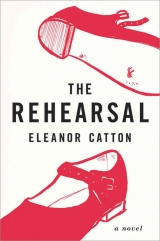
Текст книги "Rehearsal"
Автор книги: Eleanor Catton
Соавторы: Eleanor Catton
Жанр:
Новелла
сообщить о нарушении
Текущая страница: 13 (всего у книги 19 страниц)
“If you could call me back on this number,” the woman says in closing, and then there is a little pip to show that the message has come to an end.
Saturday
It is thirty-five minutes before Bridget is going to die, and she is sitting on her high upholstered stool in the video store, the till already cashed up and waiting under the counter in its dirty canvas slip. The car park outside is empty and slick, and she can see the line of yellow streetlights peeling away from her into the black.
Bridget is remembering two girls at her primary school who had for a time become obsessed with gathering facts about sex. They always referred to the act as It, and sat together for hours in grave dutiful conference as they revised and expanded their combined wisdom on the subject, from time to time closing their eyes in long-suffering horror and saying something like “Two-on-one It. That is so gross.” They were secretive and guarded and unwilling to share their wisdom, like proud and weary sphinxes guarding the door to a world that the others could not hope to understand.
Bridget recalls one athletics lesson from this period, the two girls standing together with their arms casually linked, and watching the PE teacher with the expression of forbearing solemnity that was appropriate to their studies of It. The PE teacher called out, “Today we’re practicing sprints from a crouch start,” and the smaller girl immediately whispered, “Crouch start for It.” They exchanged a grave nauseated look as if the conjured image had pained them both. Bridget felt a little jealous as she watched these two girls share their mutual feeling of pious disgust. The smaller girl’s deliberate revulsion fascinated her. “Crouch start for It,” she said. The subject was just too painful to say more. The taller girl looked down in sympathy and shook her head as if to acknowledge how sickening and inescapable the whole business was. It was all around them.
The eight-year-old Bridget had been unable to comprehend the terrible relation that this particular athletics lesson bore to the act of It, and now as she reflects upon the scene she realizes that she still has no idea how to recognize or execute a crouch start for It. Is there even such a thing? she asks herself doubtfully, but then she recalls once more the poise and perfect confidence of this ten-year-old girl, who is eighteen by now and probably thoroughly schooled in arts beyond the reach of Bridget’s imagining. Bridget reflects on how little she knows. The raindrops reach the sill and quiver there. She feels ashamed.
Tuesday
The saxophone teacher smoothes the newspaper and looks again at the article. The paper is old now, and there have been others, subsidiary stories that recap this first account, stories about holding inquiries and questioning witnesses and deciding who to blame, but this paper remains, folded into eighths, limp and graying with the hangdog look of old news. The headline reads Girl’s Death “Terrible Waste,” and the article is short. Bridget is unnamed, which is fitting, the saxophone teacher thinks, given just how forgettable Bridget was. The unnamed girl was cycling home from work, the saxophone teacher reads over and over, and she was hit by a red sedan as she made a right turn out of the video store car park. The car drove on.
The saxophone teacher thinks, She would have been at the concert with the three of us that night, if only I’d liked her enough to invite her. The thought nibbles at her for a moment, just as a possibility, like a new shirt that she may or may not try on. Finally she shrugs and snuffs it out. Outside in the courtyard she can dimly hear a group of students from the drama school, chanting and stamping their feet. She pushes the newspaper away and moves to the window to look.
Near the trunk of the ginkgo tree, six students have formed a human pyramid on a thin square of foam matting, while in front of them a larger group pace back and forth. They are like a seething flock of dark crows in the uniform black of the Institute, their feet bare and bloodless against the paving. From where the saxophone teacher is standing, the pyramid looks a little like a card castle, wobbling slightly but standing firm, growing outward and upward as more and more actors withdraw from the foreground drama and add their bodies to the tier.
The saxophone teacher watches the black flurry in the foreground for a long while. Looking back to the solid pyramid of bodies at the base of the ginkgo tree, she is startled to see that she is being watched. One of the boys in the front row, kneeling on the asphalt with his arms extended stiffly to either side, is looking up at her. His head is flung back, and the open collar of his shirt shows the length of his white throat. The saxophone teacher’s first impulse is to step away from the window, but she stays, and she thinks she sees the boy smile up at her. She looks away.
The rehearsal is coming to a close. One of the girls at the front rears up suddenly and calls out, in a rich clear voice that fills the courtyard, “I imagine things when I watch people.”
And as she says it, as the marvelous peal of her voice breaks off and the stamping and drumming comes to a swift and terrible halt and the courtyard fills with silence like a sudden rush of water, as she says it, the card castle behind her begins to fall. It tumbles down in a stately and choreographed cascade, a slow-motion melt. The figures of the actors tumble off to land on light heels and knees on the foam matting, scuttling off and leaping away until the pyramid has disappeared utterly, thawed out to a nothing-puddle of black stillness, all of the actors unmoving and silent where they have come to rest.
The girl at the front is the only figure standing now. She spreads her arms and says, “I imagine—”
There is the tiniest of pauses, the girl outstretched and full of curtailed breath that swells her ribs to bursting. Then it is as if a spell is broken, as if an invisible curtain has come down and an invisible blackout has blanked the stage, and all the fallen figures begin to move. They jump to their feet and dust themselves down and break into conversation, and the saxophone teacher hears “That fall was heaps better that time, you came in right on the beat” and “We can still get that tighter, guys” and “From the top.”
TEN
June
“So we agree that sexuality is an issue that we’re all interested in, at least,” the boy Felix said loudly, the first time the first-years met to discuss the devised theater project and the King of Diamonds playing card. Felix was bossy and pert and did not understand the humor of what he had just said, scowling at a pair of boys on the far lip of the circle who faintly snickered.
“I liked the idea of using found stories,” one of the girls said. “From the media and our communities and all that, taking them and using them and making them theatrical. I liked that idea.”
“All right,” Felix said graciously, drawing with a fat felt-tipped pen a spiky cloud around the word SEXUALITY. The others watched. At the beginning of the year Felix had labored to snare the role of the group’s organizing mind, to the irritation of most of the students, who looked at the tiny protrusion of his tongue as he wrote and felt they could do better.
“Then what about that story that Grace brought in?” Felix said when he had completed the bubble. “The teacher–student thing at Scabby Abbey.”
He used the nickname to show them that although he was organizing the group, they were not allowed to resent him or regard him as a teacher-figure.
“My sister’s at Abbey Grange,” one of the boys said. “In sixth form. She reckons they don’t know the half of it yet. What she heard was that after all the girl’s friends found out, the teacher kept them quiet for a few months by paying them out. Mostly buying them booze, on behalf.”
“But wasn’t the girl a seventh former? So most of her friends would have been eighteen anyway.”
“It’s what I heard,” the boy said, shrugging.
“How did they get caught in the end?” somebody asked.
“I heard it was another teacher,” the boy said. “The guy had been dating someone else on staff, and then they broke up and she was the one who found him with the girl. That’s what Polly said.”
“I thought it was her friends,” one of the girls said. “They caught on and went to the principal and dobbed her in.”
“I heard that it wasn’t just the one girl who was abused,” somebody said, “it was a whole bunch of them—he was playing them all at the same time. She was just the one who got caught.”
“Do we know whether anything actually happened?” one of the girls put in. “What if nothing actually happened between her and the teacher at all?”
“They had evidence. Like there were some of her clothes at his house. And there was a toothbrush.”
“A toothbrush doesn’t mean rape,” the girl said, with a sharp little laugh. “A toothbrush means the opposite of rape. It doesn’t even mean a one-night stand. A toothbrush means you’ve got foresight. It’s like if they found pajamas at his house, little girly flannel pajamas, pastel pink with a pattern of clouds. It can’t be evidence. It’s an investment. A toothbrush is an investment.”
There was a silence as they all digested this new concept.
Then one of the boys said, “Wasn’t he like sixty?”
“He wasn’t that old. There was a photo in the paper last week. He’s got brown hair.”
“So we don’t really know very much at all,” Felix said crossly, swiping his fringe away from his face. He was feeling the helpless boiling irritation of an officious person struggling to control a group too large and original for him. He uncapped his pen and wrote ISSUES at the top of his butcher’s sheet.
“We need to make really awesome use of the card itself,” one of the girls said. “Playing cards need to be an integral part of the performance, not just some little byproduct scene that’s tacked on.”
“I think that’s a given,” Felix said. “Well, let’s talk about the card then, and the different ways we could use it.” He underlined the word ISSUES, recapped his pen with a careful snap and looked expectantly at them all.
“Just the one card, or the whole pack?”
“I reckon the whole pack,” somebody said. “It’s a really great aesthetic for costuming and we can use it to shape the play kind of, like if we have four acts, each with a suit name, or thirteen scenes that each have a card name in a particular suit.”
“That’s a good idea.”
“Yeah! We can dress up like the court cards, with their weapons and stuff. Don’t they all have weapons?”
“What if we made up a game? A card game that we could use as the focus of the play. If you draw a red card you will be attracted to women. If you draw a black card you will be attracted to men.”
“Yeah, and every individual card could stand for some sort of particular—I don’t know. Some sort of particular habit or trait or something. Something to do with sexuality or whatever.”
“If you draw His Nobs, you leave before the morning?” one of the boys said, and everyone laughed.
“What’s His Nobs?”
“One of the jacks in cribbage.”
“Hang on,” said Felix, scribbling. “We’re going too fast.”
“We’re going fine,” one of the boys said. “You’re just writing too slow.”
Felix felt his authority begin to ebb. He scowled and wished he had appointed a scribe.
“What if we make the whole play a kind of fantasy, like set in a fantasy world or whatever, where as soon as you turn a certain age you have to draw a card?”
“You get sent to a fortune-teller or something—”
“Like a tarot reader.”
“Yeah! It’s like a coming-of-age ritual thing. A rite of passage.”
“The card becomes like your identity card. You keep it with you always.”
“You can’t show it to anybody.”
“So queens might mean drag or something, and if you drew a queen you’d have to take up drag.”
“Queen—like drag queen!”
“That’s what I meant.”
“Is that what we really believe, though?” Stanley said. “Do we really believe it’s like that—that your identity is dealt out to you, given to you the moment you grow up, and from then on it becomes your—your motif or something? Like a badge?”
“Yeah,” the first boy said. “Do you not believe that?”
Stanley opened his mouth but then closed it again. He wasn’t sure.
“But doesn’t that mean you’d have one card for the rest of your life?” somebody said.
“Yes,” the emphatic boy said. “Unless you gamble it away. In a high-stakes game of chance. In a deadly game of chance in an underground bar, where you run the risk of ending up with nothing.”
“We could do that really well.”
“It would dramatize really well.”
“Really steam-punk.”
“I reckon.”
“Anyway,” one of the girls said crossly, “it doesn’t matter what we actually believe. It’s a great idea. The Head of Acting would go nuts for it. It’s just the sort of crossover thing he loves.”
“What do you mean, crossover?”
“With the teacher–student thing. Using stories from the media. Did anyone see the production a few years back about the witch hunt, and they had actors in disguise all through the audience pretending to be members of the public?”
“Yeah, I saw that.”
“Until you didn’t know who was acting and who wasn’t, all around you. It was really scary, actually. The season totally sold out. They had to extend by a week.”
There was a small hush as they all imagined extending their opening season by a week. Felix had stopped writing and was looking around with his pen limp in his hand.
“I like the Abbey Grange idea,” someone said.
“So do I.”
“What are we going off, though? Just a few articles in a local paper? That isn’t enough.”
“We’ll have to research it. We’ll have to find out more.”
“Because at the end of it everything collapses,” one of the girls said. “For the girl, the victim, the one who was abused. It all comes down around her like a castle of cards.”
July
The blinds were open on the corridor side when Stanley and the girl passed, carrying their costumes down to the art department. They heard the noise and turned their heads, and then they stopped and moved closer to the glass, to watch.
A boy was howling, squirming and bent almost double with his hands at his groin. The Head of Voice was crouched over him, leaning right over with her feet planted sturdy and apart and her cheek against his, and her plump arms around him, clasping him tight. She was muttering urgently and inaudibly into his ear as he howled. His howl was unpitched and irregular and ever-changing, morphing into a guttural hum, a throaty kind of gurgle, even a bat-shriek that was too high and whispery to be heard. He appeared to be trying to twist away from the Head of Voice but she was clamped tightly to his back and the boy could only writhe and struggle. His eyes were closed.
“What’s happening to him?” Stanley whispered.
“Remedial Voice,” the girl whispered back. “He’s working through a lot of stuff from when he was a kid, I think. Really bad stuff that’s all locked inside.”
The boy was slack faced and open mouthed and his expression showed no pain, but the noise he was making was raw and brutish and full of hurt. It was frightening, this terrible noise coming out of this boy’s calm unworried throat. If it weren’t for the leaping of his Adam’s apple, Stanley would have thought the noise recorded.
“It’s horrible,” Stanley said.
The girl shot him a disdainful look, as if he couldn’t hope to understand. “Better than releasing it any other way,” she said. “Putting kittens in a microwave or whatever.”
“Is that what he’s doing? Releasing it?”
“Course,” the girl said, and tossed her head. “That’s her specialty. Head of Voice. People hire her out, outside the Institute—she goes to people’s private homes and stuff. It’s like a special type of therapy. She’s really good.”
They watched the boy howl for a while, thrashing stiffly with the dead weight of the Head of Voice clamped around him. His expression changed. He peeled his lips back so all his teeth were exposed and his nose was wrinkled in a snarl, and inside his mouth the hump of his tongue rose up, quivering and taut. He snapped his jaw and barked a little, short gasping barks from the back of his throat like a cough. The Head of Voice had begun crooning in his ear now, a gentle private lullaby that welled up underneath the frenzied barking and caused the boy to wither and gasp. Stanley felt suddenly ashamed.
“Come on. We should go,” he said, and tore his gaze away. The girl was already gone.
September
One Saturday afternoon in spring Stanley was huddled in a cubicle in the empty art department and trying without success to untangle the bobbin on his sewing machine. He was near finishing his Queen of Spades costume, sewing in a large waxy piece of cardboard behind the patterned front of the bust to give himself a more angular thrust. He had spent all morning struggling with the wire halo that fitted around his forehead. The headpiece was spangled with wire spokes designed to lift the geometric wimple higher off his head. After nearly five hours squinting at the seams and bruising his fingertips as he molded the rough end of the wire, he was finally satisfied that the effect was rather good. He was wearing the wimple now as he bent over the sewing machine, obscured to the rest of the room by a cluster of colonial furniture that had been carried to the art department for painting and left over the weekend to dry. All around him was the sweet smell of acrylic paint, as always at the Institute laced with detergent so the paint could be easily removed when the production closed.
Stanley bent over his costume. In his research for the production he had come to know his card very well: he knew that in the traditional French deck of cards the Queen of Spades was supposed to represent Joan of Arc, and in the game of Hearts the Queen of Spades was so unlucky she was known as the Black Bitch. He knew that she was the only queen to carry a scepter as well as a daisy flower, and for that reason she was sometimes called the Bedpost Queen. He had pored over the court cards in his deck at home for such a long time that he found the red-and-black images appearing after he closed his eyes at night. He disentangled the bobbin finally from the thready mess below the foot, and snipped the stray threads away. He pinched the end of the bobbin-thread in his fingers to pull it through the notch in the bobbin-holder, and heard the spool spin cleanly.
The door opened and Stanley caught a faint swell of music from the dance hall near the foyer, where a group of schoolchildren were taking their Saturday lessons in jazz.
“In here, then,” he heard somebody say, “Nobody should disturb us in here. It’s a bugger they’re using the staffroom. Sit down there if you like.”
The voice belonged to the Head of Movement. Stanley was still intently returning the bobbin to its tiny hinged cavity in the base of the sewing machine, a scrap of thread in his mouth, and he did not reveal himself at once. He wound the wheel at the side of the sewing machine and watched the needle plunge down to retrieve the bobbin-thread, bringing it up in a little scarlet loop that he flicked up with the tip of his scissors and tugged gently outward. He was so intent on the task that when it was done the Head of Movement and his guest were already in mid-conversation, speaking easily and with great relief, as two people who have longed for time alone to talk.
“They all want it,” the Head of Movement was saying. “Not just the first-years—everyone, right up until the day they leave.”
“Why doesn’t the school offer that sort of thing, then? One-on-one tutorials or whatever. If it’s what the students want.”
As slowly as he could, Stanley leaned sideways around the edge of his cubicle and saw, through the tiny sliver of view between an upended wing armchair and a sideboard, the central figure from the Theater of Cruelty exercise, the masked boy from second year who had slapped and shorn and nearly drowned his victim on the stage. Stanley watched him for a second, his smooth face unmasked now and taut with eager concentration as he listened to the Head of Movement speak.
“With you,” the Head of Movement was saying, “I think that this Institute will fall short in several respects. That’s what I wanted to say yesterday—I recommend something postgraduate, even an internship. The mime school. You’re going to be unfinished at the end of next year. Unfinished and hungry.”
The Head of Movement was speaking earnestly but without the clipped, rehearsed quality that usually characterized his speech. Stanley regarded the pair of them jealously through his sliver. The boy was sitting with his leg hiked up under him and his fingers stroking the frayed upholstery, nodding carefully as the Head of Movement spoke, and suddenly it struck Stanley what was so odd about the situation: they are friends, he thought in wonder.
“I value your opinion completely,” the unmasked boy said, leaning in close, and in that instant Stanley remembered the golden boy, greased and glittering like an artificial dish sprayed with lacquer to be photographed for a cuisine magazine. The golden boy had gleamed, and this boy was gleaming now.
Stanley swallowed and felt a bitter injustice in his throat. He recalled a vision of himself, in the Head of Movement’s office, pushing away tears as he shouted in complaint. Even now he felt a flicker of self-congratulation that he had responded to the Theater of Cruelty exercise in that violent way. Why hadn’t the Head of Movement been impressed, then? Why hadn’t the tutor relaxed into a rare and sudden intimacy, inspired by Stanley’s fragile openness to confess a vulnerability of his own? Why this boy, Stanley thought, this smooth-faced unmasked boy who was no better or worse than the rest of them?
“It’s funny,” the Head of Movement was saying now, “in many ways you’ve really… well. Woken me up, I suppose.”
“My growth is projected on to him… it is found in him,” the unmasked boy quoted, and through his secret sliver Stanley saw both of them smile.
“Shared or double birth,” the Head of Movement said. “Not the instruction of a pupil but utter opening to another person.” He was silent a moment, and then he added, “Well remembered.”
They sat there and looked at their shoes, enjoying the shallow silence of the room. Behind the cold discolored flank of the sewing machine, Stanley watched and felt bitter. He waited two long hours, with cramp in both knees and a terrible hunger gnawing at his insides, until the boy and the Head of Movement finally ended their conversation and left the room.
July
“Let’s improvise it,” one of the first-year boys suggested. “Let’s start with what we had last week and see where that goes. I really liked what was happening with the two characters together, both of them saying things that the other doesn’t really hear, like neither of them is fully present for the other.”
“We’ll just start rolling,” one of the girls said. “First Mr. Saladin and then the girl, rotating like that. Anyone can get up at any time. Anyone can play either of them, doesn’t matter who. We’ll just try and keep the scene moving and see what happens.”
“We’ll get a real dialogue going.”
“That’s right.”
There was a brief pause as everyone digested the formula and swiftly began to prepare what they would later say. Then one of the boys got to his feet. He transformed into a different person as he stood up, a man rising like a phoenix out of the pallid, ashy figure that had been the boy. Once he was standing, hands on hips and his jaw thrust back and his bare feet apart and solid on the floor, nobody doubted who he had become.
The man said, “When the girls spoke of it, they said all the way, as if the process was a passage, a voyage, some sort of ritual first crossing of a dimly charted sea. Victoria said those words to me—all the way. She asked a question. She asked, Do you want to go all the way with me? as if her departure were already scheduled, her moorings already cast, and I could simply choose to board and join her, to sail away with her and disappear. All the way, she said. Every inch of it. Every inch of that windblown ocean-salted bucking rolling passage. Every inch.”
He sat down. There was the briefest of pauses again, and then Stanley stood up. He stood with his weight on one leg like a girl, one arm crossed over his chest and holding his hip, the other gesticulating with a crooked elbow and a flat palm.
“He took a long time to answer the question,” Stanley said. “At first he gave this little shout of a laugh and gathered me up into him and kissed my crown. Sometimes when he kissed me he’d make this keening sound in the back of his throat, like a puppy almost, some kind of ghostly underwater voicing of some deep-felt feeling, right inside. Once he burrowed his head into the pilled blue wool of my armpit and moaned out loud and he said, I just feel so blessed, Victoria. I feel so incredibly, incredibly blessed. We were sitting there on the cream leather sofa in his living room and I said, Do you want to go all the way with me? and he said, Oh, you precious, precious little girl. Not yet. Not just yet. Let’s just enjoy the innocence for a moment, before it dissolves and we can never have it back again. Let’s just take this moment to enjoy how much is still to come.”
Stanley sat down. All around him the students were stern and glassy. They had only half-listened to his performance, all of them preoccupied already with the inward rehearsal of what they would say when they got up in front of the rest, and how they would contrive to make the words seem spontaneous and unrehearsed and pure.
One of the girls got up. Like any girl who tries to play a grown man, her performance was disproportionate and slightly embarrassing. She let her voice deepen and placed her feet wide apart and assumed a manner that was overly earnest and gruff. She raised her chin and said, “Could it have been one of the others, if this girl had never dared? Could it just as easily have been the girl to her right or left, another saxophonist in the front row of the jazz band, some girl whose breasts were smaller, whose gaze was sharper, whose fingernails were squatter, maybe, and poorer in shape, whose jersey was coming unraveled at the hem? All of them have smiled at me, looked hard at me, laughed with me. When we won our section at the high school jazz festival, some of them even hugged me. Would it have been different, with one of them?”
Another girl got up as this Mr. Saladin was returning to her seat on the floor. The new girl spread her hands and said, “It’s funny to think that I never saw him wake up. I never rolled over to see him still sleeping, never saw his eyelids waxed and still in the pale morning light, never burrowed down into the sweet hot breath of the bed and felt him stir and lift his heavy sleepy arms to let me in. We had no mornings-after. We had no nights, no long uninterrupted nights where we could sleep and sleep and sleep. We had no silence. We never breakfasted together. We never swam together, shopped together, walked to the cinema together; I never called him at work to check when he was due to come home; I never pegged his laundry on the line. I never knew his mother or his nephews or his life.
“All these are adult things, and they’re all things I never had with him. People say, now, that I was a child wrongfully thrust into an adult’s role. People call it an adult relationship, illicit and untimely and premature. In fact it was the opposite. It was Mr. Saladin who had the adolescent relationship, all backseat whispers and doorway fumbles and getting home before midnight, waiting for the parents to go to sleep or leave the house, sending messages in code and on the sly. I didn’t play the adult. Mr. Saladin played the child.”
August
Opening night drew nearer and nearer. Without a central script, the devised performance did not seem to be approaching any kind of finished state, but merely began blooming and swelling in odd places, like an ancient wrinkled party balloon that was being forcibly refilled with breath. Tempers in the group ran high, and fractures began to form around the strongest personalities as the dissatisfied students met in whispering mutinous pairs in doorways around the Institute.
“Andy strutting around in that costume like that makes me sick,” was how the whispers ran. “Thinks he’s God’s gift to the stage. Every time he walks past I want to stick out a leg and trip him up.”
“Do you know how hard it is to act in a scene with Oliver if Esther’s around? Today she was practically humping his leg.”
“If Felix clears his throat like that one more time I swear I am going to clock him.”
“What is this show, like a two-hour tribute to one guy? Why does Sam get so much stage time? It’s not like he’s the cream of the crop or anything.”
The real risk was that these dissatisfied students, the whisperers, angry at the comparative insignificance of their parts and sick of the officious prodding from the others in the group, might want so much to disassociate themselves from the performance that on opening night they might intentionally act poorly, calling deliberate attention, through their ham acting, to the distance between the actor and the role. This became a tacit threat; it hung in the air around them, and the actors became wary and mistrusting, hugging their costumes tighter to their chests as if they were trying to hold the fractured shell of their ego in one place with the force of their hands.
Leaving the Institute after a rehearsal one day, Stanley bundled his bag of take-home props under his arm and threw his head back for a moment to enjoy the pale afternoon sun. He had left quietly, through the backstage area and out the players’ door into the alley, slipping away from his scowling, shadow-eyed classmates who were still arguing as they stacked the chairs away and cleared the rehearsal room for the next morning.
He rounded the corner into the northern quadrangle and to his surprise came face to face with the girl who had appeared so oddly and suddenly in the wings of the auditorium stage, the wide-eyed schoolgirl who had collided with him in the velvet black. He stalled a moment as he recognized her, again recalling the brief and breathy impact in the dark, the girl gasping and stricken and looking down at him in mute apology as he fell.