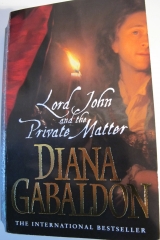
Текст книги "Lord John and the Private Matter "
Автор книги: Diana Gabaldon
Жанр:
Исторические приключения
сообщить о нарушении
Текущая страница: 9 (всего у книги 17 страниц)
Grey felt as though he’d received a sudden punch to the midsection. Christ, he’d forgotten all about his invitation to Trevelyan.
“Whyever do you want a German wine, though?” The Countess laid her head on one side, one fair brow lifted in curiosity.
“That is another matter, quite separate,” Grey said hastily. “Are you still getting your wine from Cannel’s?”
“For the most part. Gentry’s, now and then, and sometimes Hemshaw and Crook. Let me see, though . . .” She ran the tip of a forefinger slowly down the bridge of her nose, then pressed the tip, having arrived at the sought-for conclusion.
“There is a newish wine merchant, rather small, down in Fish Street. The neighborhood isn’t very nice, but they do have some quite extraordinary wines; things you can’t find elsewhere. I should ask there, if I were you. Fraser et Cie is the name.”
“Fraser?” It was a fairly common Scots name, after all. Still, the mere sound of it gave him a faint thrill. “I’ll ask there. Thank you, Mother.” He leaned forward to kiss her cheek, taking in her characteristic perfume: lily of the valley, mixed with ink—the latter fragrance more intense than usual, owing to the newness of the book in her lap.
“What’s that you’re reading?” he asked, glancing at it.
“Oh, young Edmund’s latest bit of light entertainment,” she said, closing the cover to display the title: A Philosophical Enquiry into the Origin of Our Ideas of the Sublime and Beautiful, by Edmund Burke. “I don’t expect you’d like it—too frivolous by half.” Taking up her silver penknife, she neatly cut the next page. “I have a new printing of John Cleland’s Fanny Hill, though, if you find yourself in want of reading matter. You know, Memoirs of a Woman of Pleasure?”
“Very amusing, Mother,” he said tolerantly, scratching Eustace behind the ears. “Do you mean to read the Cleland thing, or do you intend merely to leave it artfully displayed in the salon, in order to drive off Lady Roswell in a state of shock?”
“Oh, whata good idea!” she said, giving him a look of approval. “I hadn’t thought of that. Unfortunately, it hasn’t got the title on the cover, and she’s much too stupidly incurious simply to pick up a book and open it.”
She reached over and rummaged through the stacked books on her secretary, pulling out a handsome calf-bound quarto volume, which she handed to him.
“It’s a special presentation edition,” she explained. “Blank spine, plain cover. So one can read it in dull company, I suppose, without arousing suspicion—as long as one doesn’t let the illustrations show, at least. Why don’t you take it, though? I read it when it first came out, and you’ll be needing some sort of present for Joseph’s bachelor party. That seems rather appropriate, if half what I hear of such parties is true.”
He had been about to rise, but stopped, holding the book.
“Mother,” he said carefully. “About Mr. Trevelyan. Do you think Livy is terribly in love with him?”
She looked at him with raised brows; then, very slowly, closed her book, took her feet off Eustace, and sat up straight.
“Why?” she asked, in a tone that managed to communicate all of the wariness and cynical suspicion regarding the male sex that was the natural endowment of a woman who had raised four sons and buried two husbands.
“I . . . have some reason to think that Mr. Trevelyan has . . . an irregular attachment,” he said carefully. “The matter is not yet quite certain.”
The Countess inhaled deeply, closed her eyes for a moment, then opened them and regarded him with a pale, clear blue gaze of pragmatism, tinged only slightly with regret.
“He is a dozen years her senior; it would be not merely unusual, but most remarkable, if he had not had several mistresses. Men of your age do have affaires, after all.” Her lashes lowered briefly in delicate reference to the hushed-up scandal that had sent him to Ardsmuir.
“I could hope that his marriage would cause him to abandon any such irregular liaisons, but if it does not . . .” She shrugged, her shoulders sloping in sudden tiredness. “I trust he will be discreet.”
For the first time, it occurred to Grey to wonder whether either his father or her first husband, Captain DeVane . . . but this was not the time for such speculations.
“I think Mr. Trevelyan is highly discreet,” he said, clearing his throat a little. “I only wondered if . . . if Livy would be heartbroken, should . . . anything happen.” He liked his cousin, but knew very little about her; she had come to live with his mother after he himself had left to take up his first commission.
“She’s sixteen,” his mother said dryly. “ SignorDante and his Beatrice notwithstanding, most girls of sixteen are not capable of grand passion. They merely think they are.”
“So—”
“So,” she said, cutting him neatly off, “Olivia actually knows nothing whatever of her intended husband, beyond the fact that he is rich, well-dressed, not bad-looking, and highly attentive to herself. She knows nothing of his character, nor of the real nature of marriage, and if she is truly in love with anything at the moment, it is with her wedding dress.”
Grey felt somewhat reassured at this. At the same time, he was well aware that the cancellation of his cousin’s nuptials might easily cause a scandal that would dwarf the controversy over the dismissal of Pitt as Prime Minister two months before—and the brush of scandal was not discriminating; Olivia could be tarred with it, blameless or not, to the real ruin of her chances for a decent marriage.
“I see,” he said. “If I were to discover anything further, then—”
“You should keep quiet about it,” his mother said firmly. “Once they are married, if she should discover anything amiss regarding her new husband, she will ignore it.”
“Some things are rather difficult to ignore, Mother,” he said, with more of an edge than he intended. She glanced at him sharply, and the air seemed for an instant to solidify around him, as though there were suddenly nothing to breathe. Her eyes met his straight on and held them for a moment of silence. Then she looked away, setting aside her volume of Burke.
“If she finds she cannot ignore it,” she said steadily, “she will be convinced that her life is ruined. Eventually, with luck, she will have a child, and discover that it is not. Shoo, Eustace.” Pushing the somnolent spaniel aside with her foot, she rose, glancing at the small chiming clock on the table as she did so.
“Go and look for your German wine, John. The wretched sempstress is coming round at three, for what I sincerely hope is the antepenultimate fitting for Livy’s dress.”
“Yes. Well . . . yes.” He stood awkwardly for a moment, then turned to take his leave, but halted suddenly at the door of the boudoir, turning as a question struck him.
“Mother?”
“Mm?” The Countess was picking up things at random, peering nearsightedly beneath a heap of embroidery. “Do you see my spectacles, John? I know I had them!”
“They’re on your cap,” he said, smiling despite himself. “Mother—how old were you when you married Captain DeVane?”
She clapped one hand to her head, as though to trap the errant spectacles before they could take flight. Her face was unguarded, taken by surprise by his question. He could see the waves of memory pass across it, tinged with pleasure and ruefulness. Her lips pursed a little, and then widened in a smile.
“Fifteen,” she said. The faint dimple that showed only when she was most deeply amused glimmered in her cheek. “I had a wonderfuldress!”

Chapter 12
Along Came a Spider
There was unfortunately not time to visit Fraser et Cie before his appointment with Quarry, whom he found waiting in front of the church of St. Martin-in-the-Fields, as advertised.
“Are we attending a wedding or a funeral?” he asked, stepping down from the coach that had brought him.
“Must be a wedding—I see you’ve brought a present. Or is that for me?” Quarry nodded at the book beneath his arm.
“You may have it, if you like.” Grey surrendered the presentation copy of Fanny Hillwith some relief; he had been obliged to leave the house with it, as Olivia had come upon him as he passed through the hall and then had accompanied him to the door, flourishing further samples of lace beneath his nose while asking his opinion.
Quarry opened the book, blinked, then looked up at Grey, leering.
“Why, Johnny. Didn’t know you cared!”
“What?” Seeing Quarry’s grin, he snatched the book back, discovering only then that there was an inscription on the title page. Evidently the Countess had been in ignorance of it, too—or at least he hoped so.
It was a fairly explicit verse from Catullus, inscribed to the Countess, and signed with the initial “J.”
“Too bad my name’s not Benedicta,” Quarry remarked. “Looks quite an interesting volume!”
Gritting his teeth and hastily reviewing a mental list of his mother’s acquaintance for persons beginning with “J,” Grey carefully tore the title page from the book, stuffed it in his pocket, and handed the volume firmly back to Quarry.
“Who are we going to see?” he inquired. He had, as instructed, come in his oldest uniform, and picked critically at an unraveling thread at his cuff. Tom Byrd was an excellent barber, but his skill at valeting left something to be desired.
“Someone,” Quarry said vaguely, looking at one of the illustrations. “Don’t know his name. Richard put me onto him; said he knew all about the Calais business; might be helpful.” Richard was Lord Joffrey, Quarry’s elder half-brother, and a force in politics. While not directly involved with army or navy, he knew everyone of consequence who was, and generally was informed of any brewing scandals weeks before they erupted in public.
“Something in government, then, this person?” Grey asked, because they were turning into Whitehall Street, which contained little else.
Quarry closed the book and gave him a wary look.
“Don’t know, exactly.”
Grey gave up asking questions, but hoped that the business wouldn’t take too long. He had had a frustrating day; the morning spent in futile inquiries, the afternoon in being fitted for a suit that he was increasingly sure would never be worn at the wedding for which it was intended. He was, all in all, in the mood for a hearty tea and a stiff drink—not interviews with nameless persons holding nonexistent positions.
He was a soldier, though, and knew duty when it called.
Whitehall Street was architecturally undistinguished, bar the remnants of the Palace and the great Banqueting Hall, left over from a previous century. Their destination was neither of these, nor yet any of the faintly moldy buildings in the neighborhood that housed the minor functions of government. To Grey’s surprise, Quarry turned in instead at the door of the Golden Cross, a dilapidated tavern that stood across from St. Martin-in-the-Fields.
Quarry led the way to the snug, calling to the barman for a pair of pint-pots, and took a bench, behaving for all the world as though this were his local place of refreshment—and there were in fact a number of military persons among the clientele, though most of these were minor naval officers. Quarry kept up the pretense so far as to hold a loudly jocose conversation with Grey regarding horse-racing, though his gaze roamed ceaselessly round the room, taking note of everyone who entered or left.
After a few minutes of this pantomime, Quarry said very quietly, “Wait two minutes, then follow me.” He gulped the rest of his drink, shoved the empty glass carelessly away, and went out, going down the back passage as though in search of the privy.
Grey, rather bemused, drank the rest of his ale in a leisurely manner, then rose himself.
The sun was setting, but there was enough light to see that the cramped yard behind the Golden Cross was empty, bar the usual detritus of rubbish, wet ash, and broken barrels. The door to the privy hung ajar, showing that to be empty too—bar a cloud of flies, encouraged by the mild weather. Grey was waving off several of these inquisitive insects, when he saw a small movement in the shadows at the end of the yard.
Advancing cautiously, he discovered a personable young man, neatly but unobtrusively dressed, who smiled at him, but turned without greeting. He followed this escort, and found himself climbing a rickety stair that ran between the wall of the tavern and the neighboring building, ending at a door that presumably guarded the tavern owner’s private quarters. The young man opened this and, going through, beckoned him to follow.
He was not sure what this preliminary mystification had led him to expect, but the reality was sadly lacking in excitement. The room was dark, low-raftered, and squalid, furnished with the well-used objects of a shabby life—a battered sideboard, a deal table with bench and stools, a chipped chamber pot, a smoky lamp, and a tray holding smudged glasses and a decanter full of murky wine. By way of incongruous decoration, a small silver vase sat on the table, holding a bunch of brilliant yellow tulips.
Harry Quarry sat just by the flowers, close in conversation with a small, fusty-looking man whose pudgy back was turned to Grey. Quarry glanced up and flicked an eyebrow, acknowledging Grey, but made a small motion with one hand, indicating that Grey was to stay back for a moment.
The discreet young man who had brought him in had disappeared through a door into the next room; another young man was busy at the far end of the room, sorting an array of papers and portfolios at the sideboard.
Something about this gentleman piqued his memory, and he took a step in that direction. The young man suddenly turned around, hands full of papers, looked up, and stood stock-still, gaping like a goldfish. A neat wig covered the golden curls, but Grey had no difficulty in recognizing the white face beneath it.
“Mr. Stapleton?” The pudgy little man at the table did not turn round, but lifted a hand. “Have you found it?”
“Yes, Mr. Bowles,” the young man said, hot blue eyes still fixed on Grey’s face. He swallowed, Adam’s apple bobbing in his throat. “Just coming.”
Grey, having no idea whom this Mr. Bowles might be, nor what was going on, gave Stapleton a small, enigmatic smile. The young man tore his eyes away, and went to give the pudgy man the papers in his hand, but could not resist a quick, disbelieving glance over his shoulder.
“Thank you, Mr. Stapleton,” the little man said, a clear tone of dismissal in his voice. Mr. Stapleton, alias Neil the Cunt, gave a short, jerky bow and moved away, eyes flickering to and from Grey with the air of one who has just seen an apparition but hopes it will have the good manners to disappear before the next glance.
Quarry and the shabby Mr. Bowles still murmured, heads together. Grey sauntered unobtrusively to an open window, where he stood, hands folded behind him, ostensibly seeking air as an antidote to the fug inside the room.
The sun was nearly down, the last of it gleaming off the rump of the bronze horse bearing the statue of Charles I that stood in the street below. He had always felt a sneaking fondness for that statue, having been informed by some forgotten tutor that the monarch, who had been two inches short of Grey’s own current height, had had himself rendered on horseback in order to look more imposing—in the process, having his height unobtrusively amended to an even six feet.
A slight clearing of the throat behind him informed him that Neil the Cunt had joined him, as intended.
“Will you take some wine, sir?”
He half-turned, in such a way that it seemed natural for the young man, bearing his tray, to step forward and set it down on the broad sill. Grey made a small gesture of assent, looking coolly on as the wine was poured.
Stapleton’s eyes flicked sideways to insure that no one was watching, then darted back to fix on Grey’s with an expression of unspoken desperation.
Please. His lips moved soundlessly, as he held out the tumbler. The wine trembled, washing to and fro against the cloudy glass.
Grey didn’t move to take it at once, but flicked his own glance sideways toward Mr. Bowles’s bowed head, and back at Stapleton, raising his brows in question.
A look of horror at the thought filled Stapleton’s eyes, and he shook his head, very slightly.
Grey reached out and wrapped his hand around the glass, covering the tips of Neil’s fingers as he did so. He squeezed them briefly, then took the glass, lowering his gaze.
“I thank you, sir,” he said politely.
“Your servant, sir,” Stapleton said, with equal politeness, and bowed before turning to lift the tray. Grey caught the faint scent of Stapleton’s sweat, rank with fear, but the decanter and remaining glasses stayed steady as he carried them away.
From this angle of view, he could see the pillory that stood near Charles’s statue. Grey barely tasted the foul wine, half-choked as he was by the beating of the pulse in his own throat. What in God’s name was going on? He didn’t think this meeting was to do with him; surely Harry would have warned him. But perhaps Stapleton had—no, or he would scarcely have been so terrorized at Grey’s appearance. But then, what—
A scraping of chairs fortunately interrupted his speculations before they became any more incoherent.
“Lord John?” Quarry had stood up, addressing him formally. “May I present Mr. Hubert Bowles? Major Grey.”
Mr. Bowles had stood up, too, though he scarcely appeared to have done so, he being so short that there was little change in height from his seated aspect. Grey bowed courteously, murmuring, “Your servant, sir.”
He took the indicated stool, and found himself facing a pair of soft blue eyes, the vague slaty color of a newborn child’s, set in a face bearing as much distinction of feature as a suet pudding. There was an odd scent in the air—something like very old sweat, but with a hint of putrid decay. He couldn’t tell whether it came from the furnishings or from the man in front of him.
“My lord,” Bowles said, in a lisping voice little more than a whisper. “It is kind of you to attend us.”
As though I were here of choice, Grey thought cynically, but merely bowed and murmured a courtesy in reply, trying meanwhile to breathe exclusively through his mouth.
“Colonel Quarry has been recounting your efforts and discoveries,” Bowles said, turning over a sheet of paper with short-fingered delicacy. “You have been most assiduous.”
“You flatter me too much, sir,” Grey said. “I have found out nothing certain—I take it we are discussing the death of Timothy O’Connell?”
“Among other things.” Bowles smiled pleasantly, but the vague expression in his eyes did not alter.
Grey cleared his throat, belatedly tasting the nastiness of the wine he had swallowed. “I imagine that Colonel Quarry has informed you that I have discovered no proof of O’Connell’s involvement in—the matter at hand?”
“He has.” Bowles’s gaze had drifted away from Grey, and rested idly on the yellow tulips. They had orange throats, Grey saw, and glowed like molten gold in the last of the light. If they had a scent, it wasn’t strong enough to perceive, unfortunately. “Colonel Quarry thinks that your efforts might be aided were we to inform you of the results of our other . . . inquiries.”
“I see,” Grey said, though he saw nothing at all, so far. “Our other inquiries.” And who were “we,” exactly? Harry sat hunched on his own stool, an untasted glass of wine in his hand, face carefully expressionless.
“As the Colonel told you, I believe, there were several suspects in the original theft.” Bowles’s small, soft paw spread itself on the papers. “Inquiries were instituted at once, through a variety of channels, regarding all of these men.”
“I supposed that to be the case.”
It was very warm in the chamber, despite the open window, and Grey could feel his shirt sticking to his back, sweat tickling his temples. He wanted to wipe his face on his sleeve, but somehow the presence of this odd little man constrained him to do no more than nod, sitting rigidly at attention.
“Without divulging details”—a tiny smile flitted across Bowles’s face at that, as though the thought of withholding details was something secretly delicious—“I can inform you, Major, that it is now all but certain that Sergeant O’Connell was the guilty party.”
“I see,” Grey said again, guardedly.
“We lost track of him, of course, when the man who was following him—Jack Byrd, was that the name?—disappeared on Saturday.” Grey was quite sure that Bowles knew the name; knew a lot more than that, in all likelihood.
“However,” Bowles continued, extending a stubby finger to touch one of the shimmering petals, “we have recently received a report from another source, placing O’Connell at a particular location on the Friday. The day before his death.”
A drop of sweat was hanging from Grey’s chin; he could feel it trembling there like the grains of pollen trembling on the soft black anthers of the tulips.
“A rather unusual location,” Bowles went on, stroking the petal with dreamy gentleness. “A place called Lavender House, near Lincoln’s Inn. Have you heard of it?”
Oh. Christ.He heard the words distinctly, and hoped he hadn’t spoken them aloud. This was it, then.
He sat up straighter still and wiped the drop of sweat from his chin with the back of his hand, setting himself for the worst.
“I have, yes. I visited Lavender House myself last week—in the course of my inquiries.”
Bowles did not—of course!—look astonished by this. Grey was conscious of Quarry by his side, looking curious but not alarmed. He was reasonably sure that Harry had no idea of the nature of Lavender House. He was quite sure that Bowles did.
Bowles nodded amiably.
“Quite. What I am wondering, Major, is what you discovered regarding O’Connell that led you to that destination?”
“It—was not O’Connell about whom I was inquiring.” Quarry shifted a little at that, and emitted a small “Hmph!”
No help for it. Commending his soul to God, Grey took a deep breath and recounted the entire story of his explorations into the life and behavior of Joseph Trevelyan.
“A green velvet dress,” Bowles said, sounding only mildly curious. “God bless my soul.” His hand had dropped from the tulips, and was now curled possessively around the fat little belly of the silver vase.
Grey’s shirt was soaked through by now, but he was no longer anxious. He felt an odd sort of calm, in fact, as though matters had been taken quite out of his own control. What happened next lay in the hands of Fate, or God—or Hubert Bowles, whoever in God’s name he was.
Stapleton was plainly in the employ of Mr. Bowles’s office—whatever nameless office that might be—and Grey’s second thought, after the shock of seeing him, had been that Stapleton had gone to Lavender House as an agent of Bowles.
But Stapleton had been terrified by Grey’s sudden appearance; that meant that Stapleton thought Bowles to be in ignorance of his own nature. Why else that silent plea?
That being so, Stapleton would never have mentioned Grey’s presence at Lavender House; he could not do so without incriminating himself. And that in turn meant that his presence there had been purely personal. Given room to think for a moment, Grey realized—with the stomach-dropping relief of one stepping back from the trap of a scaffold—that Mr. Bowles was not in fact inquiring into his own behavior, save as it pertained to the O’Connell affair. And with an obvious reason for his presence at Lavender House given . . .
“I b-beg your pardon, sir?” he stammered, realizing belatedly that Bowles had said something to him.
“I asked whether you were convinced that these Irish were conspicuously involved, Major? The Scanlons?”
“I think that they are,” he replied cautiously. “But that is an impression only, sir. I have said to Colonel Quarry that it might be useful to question them more officially, though—and not only the Scanlons, but Miss Iphigenia Stokes and her family.”
“Ah, Miss Stokes.” The pendulous cheeks quivered faintly. “No, we are familiar with the Stokes family. Petty smugglers, to a man, but nothing whatever in the political line. Nor have they any connexion to the . . . persons at Lavender House.”
Persons. That, Grey realized, almost certainly meant Dickie Caswell. For Bowles to know about O’Connell’s presence at Lavender House, someone there must have told him. The obvious conclusion was that Caswell was the “source” who had provided the information regarding O’Connell—which in turn implied that Caswell was a regular source of information for Mr. Bowles and his shadowy office. That was rather worrying, but there was no time to think of such things just now.
“You said that Mr. O’Connell visited Lavender House upon the Friday,” Grey said, taking a fresh grip on the conversation. “Do you know whom he spoke with there?”
“No.” Bowles’s lips thinned to nothing. “He went to the back door of the establishment, and when asked his errand, replied that he was looking for a gentleman named Meyer, or something of the sort. The servant who saw him told him to wait and went away to inquire; when he returned, O’Connell had gone.”
“Meyer?” Quarry leaned forward, interjecting himself into the conversation. “German? A Jew? I’ve heard of a fellow of that name—traveling coin-dealer. Think he works in France. Very good disguise for a secret agent, that—going about to big houses, carrying a pack, what?”
“There you have me, sir.” Bowles seemed mildly annoyed by the admission. “There was no such person at Lavender House, nor was any such known by that name. It does seem most suspicious, though, given the circumstances.”
“Oh, rather,” Quarry said, with a tinge of sarcasm. “So, then. What d’you suggest we do?”
Bowles gave Quarry a cold look.
“It is of the utmost importance that we discover the man to whom O’Connell intended to sell his secrets, sir. It seems clear that this was a crime of impulse, rather than deliberate espionage—no one could have known that the requisitions would be exposed and unattended.”
Quarry gave a grunt of agreement, and sat back, arms folded across his chest.
“Aye, so?”
“Having recognized the value of the information, though, and removed the documents, the thief—call him O’Connell, for convenience—would then be faced with the necessity of finding someone to pay for them.”
Bowles pulled several sheets of rough foolscap from the stack before him, and spread them out. They were covered with a round scrawl, done in pencil, and sufficiently illegible that Grey could make out only the occasional word, read upside down.
“These are the reports that Jack Byrd supplied to us through Mr. Trevelyan,” Bowles said, dealing the sheets upon the table one by one. “He describes O’Connell’s movements, and notes the appearance—and often the name—of each person with whom he observed the Sergeant conversing. Agents of this office”—Grey noticed that he didn’t specify whichoffice—“have located and identified most of these persons. There were several among them who do indeed have tenuous connexions with foreign interests—but none who would themselves be able to accomplish a contract of such magnitude.”
“O’Connell was looking for a purchaser,” Grey summarized. “Perhaps one of these small fish gave him the name of this Meyer for whom he was searching?”
Bowles inclined his round little head an inch in Grey’s direction.
“That was my assumption as well, Major,” he said politely. “‘Small fish.’ A very picturesque and appropriate image, if I may say so. And this Meyer may well be the shark in our sea of intrigue.”
Grey caught a brief glimpse from the corner of his eye of Harry making faces, and coughed, turning a bit to lead Bowles’s gaze in his own direction.
“Your . . . um . . . source, then—could he not discover any such person, if the suspect had an association with Lavender House?”
“I should certainly expect so,” Bowles said, complacency returning. “My source disclaims all knowledge of such a person, though—which leads me to believe either that O’Connell was misdirected, or that this Meyer goes by an alias of some sort. Hardly an unlikely possibility, given the . . . ah . . . nature of that place.”
“That place” was spoken with such an intonation—something between condemnation and . . . fascination? gloating?—that Grey felt a brief crawling sensation, and rubbed instinctively at the back of his hand, as though brushing away some noxious insect.
Bowles was reaching into yet another folder, but the paper he withdrew this time was of somewhat higher quality; good parchment, and sealed with the Royal Seal.
“This, my lord, is a letter empowering you to make inquiries in the matter of Timothy O’Connell,” Bowles said, handing it to Grey. “The language is purposely rather vague, but I trust you may employ it to good use.”
“Thank you,” Grey said, accepting the document with profound misgivings. He wasn’t sure yet why, but his instincts warned him that the red seal indicated danger.
“Well, then, d’ye want Lord John to go back there and rummage the place?” Quarry asked, impatient. “We’ve a tame constable; shall we ask him to collect the Jews in his district and put their feet to the fire until they cough up this Meyer? What shall we do, for God’s sake?”
Mr. Bowles disliked being hurried, Grey could see. His lips thinned again, but before he could reply, Grey made his own interjection.
“Sir—if I might? I have something—it may be nothing, of course—but there seems to be an odd connexion . . .” He explained, as well as he could, the appearance of an unusual German wine at Lavender House and its apparent connexion with Trevelyan’s mysterious companion. And Jack Byrd, of course, was connected to Trevelyan.
“So I am wondering, sir, whether it might be possible to trace buyers of this wine, and thus perhaps to fall upon the scent of the mysterious Mr. Meyer?”
The small bulge of flesh that served Mr. Bowles for a brow underwent convulsions like a snail thinking fierce thoughts—but then relaxed.
“Yes, I think that might be a profitable channel of inquiry,” he conceded. “In the meantime, Colonel”—he turned to Quarry with an air of command—“I recommend that you apprehend Mr. Scanlon and his wife, and make such representations to them as may be appropriate.”