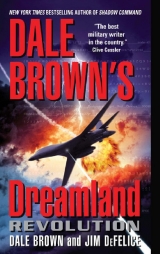
Текст книги "Revolution"
Автор книги: Dale Brown
Жанр:
Боевики
сообщить о нарушении
Текущая страница: 9 (всего у книги 25 страниц)
The lieutenant nodded, said something in Romanian, then turned to the rest of his men and began explaining what Danny had said. They all nodded earnestly.
The Romanian platoon was housed in a pair of farmhouses south of Route E581, about three miles from Tutova.
From the looks of things, Danny guessed that the buildings had been requisitioned from their owner or owners fairly recently. The walls of both were covered with rectangles of lighter-colored paint, presumably the spots where photos or paintings had hung. The furniture, old but sturdy, bore the marks of generations of wear. The uneven surface of the wooden dining room table had scrapes and scuff marks at each place setting, and the sideboard was topped by a trio of yellowed doilies, used by the troops as trivets for the serving plates.
Dinner included a helping of local beer for each man. The tall glass of golden pilsner was not enough to get anyone drunk, but it did add a pleasant glow as the plates were cleared. Danny, Boston, the platoon lieutenant, and the NCOs retreated to a nearby room to talk over plans for the next few days. Danny intended to stay with the unit for another day at least, so he could get a feel for how it operated in the field.
At that point, he’d leave Boston to complete the training and move to the Romanian Second Army Corps headquarters, where he would set up a temporary school. The most promising men from this unit would accompany him as assistant instructors. He hadn’t worked out all the details yet, but he thought he would send Boston to some of the units in the field to judge how the training was actually working.
Some of the younger men spoke very good English, and when their lieutenant excused himself to take a phone call, REVOLUTION
155
Danny asked them to describe where they’d grown up and what their childhoods were like. Most came from small rural villages in the southwest. To them, this part of Romania was almost a different country, more closely associated with neighboring Moldova than Romania.
Before they could explain the reason, Lieutenant Roma returned, his face grim.
“There has been a sighting of a guerrilla force three kilometers from here,” he said. “Muster the men.”
Bucharest, Romania
1900
STONER REALIZED HE HAD MADE A MISTAKE SPEAKING OF
revenge to Sorina as soon as the words came out of his mouth, but it was too late to take them back. All he could do was brood about it, replaying the conversation in his mind as he struggled to find the key to her cooperation.
Sorina Viorica wasn’t motivated by revenge, nor by money, the two most likely motivations for a spy. She wanted justice, though her sense of it was distorted. She could rail about a woman starving to death in the streets, but not do anything practical about it, like sharing her sandwich.
She’d railed against her movement, now taken over—in her eyes, at least—by the Russians and fools. But was that enough to make her betray them? Because it was betrayal, as she had said.
Certainly as long as she thought of the movement as a just one, she would not move further against it.
The Russians were a different story. But her knowledge of them was limited. Or at least, what she thought she knew was limited.
Stoner spent the day trying to flesh out the tiny tidbits she had given him, running down information on the Russians and their network in the country. The military attaché, like 156
DALE BROWN’S DREAMLAND
all military attachés, was suspected of being a spymaster. He had worked in Georgia, the former Soviet Republic, possibly encouraging the opposition forces there before coming to Romania eight months before.
Right before the first CIA officer’s death.
A coincidence?
Stoner spent the afternoon with a man who claimed to be the only witness to one of the deaths, a town police chief who had just moved to the capital and claimed to fear for his life. The police chief had been down the street when the car bomb that killed the CIA officer exploded. The American was on his way to meet him to learn about the guerrillas, and the chief was filled with guilt, thinking the bomb had been meant for him. According to the chief, there was no doubt that the guerrillas had planted it. Despite gentle probing by Stoner, he never mentioned the Russians, and when Stoner brought them up directly, the chief seemed to think it was a ridiculous idea.
After the interview, Stoner returned to the embassy. He’d asked for access to NSA taps on Russian communications from the country. This was not a routine request, but the nature of Stoner’s business here facilitated matters. One of the desk people back at Langley had been assigned to help review the information. She’d forwarded some of the most promising intercepts, starting with a year ago. Paging through them, Stoner realized there was little direct evidence of anything. What was interesting was the fact that the number of communications had increased sharply after the new attaché
arrived.
Not a smoking gun. Just a point of interest.
There was still considerable information to sort through.
Stoner decided to leave it to his assistant in Langley. He emerged from the secure communications room as perplexed as ever, sure that whatever was going on lay just beyond his ability to grasp it.
REVOLUTION
157
* * *
IT WAS ALREADY DARK, HOURS LATER THAN HE HAD THOUGHT.
He caught a ride over to the center of town, then took a cab to his hotel, checking along the way to make sure he hadn’t picked up a tail.
Coming into his hotel room, he caught a glimpse of his face in the mirror opposite the door. His eyelids were stooped over, making his whole face sag. He needed to sleep.
First, a shave and a shower.
Though the room was one of a block that the Agency had under constant surveillance, he checked for bugs. Satisfied that it was clean, he went into the bathroom and started the shower. Hot steam billowing around him, he lathered up and began to shave.
He was about halfway through when his sat phone rang.
“Stoner,” he said, answering it.
“What are you doing for dinner?”
It was Sorina Viorica.
“I don’t know,” he told her. “What do you suggest?”
“You could meet me. There’s a good restaurant I know. It’s near the Bibloteque Antique.”
“Sure,” he said.
“IT IS NOT SO EASY TO TELL YOU WHERE THEY ARE,” SORINA Viorica told him as they waited for their dinners. “You will kill them. Not you, but the army.”
There was no sense lying to her. Stoner didn’t answer.
“They were once good people. Now … ” She shook her head. “War changed everything.”
“Maybe you don’t need to be at war. Maybe you have more in common with this government than you think. It’s a democracy.”
“In name only.”
“In more than name.”
158
DALE BROWN’S DREAMLAND
She drank her wine. The short hair sharpened her features. She was pretty—he’d known that from the moment he saw her, but here in the soft light of the small restaurant, he realized it again. She’d gone out and gotten herself some clothes—obviously she had money stashed away, wasn’t as poor as he’d thought. She wore a top that gave a peek at her cleavage, showing just a glimpse of her breasts. When they left the restaurant, he noticed how the red skirt she wore emphasized the shape of her hips.
They went near the Sutu Palace, once the home of kings, now a historical museum. It was a cold night and they had the street to themselves. Except for the bright lights that flooded the pavement, they could have been in the eighteenth or nineteenth century, royal visitors come to see the prince.
They walked in silence for a while. He knew she was thinking about what to do, how far to go with it. Eventually, he thought, she’d cooperate. She’d tell him everything she knew about the guerrilla operations.
But maybe none of it would help him fulfill his mission.
“So you come back to Bucharest often?” he asked.
“Not in two years.”
“You seem to know your way around.”
“Do you forget the places you’ve been?”
“I’d like to. Some of them.”
She laughed.
“Do you go back and forth a lot?” he asked her.
“I have been in Moldova for the past year. And on a few missions.”
Stoner wanted information about the missions, but didn’t press. It had grown colder, and the chill was getting to her. He pulled off his jacket, wrapped it around her.
“Are you married, Stoner?”
“No.”
“Would you like to be?”
“I never really thought about it,” he lied.
REVOLUTION
159
“Are men really that different from women?”
“How’s that?”
She stopped and looked at him. “I can’t believe you never thought about getting married.”
Stoner suddenly felt embarrassed to be caught in such a simple lie. He was working here, getting close to her—and yet felt ashamed of himself for not telling the truth.
They walked some more. He asked about the missions, but she turned the questions aside and began talking about being a girl and visiting Bucharest. He tried gently to steer the conversation toward the guerrillas, but she remained personal, talking about herself and occasionally asking him questions about where he’d grown up. He gave vague answers, always aiming to slip the conversation back toward her.
After an hour they stopped in a small club, where a band played Euro-electro pop. Sorina Viorica had half a glass of wine, then abruptly rose and said she wanted to go to bed.
Stoner wasn’t sure whether it was an invitation, and he debated what to do as they walked back to the apartment.
Sleeping with her might help him get more information. On the other hand, it felt wrong in a way he couldn’t explain to himself.
She kissed him on the cheek as they reached the door of the apartment, then slipped inside, alone.
He was glad, and disappointed at the same time.
Iasi Airfield, northeastern Romania
2100
COLONEL BASTIAN SAT DOWN AT THE COMMUNICATIONS
desk in the Dreamland Mobile Command Center and pulled on a headset. He typed his passwords into the console, then leaned back in the seat, preparing to do something he hadn’t had to do in quite a while—give an operational status report to his immediate superior.
160
DALE BROWN’S DREAMLAND
The fact that he didn’t much like General Samson ought to be besides the point, he told himself. In the course of his career, he’d had to work for many men—and one or two women—whom he didn’t particularly like. It wasn’t just their personality clashes, though. The truth was, he’d had this command, and now he didn’t. Even having known that Dreamland would either be closed or taken over by a general, he still resented his successor.
The best thing for him to do—and the best thing for Dreamland—was to move on. As long as he was here, the friction between him and Samson would be detrimental to the unit and its mission.
“Colonel Bastian, good morning,” Captain Jake Lewis, on duty in the base control center, said to him through the headset.
“It’s pretty late at night here,” said Dog. “Twenty-one hundred hours.”
“Yes, sir. You’re ten hours ahead of us. Soon your today will be our tomorrow.”
Dog frowned. Somehow, the captain’s joke seemed more like a metaphor of his career situation.
“Would you like to speak to General Samson?” asked the captain.
“Absolutely,” lied Dog.
“Stand by, Colonel.”
Dog expected Samson to be connected via the special phone up in his office. But instead the general’s face flashed on the screen. Obviously he’d been in the command center, waiting for Dog to check in.
You couldn’t blame him for that, Dog decided. He would have done the same thing. A lot of what Samson did, he would have done.
Differently. But what was bugging him was the fact that it was Samson doing it, not him.
Jealousy. Yes. He had to admit it.
REVOLUTION
161
“This is Samson. What’s going on over there, Bastian?”
“Good morning, General. We’ve completed our first day of working with Romanian ground soldiers. There were some language glitches, but all in all it went well.”
“What kind of glitches?”
“Nothing critical. A little hard sometimes to understand what they’re saying, and I imagine vice versa.”
“That’s it?”
“No. I wanted to alert you to something that should be passed on to Jed Barclay and the White House.”
Samson’s scowl made it clear that he’d be the judge of that.
“While we were up, a flight of Russian MiGs flew over the Black Sea and part of the Ukraine. I believe they were shadowing us. They appear to have been working with one of their Elint planes to get an idea of where we were. I took a hard turn toward them and they vamoosed. I’m not positive, of course, but—”
“What do you mean, you took a hard turn toward them?
You went into Moldova?”
“No, General, I didn’t. I stayed inside the country’s boundaries and flew in the direction of the Black Sea. But they were watching me closely, and it seems to me they didn’t want to be noticed.”
“Don’t overanalyze it. What sort of planes?”
“Two MiG-29s, configured for air-to-air intercept. There was a Tu-135 just beyond them. We were too far to get comprehensive details. I didn’t want to go out of Romanian airspace.”
Dog watched Samson step over to one of the nearby consoles in the command center, consulting with one of the men there. Finally he looked back in the direction of the video camera attop the main screen in the front of the room.
“What else do you have?” asked Samson.
“Nothing else. I was wondering when the Johnson will arrive.”
162
DALE BROWN’S DREAMLAND
“Englehardt and his crew took off an hour ago,” said Samson. “They should be there tonight, our time.”
“Once they’re here, I expect to start running two sorties a day. We’ll stagger them—”
“I don’t need the details. Carry on.”
The screen blanked. Dog leaned back in his seat. He was sorry now that he’d agreed to take on the mission. He should just have gone on leave—he was more than entitled.
Rising, he took off his headset and pulled back the curtain to call the Whiplash communications specialist. As he did, the console buzzed, indicating an incoming communication.
It was Danny Freah.
“Colonel, we have something up,” said Danny as soon as he punched the buttons to make the connection. “Report of a possible attack in a village southeast of us. We could use some Flighthawk coverage.”
“We’re on our way.”
Allegro, Nevada
1105
BREANNA PULLED UP AGAINST THE SIDE OF THE POOL, catching her breath. Her heart was pumping ferociously, the beats so fast she didn’t count them. Fearing she was far over her targeted pulse rate, she took a deep, slow breath, savoring the oxygen in her lungs. Then she went to the side and pulled herself out.
“Hell of a workout,” said one of the club trainers, a white woman in her mid-thirties with the unfortunate nickname of Dolly, though she didn’t seem to mind it. “You were swimming up a storm.”
Breanna nodded, still catching her breath.
“You OK, girl?” asked Dolly.
“I’m fine.” Breanna forced a smile. She loved to swim, and REVOLUTION
163
the water workouts were easy on her knee, but her ribs ached from the vigorous strokes.
“You trying to prove something?” asked Dolly.
“Why?”
Dolly laughed. “I think you just broke the record for the 10K free-style.”
“Just that I’m in good shape.”
“No doubts there.”
Breanna smiled, then grabbed her water bottle and the small towel she always took with her during a workout.
No doubt there.
All she had to do was convince the doc. Maybe she’d bring him along tomorrow.
She’d just reached the locker room when she heard her cell phone ringing. She opened the lock and took out the phone, opening it without looking at the number.
“This is Breanna.”
“I got those tickets. Meet me over at the county airport at four.”
“Tickets?”
“To the Lakers, remember?”
“Oh, Sleek. Um, OK. Sure. Where?”
Sleek Top leased part of a small Cessna that was kept at the Las Vegas airport; they’d take it to L.A., where the Lakers were facing Kings later that evening. He told her where to meet him.
“We’ll grab something to eat at the game,” he said. “I’ll have you back home before midnight.”
“Great,” she said. “I’ll see you then.”
Near Tutova, northeastern Romania
2115
THE ROMANIAN PLATOON TRAVELED IN FOUR 1980S VINTAGE
Land Rover III three-quarter-ton light trucks, and a pair of 164
DALE BROWN’S DREAMLAND
much older UAZ469B jeeplike vehicles. The former were badly dented and the latter were rusted, but their engines were in good order and the troops wasted no time moving out, driving down the highway in the direction of the reported guerrilla sighting. The gas pipeline was about fifteen miles to the northwest, and Danny wondered if the report wasn’t the result of a mistake or perhaps hysteria until he saw the glow of a fire in the distance.
“It’s the local police station,” Lieutenant Roma told him, leaning back from the front seat of the UAZ. “They make these kind of attacks all the time.”
The police station was located across from a church in a cluster of six or seven buildings just off the main road. The station was one of three wooden buildings nestled together, and the flames that had been started by an explosion had set the other two buildings on fire.
The Romanian lieutenant split up his force, using about half to secure the road on both sides of the hamlet. The rest came with him as he went to investigate the attack.
The men leaped out of the trucks as they arrived, shouting at the people in front of the burning buildings and telling them to get back. Everything was chaos. There were a dozen civilians, some crying, some screaming, others stoically using pails in a vain attempt to put out the flames.
A man in a soot-covered police uniform materialized from the right of the buildings, his face burned to a bright red by the heat. He had something in his arms—a doll, Danny thought at first. And then as he stared, he realized the doll was a human child who’d been pulled out of the building too late.
Tears streamed from the policeman’s eyes, and Danny felt his stomach weaken.
Lieutenant Roma was talking with an older man near the steps to the church. The man spoke in almost a whisper, his head pitched down toward the ground, as if speaking to his shoes.
REVOLUTION
165
Roma listened for a while, then nodded. He moved away from the church, toward Danny.
“There were twelve,” he told him. “They may have taken a policeman hostage. They blew up the building with no warning.”
“Where’d they go?”
Roma shook his head. “They have the police car, the ambulance, and may have taken a truck as well. Someone heard tires screeching on the back road there.” He pointed to the side street, which ran to the southeast. “It would make sense that they would go that way. They’ll avoid the highway.”
“Let’s get after them.”
The lieutenant frowned. Danny realized he wasn’t hesitating out of cowardice—there was no local fire department, and he was debating whether anything could be done to stop the fire.
It was already far too late. Fed by the wood that had dried for more than a hundred years, the flames climbed into the night sky. The back of one of the buildings crumbled to the ground. The fire flared, but without wind to spread it across the street, it would soon run out of fuel, choked by its own ravenous hunger.
Thicker, heavier parts of the buildings—rugs, appliances—began to melt rather than burn. Acrid smoke spread across the road, stinging everyone’s nose and eyes.
“Yes, let’s go.” Roma turned to the man and told him in Romanian that they would be back. Then he looked at Danny.
“Are your people ready to help us?”
“They should be in the air any second.”
Aboard the Bennett,
above northeastern Romania
2124
ZEN TOOK OVER THE FLIGHTHAWK AS SOON AS IT WAS
launched, juicing the throttle and heading toward the GPS
166
DALE BROWN’S DREAMLAND
reading from Danny Freah’s radio. The infrared camera in the Flighthawk’s nose showed a docile, almost dreamlike landscape of empty fields broken only occasionally by small clusters of houses. It seemed impossible that there was a war here, but Danny’s voice when he checked in sounded as grim as if he were in the middle of hell itself.
“We’re traveling on local Road 154,” said Danny. “They have a police car, an ambulance, and maybe a pickup truck.
There may be a hostage.”
“Roger that,” said Zen. His rules of engagement required him to get permission not just from Dog, but the Romanian Second Army Corps commander before firing—unless the guerrillas were shooting directly at a Whiplash team member.
In that case he’d obliterate whatever he felt was a danger and ask questions later.
“Check the highways nearby, just in case,” added Danny.
“But we think this is the road they took.”
“Yeah, we’re on it.”
Romanian road maps had been uploaded into the computer’s memory. Zen gave a verbal command and the computer projected the map on the screen. After highlighting his position, it flashed an arrow on the highway Danny had mentioned, a long, winding road that ran from the larger highway to the south.
The road was about thirty miles away. Zen adjusted his course, turning so he would bring the road into view just south of Danny’s location. Then he pushed the plane lower, his eyes locked on the view in the screen.
The road ran for about three miles, taking a few gentle S-turns past farm fields and ending at a shallow creek and woods. There were no vehicles of any kind along it. The infrared camera didn’t show anything warm in the vicinity. Zen rechecked his position, then took another pass, slowing the Flighthawk down to get a better look.
Spiff, operating the ground radar, reported that the high-
REVOLUTION
167
way was clear, except for a fire truck responding from a neighboring town.
“Danny, are you sure this is the road?” Zen asked as he flew the Flighthawk north, passing over the army vehicles.
“It’s their best guess.”
Zen pulled up, taking a moment to consult the radar image of the ground. The odd thing about this road was that it didn’t connect to any other roads; it was essentially a dead end, albeit a very long one, flanked by numerous barns and some isolated farmhouses. If the guerrillas had used it, they were almost certainly hiding somewhere.
Near Tutova, northeastern Romania
2131
ADRENALINE WAS BOTH A CURSE AND A BOON. TOO MUCH
and you started to lose your sense of judgment, rushed into things without taking the wisest approach. Too little and you lost your edge, holding back when you should attack.
Even for Danny Freah it was a difficult balance. The dark night, the unfamiliar territory, and most of all his role as an observer rather than a leader, made it more difficult to walk the tightrope. His heart sped; his head told it to slow down.
Even though Zen had said the road was empty, Lieutenant Roma insisted on driving to the very end. When they reached it, he got his troops out and had them cross the creek, searching the woods and nearby fields. Danny, watching the infrared feed from the Flighthawk on his smart helmet’s visor, could tell that the woods were too sparse to hide any of the vehicles. When he told the lieutenant, the Romanian replied that a few months back after a similar attack the troop had chased a small unit of guerrillas across a stream nearby and trapped them in the woods.
A nice story, thought Danny, but one that had no bearing on their present situation.
168
DALE BROWN’S DREAMLAND
“They always go back across the border,” said Roma.
“They are cowards and head in that direction.”
“But if they took a police car and the other trucks, shouldn’t we look for them? They must be hiding in one of the barns we’ve passed, waiting for daybreak to launch another attack.”
“They will abandon them somewhere,” said the lieutenant.
“Why take something so obvious as a police car or an ambulance unless you’re going to use it?” asked Danny.
“We have only the mayor’s word that they took a police car. Sometimes they say things like that because they hope the government will give them new vehicles. That is what I think is happening here—it’s a small village; there may not even have been a police car, let alone an ambulance.”
Roma had left two of his men back near the village, and between them and the Flighthawk, it was unlikely that the guerrillas would be able to double back without being seen.
But the allocation of resources bothered Danny’s sense of priorities. When one of the soldiers thought he saw tire ruts on the other side of a shallow stretch of the stream, Roma ordered most of his men to cross the field and search, a decision that would not only waste time but fatigue the troops unnecessarily, Danny thought. He radioed Zen, who took a low, slow pass overhead.
“The terrain goes up pretty sharply at the end of the field,” Zen reported. “I could see maybe a jeep getting in and through there, but not a car, let alone an ambulance.”
“How about a pickup truck?”
“Yeah, I guess if it’s four-wheel drive. But I don’t see anything up there on the infrared. It’d be pretty easy to spot.”
“You see tracks?”
“Those might be a little harder, but no, nothing obvious.”
“Keep looking, all right?”
“I’m on it.”
REVOLUTION
169
While Roma’s men continued searching the area, the Romanian lieutenant checked in with his division headquarters.
The border guards had been alerted, and another company sent over to the hamlet that had been attacked. Five people had died in either the explosion or the subsequent fire; two others were missing. It wasn’t clear whether they had been taken hostage or were still somewhere in the smoldering ruins of the buildings.
When the search of the field failed to turn up anything, Lieutenant Roma called his men back and began a systematic search of the buildings they’d passed. The soldiers split into groups so they could cover each other as well as prevent an escape.
The first barn was quite a distance from its owner’s house, and Roma didn’t bother asking permission before inspecting it. After sealing off the driveway and posting lookouts on the other three sides, two men with submachine guns and a third with a grenade launcher took up positions opposite the large door, which was mounted on a track of wheels that allowed it to be pushed to the side to open. On the count of three, a pair of soldiers shot off the locks and hauled it aside, the runners squeaking and the men huffing as they pushed, then dove to the ground for cover.
Except for some old farm equipment and a few bales of hay, the interior was empty. The house didn’t have a garage; after a precursory check of the owner’s small Fiat parked in back, the troops moved on.
The second barn was right next to a house, and because of the proximity, the lieutenant decided to alert the owner to the search. After his troops surrounded the place, the Romanian and Danny walked up the creaky wooden steps to the front porch.
Danny had a premonition of danger. He edged his finger against the trigger housing of his MP5 as a light came on inside. A plump woman in her early fifties answered the door, 170
DALE BROWN’S DREAMLAND
wearing a bathrobe. For a moment she seemed confused.
Then she turned angry and began scolding the lieutenant.
Roma ignored her, signaling for his men to proceed. They shot off a lock in the nearby barn, hauled the door open, and began their search.
The woman shouted angrily. Roma turned his back on her, signaling for a squad to search inside the house. Enraged, she swung her fist at the back of his head.
Danny grabbed her arm before she connected. She screamed even louder, then spun and tried clawing at his face and bulletproof vest. He pushed her as gently as possible back inside the house. She squirmed against him, flailing with her fists, her fury unleashed. Afraid that she was going to grab his pistol, Danny went to push her away with his left arm and inadvertently smacked her across the forehead with the MP5. The woman staggered back, slapping her head against the doorjamb and then slipping to the floor. He reached out to grab her but was too late; she fell in a heap on the floor, stunned.
Two of Roma’s men who had run up to assist grabbed the woman and dragged her farther inside. They pushed her into an upholstered chair. One pointed his rifle at her face and barked something in fierce Romanian. The rest of the squad began searching the house.
Danny stayed downstairs, unsure whether he would be needed or not. The woman sat in the chair, her eyes narrow slits and her mouth clamped shut. She looked as if her insides were literally boiling, her forehead reddened from the effort to keep from exploding.
The whole house shook with the heavy footsteps of the men searching above. Danny moved to the side of the room, watching an alcove that led into two rooms in the back. One of the rooms was a kitchen; a small vase of plastic flowers sat in the middle of the table between two candles, almost as if the woman were expecting a romantic evening.
REVOLUTION
171
“Nothing,” said one of the soldiers to Danny in English as he came down the steps.
He nodded. The soldier began questioning the woman in Romanian, but she clamped her mouth shut. As the other men came downstairs, Danny decided he’d be of more use outside, and went to see what was going on.
He’d stepped off the porch and was just about to contact Zen when he heard a scream and a crash inside the house.
The soldiers filed out quickly. Danny went back and looked into the room. The woman lay on the floor on her back. Slowly, she rolled over and started getting to her feet.
He was about to go help her but the expression on her face stopped him. She was afraid he was going to kill her, and he realized the kindest thing he could do was simply back away.
OUTSIDE, THE BARN AND NEARBY GROUNDS HAD BEEN
searched without anything being found. Danny checked in with Zen, then walked back to the troop trucks.
Roma was already there, talking to his commander. More troops were being sent to help with the search.
“I think one of your men hit the old lady in the house,”
Danny told him, explaining what he’d heard.
“You saw what she was like,” said Roma. “Many of these people are like that.”
“Still—”
“You had to hit her yourself.”
“I grabbed her so she wouldn’t hit you.”
Roma turned and ordered his men into the trucks.
“Aren’t you going to do anything?” Danny demanded.
The lieutenant didn’t answer.