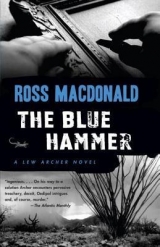
Текст книги "The Blue Hammer"
Автор книги: Ross MacDonald
Жанры:
Триллеры
,сообщить о нарушении
Текущая страница: 10 (всего у книги 18 страниц)
chapter
26
The Monte Cristo was a three-story stucco hotel that had once been a large private residence. Now it advertised “Special Rates for Weekenders.” Some of the weekenders were drinking canned beer in the lobby and matching coins to see who was going to pay for it. The desk clerk was a little doll-faced man with an anxious look that intensified when he saw me. I think he was trying to decide whether I was a cop.
I didn’t tell him whether I was or not. Sometimes I didn’t even tell myself. I asked him if Paola Grimes was in. He gave me a puzzled look.
“She’s a dark girl with long black hair. Good figure.”
“Oh. Yeah. Room 312.” He turned and examined her key slot. “She isn’t in.”
I didn’t bother asking him when to expect Paola. He wouldn’t be likely to know. I kept her fifty dollars in my wallet and made a mental note of her room number. Before I left the hotel, I looked into the bar. It was a kind of post-historic ruin. All the girls waiting there were blond. Outside, along the beach front, there were a number of women with long black hair but none of them was Paola.
I drove uptown to the newspaper building and left my car at a fifteen-minute curb in front of it. Betty was at her typewriter in the newsroom. Her hands were quiet on the keys. She had faint blue circles under her eyes, no lipstick on her mouth. She looked dispirited, and she failed to brighten appreciably when she saw me.
“What’s the matter, Betty?”
“I haven’t been making good progress on the Mildred Mead thing. I can’t seem to find out enough about her.”
“Why don’t you interview her?”
She screwed up her face as if I’d threatened to slap her. “That isn’t funny.”
“It wasn’t meant to be. Mildred Mead has a box in the Santa Teresa post office, number 121 in the main branch. If you can’t get to her through that, she’s probably in one of the local nursing homes.”
“Is she sick?”
“Sick and old.”
Betty’s eyes, her whole face, changed and softened. “What on earth is she doing here in Santa Teresa?”
“Ask her. And when she tells you, you tell me.”
“But I don’t know which nursing home she’s in.”
“Call all of them.”
“Why don’t you?”
“I want to talk to Captain Mackendrick. Besides, you can do a better job on a phone check. You know the people in this town and they know you. If you locate her, don’t say anything to scare her off. I wouldn’t mention that you work for a newspaper.”
“What shall I say?”
“As little as possible. I’ll check back with you.”
I drove across the center of town to the police station. It was a stucco oblong that lay like a dingy sarcophagus in the middle of an asphalt parking lot. I talked my way past an armed and uniformed woman guard into Mackendrick’s office, which was small and bleak. It contained a wall of files, a desk and three chairs, one of which was occupied by Mackendrick. Across the single window there were bars.
Mackendrick was studying a typed sheet that lay flat on the desk in front of him. He was slow in looking up. I wondered if this was meant to imply that he was more important than I was, but not important enough. He finally raised his impervious eyes to mine.
“Mr. Archer? I thought you’d left town for good.”
“I went to Arizona to pick up the Biemeyer girl. Her father flew us back in one of his company’s jets.”
Mackendrick was impressed, and slightly startled, as I had meant him to be. He massaged the side of his crumpled face with his hand, as if to reassure himself of its solidity.
“Of course,” he said, “you’re working for the Biemeyers. Right?”
“Right.”
“Does he have some special interest in the Grimes killing?”
“He bought a picture from Grimes. There’s some question whether it’s a phony or a genuine new Chantry.”
“If Grimes had anything to do with it, it probably is a phony. Is that the picture that was stolen?”
“It wasn’t exactly stolen,” I said, “at least not the first time around. Fred Johnson took it to make some tests on it at the art museum. Somebody stole it from there.”
“Is that Johnson’s story?”
“Yes, and I believe it.” But even to me the story had sounded weak in my retelling.
“I don’t. Neither does Biemeyer. I’ve just been talking to him on the phone.” Mackendrick smiled in cold pleasure. He had taken a point from me in the endless game of power that complicated his life. “If you want to go on working for Biemeyer, you better check with him about some of those little details.”
“He isn’t my only source. I’ve talked to Fred Johnson at some length, and I don’t believe he’s a criminal type.”
“Nearly everybody is,” Mackendrick said. “All they need is the opportunity. And Fred Johnson had that. He may even have been in cahoots with Paul Grimes. That would be quite a trick, to sell a phony Chantry, then steal it back before it could be detected.”
“I thought of that possibility. But I doubt that it happened. Fred Johnson isn’t capable of planning and carrying out an action like that. And Paul Grimes is dead.”
Mackendrick leaned forward with his elbows on his desk, his left palm and his right fist forming a ball joint under his chin. “There may be others involved. There almost certainly are. We may be dealing with an art-theft ring of queers and addicts. It’s a crazy world.” He disengaged his hands and waved his fingers in front of his face, miming the wildness of the world. “Did you know Grimes was a queer?”
“Yes. His wife was telling me that this morning.”
The captain’s eyes widened in astonishment. “He has a wife?”
“He had. She told me they’ve been separated for years. She runs an art shop in Copper City under her married name.”
Mackendrick penciled a note on a yellow pad. “Is Fred Johnson queer?”
“I doubt it. He has a girl.”
“You just got finished telling me that Grimes had a wife.”
“It’s true, Fred could be bisexual. But I’ve spent a fair amount of time with him now, and haven’t seen any evidence of it. Even if he is, it doesn’t make him a thief.”
“He stole a picture.”
“He took it with the knowledge and permission of the owner’s daughter. Fred is a budding art expert. He wanted to test the picture for age and authenticity.”
“So he says now.”
“I believe him. I honestly don’t think he belongs in jail.”
Mackendrick’s palm and fist came together again like parts of a machine. “Is Fred Johnson paying you to say this?”
“Biemeyer is paying me to recover his picture. Fred Johnson says he hasn’t got it. I think it’s time we looked elsewhere. In fact, that’s what I’ve been doing, more or less accidentally.”
Mackendrick waited. I told him what I had learned about Paul Grimes’s early life in Arizona, and about his relationship with Richard Chantry. I also told him about the death of Mildred Mead’s illegitimate son, William, and the quick departure of Richard Chantry from Arizona in the summer of 1943.
Mackendrick picked up his pencil and began to draw connected squares across the yellow paper, a series of squares like a random chessboard representing the precincts of the city or his mind.
“This is new information to me,” he admitted finally. “Are you sure that it’s good information?”
“I got most of it from the sheriff who handled the William Mead killing. You can check with him if you want to.”
“I’ll do that. I was in the army when Chantry came here and bought that house on the ocean. But I got out and joined the force in 1945 and I was one of the few people who got to know him personally.” Mackendrick spoke as if his own experience and the history of the city had become almost synonymous to him. “I patrolled the beach front there for several years, until I made sergeant. That was how I became acquainted with Mr. Chantry. He was very security-conscious. He did a lot of complaining about people loitering around his house. You know how the beach and the ocean always attract out-of-towners.”
“Was he nervous?”
“I guess you’d say that. He was a loner, anyway. I never knew him to give a party, or even invite friends into his house. As far as I knew, he had no friends. He kept himself locked up in that house with his wife and a man called Rico, who cooked for them. And he worked. As far as I know, all he did was work. Sometimes he’d be up painting all night and I’d see the lights still burning in his house when I cruised by on the early-morning shift.” Mackendrick lifted his eyes, which had been emptied of the present and now became filled and perplexed by it again. “Are you sure that Mr. Chantry was a homo? I never knew one of them who liked hard work.”
I didn’t mention Leonardo for fear of confusing the issue. “I’m fairly certain. You could ask around.”
Mackendrick shook his head abruptly. “Not in this town I couldn’t. He’s Santa Teresa’s claim to fame—gone for twenty-five years, and still our leading citizen. And you be careful what you say about him.”
“Is that a threat?”
“It’s a warning. I’m doing you a favor giving it. Mrs. Chantry could sue you, and don’t think she wouldn’t. She’s got the local paper so bulldozed that they let her read it ahead of time whenever they mention her husband. Especially when they mention his disappearance, it has to be handled with kid gloves.”
“What do you think happened to him, Captain? I’ve told you what I know.”
“And I appreciate it. If he was a homo, as you say he was, then there’s your answer right there. He stayed with his wife for seven years and couldn’t stick it any longer. It’s one thing I’ve often noticed about homos. Their lives run in cycles; they can’t stay the course. And they have a tougher course to run than most of us.”
Mackendrick had succeeded in surprising me. There was a vein of tolerance in his granite after all.
I said, “Is that the official theory, Captain? That Chantry simply took off of his own accord. No murder? No suicide? No blackmailing pressure?”
Mackendrick took in a deep whistling breath through his nose, and blew it out through his lips. “I wouldn’t attempt to tell you how many times I’ve been asked that question. It’s just about my favorite question by now,” he said with irony. “And I always give the same answer. We never came up with any evidence at all that Chantry had been killed, or forced to leave. As far as we were able to establish the facts, Chantry left here because he wanted to start a new life. And what you tell me about his sexual background only confirms it.”
“I assume his farewell letter was checked out in every way.”
“Every way possible. Handwriting, fingerprints, source of stationery—everything. The writing and the prints and the stationery were all Chantry’s. There was no evidence that the letter was written under duress, either. And no new evidence has come up in the twenty-five years since then. I’ve had a special interest in the case from the beginning, because I knew Chantry, and you can take my word for all this. For some reason, he got sick and tired of his life here in Santa Teresa, and he dropped out.”
“He may have dropped in again, Captain. Fred Johnson seems to think that the stolen picture is a Chantry, and a fairly recent one.”
Mackendrick made an impatient flinging gesture with his left hand. “I’d want a better opinion than Fred Johnson’s. And I don’t buy his story that the picture was stolen from the museum. I think he’s got it stashed someplace. If it is a genuine Chantry, it’s worth real money. And in case you don’t know it, Fred Johnson’s family is on the rocks financially. His father’s a hopeless drunk who hasn’t worked for years; his mother lost her job at the hospital under suspicion of stealing drugs. And no matter whether he lost it or sold it or gave it away, Fred is criminally responsible for the loss of that picture.”
“Not until he’s proved responsible.”
“Don’t give me that, Archer. Are you a lawyer?”
“No.”
“Then stop trying to act the part of one. Fred is where he belongs. You’re not. And I have an appointment with the deputy coroner.”
I thanked Mackendrick for his patience, without irony. He had told me a number of things I needed to know.
Leaving the police station, I passed my friend Purvis coming in. The young deputy coroner had the bright glazed look of a dedicated public servant on his way to get his picture in the paper. He didn’t even break stride as he went by.
I waited beside his official station wagon. Squad cars came and went. A flock of starlings flew over in a twittering cloud, and the first early shadow of evening followed them across the sky. I was worried about what might happen to Fred in jail, and regretful that I hadn’t been able to spring him.
Purvis came out of the station eventually, walking more slowly, with a certain weight of confidence.
I said, “What’s the word?”
“Remember the cadaver I showed you the night before last in the morgue?”
“I’m not likely to forget him. Jacob Whitmore, the painter.”
Purvis nodded. “He wasn’t drowned in the ocean after all.
We completed a very careful autopsy this afternoon. Whitmore was drowned in fresh water.”
“Does that mean he was murdered?”
“Probably. Mackendrick seems to think so. Drowned in somebody’s bathtub and chucked into the ocean afterwards.”
chapter
27
I drove out to Sycamore Point and knocked on the door of Jacob Whitmore’s cottage. It was opened by the girl he had left behind. The low sun touched her face with a rosy glow and made her narrow her eyes. She didn’t appear to recognize me.
I had to remind her who I was. “I was here the night before last. I bought some of Jake’s pictures from you.”
She shaded her eyes and studied my face. Hers was pale and unfocused. Her blond hair was uncombed, and it was lifted by the sundown wind pouring down the draw.
She said, “Are the pictures okay?”
“They’re okay.”
“I have some more if you want them.”
“We’ll talk about it.”
She let me into her front room. Nothing in it had changed essentially, but it had lapsed into more extreme disorder. A chair was lying on its back. There were bottles on the floor, fragments of enchilada on the table.
She sat at the table. I picked up the fallen chair and sat facing her. “Have you heard from the coroner this afternoon?”
She shook her head. “I haven’t heard from anybody; not that I remember, anyway. Excuse the condition of the room, will you, please? I drank too much wine last night and I must have had a tantrum. It seemed—it seems so unfair that Jake had to drown.” She was silent for a time, and then said, “They asked my permission to do an autopsy yesterday.”
“They did it today. Jake drowned in fresh water.”
She shook her bleached head again. “No, he didn’t. He drowned in the ocean.”
“His body was found in the ocean, but the water that killed him was fresh water. You can take the coroner’s word for it.”
She looked at me dimly through her half-closed eyes. “I don’t understand. Does that mean he drowned in a creek and his body was washed down into the sea?”
“That isn’t likely. The creeks are low in the summer. It probably means that he was drowned in a bathtub or a swimming pool, and whoever did it dumped his body here in the ocean.”
“I don’t believe it.” She looked around the room as if the murderer might be lurking behind the furniture. “Who would do that to Jake?”
“You tell me, Mrs. Whitmore.”
She shook her head. “We weren’t married. My name is Jessie Gable.” The sound of her name brought tears to her eyes. She blinked and the tears ran down her cheeks. “You’re telling me that Jake was murdered, aren’t you?”
“Yes.”
“I don’t understand. He never hurt a living soul. Except me. But I forgave him.”
“Murder victims don’t usually deserve it.”
“But he had nothing worth stealing.”
“Maybe he had. Didn’t Paul Grimes buy some of his pictures?”
She nodded. “That’s true, he did. But it wasn’t really the pictures that he wanted. I was here in the room when Grimes was talking to Jake. He was trying to get some information out of him, and he bought Jake’s pictures just to get him talking.”
“Talking about what?”
“The other picture. The picture that Jake had sold him at the beach art show, the day before.”
“And did Jake tell him what he wanted to know?”
“I don’t know. They went outside to talk about it. They didn’t want me to hear what they were saying.”
I got out my photograph of the Biemeyers’ stolen painting and showed it to her in the light from the window. “Is this the picture that Jake sold to Grimes the day before?”
She took the picture and nodded. “It certainly looks like it. It’s a really good picture and Jake got a lot of money for it. He didn’t tell me how much, but it must have been several hundred, anyway.”
“And Grimes probably sold it for several thousand.”
“Really?”
“I’m not fooling, Jessie. The people who bought the picture from Grimes had it stolen from them. I was hired to recover it.”
She sat up straight and crossed her legs. “You don’t think I stole it, do you?”
“No. I doubt you ever stole anything.”
“I didn’t,” she said firmly. “I never did. Except Jake from his wife.”
“That isn’t a felony.”
“I don’t know,” she said. “I’m being punished like it was. And so was Jake punished.”
“Everybody dies, Jessie.”
“I hope that I die soon.”
I waited. “Before you do,” I said, “I want you to do Jake a favor.”
“How can I? He’s already dead.”
“You can help me find the person or persons who killed him.” I took the photograph from her limp hands. “I think he was killed over this.”
“But why?”
“Because he knew or figured out who painted it. I’m winging, you understand. I don’t know for certain that that’s true. But I think it is. This picture was the connecting link between the two men who were killed, Jake and Paul Grimes.”
I remembered as I said it that a third man had been killed: William Mead, whose body was found in the Arizona desert in 1943, and whose mother was the subject of the picture. These facts coming together in my mind gave me a kind of subterranean jolt, like an earthquake fault beginning to make its first tentative move. I was breathing quickly and my head was pounding.
I leaned across the littered table. “Jessie, do you have any idea where Jake got this picture?”
“He bought it.”
“How much did he pay for it?”
“Fifty dollars at least—probably more. He wouldn’t tell me how much more. He took the fifty dollars I had in my safety fund—that’s money I kept in case we couldn’t pay the rent. I told him he was crazy to put out cash for the picture, that he should take it on consignment. But he said he had a chance to make a profit. And I guess he did.”
“Did you ever see the person he bought it from?”
“No, but it was a woman. He let that slip.”
“How old a woman?”
Jessie spread her hands like someone feeling for rain. “Jake didn’t tell me, not really. He said that it was an older woman but that doesn’t mean it was. She could be seventeen and he’d still tell me she was an older woman. He knew that I was jealous of the chicks. And I had reason to be.”
Tears rose in her eyes. I didn’t know whether they stood for anger or grief. Her feelings seemed to be fluctuating between those two emotions. So did mine. I was weary of questioning the widows of murdered men. But I still had questions to ask.
“Did the woman bring the picture here to the house?”
“No. I never saw her. I told you that. She took it down to the waterfront on a Saturday. These last years, Jake had a sideline buying and selling pictures at the Saturday art show. He bought the picture there.”
“How long ago was that?”
She was slow in answering, perhaps looking back over a flickering passage of days that seemed all the same: sun and sea, wine and pot and grief and poverty.
“It must have been a couple of months ago. It’s at least that long since he took my safety fund. And when he sold the picture to Paul Grimes he didn’t replace my fund. He kept the money himself. He didn’t want me to know how much it was. But we’ve been living on it ever since.” She scanned the room. “If you can call this living.”
I got a twenty out of my wallet and dropped it on the table. She scowled at it and then at me.
“What’s that for?”
“Information.”
“I couldn’t give you much. Jake was secretive about this deal. He seemed to think he was on to something big.”
“I think he was, too, or trying to get on to it. Do you want to try and dig up some more information for me?”
“What kind of information?”
“Where this picture came from.” I showed her the portrait of Mildred Mead again. “Who Jake bought it from. Anything else that you can find out about it.”
“Can I keep that photo?”
“No. It’s the only one I have. You’ll have to describe it.”
“Who to?”
“The dealers at the Saturday art show. You know them, don’t you?”
“Most of them.”
“Okay. If you come up with anything usable, I’ll give you another twenty. If you can give me the name or address of the woman who sold Jake this picture, I’ll give you a hundred.”
“I could use a hundred.” But she looked at me as if she didn’t expect to see it in this life. “Jake and I had bad luck. He’s had nothing but bad luck since he joined up with me.” Her voice was harsh. “I wish I could of died instead of him.”
“Don’t wish it,” I said. “We all die soon enough.”
“It can’t come too soon for me.”
“Just wait awhile. Your life will start again. You’re a young woman, Jessie.”
“I feel as old as the hills.”
Outside, the sun had just gone down. The sunset spread across the sea like a conflagration so intense that it fed on water.