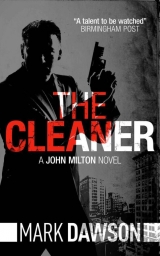
Текст книги "The Cleaner"
Автор книги: Mark Dawson
Жанры:
Шпионские детективы
,сообщить о нарушении
Текущая страница: 5 (всего у книги 19 страниц)
12
It took half an hour back at the office for the formalities of the lease to be taken care of. Milton paid the deposit and the advance rent in cash. There were no references or credit checks required, which was just as well, since a search of Milton’s details would not have returned any results. The agent asked him whether he was sure that the house was what he wanted, and, again, offered a handful of alternatives that he thought would be more appropriate. Milton politely declined the offer, thanked him for his help, took the keys and left the office.
There was a small mini-market serving the area. It was sparsely stocked, a few bags of crisps and boxes of cereal displayed under harsh strip lights that spat and fizzed. Alcohol and cigarettes, however, were well provided for, secured behind the Perspex screen from behind which the owner surveyed his business with suspicious eyes. Milton nodded to the man as he made his way inside and received nothing but a wary tip of the head in return. He made his way through the shop, picking out cleaning products, a carton of orange juice and a bag of ice. He took his goods to the owner arranged them on the lip of counter ahead of the screen. As the man rang his purchases up, Milton looked behind him to shelves that were loaded with alcohol: gin, vodka, whiskey.
The owner caught his glance? “You want?”
He paused, and almost wavered. 692 days, he reminded himself. 692 going on 693.
He needed a meeting badly.
“No, just those, please.”
Milton paid and returned to the maisonette. He unlocked the doors and scraped the security door against the concrete lintel as he yanked it aside. It didn’t take long to establish himself. He unpacked in the larger of the two bedrooms, hanging the clothes in a wardrobe made of flimsy sheets of MDF. He spread his sleeping bag out across the lumpy mattress, went downstairs to the kitchen and took out the mop and bucket he found in a small cupboard. He filled the bucket with hot water, added detergent, and started to attack the layers of grease that had stratified across the cheap linoleum floor.
It took Milton six hours to clean the house and, even then, he had only really scratched the surface. The kitchen was presentable: the floor was clean, the fridge and oven had been scoured to remove the encrusted stains, the utensils, crockery and surfaces were scrubbed until the long-neglected dirt had been ameliorated. There were mouse droppings scattered all about but, save clearing them away, there was nothing that Milton could do about that. He moved onto the bathroom, spending an hour scrubbing the toilet, the sink and the bath and washing the floor. When he was finally finished he undressed and stood beneath the shower, washing in its meagre stream of warm water until he felt clean. He put on a fresh t-shirt and jeans, took his leather jacket from where he had hung it over the banister, went outside and locked the door behind him. He set off for the main road.
He took out his phone and opened the bookmarked page on his internet browser. He double-tapped an icon and his mapping application opened. His destination was a three-mile walk away. He had an hour before the meeting, and it was a hot evening. He decided that rather than take the bus, he would walk.
St Mary Magdalene church was on the left-hand side of the road, set back behind a low brick wall, well-trimmed topiary and a narrow fringe of grass studded with lichen-covered gravestones from a hundred years ago. A sign had been tied to the railings: two capital As, set inside a blue triangle that was itself set within a blue circle. An arrow pointed towards the church. Milton felt a disconcerting moment of doubt and paused by the gate to adjust the lace of his shoe. He looked up and down the street, satisfying himself that he was not observed. He knew the consequences for being seen in a place like this would be draconian and swift; suspension would be immediate, the termination of his employment would follow soon after, and there was the likelihood of prosecution. He was ready to leave the service, but on his own terms, and not like that.
He passed through the open gate and followed a gravel path around the side of the building, descended a flight of stairs and entered the basement through an open door. The room inside was busy with people and full of the noise of conversation. A folding table had been set up and arranged with a vat of hot water, two rows of mismatched mugs, a plastic cup full of plastic spoons, jars of coffee and an open box of tea bags, a large two-pint container of milk, a bowl of sugar and a plate of digestive biscuits. The man behind the table was black and heavy-set, with a well-trimmed salt-and-pepper beard and hair cropped close to his scalp. His arms bulged with muscle and his shirt was tight around his chest and shoulders.
Milton approached the table.
“Can I get you a drink?” the man said.
“Coffee, please.”
The man smiled, took one of the mugs and added two spoonfuls of coffee granules. “Haven’t seen you before,” he said.
“My first time.”
The man poured hot water into the mug. “Your first meeting here or your first ever?”
“First time here.”
“Alright then,” the man said. A silence extended but, before it could become uncomfortable, the man filled it. “I’m Rutherford,” he said. “Dennis Rutherford, but everyone just calls me Rutherford.”
“John.”
“Nice to meet you, John.” He handed him the mug. “Help yourself to biscuits. The meeting’s about to get started. It’s busy tonight – go in and get a seat it I were you.”
Milton did. The adjacent room was larger, with a low, sloping ceiling and small windows that were cut into the thick brick walls that served as foundations for the church above. A table had been arranged at one end with two chairs behind it, and the rest of the space was filled with folding chairs. A candle had been lit on the table, and tea-lights had been arranged on windowsills and against the wall. The effect was warm, intimate and atmospheric. Posters had been stuck to the walls. One was designed like a scroll, with twelve separate points set out along it. It was headed THE TWELVE STEPS TO RECOVERY.
Milton took a seat near the back and sipped the cheap coffee as the chairs around him started to fill.
A middle-aged man wearing a black polo neck top and jeans sat at one of the chairs behind the table at the front of the room. He banged a spoon against the rim of his mug and the quiet hush of conversation faded away. “Thank you,” the man said. “Good to see so many of you – I’m glad you could come. Let’s get started. My name is Alan, and I’m an alcoholic.”
Milton sat quietly at the back of the room. Alan was the chairman, and he had invited another speaker to address the group. The second man said that he was a lawyer, from the city, and he told his story. It was the usual thing: a man who appeared to be successful was hiding a barrage of insecurities behind addictions to work and drink, a tactic that had worked for years but now was coming at too high a price: family, relationships, his health. The message was clichéd – Milton had heard it all before, a thousand times before – and yet the passion with which the man spoke was infectious. Milton listened avidly, and, when he looked at his watch at the end of the man’s address, half an hour had passed. The floor was opened after that and the audience contributed with observations of their own. Milton felt the urge to raise his hand and speak but he had no idea how best to start his story. He never did. Even if had been able to tell it, he would not have known where to start. There was so much that he would not have been able to relate. He felt the usual relief to be there, the same sense of peace that he always felt, but it was something else entirely to put those thoughts into words. How would the others feel about his history? The things that he had done? It made him feel secretive, especially compared to the searing honesty of those around him. They talked openly and passionately, several of them struggling through tears of anger and sadness. Despite the sure knowledge that he belonged there with them, his inability to take part made him feel like a fraud.
13
At the end of the meeting a group gathered to talk and smoke cigarettes outside. They smiled at Milton as he climbed the steps from the basement. He knew that their smiles were meant as encouragement for him to stop and speak. They meant well, of course they did, but it was pointless; he couldn’t possibly. He smiled back at them but did not stop. He had no idea what he would say. Far better to make a quick exit.
“Hey, man – hey, hey, hold up.”
Milton was at the gate, ready to turn onto the street to start the walk home. He paused, and turned back. The man who had been serving the coffee, Rutherford, was jogging across in his direction. Milton took a moment to consider him again. He was big, over six foot tall, and solid with it, several stones heavier than he was. He loped across the churchyard, moving with an easy spring that suggested plenty of strength in his legs.
“You don’t hang about,” he said as he reached him. “There’s a café down the road. People stop for coffee or a bite to eat, have a chat. You should come.”
Milton smiled. “Not for me. But thanks.”
“You didn’t speak in the meeting. There’s no point just sitting there, man, you got to get stuck in.”
“Listening’s good enough.”
“Not if you want to really make a difference. I had that problem myself, back when I first started coming. Thought it was crazy, no-one was gonna want to listen to my shit. But I got over it in the end. Eventually, the way I saw it, coming along and not doing anything was a waste of my time. That’s why I do the coffees – start small, right, and take it from there? You got to get involved.” Rutherford spoke slowly and deliberately, as if measuring each word. The effect was to imbue each with a persuasive weight. He was an impressive man.
“I suppose so.”
“Which way you headed, man? Back to Hackney?”
“Yes.”
“Me too. Come on – you don’t mind, we can walk together.”
“You don’t want to go to the café?”
“Nah, won’t make no difference if I miss it tonight. I’m up at six tomorrow, I should probably get an early night.”
Milton would have preferred to walk alone but there was something infectious in Rutherford’s bearing that stalled his objections and, besides, it didn’t look like he was going to take no for an answer. They set off together, making their way along Holloway Road towards Highbury Corner.
He started speaking. “What’s your story, then?”
Milton took a breath. “The same as most people, I suppose. I was drinking too much and I needed help to stop. How about you?”
“Same deal, man. I was in the Forces. Fifteen years. Saw some stuff I never want to see again. I only stopped feeling guilty about it when I was drunk.” He turned to look at him. “Don’t mind me being presumptuous, John, but you’re a soldier too, right?”
“Is it that obvious?”
“You know what it’s like – we got that look. Where did you serve? The Sandpit?”
“For a while.”
“Ireland?”
“Yes.”
“I been all over the place too, man. ‘See the world’, that’s what they told me when they were trying to get me to sign up, like it’s some glamorous holiday. It was fun for a while but then I saw what it was really all about. By the time I got wise to it I was a raging drunk.”
“What happened?”
“Look, I ain’t saying I’m not grateful for what the Army did for me. When I was a younger man, ten years ago, I got into all sorts of mess that I didn’t want to be getting involved in. Trouble, man, all kinds of trouble. Got myself in with a bad crowd from around here. Ended up doing plenty of things I regret. Drink and drugs – you know what it’s like. I got friends from around that time, plenty of them got banged up and a couple of them are dead. Could’ve easily been me. The army was a way to get away from all that.” He spoke fluently, settling comfortably into a story that he had clearly told many times before, probably at the meetings. “And it worked, least for a time. Took me away from here, broadened my horizons, gave me structure and discipline in my life. And those things are good things, things I needed. But they come at a price, right? The things I saw while I was out there doing my thing—” He paused. “Well, shit, it got so bad by the end that I could only live with myself with a drink inside me. You know what I mean?”
He was full of heat and passion. Milton said that he understood.
“I don’t take this life lightly, John. The way I see it, the Fellowship has given me a blessing. The gift of knowledge. I can see what’s wrong with how things are. I know the things that work and the things that don’t. Drink and drugs – they don’t. Not many people get given a chance to make a difference, but I did. And, one day at a time, I ain’t going to throw it away.”
They passed into the busy confluence of traffic and pedestrians circulating around the roundabout at Highbury Corner and moved onto Dalston Lane. Youngsters gathered outside the tube, ready to filter towards the pubs and bars of Islington High Street. Touts offered cheap rides, immigrants pushed burgers and hot dogs, drunken lads spilled out of the pub next to the station.
“How?” Milton asked him.
“How what, man?”
“How are you going to make a difference?”
“Boxing. I used to be a tasty heavyweight when I was a lad. I got to be big early, big and strong, and I had a right hand you didn’t want to get hit by. If I’d stayed with it, who knows? I wouldn’t have got into the trouble I did, that’s for sure, I wouldn’t have gotten into the army, and I reckon I was probably good enough to make a decent career out of it. I’m too old and out of shape for that now, but I’ve still got it all up in here.” He tapped a finger to his temple. “So I’ve set up a club for youngsters, see? Amateurs, girls and boys, all ages. They ain’t got nothing to do around here, nothing except run with the gangs and get into mischief, and I know better than most where that road leads. You’re a younger born here, you run with one of them gangs, there are two places for you to go: prison or the crematorium. The military is one way out, but I can’t recommend that no more. So I try and give them another way. Something else to do, some structure, some discipline, and you hope that’s enough. It can be the difference. And, the way I see it, if I help a handful of them get away from temptation, that’s good enough. That’s my job done.”
“I used to box,” Milton said, smiling for the first time. “A long time ago.”
Rutherford looked him up and down: tall, lean and hard. “You’ve got the look for it,” he said. “Cruiserweight?”
“Maybe these days,” Milton smiled. “Middleweight back then. Where’s the club?”
“Church hall on Grove Road, near the park. Monday, Wednesday and Friday nights and all day Saturdays. Got about twenty regulars now.” His eyes flashed with passion. “Got some kids who are on the fringes of the gangs. Some of them have potential. This one girl, man, you wouldn’t believe how hard she can hit. Like a pile driver, knocked this lad who was giving her lip into the middle of next week. He never gave her lip after that.” He grinned at the memory of it.
They reached Milton’s turning. “This is me,” he said.
Rutherford cocked an eyebrow in surprise. “You living on the Estate?”
“Yes.”
Rutherford sucked his teeth.
“Not good?”
“You’re in the worst bit of Hackney and Hackney’s different. You talk about Waltham Forest, you talk about Camden, Southwark, Lambeth, all the rest – sure, they got bad people there. Plenty of serious players. But here? Man, Hackney’s different. You understand? The boys here are more serious than anywhere else. Everyone is banging. I mean, everyone. You can’t even compare what it’s like here with them other places. You best be careful, you hear? Don’t matter how big you are, they won’t care about that. They got a knife or a shooter and they think you’re worth rolling, I’m telling you, man, it don’t matter how mean you look, they’ll do it.”
“Nice to meet you, Rutherford.”
“You too, John. You take it easy. Maybe I’ll see you at the meeting next week?”
“Maybe.”
“And say something next time, alright? You look like you got plenty on your mind. You’ll be surprised the difference it makes.”
Milton watched as the big man walked away from him. He turned off the main road and headed into the Estate, stopping at the mini-market to buy a bag of ice. He ignored the sullen aggression of the teenagers who were gathered outside the shop, the silence as he passed through them and then the hoots of derision, the calls of “lighty!” and “batty boy”, as he set off again. Most of them were young, barely in their teens. Milton did not give them a second look.
It was half-ten by the time he returned to the maisonette. He took the carton of orange juice and poured into one of the newly cleaned glasses. He opened the bag of ice and dropped in three chunks, putting the rest in the freezer. He took off his clothes and put his gun and holster under a pillow. He swilled the juice around to cool. He pulled a chair up to the window, then went and sat down, letting the hot air, the compound smell of baked asphalt and fried food, breathe over his body. He sipped the cool drink, feeling the tang against the back of his throat, felt it slide cold down his throat and into his stomach.
He filled up his glass again, this time with more ice, and sat back down. The bedroom overlooked the front of the house. He looked out onto the street and, beyond that, the looming mass of Blissett House. A group of young boys had gathered at the junction of the road, the glowing red tips of their cigarettes and joints flaring as they inhaled.
Milton felt restless. He went over and took his gun from beneath the pillow, slipped out the magazine and pumped the single round onto the bed. He tested the spring of the magazine and of the breech and drew a quick bead on various objects round the room. His aim was off, just a little, but detectable nonetheless. It was the tiny tremor in his hand. He had noticed it in France and it seemed to be getting worse. He snapped the magazine back. He pumped a round into the breech, put up the safety, and replaced the gun under the pillow.
He watched the kids outside for another five minutes, the sound of their raucous laughter carrying all the way back to the open window. Then, tired, he closed the curtains, finished undressing, and went to bed.
14
Elijah watched the Vietnamese hassling the shoppers as they came out of Tesco. They were in the car park, far enough away from the entrance to go unnoticed by the security guards. They stepped up to the shoppers with their trolleys full of groceries and held open the satchels that they wore around their shoulders. There were four of them, two men and two women, all of them slim and dark-haired. The satchels were full of pirated DVDs. They were given the brush off most of the time but, occasionally, someone would stop, rifle through the bags and hand over a ten pound note in exchange for a couple of them.
“You ready, younger?” said Pops.
“Yeah,” Elijah said. “Ready.”
“Off you go, then.”
He did exactly as Pops had instructed him. One of the Vietnamese women was distracted by Little Mark, who pretended to be interested in her DVDs. She kept her money in a small shoulder bag that she allowed to hang loosely across her arm. Elijah ran up to her and, her attention diverted, he yanked on the bag as hard as he could. Her arm straightened as he tugged the bag down, her fingers catching it. A second, harder tug broke her grip and he was away. He sprinted back again, the other boys following after him in close formation. The two men started in pursuit, vaulting the wall that separated the car park from the pavement and the bus stop beyond, but it did not take long for them to abandon the chase. They were outnumbered and being led into unfriendly territory. They knew that the money was not worth the risk.
They boys ran down Morning Lane, whooping and hollering, eventually taking a sharp left along the cycle path that ran underneath the East London Line. They sprinted up the shallow incline on the other side of the tunnel and slowed to a jog. Once they were in the Estate they found a low wall and sat down along it.
Pops held up his fist and Elijah bumped it with his. He beamed with pride. He knew he ought to keep his cool, hide away the excitement and happiness that he felt, but he could not help it. He did not care how foolish it made him look.
“How much you get?”
Elijah took the notes from his pocket and fanned through them. “Two hundred,” he reported.
“Not bad.” Pops reached across and took the notes. He counted out fifty and gave it back to Elijah. “Go on, younger, put that towards some new Jordans. You done good.”
Little Mark went into the minimart nearby and returned with a large bottle of cider and a bagful of chocolate. The cider was passed around, each boy taking a long swig of it. Elijah joined in when the plastic bottle reached him, the sickly sweet liquid tasting good as he tipped it down his throat.
“What did you get?” Kidz asked.
Little Mark opened the bag and emptied out the contents. He laid the bars out on the wall. “Twix, KitKat, Mars, Yorkie.”
“Too pikey.”
“Maltesers. Milky Way.”
“Too gay.”
“Got them for you, innit? Galaxy, Caramel – that’s it. You want something else, go get it yourself.”
Pops tossed the chocolate around and they devoured it.
“I gotta jet,” Pops said eventually, folding the wad of notes and sliding them into his pocket. “My woman wants to see me. I’ll see you boys tomorrow, aight?”
“Hold up,” Little Mark said. “I’m going your way.”
“Me, too,” Kidz said.
Elijah was left with Pinky. He wanted to go with the others but Pinky got up and stretched. “Come on,” he said. “I’ll walk back with you.”
They set off together, making their way through the Estate and cutting across a scrubby patch of grass. Pinky was a little older, and a little taller, than Elijah. His face was sharply featured, with a hook nose and prominent cheekbones. He was normally boisterous and brash, full of spiteful remarks, yet now he was quiet and brooding. Elijah quickly felt uncomfortable and wondered if there was a way he could disentangle himself without causing offence. They made their way through the Estate to a children’s playground. The surface was soft and springy beneath their trainers but the equipment had all been vandalised. The swings had been looped over the frames so that they hung high up, uselessly, and the roundabout had been pulled from its fixings. Vials of crack were crushed underfoot, shards that glittered like diamonds amid the dog mess, discarded newspaper and fast food wrappers.
“Let’s sit down here for a minute,” Pinky said, pointing to a bench at the edge of the playground. “Something I want to talk to you about.”
Elijah’s nerves settled like a fist in his stomach. “I got to get back to my Mums,” he said.
“You don’t want a quick smoke?” Pinky reached into his jacket and grinned as he opened his hand; he had a small bag of weed and a packet of Rizlas. “Sit yourself down. I wanna get high. Won’t take long.”
Elijah did as he was told and sat.
Pinky was quiet as he held the cigarette paper open on his lap and tipped a line of marijuana along the fold. He rolled the joint with dexterous fingers, sealed it and put it to his lips. He put flame to the end and sucked down greedily. He did not give the joint to Elijah.
“You quietened down now, little man,” he said.
“Yeah?” Elijah said, uncertainly.
“You don’t get wanna too excited.”
“What do you mean?”
“That big smile you had on your face back then. Like you’d won the fucking lottery. Robbing those nips ain’t nothing. Rolling that train weren’t, either. You ain’t done shit yet.”
Elijah was ready to fire back some lip but he saw the look in the boy’s face and decided against it. He knew banter, and this was something different; hostility sparked in his dark eyes and he could see it would take very little for the sparks to catch and grow into something worse.
“You don’t know me, do you?”
“What you mean?”
“You don’t know who I am.”
“Course I do.”
“So?”
“You’re Pinky,” he said with sudden uncertainty.
“That’s right. But you don’t know me, do you? Not really know me.”
“I guess not.”
“You know my brother? Dwayne? You heard of him?”
“No.”
The joint had gone out. Pinky lit it again. “Let me tell you a story. Five years ago, my brother was in the LFB, like me. They called him High Top. Your brother, Jules, he was in, too. The two of them was close, close as you can be, looked out for each other, same way that we look out for each other, innit?” He put the joint to his lips and drew down on it hard. “There was this one time, right, there was a beef between this crew from Tottenham and the LFB. So they went over there, caused trouble, battered a couple of their boys. Tottenham came over these ends to retaliate, and they found your brother and my brother smoking in the park. Like we are, right now. They got the jump on them, they was all tooled up and our brothers didn’t have nothing. Rather than stay and get stuck in, your fassy brother breezed. Straight out of the park, didn’t look back, forgot all about my brother. And he wasn’t so lucky. The Tottenham boys had knives and cleavers and they wanted to make an example out of him. They cut my brother up, bruv. Sliced him – his face, across his back, his legs, all over. Ended up stabbed him in the gut. He was in hospital for two weeks while they stitched together again. His guts – they was all fucked up. He weren’t never the same again. He has to shit into a bag now and it ain’t never going to get better. Turned him into a shadow of himself.”
“Fuck that,” Elijah managed to say. “My brother would never have done that.”
“Yeah? Really? Your brother, what’s he doing now?”
“We don’t see him no more.”
“Don’t go on like you don’t know. I seen him – he’s a fuckin’ addict. He was a coward then and now he’s a fuckin’ junkie.”
Elijah got up from the bench.
“Give me that money,” Pinky said.
Elijah shook his head. “No. Pops gave it to me. I earned it. It’s mine.”
“You wanna fall out with me, little man?”
“No—”
Pinky grabbed him by the lapels of his coat and shoved him to the ground. He fell atop him, pressing his right arm across his throat, pinning him down, and reached into the inside of his jacket with his left hand. He found the notes and pocketed them.
“Remember your place,” he said. “You ain’t nothing to me. You think you a gangster, but you ain’t shit. Give me lip like that again and I’ll shank you.” He took out a butterfly knife, shook it open and held the blade against Elijah’s cheek. “One jerk of my hand now, bruv, and you marked for life. Know what it’ll say?”
“No,” Elijah said, his voice shaking.
“‘Pinky’s bitch.’”
Elijah lay still as Pinky drew the cold blade slowly down his face. Pinky took a bunched handful of his jacket and pulled his head up and then, with a pivot, slammed him down again. The surface was soft but, even so, the sudden impact was dizzying. Pinky got up and backed away. He pointed at Elijah’s head and laughed. Elijah felt a dampness against the back of his crown and in the nape of his neck. He reached around, gingerly, expecting to find his own blood. He did not. Pinky had pushed him back into dog mess. The shit was in his hair and against his skin, sliding down beneath the collar of his jacket.
“Later, little man,” Pinky laughed at him. He left Elijah on the floor.
He bit his lip until the older boy was out of sight and then, alone, he allowed himself to cry.