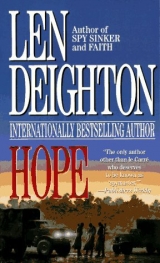
Текст книги "Hope"
Автор книги: Len Deighton
Соавторы: Len Deighton
Жанры:
Шпионские детективы
,сообщить о нарушении
Текущая страница: 8 (всего у книги 18 страниц) [доступный отрывок для чтения: 8 страниц]
'No.
'How do you clean your teeth?'
'In booze.'
'Red wine is a stain.'
'But Polish vodka is bleach.'
'Comics die younger than straight men. Have you noticed that, Bernard?' He wiped his nose again, and then folded his handkerchief and put it away. 'We'll have to get out of here very soon.'
'How soon is very soon?'
'Maybe tomorrow.'
'You don't want to check out his story about George being murdered?'
'What could we do?'
'Go and ask the cops if they are holding these Russkies. Give the cops some money to get lost, and then grill the Russkies.'
'Is that what you would do if I wasn't with you?'
'Shall I stay on?'
'Better we keep together,' said Dicky. 'You'd bribe the cops?'
'Possibly,' I admitted. I was exaggerating a little. Dicky brought out my desire to push it.
'We'll keep together, Bernard. As soon as Stefan gives me a proper certified copy of the death certificate we can get out of here.'
'I think we should check it out.'
'Do you know what that death certificate will empower me to do? George is a British subject. I'll get court authority to seize all his possessions. We'll go through him with a fine-tooth comb.'
'And is that what you really wanted all along?'
'That's part of what I wanted.'
'I see.'
'Why did Stefan stop playing cards tonight? Did I upset him earlier on when I asked if anyone around here owned an old Bugatti?'
'No. It was nothing to do with that, Dicky.'
'He jumped up suddenly and let the game end. And it was just as I hit a winning streak.'
'You didn't stand a chance, Dicky.'
'What puzzles me – he says he loses all his money on horses but tonight he won and won and won at cards.'
'They don't let him shuffle the horses,' I said.
He gave a pained smile. 'You don't think . . . ?'
'A man who can pull an ace of spades out of your ear is likely to know what you're holding in your hand.'
'No, no, no. Stefan is from a fine old family . . . goes back two hundred years. That old man Nico told me Stefan is a duke, or the Polish equivalent.'
'It's not mutually exclusive, Dicky. Cheating at cards and being a duke.'
'You haven't answered my question. Why did Stefan stop playing cards on the stroke of midnight?'
'Because he's going to Mass in the morning. Playing cards after midnight would have prevented him taking communion.'
'You're a bloody fund of information, Bernard,' he said, as though annoyed at having his question answered. 'Mass. Yes, I suppose that would be it.' Dicky went to his suitcase and got out a heavy roll-neck to wear over his pajamas. 'I'll say good night, Bernard.'
Thus I was dismissed. 'Good night, Dicky.'
It was three-thirty in the morning when I was awakened by a commotion from downstairs. I could hear men's voices shouting and a woman sobbing. I put on my trenchcoat over my pajamas and went downstairs. In the front hall there were two strangers in heavy overcoats, red-faced and radiating cold air. There were servant girls too, standing on the stairs with overcoats buttoned tightly over frilly nightclothes that were evident at throat and legs. Stefan was there too, but he was fully dressed in a three-piece suit complete with collar and tie.
'What's going on?' I asked.
'The alarm. They say the Russians have crossed the border,' said Stefan calmly. 'These two villagers are insisting that I must go with them to a meeting in the village.'
'An invasion?'
At that moment Dicky came down the stairs behind me. 'An invasion?' scoffed Dicky. 'They wouldn't dare . . .'
Stefan said, 'One of the young men has taken the short-wave radio upstairs. He'll connect it to the big antenna on the roof. He'll get the London overseas service. They will probably be the first to announce it if it's true.'
'Have these men seen anything?' Dicky asked.
'I will go with them. You may as well go back to bed and get some rest,' said Stefan. 'It's probably not true. These rumors spread very quickly when the vodka is flowing. Both these fellows stink of booze.' The two villagers smiled, not understanding what Stefan was saying about them in English.
A servant helped Stefan into a magnificent fur coat and he went out to where Karol the secretary was sitting at the wheel of a car, keeping the engine ticking over.
'Go to bed!' Uncle Nico told the servant girls, who had now grown in number, and he clapped his hands and raised his voice as he said it again.
'Could it be true?' Dicky asked Uncle Nico when the young women had hurried off to their beds.
'I doubt it,' said Uncle Nico. He lowered his voice. 'But what he didn't tell you is that two more bodies have been found. That's what the two farmhands came here for. Some drunks coming home through the forest stumbled over two dead bodies late last night. Two full-grown men thrown into the bottom of a ditch. God knows who they can be. It could be something to do with the rumors. In the village they are saying they must be Russian parachute spies.'
'Stefan should have waited for the radio,' said Dicky.
'He'll want to go to Mass,' confided Uncle Nico. 'There is a Mass at 5:50. Stefan likes to go early; he doesn't meet anyone he knows.'
Still not fully awake, I returned to my room, climbed back into bed and went into a deep sleep peopled with marching men and barking dogs, arguments with Dicky and a disinterred corpse. I woke up with a headache as I tried to distinguish dream from reality.
Dicky was already up and dressed. He was standing over me shaking me. 'The Russians are coming. You'd better get up and shave.' I could tell from his jokey voice that it was not true.
I got out of bed very slowly and became aware of the howling wind. When I went to the window I saw that the invasion from Russia had come, but it was in the shape of ice and snow. The blue sky had gone: snow was whipping past, the streaks of it almost horizontal in the fierce wind that was blowing all the way from the Steppes.
'We've got to get out of here right away,' said Dicky. 'The snow is falling heavily. We must get to the main road or we'll be snowed in until they dig us out, and that could take weeks.'
'It's not cold enough for snow to build up. It has to be colder than two degrees centigrade for it to survive and build up on the ground . . .'
'I'm not in the mood for another of your science lectures,' said Dicky with unaccountable fury and stomped out of the room.
'And the ground is still too soft for heavy tanks and artillery,' I called after him.
There was no hot water by the time I got into the bath. The hot tap of the shower produced a blizzard of cold rusty water and then spluttered and stopped altogether. I'd given up on the bath and was starting to shave in cold water when Stefan appeared at the door of the bathroom.
'Did you sleep?'
'Yes, I did,' I said.
'There is no truth in the invasion rumors. We get these crazy panies frequently and we are used to them. One day it will be true, of course, but by that time we will have grown accustomed to the notion and be ready to submit.' He said it with a bitterness that I'd not seen in him before.
Dicky came bearing three cups of hot sweet coffee from the kitchen. I interrupted my shaving to drink a mouthful and used the rest for shaving.
Stefan watched me without commenting. 'Everyone in Warsaw was complaining about the sudden shortage of black-market booze,' he confided. 'There's not a drop of the really good stuff to be had anywhere. You can name your own price for a case of Scotch whiskey or real French cognac. Foreign gangsters are moving in to take over from our own people. Two brothers from Cracow had the monopoly until now, but they have stopped trading. I heard they were enticed up into an apartment in Praga and nearly killed by American gangsters sent here specially to murder them. One of the brothers is in hospital with multiple fractures and the other is back home on crutches, and with his jaw in wires. Meanwhile all the tourist bars and illegal dives in the Old Town are desperate for supplies.'
'Umm,' said Dicky.
'Any guesses who they are?' Stefan asked me. 'They must have arrived about the time you did. Did you see anyone suspicious in the Europejski Hotel?'
'Me?' I said. 'No.' I dipped the razor in my coffee and continued dragging it through my beard.
'The underworld has put a price on their heads: fifty thousand zlotys for delivering either of these American killers to the black market people. At least that's what I heard.'
'That's only about fifteen hundred dollars apiece,' said Dicky. 'I'd have thought two top-notch hit men were worth more than that.'
'I'm sorry you are departing so soon,' said Stefan. 'But winter is not the best time to show you Polish hospitality. And we Poles enjoy providing a show for visitors.'
We were back on the road by noon, our bellies filled with hot potato soup and our gas tank with precious fuel. But we were still on the estate – and only three miles from the house – when we found the road ahead blocked by two army trucks and a bulldozer. There was a huddle of men: some soldiers were talking to two men hefting a l6mm film camera and recording equipment. Father Ratajczyk, the priest who had exorcized the rooms, was there too, together with Tadeusz, the technician who had assisted him.
A young officer of the Polish army, in sheepskin overcoat and military-style fur hat, detached himself from the group and walked towards us through the fast-falling sleet. He saluted and then leaned in to the car window.
'You're the two Englishmen from the Kosinski house?'
'Yes,' said Dicky. There was little point in denying it.
'I'm sorry to delay you. You can't get through. It will take about half an hour.' He spoke good English. 'We have to bring a big earth-moving machine up the road and there is only just enough clearance to get it between the trees.'
'What's happening?' said Dicky.
'We have to work quickly. By tomorrow the snow could be making it very difficult.'
'What's happening?'
'You don't know? Another mass grave. Trees have grown over a part of it and we can't estimate the size of it yet.'
'My God,' said Dicky. 'A mass grave?'
'At least five hundred bodies. My own guess is that there might be anything up to a thousand poor souls buried here.' He made the sign of a cross.
'They said they found two bodies last night,' said Dicky. 'Are they a part of it? When do they date from?'
'Yes, it's from the war,' said the young officer.
'Murdered by the Russians or by the Nazis?'
'Who knows?' said the officer, and wiped the wet snow from his face. 'They are Polish and they are dead, that's probably all we'll ever be sure about.'
5
Kent, England.
'You haven't told me what it's like in Warsaw these days,' said Harry Strang, newly retired and relaxed in his baggy roll-neck sweater and worn corduroy trousers. I was used to him in suits and stiff collars, and with his hair combed to conceal the bald patch that I now noticed for the first time.
'I haven't told you that I've been to Warsaw.'
'You can't keep a secret from an old agent. Isn't that what they say?' Harry Strang was one of the few pen pushers who could legitimately claim to have been an agent. I'd first met Harry in Berlin. I was very young, and too insensitive to see how miserable and out of place he felt in that city. It was my father who persuaded him not to resign from the service altogether. Harry was posted to Spain and made his reputation infiltrating Catalonian communist networks at a time when the Franco government had made communism a hazardous faith. Despite his remarkable Spanish, Harry couldn't look anything but what he is: a middle-class English gent, but he moved easily amongst an assortment of Spanish reds: terrorists, apparatchiks, opportunists, theorists and politicians. Then with Franco on his deathbed, Harry went to Argentina and worked for a shipping company, and was there working for us right through the Falklands; war. Apart from the fingernails that never grew straight after being torn off, malfunctioning kidneys damaged during a series of beatings in Franco's police stations, and a liver that was the casualty of cheap Rioja and inferior sherry, he had survived intact. Eventually he had been given a position in Operations in London and stayed there long enough to collect his pension. Not many field agents managed that.
'The kids are climbing around your Peugeot,' I warned him.
'It's an old wreck. Come away from the window. Let them alone, they can't hurt it, Bernard.'
'You haven't left the keys in?'
'Why kidnap your kids if you're going to spend every minute worrying about them?'
'I didn't kidnap them; I told my father-in-law I was collecting them from school.'
'You said you left a message on his telephone recording machine,' he corrected me. 'You didn't actually tell him.'
'What's the difference?'
'If he doesn't monitor his messages before he collects the kids from school himself, you'll find out what the difference is,' he said grimly. 'He'll tell the cops, and the TV news will say they are hunting for a tall child molester with wavy hair and glasses.'
'Very funny.'
'It wasn't a joke, Bernard.'
'My father-in-law monitors his bloody messages every five minutes. He was born with a telephone in his ear and right now he's frantically picking up the pieces after the stock market crash.'
Without moving from his chair, Harry looked out of the window at the full extent of his property. No doubt he saw five acres of root vegetables, soft fruit and a dozen plump pigs, but winter had all but eliminated the vegetation, and left only a ramshackle shed in a sea of shiny mud. With only a scrawny youngster to help him it was too much work, but Harry seemed to be content.
'They are nice kids, Bernard. The boy is the image of you.' We had eaten lunch, squelched through the mud in borrowed boots, been shown round the pigsties by a soft-spoken amiable farmhand, and come back inside to drink tea and inspect every last one of Harry's collection of Japanese swords.
I hear Dicky is very active lately,' said Harry, keeping his tone neutral.
'Very active,' I said. 'He's fighting with Daphne so he tries to get away every weekend. And he drags me with him. Then he gives me odd days off. But what good is that when Fiona is at work and my kids at school?'
Harry ran his hands together, pushing the fingers of his white cotton gloves tighter on his fingers. 'The children should be living at home with you,' he said. He rescued a sword which was precariously balanced on the sofa, and held it up to admire the engraving on its blade. There were swords everywhere; on the floor, on the sofa and on the dining table. Glittering blades and shiny scabbards were exploding out of the little box room where he stored his collection, protruding through the door as if some huge metallic hedgehog was trying to break out from hibernation there.
I know,' I said.
'But Fiona is keeping busy at work eh?' He slashed the air with the sword and then slid it into its scabbard. He found a place for it on the sideboard which had been until then the only place free of edged weaponry.
'She's Dicky's Deputy,' I said.
'I heard. And he's hanging on to the German Desk and running the Europe Desk too?'
'Only because Fiona is there to do the real work – trying to keep the networks running on less and less money.'
'Any familiar faces in Warsaw?'
'Only Boris.'
'Boris Zagan?'
'Who else.'
'Was that girl with him? . . . the German one?'
'Sarah. Yes, she was there. She's married to Boris.'
'Is that so? The way I heard it she was whoring for him.'
'I don't think so,' I said. He opened a simple but beautifully made wooden box. From it he took a sword and held it up to me. 'Personally inscribed as a presentation sword for General Hoyotaro Kimura.'
I looked at it and nodded my appreciation. But swords all look very alike to pacifists like me.
Perhaps sensing that, he added, 'Burma: the commander of the Japanese 15th Army.'
'Yes,' I said as he put the sword away in its box again.
'You were always sweet on her. In Berlin . . . when you were a teenager doing little jobs for your Dad. I remember you were mad about her then.'
'No,' I said. Harry looked at me with raised eyebrow. 'We were just kids,' I said. 'Silly teenagers.'
'Not her. She'd grown up in a hurry. Women had to grow up fast in Berlin in those funny old times. She was jumping into bed with everyone who beckoned. Five cigarettes a time is the way I heard it. American cigarettes.'
'You always were a romantic,' I said.
'And you always were a pragmatist, weren't you, Bernard?'
'I don't know; I've never pragmarred.'
'You didn't come down here so that your kids could play hide-and-seek among my dead cabbages. And to get a bellyful of canned lager and that lousy rubber quiche, which I notice even you didn't finish.'
'Why did I come?' I said.
He stared at me and furrowed his brow as if thinking about it for the first time. 'Perhaps because I spent nearly five years sitting in the Deputy Director-General's office filling in his appointment books and keeping the riffraff at bay. That's usually why Department people want to see me out of office hours.'
So there were others? He'd only been retired five minutes. Or did he mean before retirement? 'Never a social call?'
'Sometimes. But not from you, Bernard. You are not a starry-eyed teenager any longer. You haven't been starry-eyed for a long time. You've changed a lot.' I wanted to explain but he waved me silent. He'd warmed to the idea of guessing what I had come to discuss with him. 'Which year would it be . . . ' he said, as if thinking aloud. 'It won't be anything about your Dad. I wasn't there at the right time to have ever dealt with your Dad's personal files. No, it will be something about that time when the German Desk fell vacant, and you and Dicky Cruyer were the contenders for it.' He looked at me and smiled. 'You had a lot of ardent supporters, Bernard. Let me say it – you were the best man for the job. Is that what you wanted to know about? The arguments and the meetings and how the old man finally turned you down for it?'
The pained smile was back on his leathery face. His eyes moved as if he was daring me to say yes. As if he could provide me with some remarkable and scandalous facts if I wanted to hear them.
'It wasn't about that,' I said.
'No?' His face was set in that jovial but omnipotent grimace that you see in cheap bronze Buddhas. After his field work he'd come to the office and ended up as a not-unusual example of the Eton Oxbridge Buddha class: sadistic, self-sufficient apparatchiks who controlled Whitehall by stealth, wealth and consanguinity and – no matter how friendly – inevitably closed ranks against intruders like me. Could I have become a Harry Strang? A close friend of my father, Silas Gaunt, had put my name down for Eton and offered to pay the fees, but my self-made father was strongly opposed to having his son made into a janissary who would fight the battles of the ruling class. Better, said my father, that I remained with my family, went to the local school with the Berlin boys I played with in the street. My father told his friends (although he never told me) that I would grow up with such an intimacy with Germany and Germans that I would inevitably rise to become Director-General.
Well, Dad proved wrong. A Berlin school – even if you were the top scholar there – was no preparation for Whitehall. Or for boys like Harry Strang and Dicky Cruyer, who had grown up learning how to survive the loves, tear-, and terrors of expensive English boys' boarding schools; learning how to conceal all human feelings until they faded and stopped coming back.
'No,' I said. 'I want to know about the night we brought my wife out of the East.'
'What can I tell you about that, Bernard? You were there. You shot the bastards who trapped her. You brought her to Helmstedt and safety.'
'I need some background,' I said. 'Who gave the order? Who chose that night for it?'
'You remember. There was that fancy-dress party . . . Half Berlin was celebrating at Tante Lisl's hotel. It was perfect timing.'
'There must have been a written order?'
'No. It would have been left to the people on the spot,'
'I don't think so, Harry,' I said. 'Frank Harrington, the Berlin Rezident, was technically the senior man. He certainly didn't know it was happening until the Sunday morning. Dicky Cruyer, from London, was at the party. He came out to find me and ask what was happening. Who gave the order, Harry? It would require at least twenty-four hours to fix up all the preparations. There was a chopper waiting at Helmstedt, and the RAF positioned a big transport plane for us. We were flown directly to America that same night. There was a hell of a lot of planning. Interservice planning; you know how long that takes.'
'Yes, you're right. There were a lot of people on stand-by: soldiers, field agents and our own liaison people at the border posts. It's coming back to me now. The RAF were phoning and complaining about the delay. They'd been told to supply a doctor, and after six hours waiting in the transit barracks the quack buggered off to a local bar and got paralytic drunk.'
'So who arranged it all?'
'You did, in effect. You were briefed by Frank weren't you? You went to the rendezvous and blew away two Stasi men, or KGB or whatever they were.'
'Why do you say that?'
'It was in the report you wrote.'
'I never wrote any report.'
'Then you must have told Bret Rensselaer when he debriefed you in California.'
'And he told you?' Harry smiled one of his inscrutable smiles. Artfully he had led the conversation away from my question. 'But I am still curious about who gave the order. When was the decision made? There must have been meetings with someone at top level.'
'There was no time.'
'Even a phone call would have gone into the log, Harry.'
'Not this one.'
'Planting my wife in the DDR was the greatest hit the Department ever scored. It was vital to bring her out happy, healthy and intact. It had to be a story to be told to the politicians, and that means one with a happy ending. The decision about when and how to bring her out was going to be decisive. The D-G would have to be kept informed, even if he didn't give the order.'
'I was the personal assistant to the Deputy, not to the D-G himself The D-D-G was not always a party to the day-to-day operational doings. Especially tricky ones.'
'That famous Strang total recall is letting you down, Harry,' I said. 'You weren't with the Deputy at that time. The D-G's PA was in hospital; you worked for the D-G while the Deputy's secretary filled in for you with the Deputy.'
'What a memory you've got, Bernard,' he said, without demonstrating unbridled admiration or delight. 'Yes, of course, young Morgan was in hospital with gunshot wounds.' He smiled. Morgan – the old man's personal assistant – had suffered multiple minor wounds to his leg when a fellow guest at a weekend shooting party discharged a shotgun by accident. By the time the story got to the office, it was inevitably Morgan's ass that was the target, and in some embellishments it was an irate husband who fired the gun. Harry Strang allowed himself a chuckle; Morgan was not the most popular man in London Central. I waited. I could see that Harry was putting something together in his mind. 'Yes, there were meetings. But I don't know who he was with, or where they took place.'
'Away from the office, you mean?'
'You know what the old man is like. He's getting old and eccentric. He pops up here and there, like a jack-in-the-box. That's why he's always had two duty drivers. There were days when he was not in the office at all. The Thursday and Friday before the weekend that Fiona came out. On those days the D-G didn't come in to the office at all as I remember it.'
'It's been great, Harry. But I must be getting along,' I said, getting to my feet.
'I wish I could give you more details.'
'It was just idle curiosity,' I said. 'But I suppose we'll never know the whole story.'
'Not many people know the whole story about anything,' said Harry.
'Can I help with the washing up?'
'I have a machine,' said Harry.
'I'll see if the kids want to use the bathroom.'
As I got to the back door Harry touched my arm. 'You should have been given the German Desk, Bernard. Everyone said so. But the old man was against it.'
I opened the back door and shouted, 'Sally! Billy! We're leaving now. Come and say thank you to Uncle Harry.' The clouds had become a cauldron of molten lead, silvery-gray cumulus boiling and swirling around the red blobby parts. And yet the sky behind the clouds remained clear blue, as if from some other day and some other season.
'They treated your Dad badly,' Harry said softly as we watched the children slowly and reluctantly getting out of his old car. 'The D-G was afraid that giving you the German Desk would seem as if the Department was trying to make amends for that past wrong they did your Dad, and for God knows what else.'
'We couldn't have that,' I said sarcastically.
'No, that would never do. You won't stay for tea?'
'I must get back on the road,' I said.
The children arrived breathless, having run from the end of the garden. 'Do you want to use the bathroom?' I asked.
'What does a Frenchman eat for breakfast?' Billy asked Harry Strang. He'd already used his joke on me.
'I don't know,' said Harry, playing along with him.
'Huit heures bix,' said Billy and laughed. Sally laughed politely too. 'Weetabix,' Billy repeated, in case we had missed the joke. Harry produced a fine baritone laugh.
'It's a long drive to Grandma,' I said.
'It will seem even longer if he tells us all his corny jokes,' Sally said.
'Dad said he likes corny jokes,' said Billy. 'I save them for him. Isn't that right, Dad?'
'There's no joke like an old joke,' I said.
'That's right,' said Harry. 'It's like friends.' He looked at me as if trying to decide whether our friendship had anything going for it.
Billy went upstairs to the bathroom while Sally cleared away the dishes on the table. Harry began putting his swords back into the cupboard where they belonged.
'Lovely kids, Bernard. They are a credit to you. I thought your boy would have been keen on the swords.'
'He is,' I said, 'but he hates white gloves.'
'You can't handle them with your bare hands,' said Harry, who was not renowned for joke recognition. 'The acid perspiration would destroy the blades.' Harry looked at each sword lovingly as he put it away. 'Yes, nice kids. Count your blessings, Bernard.' Harry's voice was different now; warmer and more trusting. 'I wish my marriage had lasted, but you can't have everything. It took me a long time to realize that, but it's true.'
'When did the heavy-glove men come here, Harry?' I said. 'Am I a lot too late?'
'Don't be silly, Bernard.' The shutters came down with a clang and his face was blank.
'Yesterday? Last week? What did they say they would do? They can't touch your pension can they?'
'Careful how you drive, Bernard. Those Frenchmen, in the big trucks coming from the ferry, drive like maniacs. Sometimes I wonder if it's all that vin rouge.'
'How do they do it? I've often wondered. High-level, low-level, or anonymous? Do they send one of those bastards from Internal Security?'
He smiled another of those mirthless smiles. It completely prevented one reading anything into his expression; maybe that's why he did it. 'I miss the old man,' he said. 'I enjoyed my time working on the top floor. And Sir Henry is a gentleman of the old school. Even during the hectic days when your wife was coming out, he went down to pay his respects to Uncle Silas. He kept in touch to make him feel he was still a part of things.' Harry looked at me. 'Uncle Silas was sick. He'd fallen off a horse, they said.'
'He was too old for horses.'
'That's what I thought,' said Harry sharply, as if I had suddenly solved a mystery that had puzzled him.
I knew it was as far as Harry would go. In reversed circumstances – with a pig farm and pension in the balance – it was perhaps more than I would have risked for him.
As we were departing, Harry's young farmhand came up the path carrying a bucket of newly dug potatoes. He was very muddy and looked perished with the cold, but he wore the same gentle bemused smile that he'd worn when showing us his favorite porkers.
'Come along, Tommy!' Harry shouted to him. 'Come in and get warm. I'm brewing up some tea.'