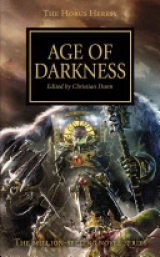
Текст книги "Age of Darkness"
Автор книги: Кристиан Данн
Жанр:
Боевая фантастика
сообщить о нарушении
Текущая страница: 17 (всего у книги 22 страниц)
Hibou Khan fled, leaving twelve men of Aximand’s company dead by his own hand, and earning himself a place on Aximand’s death list.
A new helm was forged for him, with the half-moon above the right eye. The armourers were already busy graving Mournival marks to the helms of Grael Noctua and Falkus Kibre. When Aximand was shown the pieces of his old headgear, he saw that the blade had sliced his half-moon mark in half.
Had he been a man prone to superstition and belief in omens, he might have read bad things into this. But he was not afraid of change. He was not really even a man.
Under the surgeon’s knife, in stasis sleep, he had dreamt one final dream. The identity of the faceless intruder had ultimately been revealed. Aximand had been slightly apprehensive that the intruder’s face would turn out to be his own, or one just like it, and that lengthy psychological work would be required as a consequence.
It was not. As they restored his face, he dreamt the face of the other.
It was the face of Garviel Loken.
When Aximand woke, he felt a measure of happiness and relief. A man could not be afraid of the dead, and Loken was dead, and that fact would not change.
Not that he was afraid of change. Change was, he always insisted, part of his ruling character.
‘The melancholic humour is protean,’ he said. ‘It possesses the quality of autumn. It is transformative. It makes me the accelerator of death, the enabler of ends and beginnings. I was made to clear away this world ready for renewal. To change the order of things. To cast out the false and enthrone the true. This is my purpose. I am not afraid.’
Then again, once they reattached his face, all he ever really looked was invincible.
THE IRON WITHIN
Rob Sanders
THE IRON WITHIN. The iron without. Iron everywhere. The galaxy laced with its cold promise. Did you know that Holy Terra is mostly iron? Our Olympian home world, also. Most habitable planets and moons are. The truth is we are an Imperium of iron. Dying stars burn hearts of iron; while the heavy metal cores of burgeoning worlds generate fields that shelter life – sometimes human life – from the razing glare of such stellar ancients.
Empires are measured in more than just conquered dirt. Every Iron Warrior knows this. They’re measured in hearts that beat in common purpose, thundering in unison across the void: measured in the blood that spills from our Legiones Astartes bodies, red with iron and defiance. This is the iron within and we can taste its metallic tang when an enemy blade or bullet finds us wanting. Then the iron within becomes the iron without, as it did on what we only now understand to be the first day of the Great Siege of Lesser Damantyne…
THE WARSMITH STEPPED out onto the observation platform, each of his power-armoured footfalls an assault on the heavy grille. The Iron Warrior’s ceramite shoulders were hunched with responsibility, as though the Space Marine carried much more than the deadweight of his Mark-III plate. He crossed the platform with the determination of a demigod, but the fashion in which his studded gauntlets seized the exterior rail betrayed a belief that he might not make the expanse at all. The juggernaut ground to an irresistible halt.
A rasping cough wracked the depths of his armoured chest, his form rising and falling with the exertion of each tortured, uncertain breath. Imperial Army sentries from the Ninth-Ward Angeloi Adamantiphracts watched the Warsmith suffer, uncertain how to act. One even broke ranks and approached, the flared muzzle of his heavy carbine lowered and scalemail glove outstretched.
‘My lord,’ the masked soldier began, ‘can I send for your Apothecary or perhaps the Iron Palatine…’
Lord Barabas Dantioch stopped the Adamantiphract with an outstretched gauntlet of his own. As the Warsmith fought the coughing fit and his convulsions, the armoured palm became a single finger.
Then, without even looking at the soldier, the huge Legiones Astartes managed: ‘As you were, wardsman.’
The soldier retreated and a light breeze rippled through the Iron Warrior’s tattered cloak, the material a shredded mosaic of black and yellow chevrons. It whipped about the statuesque magnificence of his power armour, the dull lustre of his Legion’s plate pitted with rust and premature age, lending the suit a sepia sheen. He wore no helmet. Face and skull were enclosed in an iron mask, crafted by the Warsmith himself. The faceplate was a work of brutal beauty, an interpretation of the Legion’s mark, the iron mask symbol that adorned his shoulder. Lord Dantioch’s mask was a hangdog leer of leaden fortitude with a cage for a mouth and eyes of grim darkness. It was whispered in the arcades and on the battlements that the Warsmith was wearing the mask – pulled glowing from the forge – as he hammered it to shape around his shaven skull. He then plunged head and iron into ice water, fixing the beaten metal in place forever around his equally grim features.
Gripping the platform rail, Dantioch drew his eye-slits skywards between his hunched, massive shoulders and drank in the insane genius of his creation. The Schadenhold: an impregnable fortress of unique and deadly design, named in honour of the misery that Dantioch and his Iron Warriors might observe if ever an enemy force was foolish enough to assault the stronghold. During the process of Compliance, as part of the Emperor’s strategy and holy decree, thousands of bastions and citadels had been built on thousands of worlds, so that the architects of the Great Crusade might watch over their conquered domain and the new subjects of an ever expanding Imperium. Many of these galactic redoubts, castles and forts had been designed and built by Dantioch’s Iron Warrior brothers: the IV Legion was peerless in the art of siege warfare, both as besiegers and the besieged. The galaxy had seen nothing like the Schadenhold, however – of that Dantioch was sure.
Under his mask the Iron Warrior commander’s pale lips mumbled the Unbreakable Litany. ‘Lord Emperor, make me an instrument of your adamance. Where darkness is legion, bless our walls with cold disdain; where foolish foes are frail, have our ranks advance; where there is mortal doubt, let resolution reign…’
The Warsmith had blessed the Schadenhold with every modern structural fortification: concentric hornworks; bunkers; murder zones; drum keeps; artillery emplacements and kill-towers. The fortress was a monstrous study in 30th Millennium siegecraft. For Dantioch, however, location was everything. Without the natural advantages of material, elevation and environment, all other architectural concerns were mere flourish. A stronghold built in a strategically weak location was certain to fall, as many of Dantioch’s kindred in the other Legions had discovered during the early trials of Compliance. Even the Imperial Fists had had their failures.
Dantioch had hated Lesser Damantyne from the moment he had set foot on the dread rock and had felt instantly that the planet hated him also. It was as though the world did not want him there and that appealed to the Warsmith’s tactical sensibilities: he could use Damantyne’s environmental hostilities to his advantage. The small planetoid was situated in a crowded debris field of spinning rock, metal and ice that made it seem unfinished and hazardous from the start. The cruisers of the 51st Expedition that had brought the Warsmith and his Iron Warriors there had negotiated the field with difficulty. Although the planet had tolerable gravity and low-lying oxygen that made an outpost possible, the surface was a swirling hellstorm of hurricane winds, lashing lightning and highly corrosive, acid cloud cover. Nothing lived there: nothing could live on the surface. The acidic atmosphere ate armour and ordnance like a hungry beast, rapidly stripping it away layer by layer in an effort to dissolve the flesh and soft tissue of the Legiones Astartes beneath. Even the most heavily armoured could only expect to survive mere minutes on the surface.
This made vertical, high-speed insertions by Stormbird the sole way down and that was only if the pilot was skilful enough to punch through the blinding cloud cover and down into one of the narrow, bottomless sinkholes that punctuated the rocky surface. Through some natural perversity of Damantyne’s early evolution, the planetary crust was riddled with air pockets, cavities and vast open spaces: a cavern system of staggering proportion and labyrinthine madness. Dantioch chose the very heart of this madness as the perfect location for his fortress, in a vaulted subterranean space so colossal it had its own primitive weather system.
‘From iron cometh strength. From strength cometh will. From will cometh faith. From faith cometh honour. From honour cometh iron. This is the Unbreakable Litany. May it forever be so. Dominum imperator ac ferrum aeturnum.’
The Iron Warriors were not the first to have made Lesser Damantyne their home. Below the surface, the lithic world was rich with life which had evolved in the deep and the dark. The only real threat to the Emperor’s chosen were the megacephalopods: monsters that stalked the caverns with their sinuous tentacles and could collapse their rubbery bulk through the most torturous of cave tunnels, creating new entrances with their titanium beaks. The Legiones Astartes, first few years on Lesser Damantyne comprised a war of extermination on the xenos brutes, who seemed intent on tearing down any structures the IV Legion attempted to erect.
With the alien threat hunted to extinction, Dantioch began construction on his greatest work: the Schadenhold. While Iron Warriors had been battling chthonic monstrosities for planetary supremacy, Dantioch had had his Apothecaries and Adeptus Mechanicum advisors hard at work creating the muscle that would build his mega-fortress. Iron Warrior laboratories perfected genestock slave soldiers, colloquially known as the Sons of Dantioch. Although the Warsmith’s face had been hidden for many years behind the iron of his impassive mask, it was plain to see on the gruesome hulks that had built the Schadenhold.
Taller and broader than a Space Marine, the genebreeds used the raw power of their monstrous bulk to mine, move and carve the stone from which the fortress was crafted. As well as physical prowess the slave soldiers had also inherited some of their gene-father’s cold, technical skill and the Schadenhold was more than a hastily constructed rock edifice: it was an enormous example of strategic art and siegecraft. With the fortress complete, the Sons of Dantioch found new roles in the maintenance and basic operation of the citadel and as close-quarters shock troops for the concentric kill zones that layered the stronghold. It pleased the ailing Warsmith to be surrounded by brute examples of his own diminished youth and physical supremacy and, in turn, the slave soldiers honoured their gene-father with a simple, unshakable faith and loyalty: a fealty to the Emperor as father of the primarch and the primarch as father of their own.
‘I never tire of looking at it,’ a voice cut through the darkness behind. It was Zygmund Tarrasch, the Schadenhold’s Iron Palatine. Dantioch grunted, bringing an end to his mumbled devotions. Perhaps the Adamantiphract had sent for him; or perhaps the Iron Palatine had news.
The Space Marine joined his Warsmith at the rail and peered up at the magnificence of the fortress above. Although Dantioch was Warsmith and ranking Legiones Astartes among the thirty-strong Iron Warrior garrison left behind by the 51st Expeditionary Fleet, his condition had forced him to devolve responsibility for the fortress and its day-to-day defence to another. He’d chosen Tarrasch as Iron Palatine because he was a Space Marine of character and imagination. The cold logic of the IV Legion had served the Iron Warriors well but, even among their number, there were those whose contribution to Compliance was more than just a conqueror’s thirst – those who appreciated the beauty of human endeavour and achievement, not just the tactical satisfaction of victory and the hot delight of battle.
‘Reminds me of the night sky,’ Tarrasch told his Warsmith. The Iron Palatine nodded to himself. ‘I miss the sky.’
Dantioch had never really thought of the Schadenhold in that way before. It was certainly a spectacle to behold and the final facet in the Warsmith’s ingenious design, for the two Iron Warriors were standing on a circular observation platform, situated around the steeple-point of the tallest of the Schadenhold’s citadel towers. Only, the tower did not point towards the sky or even at the cavern ceiling: it pointed down at the cavern floor.
The Schadenhold had been hewn out of a gigantic, conical rock formation protruding from the roof of the cave. Dantioch had immediately appreciated the rock feature’s potential and committed his troops to the difficult and perilous task of carving out an inverse citadel. This hung upside-down, but all chambers, stairwells and interior architecture were oriented skywards. The communications spires and steeple-scanners at the very bottom of the fortress were hanging several thousand metres above a vast naturally-occurring lake of crude promethium, which bubbled up from the planet depths. At the very top of the stronghold were the dungeons and oubliettes, situated high in the cavern roof.
As Dantioch cast his weary eyes up the architecture, he came to appreciate the comparison the Iron Palatine was making. In the bleak darkness of the gargantuan cavern, the bright glare of the fortress searchlamps and soft pinpricks of illumination escaping the embrasure murder holes appeared like a constellation in a deep night sky. This was accentuated further by the phosphorescent patches of bacteria that feasted on the feldspar in the cavern roof and the dull glints reflecting off the shiny, pitch surface of oozing promethium below: each giving the appearance of ever more distant stars and galaxies.
‘You have news?’ Dantioch put to Tarrasch.
‘Yes, Warsmith,’ the Iron Palatine reported. The Space Marine was also in full armour and Legion colours, bar gauntlets and helmet, which he clutched in one arm. The vigilance (or paranoia, as some of the other Legions believed) of the Iron Warriors was well known and the Schadenhold and its garrison maintained a constant state of battle readiness. Tarrasch ran a hand across the top of his bald head. His dark eyes and flesh were the primarch’s own, a blessing to his sons. As the Warsmith turned and the light of the observation platform penetrated the slits of his iron mask, Tarrasch caught a glimpse of sallow, bloodshot eyes and wrinkled skin, discoloured with age.
‘And?’
‘The flagship Benthoshails us, my lord.’
‘So, the 51st Expedition returns,’ Dantioch rasped. ‘We’ve had them on our relay scopes for days. Why the slow approach? Why no contact?’
‘They inform us that they’ve had difficulty traversing the debris field,’ the Iron Palatine reported.
‘And they hail us only now?’ Dantioch returned crabbily.
‘The Benthosaccidentally struck one of our orbital mines,’ Tarrasch informed his master. Dantioch felt something like a smile curl behind the caged mouth of his faceplate.
‘An ominous beginning to their visit,’ the Warsmith said.
‘They’re holding station while they make repairs,’ the Iron Palatine added. ‘And they’re requesting coordinates for a high speed insertion.’
‘Who requests them?’
‘Warsmith Krendl, my lord.’
‘Warsmith Krendl?’
Tarrasch nodded: ‘So it would appear.’
‘So Idriss Krendl now commands the 14th Grand Company.’
‘Even under your command,’ Tarrasch said, ‘he was little more than raw ambition in polished ceramite.’
‘You might just get your night sky, my Iron Palatine.’
‘You think we might be rejoining the Legion, sir?’
For the longest time, Dantioch did not speak – the Warsmith lost in memory and musing. ‘I sincerely hope not,’ the Warsmith replied.
The answer seemed to vex the Iron Palatine. Dantioch laid a gauntleted hand on Tarrasch’s shoulder. ‘Send the Benthoscoordinates for the Orphic Gate and have two of our Stormbirds waiting near the surface to escort our guests in.’
‘The Orphic Gate, sir? Surely the–’
‘Let’s treat the new Warsmith to some of the more dramatic depths and cave systems,’ Dantioch said. ‘A scenic route, if you will.’
‘As you wish, my lord.’
‘In the meantime have Chaplain Zhnev, Colonel Kruishank, Venerable Vastopol and the cleric visiting from Greater Damantyne meet us in the Grand Reclusiam: we shall receive our guests there and hear from Olympian lips what our brothers have been doing in our absence…’
THE GRAND RECLUSIAM rang with both the wretched coughing of the Warsmith and the hammer strokes of his Chaplain. The chamber could easily accommodate the thirty-Iron Warrior garrison of the Schadenhold and their cult ceremonies and rituals. In reality – with the fortress in a state of constant high alert – there were ordinarily never more than ten Legiones Astartes in attendance during any one watch.
Dantioch and his Chaplain had not allowed such a restriction to affect the design and impact of the chamber. The Iron Warriors on Lesser Damantyne were few in number but great of heart and they filled their chests with a soaring faith and loyalty to their Emperor. To this end the Grand Reclusiam was the largest chamber in the fortress, able in fact to serve the spiritual needs of ten times their number. From the vaulted stone ceiling hung a black forest of iron rods that dangled in the air above the centrum altar approach. These magnified the cult devotions, rogational and choral chanting of the small garrison to a booming majesty – all supported by the roar of the ceremonial forge at the elevated head of the chamber and the rhythmic strikes of hammer on iron against the anvil-altar.
The aisles on either side of the centrum consisted of a sculptured scene that ran the length of the Grand Reclusiam, rising with the flight of altar steps and terminating at the far wall. Towering above the chamber congregation, it depicted a crowded, uphill battle scene crafted from purest ferrum, with Iron Warrior heroes storming a barbaric enemy force that was holding the higher ground. The primitive giants were the titans and personifications of old: the bastions of myth and superstition, smashed upon the armour and IV Legion’s virtues of technology and reason. As well as serving as an inspiring diorama, the sculpture created the illusion that the congregation was at the heart of the battle – and there was nowhere else Dantioch’s men would rather be.
Beyond the sculpture on either side, the rocky walls of the chamber had been lined with polished iron sheeting, upon which engraved schematics and structural designs overlapped to create a fresco of the Emperor looking on proudly from the west and the Primarch Perturabo from the east.
‘My lord, they approach,’ Tarrasch announced and with difficulty the Warsmith came up off one devout knee. Shadows and the sound of self-important steps filled the Reclusiam’s grand arch entrance. The Iron Palatine turned and stood by his Warsmith’s side, while Colonel Kruishank of the Ninth-Ward Angeloi Adamantiphracts hovered nearby in full dress uniform. His reverential beatings complete, Chaplain Zhnev uncoupled the relic-hammer from a slender, bionic replacement for his right arm and shoulder. He handed the crozius arcanum attachment to a hulking genestock slave whose responsibility it was to keep the ceremonial forge roaring. Zhnev made his solemn way down the steps, nodding to the only member of the congregation who was not part of the Schadenhold garrison: a cleric dressed in outlandish, hooded robes of sapphire and gold.
‘They come,’ Zhnev murmured as the delegation marched into his Reclusiam and up the long approach to the altar steps.
Out front strode Idriss Krendl, the new Warsmith of the 14th Grand Company. The intensity of his Olympian glower was shattered by the scarring that cut up his face. Following, clad in the crimson robes of the Adeptus Mechanicum, was an adept, whose own face was lost to the darkness of his hood. A sickly yellow light emanated from three bionic oculars that rotated like the objective lenses of a microscope. Beside him was a Son of Horus. The eyes on his shoulderplate and chest were unmistakable and his fine armour was of the palest green, framed in a midnight trim. His unsmiling face was swarthy and heavy of brow, as though in constant deliberation. Flanking them, and marching in time, were Krendl’s honour guard: a four-point escort of Legiones Astartes veterans in gleaming, grey Mark-IV Maximus suits lined in gold and gaudiness.
‘Warsmith,’ Krendl greeted his former master coolly, at the foot of the altar steps.
A moment passed under the engraved eyes of the Emperor.
‘Krendl,’ Dantioch replied.
The Iron Warrior pursed his mangled lips but let the failure to acknowledge his new rank pass. ‘Greetings from the 51st Expedition. May I introduce Adept Grachuss and Captain Hasdrubal Serapis of the Sons of Horus.’
Dantioch failed to acknowledge them also. The Warsmith gave a short cough and waved a gauntlet nonchalantly behind him.
‘You know my people,’ Dantioch said. Then added, ‘and yours.’
‘Indeed,’ Krendl said, raising a ragged eyebrow. ‘We bring you new orders from your primarch and your Warmaster.’
‘And what of the Emperor’s orders? You bring nothing across the stars from him?’ Dantioch asked.
Krendl stiffened, then seemed to relax. He gave Serapis a glance over his armoured shoulder but the captain’s expression didn’t change.
‘It has long been the Emperor’s wish that his favoured sons – under the supreme leadership of his most favoured, Horus Lupercal – guide the Great Crusade to its inevitable conclusion. Out here, amongst a cosmos conquered, the Warmaster’s word is law. Dantioch, you know this.’
‘Out here, in the darkness of the East, we hear disturbing rumours of this cosmos conquered and the dangers of the direction it is taking,’ Dantioch hissed. ‘Rector, come forth. You may speak.’
The cleric in sapphire and gold stepped forwards with apologetic hesitation. ‘This man,’ Dantioch explained, ‘has come to us from Greater Damantyne with grave news.’
The priest, at once scrutinised by the supermen, retreated into the depths of his hood. He fumbled his first words, before gaining his confidence.
‘My lords, I am your humble servant,’ the rector began. ‘This system is the terminus of a little-known trade route. Merchants and pirates, both alien and human, run wares between our hinterspace and the galactic core. In the last few months they have brought terrible news of consequence to the Emperor’s Angels here on Lesser Damantyne. A civil war that burns across the Imperium, the loss of entire Legions of Space Marines and the unthinkable – a son of the Emperor slain! This tragic intelligence alone would have been enough to bring me here: the Space Marines of this rock have long been our friends and allies in the battle with the green invader. Then, a dread piece of cognisance came to my ears and made them bleed for my Iron Warrior overlords. Olympia – their home world – the victim of rebellion and retribution. A planet razed to its rocky foundations; mountains aflame and a people enthralled. Olympia, I am heartbroken to report, is now no more than an underworld of chain and darkness, buried in rotten bodies and shame.’
‘I have heard enough of this,’ Serapis warned.
Krendl turned on the Warsmith. ‘Your primarch–’
Dantioch cut him off. ‘My primarch – I suspect – had a hand in these reported tragedies.’
‘You waste our time, Dantioch,’ Krendl said, his torn lips snarling around the hard consonants of the Warsmith’s name. ‘You and your men have been reassigned. Your custodianship here is ended. Your primarch and the Iron Warriors Legion fight for Horus Lupercal now and all available troops and resources – including those formally under your superintendence – are required for the Warmaster’s march on ancient Terra.’
The Grand Reclusiam echoed with Krendl’s fierce honesty. For a moment nobody spoke, the shock of hearing such bold heresy in a holy place overwhelming the chamber.
‘End this madness!’ Chaplain Zhnev implored from the steps, the forge light flashing off his sable-silver plate.
‘Krendl, think about what you’re doing,’ Tarrasch added.
‘I am Warsmith now, CaptainTarrasch!’ Krendl exploded, ‘whatever rank you might hold in this benighted place, you will honour me with my rightful title.’
‘Honour what?’ Dantioch said. ‘The rewards of failure? You command simply because you lack the courage to be loyal.’
‘Don’t talk to me about failure and lack of courage, Dantioch. You excel in both,’ Krendl spat. He bobbed his head at Serapis, the splinters of frag still embedded in his face-flesh glinting in the chamber light. ‘That is how the great Barabas Dantioch came to be left guarding such a worthless deadrock. Lord Perturabo’s favourite here came to lose Krak Fiorina, Stratopolae and the fortress world of Gholghis to the Vulpa Straits hrud migration.’
As Krendl growled his narrative, Dantioch remembered the last, dark days on Gholghis. The hrud xenos filth. The infestation of the unseen. The waiting and the dying, as Dantioch’s garrison turned to dust and bones, their armour rusting, bolters jamming and fortress crumbling about them. Only then, after the intense entropic field created by the migratory hrud swarms had aged stone and flesh to ruin, did the rachidian beasts creep out of every nook and crevice to attack, stabbing and slicing with their venomous claws.
Most of all, Dantioch remembered waiting for the Stormbird to lift the survivors out of the remains of Gholghis: Sergeant Zolan, Vastopol the warrior-poet and Techmarine Tavarre. Zolan’s hearts stopped beating aboard the Stormbird, minutes after extraction. Tavarre died of old age in the cruiser infirmary, just before reaching Lesser Damantyne. Vastopol and the Warsmith had considered themselves comparatively fortunate but both had been left crippled with their aged, superhuman bodies.
‘He then thought it wise,’ Krendl continued with acidic disdain, ‘to question his primarch’s prosecution of the hrud extermination campaign. No doubt as a way to excuse his loss of half a Grand Company, rather than laying the blame where it really belonged: the Emperor’s bungled attempt at galactic conquest and his own failed part in that. The IV Legion spread out across the stars. A myriad of tiny garrisons holding a tattered Compliance together in the wake of a blind Crusade. Our once proud Iron Warriors, reduced to planetary turnkeys.’
‘The primarch was wrong,’ Dantioch said, shaking his iron mask. ‘The extermination campaign prompted the migration rather than ending it. Perturabo claims the hrud cleansed from the galaxy but, if that is the case, what is quietly wiping out Compliance worlds on the Koranado Drift?’
The new Warsmith ignored him.
‘You disappoint and disgust him,’ Krendl told Dantioch. ‘Your own primarch. Your weakness offends him. Your vulnerability is an affront to his genetic heritage. We all have scars but it is you he cannot bear to look upon. Is that why you adopted the mask?’ Krendl smiled his derision. ‘Pathetic. You’re an insult to nature and the laws that govern the galaxy: the strong survive; the feeble die away. Why did you not crawl off and die, Dantioch? Why hang on, haunting the rest of us like a bad memory?’
‘If I’m so objectionable, what is it that you and the primarch want with me?’
‘Nothing, cripple. I doubt you would live long enough to reach the rendezvous. Perturabo demands his Iron Warriors – all his true sons – for the Warmaster’s offensive. Horus will take us to the very walls of the Imperial Palace, where the Emperor’s fanciful fortifications will be put to the test of our mettle and history will be made.’
‘The Emperor has long grown distracted in his studies on ancient Terra,’ Hasdrubal Serapis insisted with venom. ‘The Imperium has no need of the councils, polity and bureaucracy he has created in his reclusion. We need leadership: a Great Crusade of meaning and purpose. The Emperor is no longer worthy to guide humanity in the next stage of its natural dominion over the galaxy. His son, Horus Lupercal, hasproved himself worthy of the task.’
‘Warsmith Krendl,’ Zhnev said, blanking out the Son of Horus and taking several dangerous steps forwards. ‘If you stand by and do nothing, while the Warmaster plots patricide and pours poison in his brother primarch’s ears, then you too plot a patricide of your own. Perturabo is our primarch. We must make our noble lord see the error of his judgement – not reinforce it with our unquestioned compliance.’
‘Lord Perturabo is your primarch, indeed. Is it so difficult to obey your primarch’s order?’ Serapis marvelled at the Iron Warriors. ‘Or does mutinous Olympian blood still burn in your veins? Krendl, to have your home world rebel in your absence is embarrassment enough. I trust you will not allow the same to happen amongst members of your own Legion.’
‘Save it, pontificator,’ Krendl snapped at the Chaplain. ‘I have heard the arguments. Soon the Legion will have little use for you and your kind.’ The Warsmith turned on the silent, seething Dantioch. ‘You will surrender command of this fortress and troops to me immediately.’
A moment of cool fury passed between the two Iron Warriors.
‘And if I refuse?’
‘Then you and your men will be treated as traitors to the primarch and his Warmaster,’ Krendl promised.
‘Like you and your Cthonian friend are to his majesty, the Emperor?’
‘Your stronghold will be pounded to dust and traitors with it,’ Krendl told him.
Dantioch turned and presented the grim iron of his masked face to Colonel Kruishank, Chaplain Zhnev and his Iron Palatine, Zygmund Tarrasch. Their faces were equally grim. Allowing his eyes to linger for a second on the visiting rector, Barabas Dantioch returned his gaze to his maniacal opposite. Krendl was flushed with fear and fire. Serapis merely watched: a distant observer – the puppet master with strings of his own. Adept Grachuss gurgled rhythmically and rotated his tri-ocular, the lens zeroing in on Dantioch. The Warsmith’s honour guard stood as statues: their bolters ready; their barrels on the custodians of the Schadenhold.