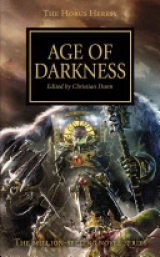
Текст книги "Age of Darkness"
Автор книги: Кристиан Данн
Жанр:
Боевая фантастика
сообщить о нарушении
Текущая страница: 10 (всего у книги 22 страниц)
Ally with the Imperium and die.
Neutral planets would go down on bended knee for the Warmaster now, the threat of reprisals too real and absolute for them to ignore.
Heka’tan had believed in the possibility of a peaceful solution. Despite everything, he dared to hope that the Traitors would adhere to the rules of engagement.
Now, the Salamander was dead, slain like so many of his Legion.
Arcadese muttered an oath for the Nocturnean beneath his breath. ‘You will not be forgotten, brother,’ he promised. ‘You shall have vengeance.’
The one responsible would be brought to account. Arcadese might have no place on the front line, but he could do that for a fallen brother. He could do that for all the forgotten sons of the Imperium.
THE LAST REMEMBRANCER
John French
‘In an age of darkness the truth must die’
– Words of a forgotten scholar of ancient Terra
THEY MURDERED THE intruder ship on the edge of the Solar System. It spun through space, a kilometre-long barb of crenellated metal, trailing the burning vapours of its death like the tatters of a shroud. Like lions running down a crippled prey two golden-hulled strike vessels bracketed the dying ship. Each was a blunt slab of burnished armour thrust through space on cones of star-hot fire. They carried weapons that could level cities and held companies of the finest warriors. Their purpose was to kill any enemy who dared to enter the realm they guarded.
This star system was the seat of the Emperor of Mankind, the heart of an Imperium betrayed by its brightest son. There could be no mercy in this place. The ship had appeared without warning and without the correct identification signals. Its only future was to die in sight of the sun that had lit the birth of humanity.
Explosions flared across the intruder ship’s hull, its skin splitting with ragged wounds that spilled dying crew and molten metal into the void. The two hunters silenced their guns and spat boarding torpedoes into the intruder’s flanks. The first armoured dart punctured the ship’s command decks, its assault ramps exploding open and disgorging amber-yellow armoured warriors in a roar of fire.
Each boarding torpedo carried twenty Imperial Fists of the Legiones Astartes: genetically enhanced warriors clad in powered armour who knew no fear or pity. Their enemy bore marks of loyalty to Horus, the Emperor’s son who had turned on his father and thrust the Imperium into civil war. Red eyes with slit pupils, snarling beast heads and jagged eight pointed stars covered the hull of the ship and the flesh of its crew. The air had a greasy quality, a meat stink that penetrated the Imperial Fists’ sealed armour as they shot and hacked deeper into the ship. Blood dripped from their amber-yellow armour and tatters of flesh hung from their chainblades. There were thousands of crew on the ship: dreg ratings, servitors, command crew, technicians and armsmen. There were only a hundred Imperial Fists facing them but there would be no survivors.
Twenty-two minutes after boarding the ship the Imperial Fists found the sealed doors. They were over three times the height of a man and as wide as a battle tank. They did not know what was inside but that did not matter. Anything kept so safe must have been of great value to the enemy. Four melta charges later, a glowing hole had been bored through two metres of metal. The breach still glowing cherry red the first Imperial Fist moved through, bolt pistol raised, tracking for targets.
The space beyond was a bare chamber, tall and wide enough to take half a dozen Land Raiders side by side. The air was still, untouched by the rank haze that filled the rest of the ship, as if it had been kept separate and isolated. There were no jagged stars scratched into the metal of the floor, no red eyes set into the walls. At first it seemed empty, and then they saw the figure at the centre of the room. They advanced, red target runes in their helmet displays pulsing over the hunched man in grey. He sat on the floor, the discarded remains of food and crumpled parchment scattered around him. Thick chains led from bolts in the deck to shackles around his thin ankles. On his lap was a pile of yellow parchment. His hand held a crude quill made from a spar of metal; its tip was black.
The sergeant of the Imperial Fist boarding squad walked to within a blade swing of the man. More warriors spread out into the echoing chamber, weapons pointing in at him.
‘Who are you?’ asked the sergeant, his voice growling from his helmet’s speaker grille.
‘I am the last remembrancer,’ said the man.
THE NAMELESS FORTRESS hid from the sun on the dark side of Titan, as if turning its face from the light. A kilometre-wide disk of stone and armour, it hung in the void above the yellow moon. Reflected light from the bloated sphere of Saturn caught in the tops of its weapon towers, spilling jagged shadows across its surface. It had been a defence station, part of the network that protected the approaches to Terra. Now the treachery of Horus had given it a new purpose. Here in isolated cells suspected traitors and turncoats were kept and bled of their secrets. Thousands of gaolers kept its inmates alive until they were of no further use: until the questioners were finished with them. There were countless questions that demanded an answer and its cells were never empty.
Rogal Dorn would be the first primarch to set foot in the nameless fortress. It was not an honour he relished.
‘Vile,’ said Dorn, watching as the void fortress grew nearer on a viewscreen. He sat on a metal flight bench, the knuckles of his armoured gauntlet beneath his chin. The inside compartment of the Stormbird attack craft was dark, the light from the viewscreen casting the primarch’s face in corpse-cold light. Dark eyes set above sharp cheekbones, a nose that cut down in line with the slope of the forehead, a down-turned mouth framed by a strong jaw. It was a face of perfection set in anger and carved from stone.
‘It is unpleasant, but it is necessary, my lord,’ said a voice from the darkness behind Dorn. It was a low, deep voice, weighted with age. The primarch did not turn to look at the person who spoke, a grey presence standing on the edge of the light. There were just the two of them alone in the crew compartment. Rogal Dorn commanded the defence of Terra and millions of troops but came to this place with only one companion.
‘ Necessary, I have heard that often recently,’ growled Dorn, not looking away from the waiting fortress.
Behind Dorn the shadowed figure shifted forwards. Cold electric light fell across a face crossed by lines of age and scars of time. Like the primarch, the figure wore armour, light catching its edges but hiding its colours in shadow.
‘The enemy is inside us, lord. It does not only march against us on the battlefield, it walks amongst us,’ said the old warrior.
‘Trust is to be feared in this war then, captain?’ asked Dorn, his voice like the growl of distant thunder.
‘I speak the truth as I see it,’ said the old warrior.
‘Tell me, if it had not been my Imperial Fists that found him would I have known that Solomon Voss had been brought here?’ He turned away from the screen and looked at the old warrior with eyes that had vanished into pits of shadow. ‘What would have happened to him?’
The flickering blue light of the viewscreen spilled over the old warrior. Grey armour, without mark or rank, the hilt of a double handed sword visible from where it projected above his shoulders. The light glittered across the ghost of a sigil on the grey of his shoulder guard.
‘The same as must happen now: the truth must be found and after that whatever the truth demands must be done,’ said the old warrior. He could feel the primarch’s emotions radiating out from him, the violence chained behind a facade of stone.
‘I have seen my brothers burn worlds we created together, sent my sons against my brothers’ sons. I have unmade the heart of my father’s empire and clad it in iron. You think I wish to avoid the realities that face us?’
The old warrior waited a heartbeat before replying. ‘Yet you come here, my lord. You come to see a man who, in all likelihood, has been corrupted by Horus and the powers that cradle him.’ Rogal Dorn did not move but the old warrior could feel the danger in that stillness like a lion poised for the kill.
‘Have a care,’ said Dorn, in a whisper like a sword sliding from a scabbard.
‘Trust is a weakness in our armour, lord,’ said the warrior, looking directly at the primarch. Dorn stepped forwards, his eyes deliberately tracing the bare grey surfaces of armour that should have displayed Legion heraldry.
‘A strange sentiment from you, Iacton Qruze,’ said Dorn.
The old warrior nodded slowly, remembering the ideals and broken oaths that had brought him to this point in time. He had once been a captain in the Luna Wolves Legion, the Legion of Horus. He was almost the last of his kind, and he had nothing left but his oath to serve the Emperor, and the Emperor alone.
‘I have seen the price of blind trust, my lord. Trust must be proved.’
‘And because of that we must throw the ideals of the Imperium to the flames?’ said Dorn, leaning close to Qruze. Such focus from a primarch would have forced most mortals to their knees. Qruze held Dorn’s gaze without faltering. He knew his role in this. He had made an oath of moment that he would stand watch over Rogal Dorn’s judgement. His duty was to balance that judgement with questions.
‘You have intervened, and so the judgement on this man is yours. He lives at your word,’ said Qruze.
‘What if he is innocent?’ snapped Dorn. Qruze gave a weary smile.
‘That proves nothing, my lord. If he is a threat he must be destroyed.’
‘Is that what you are here to do?’ said Dorn, nodding at the hilt of the sword on Qruze’s back. ‘To play judge, jury and executioner?’
‘I am here to help you in your judgement. I do this for the Sigillite. This is his domain and I am his hand in this.’
An expression that might have been distaste ghosted across Dorn’s face as he turned his back on Qruze.
On the viewscreen the side of the nameless fortress filled the screen; a toothed set of doors opening to greet them like a waiting mouth. Qruze could see a vast loading bay beyond lit by bright light. Hundreds of troops in gloss-red armour and silver-visored helmets waited in ranks, filling the docking bay floor. These were the gaolers of the nameless fortress. They never showed their faces and had no names, each was simply a number. Amongst them the hunched figures of the questioners stood in loose clusters, their faces hidden by hoods, fingers augmented with needles and blades protruding from the sleeves of their red robes.
The Stormbird settled on the deck with a purr of an antigravity field. Ice beaded its sleek body and wings as the warm air met void-cold metal. With a pneumatic hiss the ramp opened beneath the Stormbird’s nose and Rogal Dorn walked into the stark light. He shone, the light reflecting from the burnished gold of his armour, glittering from rubies clutched in the claws of silver eagles. A black cloak lined in red and edged in ivory fell from his shoulders. As one every person in the docking bay knelt, the deck ringing with the impact of a thousand knees. Rogal Dorn strode through the kneeling ranks without a glance. Behind him Iacton Qruze followed in his ghost-grey armour, like a shadow in the sun’s wake.
At the end of the ranks of crimson guards, three figures knelt and waited. Each wore armour the same gloss-red as the kneeling guards, their bowed heads encased by masks of tarnished silver. These were the key keepers of the nameless fortress. Qruze was one of the few people to have ever seen their faces.
‘ Ave Praetorian,’ called one of the bowed figures in a booming electronic voice. With one voice every kneeling human echoed the call. The primarch spoke over the fading echoes.
‘Take me to the remembrancer Solomon Voss.’
THE MAN WAS writing when the cell door opened. The light from the glow-globe above him created a murky yellow halo that cast all but the makeshift desk and the man into shadow. Thin shoulders hunched over a sheet of parchment, a quill in a thin hand scratching out black words. He did not look up.
Rogal Dorn stepped into the cell. He had removed his armour and wore a black tabard held around the waist with a belt of gold braid. Even without his battle-plate he seemed to strain the dark metal walls of the cell with his presence. Qruze followed, still in his grey armour.
‘Solomon Voss,’ said Dorn in a soft tone.
The man looked up at them. He had a flat, handsome face, the skin smooth and lined only around the eyes. His steel-grey hair was pulled back into a ponytail that hung over the rough fabric covering his back. In the presence of a primarch many people would struggle to speak. The man nodded and gave a tired smile.
‘Hello, old friend,’ said Voss. ‘I knew someone would come.’ His eyes flicked to Qruze. ‘Not alone though, I see.’ Qruze felt the disdain in the words but held his face impassive. Voss starred at him. ‘I know your face from somewhere.’
Qruze did not reply. He knew who the man was, of course. Solomon Voss: author of The Edge of Illumination, witness to the first conquests of the Great Crusade, according to many the finest wordsmith of the age. Qruze had met Voss once, long ago in a different age. So much had left its mark on Qruze since then that he was surprised his old face triggered even the weakest memory in this man.
Voss nodded at the bare grey of Qruze’s armour. ‘The colours and markings of a Legion were always a mark of pride. So what does unmarked grey imply? Shame, perhaps?’ Qruze kept his face emotionless. Such a remark would once have angered him. Now there was no false pride for it to cut. He had passed far beyond his lost life as a Son of Horus or Luna Wolf.
Dorn looked at Qruze, his face unreadable but his voice firm.
‘He is here to observe, that is all.’
‘The silent hand of judgement,’ said Voss, nodding and turning back to the sheet of parchment. The quill began to scratch again. Dorn pulled a metal-framed chair close to the desk and sat, the chair creaking under his weight.
‘I am your judge, remembrancer,’ said Dorn in a low voice tinged with a tone that Qruze could not place.
Voss did not reply but completed a line of lettering. He made a low half-whistling noise as he paused over a word. Qruze thought he could see feelings play over the remembrancer’s face, a twinge of apprehension and defiance. Then, with a flourish, the quill completed a line and Voss placed it on the desk. He nodded at the drying words and smiled.
‘Done. In all honesty I think it is my best work. I flatter myself that you would not find its equal amongst the works of the ancients.’ He turned to look at Dorn. ‘Of course, no one will ever read it.’
Dorn gave a half-smile as if he had not heard the last remark and nodded at the pile of parchment on the desk.
‘They let you have parchment and quill, then?
‘Yes,’ sighed Voss. ‘I wish I could say it was kind of them, but I rather think that they hope to scour it for secrets afterwards. They can’t quite believe I am telling the truth, you see, but they also can’t stop hoping that I am. The information on your brother, you see. I can feel their hunger for it.’ Qruze saw the slightest tightening in Dorn’s face at the mention of his brother.
‘You have been questioned?’ asked Dorn.
‘Yes. But the heavy stuff has not started. Not yet.’ Voss gave a humourless laugh. ‘But I have a feeling that it was not far off. Until they stopped asking questions and just left me here.’ Voss raised an eyebrow. ‘That was your doing?’
‘I was not going to let the great Solomon Voss disappear into an interrogation cell,’ said Dorn.
‘I am flattered, but there are many more prisoners here, thousands I think.’ Voss was looking around at the metal walls of his cell as if he could see through them. ‘I can hear the screams sometimes. I think they want us to hear them. They probably think it makes us easier to question.’ Voss’s voice trailed away.
This man is broken, thought Qruze, something within him has died and left only a half life.
Dorn leaned towards Voss.
‘You were more than a remembrancer,’ said Dorn. ‘Remember?’
‘I was something once,’ he nodded still starring into the darkness. ‘Once. Back before Ullanor, when there were no remembrancers, when they were just an idea.’ Voss shook his head and looked down at the parchment in front of him. ‘It was quite an idea.’
Dorn nodded and Qruze saw the ghost of a smile on the primarch’s normally grim face.
‘Your idea, Solomon. A thousand artists sent out to reflect the truth of the Great Crusade. An idea worthy of the Imperium.’
Voss gave a weak smile. ‘Flattery again, Rogal Dorn. Not completelymy idea, as you must remember.’ Dorn nodded and Qruze heard a note of passion in Voss’s voice. ‘I was just a wordsmith tolerated amongst the powerful because I could turn their deeds into words that could spread like fire.’ Voss’s eyes shone as if reflecting the light of bright memories. ‘Not like the iterators, not like Sindermann and the rest of his manipulating ilk. The Imperial truth did not need manipulation. It needed reflecting out into the Imperium through words, and images and sounds.’ He broke off and looked at the black ink stains on his thin fingers. ‘At least, I thought so then.’
‘You were right,’ said Dorn and Qruze saw the conviction flow into the primarch’s face. ‘I remember the manuscripts you presented to the Emperor at Zuritz. Written by you and illuminated by Askarid Sha. They were beautiful and true.’ Dorn was nodding slowly, as if trying to tease a response from Voss who was still looking at his hands. ‘The petition to create an order of artists to “witness, record and reflect the light of truth spread by the Great Crusade”. An order of people to be the Imperium’s memory of its foundation: that was what you argued was needed. And you were right.’
Voss nodded slowly, then he looked up and there was a hollow look in his eyes. It was the look of someone thinking about what they had lost, thought Qruze. He knew. He had worn it himself in many dark hours in recent years.
‘Yes, fine times,’ said Voss. ‘When the Council of Terra ratified the creation of the Order of Remembrancers, for a moment I thought I knew what you and your brothers must have felt, seeing your sons bringing illumination to the galaxy.’ He gave a dismissive snort. ‘But you are not here to flatter, Rogal Dorn, you are here to judge.’
‘You vanished,’ said Dorn in the same soft tone he had begun with. ‘In the moments after the betrayal you vanished. Where have you been?’ Voss did not answer for a second.
‘I have been telling the truth since your sons took me from that ship,’ he said, and looked at Qruze. ‘I am sure it is in their mission accounts.’
Qruze stayed silent. He knew what Voss had said to the Imperial Fists that found him, what he had been saying to his interrogators ever since. He knew, and Rogal Dorn would know, but the primarch said nothing. The silence waited until Voss looked at Dorn and said what the primarch had been waiting for.
‘I have been with the Warmaster.’
IACTON QRUZE KEPT his distance as the primarch watched the stars turn above him. They were in an observation cupola, a blister of crystal glass on the upper surface of the nameless fortress. Above them Saturn hung, its bands of muddy colour reminding Qruze of fat running through meat. Dorn had cut short the questioning of Solomon Voss, saying that he would return soon. He had said to Qruze that he needed to think. So they had come here to think beneath the light of the stars and the eye of Saturn. Qruze thought that Dorn had hoped that Voss would deny his earlier claim, that he would find a reason to set him free.
‘He is as I remember him,’ said Dorn suddenly, still gazing out at the scatter of stars. ‘Older, worn, but still the same. No sign of corruption to my eyes.’
I must do my duty, thought Qruze. Even though it is like stabbing a blade into an unhealed wound. He took a deep breath before speaking.
‘No, my lord. But perhaps you see what you want to see.’ The primarch did not move but Qruze sensed the shift in atmosphere, a charge of danger in the cold air.
‘You presume much, Iacton Qruze,’ said the primarch in a low growl.
Qruze took a careful step closer to Dorn and spoke in a level voice. ‘I presume nothing. I have nothing but one unbroken oath. That oath means I must say these things.’ The primarch turned and straightened so that Qruze had to look up into his face. ‘Even to you, lord.’
‘You have more to say?’ growled Dorn.
‘Yes. I must remind you that the enemy is subtle and has many weapons. We can protect against them only with suspicion. Solomon Voss might be as you remember him. Perhaps he is the same man. Perhaps.’ Qruze let the word hang in the air. ‘But perhaps is not enough.’
‘Do you believe his claim? That he was with Horus all this time?’
‘I believe the facts. Voss has been amongst the enemy, whether willingly or as a captive. He was on a ship enslaved to Horus that bore the marks of the enemy. The rest could be…’
‘A story.’ Dorn was nodding, a grim expression on his face. ‘He was the greatest teller of stories that I have ever known. There are billions in the Imperium that only know of our deeds by the words he wrote. You think that he is spinning a tale now?’
Qruze shook his head. ‘I do not know, lord. I am not here to judge, I am here to question.’
‘Then do your duty and question.’
Qruze took a breath and began to count off points, raising a finger for each one. ‘Why did he go to Horus if he is not a traitor? Horus slaughtered the rest of the remembrancers when he purged the Legions. Why would he keep one of them alive?’ When Dorn did not interrupt Qruze continued. ‘And an enemy ship, with a single man held safe within it, does not drift into the Solar System alone.’ He paused for a second, thinking of the thing that worried him most. Dorn was still looking at him, silently absorbing Qruze’s words. ‘It was not accident. He was returned to us.’
Dorn nodded, forming Qruze’s worry into a question. ‘And if he was, why?’
‘WHY DID YOU go to Horus?’ asked Rogal Dorn.
They were back in the cell. Solomon Voss sat by his desk with Rogal Dorn opposite him and Qruze standing by the door. Voss took a sip of spiced tea from a battered metal cup. He had asked for it and Dorn had assented. The remembrancer swallowed slowly and licked his lips before beginning.
‘I was on Hattusa, with the 817th fleet, when I heard that Horus had rebelled against the Emperor. I could not believe it at first. I tried to think of reasons why, to put it into some form of context, to make some sense of it. I could not. But when I realised that I could not make sense of it I knew what I needed to do. I needed to see the truth with my own eyes. I would witness it and I would make sense of what I saw. Then I would put it into words so that others could share my understanding.’
Dorn frowned. ‘You doubted that Horus was a traitor?’
‘No. But I was a remembrancer, the greatest remembrancer. It was our duty to make sense of great events in art. I knew that others would doubt or would not believe that the brightest son of the Imperium could turn against it. If it was true I wanted that truth shouted from the works of as many remembrancers as possible.’
Qruze saw the passion and fire flash through Voss’s face. For a moment the tiredness was gone and the man’s conviction shone from him.
‘You take much on yourself. To make sense of something that is senseless,’ said Dorn.
‘Remembrancers made what happened in the Great Crusade real. Without us who would remember any of it?’
Dorn shook his head gently. ‘A war between the Legions is not a place for artists.’
‘And the other types of wars we had been recording, were they more suitable? When all that had been built by you, by us, had been plunged into doubt, where else should I have been? I was a remembrancer; it was my duty to witness this war.’ Voss put his cup of spiced tea down on his desk.
‘I had started to make plans to get to Isstvan V by calling in favours and contacts.’ Voss’s mouth twisted as if chewing bitter words. ‘Then the Edict of Dissolution came through. The remembrancers were no more, by the order of the Council of Terra. We were to be removed and dissolved back into mundane society. Those already amongst the war fleets were no longer to be allowed to record events.’
Qruze could feel the bitterness in the man’s words. In the wake of the news of Horus’s betrayal many things had changed in the Imperium. One of these changes had been the removal of official backing for the remembrancers. With a stroke of a pen the remembrancers had been no more.
Better that than what could have become of them, thought Qruze. The image of men and woman dying under the guns of his former brothers flicked across his mind. An age ago, but no time at all, he thought. He blinked and the cell snapped back into sharp reality.
‘But you did not obey,’ said Dorn.
‘I was angry,’ spat Voss. ‘I was the father of the Order of Remembrancers. I had witnessed the centuries of the Great Crusade since it began on Terra. I had looked on demigods and the scattering of blood amongst the stars that has been the birth of the Imperium.’ He raised his hand as if gesturing to stars and planets above them. ‘I made those events real to minds that will never see them. I bound them in words so that those wars will echo into the future. In millennia to come there will be children who listen, or read, and will feel the weight of these times in my words.’ He snorted. ‘We remembrancers served illumination and truth, not the whim of a council of bureaucrats.’ Voss shook his head, his lip curled for a moment and then he blinked.
‘Askarid was with me,’ he said quietly. ‘She said that it was an impossible idea, dangerous and driven by ego. A pilgrimage of hubris, she called it.’ He smiled and closed his eyes for a moment, floating in lost happiness.
Qruze knew the name Askarid Sha, illuminator and calligraphist. She had lettered Voss’s work into scrolls and tomes as beautiful as his words.
‘Your collaborator?’ asked Qruze, the question slipping out of his lips. Dorn shot him a hard look.
‘Yes, she was my collaborator, in every sense.’ Voss sighed and looked at the dregs of tea in his cup. ‘We argued, for days,’ he said quietly. ‘We argued until it was clear that I was not going to change my mind. I knew it was possible to get to Isstvan V. I had contacts throughout the fleets, on both sides of the war. I knew I could do it.’
Voss paused, staring into space as if someone stood there looking back at him from a lost past. Dorn said nothing, but waited. After a few moments Voss spoke, a catch in his voice.
‘Askarid came with me, even though I think she feared how it would end.’
‘And how did it end?’ asked Dorn. Voss looked back at the primarch, his eyes still wide with memory.
‘Isn’t that what you are here to decide, Rogal Dorn?’
‘HE WAS RIGHT, about the Edict of Dissolution,’ said Dorn. Voss had asked to sleep and Dorn had permitted it. He and Qruze had returned to the dome of crystal beneath the starfield. Qruze could feel the leaden mood of the primarch as he stood looking at the stars.
‘The end of the remembrancers?’ said Qruze, raising an eyebrow and looking up at Dorn. ‘You think that they should be allowed to wander through this war? Recording our shame in paintings and songs?’ There was a pause. Qruze expected another growl of rebuke but Dorn showed no emotion other than in the slow breath exhaling from his nose.
‘I had my doubts when the Council ratified the edict,’ said Dorn. ‘The position as presented at the time was perfectly logical. We are at war with ourselves; we do not know how far the treachery of my brother spreads. This is not a time to allow a menagerie of artists to walk freely amongst our forces. This is not a war to be reflected in poetry. I understand that…’
‘But beyond logic, you had doubts,’ said Qruze. He felt that he suddenly understood why Rogal Dorn, Praetorian of Terra, had come to see an old remembrancer in a prison cell.
‘Not doubts, sorrow.’ Dorn turned, pointing out at the stars beyond the crystal glass. ‘We went out into those stars to wage war for a future of enlightenment. We took the best artists with us so that they could reflect that truth. Now our battles go unremembered and unrecorded. What does that tell us?’ Dorn let his hand fall.
‘It is a practicality of the situation we face. The survival of the truth that we fought for makes demands that must be met,’ said Qruze.
‘Demands that must be wrapped in silence and shadow? Deeds done that must remain unremembered and unjudged?’ Dorn began to walk away from the glass, his steps raising dust from the floor.
‘Survival or obliteration: that will be history’s judgement on us,’ said the grey warrior.
Dorn turned to stare at Qruze, the ghost of anger on his face. ‘And the only way is for the Imperium to become a cruel machine of iron, and blood?’ said the primarch in a hard-edged whisper.
‘The future will have a price,’ said Qruze, not moving from the viewport. Dorn was silent. For an instant Qruze thought he saw a flicker of despair in the primarch’s eyes. Behind him the planets of the Solar System glittered as cold points of light beyond the towers of the nameless fortress.
‘What will we become, Iacton Qruze? What will the future allow us to be?’ said Dorn, and walked away without looking back.
‘WHEN WE REACHED Isstvan V the massacre was complete,’ continued Voss. ‘I never got the chance to see the surface, but the void around it sparkled with debris. I watched it drift past the viewport of my stateroom, fragments still cooling, fires feeding on oxygen trapped in wrecks.’
Dorn nodded, his face unreadable as he listened to the remembrancer’s story. Something had changed in the primarch after they returned from the observation deck. It was as if he had begun to wall something up inside him. It reminded Qruze of the gates of a citadel grinding shut before the advance of an enemy. If Voss noticed he did not show it.