Текст книги "The Human Division"
Автор книги: John Scalzi
Жанры:
Космическая фантастика
,сообщить о нарушении
Текущая страница: 27 (всего у книги 27 страниц)
“And do you like how your grandmother smells?” Sorvalh asked.
“Not really,” Hannah admitted.
“Well,” Sorvalh said. “I promise not to tell either your grandmother or Mrs. Everston.”
“Thank you,” said Hannah, gravely.
Presently Sorvalh found herself surrounded by a gaggle of small children, who looked up at her expectantly. Sorvalh glanced over at Mrs. Everston, who also looked at her expectantly. Apparently it was all on Sorvalh now. She suppressed an inner sigh and then smiled at the children.
Some of them gasped.
“That was a smile,” Sorvalh said, quickly.
“I don’t think so,” said one of the children.
“I promise you it was,” Sorvalh said. “Hello, children. I am Hafte Sorvalh. Have any of you ever spoken to an alien before?” There were head shakes all around, signifying “no.” “Well, then, here’s your chance,” Sorvalh said. “Ask me anything you want to know.”
“What are you?” asked one of the children, a boy.
“I am a Lalan,” Sorvalh said. “From a planet called Lalah.”
“No, I mean are you like a lizard or an amphibian?” the boy asked.
“I suppose that to you I might look a little like a reptile,” Sorvalh said. “But I’m not really like one at all. I am more like you than I am like a lizard, but I admit I’m mostly not like either. It’s better to think of me as my own thing: a Lalan.”
“Do you eat people?” asked another boy.
“I eat churros,” Sorvalh said, holding up her now-neglected treat. “So unless churros are made of people, no.”
“You can’t eat churros all the time,” this new boy pointed out.
“Actually, if I wanted to I could,” Sorvalh said, taking the opposite position of her earlier comment to Tony. “It’s one of the perks of being a grown-up.”
The children seemed to pause to consider this.
“However, I don’t,” Sorvalh said. “When I am on Earth, I usually eat your fruits and vegetables. I particularly like sweet potatoes and tangerines. I only rarely eat your meats. They disagree with me. And I don’t eat people, because I wouldn’t want people to eat me.”
“Are you married?” asked another child.
“My people don’t get married,” Sorvalh said.
“Are you living in sin?” asked the same child. “Like the way my mother says my Aunt Linda is?”
“I don’t know about your mother or your Aunt Linda,” Sorvalh said. “And I’m not sure what ‘living in sin’ means here. My people don’t marry because that’s just not how we do things. The best way to describe it is that we have lots of friends and sometimes as friends we have children together.”
“Like my Aunt Linda,” the child said.
“Perhaps,” Sorvalh said, diplomatically as possible.
“Are you pregnant now?” asked another child.
“I’m too old for that now,” Sorvalh said. “And we don’t get pregnant anyway. We lay eggs.”
“You’re a chicken!” said the first boy, and there was laughter to this.
“Probably not a chicken,” Sorvalh said. “But yes, like your birds we lay eggs. We tend to do this all at the same time, and then the community cares for them all at once.”
“How many eggs have you laid?” asked the latest child.
“It’s a difficult question to answer,” Sorvalh said, guessing that Mrs. Everston probably wouldn’t want her to go into great detail about Lalan reproductive matters; humans were known to be twitchy about such things. “It’s probably best to say that I had four children who lived to adulthood, and two of them now have had children of their own.”
“How do you speak our language?” asked a girl, close to Sorvalh.
“I practice it,” Sorvalh said. “Just like anyone does. I’m good with languages, though, and I study yours every night. And when I go to other countries, I use this.” She held up her PDA. “It translates for me so I can speak to other humans and they to me.”
“Do you play basketball?” asked another child.
“I don’t think it would be much of a challenge for someone of my height,” Sorvalh said.
“How do you get into rooms?” asked a different child.
“Very carefully,” Sorvalh said.
“Have you met the president?” asked a different little girl.
“Yes, once,” Sorvalh said, recalling the event. “I liked visiting the president because I can stand up easily in the Oval Office. It has high ceilings.”
“Do you poop?” asked a boy.
“Brian Winters,” Mrs. Everston said, severely.
“It’s a valid question!” the boy said, protesting. He was apparently the sort of eight-year-old boy for whom it made sense to have the phrase “it’s a valid question” in his repertoire. Mrs. Everston said something else to Brian while Sorvalh quickly looked up the definition of “poop” on her PDA.
“I apologize for that,” Mrs. Everston said.
“Not at all,” Sorvalh said, smoothly. “It’s not the worst question I’ve ever been asked. And to answer your question, Brian, no, I don’t poop. At least not like you do. I do excrete waste from time to time, and when I do, it’s otherwise very much like going to the bathroom is for you. Next question.”
“Do you know any other aliens?” asked another girl.
“Whole planets’ worth,” Sorvalh said. “I have personally met people from four hundred different races of intelligent beings. Some of them are as small as that,” she pointed to a squirrel running frantically toward a tree, “and some of them are so large that they make me look tiny.”
“Do theypoop?”
“Brian Winters,” Sorvalh said, severely. “That is nota valid question.” Brian Winters, unused to being reprimanded by a ten-foot alien, shut up.
“Will more aliens come here?” asked a boy.
“I don’t know,” Sorvalh said. “More have been coming recently, because my government, which is known as the Conclave, has been talking to the governments here on Earth. But I think a lot will have to happen before they are so common that you don’t notice them anymore when you walk down the Mall.”
“Are we going to have a war?” asked Hannah.
Sorvalh turned her head to look at Hannah directly. “Why do you ask, Hannah?” she said, after a minute.
“My dad said to my mom that he thinks there’s going to be a war,” Hannah said. “He said that it’s going to be the humans against everyone else and that everyone else wants a war to get rid of all of us. You’ll fight us and then when we’re gone you’ll live where we live and no one will know we were here.”
“‘A monster fights and wrecks things,’” Sorvalh said. She looked out at the children and saw them quiet, waiting for her answer, the two adults standing silently as well, patient.
“I can’t say there will never be a war,” she said. “We can’t make promises like that. What I can say is that I am a diplomat. What I do is talk to people so we don’t have to fight them. That’s why I’m here. To talk and to listen and to find a way all of us can live together so that we don’t fight, and we’re not scared of each other.” She reached out and gently touched Hannah on the cheek. “It’s my job to make sure that none of us has to see the other as a monster. Do you understand what I mean, Hannah?”
Hannah nodded.
“Good,” Sorvalh said. “Then you can tell your dad, from me, that I don’t want a war either.”
“Okay,” Hannah said.
“All right, kids,” Mrs. Everston said, clapping her hands together. “Time to say good-bye to Mrs. Sorvalh now. We still have to walk to the Washington Monument.”
“Get a picture!” one of the kids said. “No one will believe us if you don’t.”
Mrs. Everston looked over. “Is it okay? I know we’ve imposed a lot on you today.”
“No you haven’t,” Sorvalh said. “And yes, it is.”
Five minutes later the pictures were done, the children were organized as much as a passel of eight-year-olds could be, and the entire crew was headed toward the Washington Monument. Sorvalh watched them go. As they walked, Hannah turned to look at Sorvalh. Sorvalh waved. Hannah smiled and turned back to her group. Sorvalh looked at the cold remains of her churros, tossed them into a nearby trash can, and went to get fresh pastries.
Tony was waiting for her with a bag of churros already gathered up.
“You are good,” Sorvalh said, taking the new churros. She reached for her money pouch.
Tony waved her off. “On the house,” he said. “You earned it today, Señora.”
“Thank you, Tony,” Sorvalh said, and pulled one out of the bag. “I think I did at that.” She smiled at her friend and then took a bite.
Acknowledgments
Writing this particular installment of the Old Man’s War universe came with its own unique set of challenges, not in the least was writing thirteen separate episodes that had to work as their own stand-alone stories while at the same time functioning as a novel when they were all stacked together. It was a hell of a lot of fun, but it was also a hell of a lot of work.
To that end, my first acknowledgment here is to my editor, Patrick Nielsen Hayden, whose confidence in the book from the day I first suggested it through to the end of the process helped me considerably, especially on the days I sat there wondering what it was I had gotten myself into. His ability not to panic is a marvelously reassuring thing, and I thank him deeply for it.
Likewise, thanks to Irene Gallo for managing the art side of things, which for this project (especially the electronic version) was far more intensive than it usually is. Irene is the best art director in science fiction and possibly all of publishing, and I am always indebted to her work on my behalf.
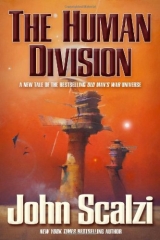
Cover artist John Harris’s contribution to The Human Divisionis significant enough that I have codedicated the entire book to him, but I want to acknowledge again his spectacular work for the book and for the individual episodes. It was a joy to see all the art for the first time, and a greater joy to get to show it all off to you. The book would not be the same without his efforts.
The copyediting of this particular book was an undertaking of its own epic scale, and for that thanks are in order to Sona Vogel. Thank you for catching my many errors. Also thank you to Heather Saunders for book design, and to Alexis Saarela and Patty Garcia and all of Tor’s publicity department for getting me out there in front of folks.
The Human Divisionwas not only released as a print book but also electronically, by episode. This was new territory for Tor and for Macmillan, who went out on a limb to try a new way of getting stories to readers. For getting out on that limb, I am indebted to Tom Doherty, Linda Quinton, Fritz Foy, Dan Schwartz, and Brian Napack.
There are always people I should thank at Tor whom I miss. I hope they will accept my apologies and know I am glad they do the work they do for me and other authors.
Over at Audible, who handled the audiobook version of The Human Division, many thanks are in order to Steve Feldberg and William Dufris.
Thanks as ever to Ethan Ellenberg and Evan Gregory, my fiction agents, and I wish them good hunting in selling this overseas. Also, this is a good time to thank my film/tv agent, Joel Gotler, and also the folks involved with the Old Man’s Warmovie project: Wolfgang Petersen, Scott Stuber, Alexa Faigen, David Self, and Chris Boal. I’m cheering you guys on.
The electronic edition of The Human Divisionfeatured dedications for each individual episode. The people to whom those individual episodes were dedicated to were (in order of episode dedication) Brad Roberts and Carl Rigney; Alex Seropian, Tim Harris, Hardy LeBel, and Mike Choi; Alexis Saarela, Patty Garcia, and Tor Publicity; Paul Sabourin and Greg DiCostanzo; Glenn Reynolds; Jonathan Coulton; the SFWA 2012–13 Board of Directors; Diana Sherman; Jared Cloud and Joanna Beu; The Webb Schools of California Class of 1987; Rena Watson Hawkins; Megan Totusek and Jesi Pershing.
As I was writing The Human DivisionI was also touring for Redshirts(my previous novel) and doing a staggering amount of travel. Trying to keep my head in the novel while at the same time doing everything else I was doing was a dizzying experience, to say the least. Friends who helped keep me sane through all of this include (in no particular order) Karen Meisner, Deven Desai, Mary Robinette Kowal, Joe Hill, Kyle Cassidy, Doselle Young, Wil Wheaton, Bill Shafer, Kate Baker, Pat Rothfuss, Natasha Kordus, Robert Lawrence, Jenny Lawson, Pamela Ribon, Lorraine Garland, Neil Gaiman, Paolo Bacigalupi, Hiro Sasaki, Dave Klecha, Yanni Kuznia, Karen Healey, Justine Larbalestier, Adam Lisberg, and Daniel Mainz. Thank you all for putting up with me while I was at loose ends. I am forgetting people. I am sorry. My brain, it is still recovering. Forgive me.
Thanks also to the board of the Science Fiction and Fantasy Writers of America, for putting up with me essentially falling into a hole for the month of October while I was finishing up the novel: Jim Fiscus, Matthew Johnson, Ann Leckie, Lee Martindale, Bud Sparhawk, Cat Valente, and Sean Williams. Sorry, guys. It won’t happen again while I’m president. I promise.
And of course, thanks always to Kristine and Athena Scalzi, whom I love more than is entirely sensible and I’m just fine with that.
Finally, thank you. You guys have been asking me to go back to the Old Man’s War universe for a while; I wanted to make sure that if I did, it would be worth your time to make the trip. I hope you enjoyed it. I enjoyed writing it for you. Thanks for making it possible.
– John Scalzi
October 27, 2012