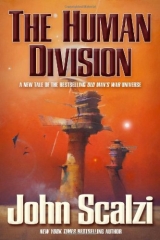
Текст книги "The Human Division"
Автор книги: John Scalzi
Жанры:
Космическая фантастика
,сообщить о нарушении
Текущая страница: 12 (всего у книги 27 страниц)
Rigney shook his head. “My wife passed on before I left Earth, and we never had children,” he said. “My friends would all be in their eighties or nineties now, which is old for humans, so they’re mostly dead, and I don’t think the ones that are living would be too pleased to see me bounding in, looking like I’m twenty-three years old.”
“I can see how that might be a problem,” Sorvalh said.
Rigney pointed at Lincoln. “He looks the same as when I left.”
“I would hope so!” Sorvalh said. “Colonel, would you mind walking as we talk? I walked down the Mall before I got here and I passed someone selling something called ‘churros.’ I should like to experiment with human cuisine, I think.”
“Oh, churros,” Rigney said. “Good choice. By all means, Councillor.”
They walked down the stairs of the Lincoln Monument and toward the Mall, Sorvalh walking slowly so as to keep Rigney from having to jog to keep up. Sorvalh noticed other humans looking curiously at her; aliens on Earth were still a rarity, but not so rare now in Washington, D.C., that the people there would not attempt nonchalance. They stared equally at the green human next to her, she noted.
“Thank you for meeting me,” Sorvalh said to Rigney.
“I was delighted to,” Rigney said. “You gave me an excuse to visit Earth again. That’s a rare thing for a CDF member.”
“It’s convenient how the Earth has become a neutral ground to both of our governments,” Sorvalh said.
Rigney winced at this. “Yes, well,” he said. “Officially I am not allowed to be pleased by that particular development.”
“I understand entirely,” Sorvalh said. “Now then, Colonel. To business.” She reached into the folds of her gown and produced the manuscript and handed it to Rigney.
He took it and looked at it curiously. “I’m afraid I can’t read this,” he said, after a moment.
“Come now, Colonel,” Sorvalh said. “I know perfectly well that you have one of those computers in your head, just like every other Colonial Defense Forces member. What is the ridiculous name you call them?”
“A BrainPal,” Rigney said.
“Yes, that,” Sorvalh said. “So I am confident that not only have you already recorded the entire content of that paper into the computer, it has also rendered you a translation.”
“All right,” Rigney said.
“We aren’t going to get anywhere, Colonel, if you are going to insist on fighting me on even the simplest of things,” Sorvalh said. “We would not have opened up this back channel if it were not absolutely necessary. Please do me the courtesy of presuming I am not on my first mission of diplomacy.”
“My apologies, Councillor,” Rigney said, and handed back the document. “I’m in the habit of not revealing everything. Let’s just say my automatic reflexes kicked in.”
“Very well,” Sorvalh said, took the manuscript and then placed it back into the folds of her gown. “Now that you’ve undoubtedly had time to scan the translation, you can tell me what was written on the document.”
“It was a list of uninhabited planets,” Rigney said.
“I question that modifier, Colonel,” Sorvalh said.
“Officially speaking, I have no idea what you are talking about,” Rigney said. “Unofficially, I would be very interested in knowing how you developed that list.”
“I am afraid I must keep that a secret,” Sorvalh said. “And not just because I was never told. But I assume now we can dispense with the polite fiction that there are not, in fact, ten human colonies where they should not be.”
“Those aren’t sanctioned colonies,” Rigney said. “They’re wildcats. We can’t stop people from paying spaceship captains to take them to a planet and drop them there without our permission.”
“You could, I am certain,” Sorvalh said. “But that’s not the issue at the moment.”
“Does the Conclave blame the Colonial Union for the existence of these wildcat colonies?” Rigney asked.
“We question that they are wildcat colonies at all, Colonel,” Sorvalh said. “As wildcat colonies typically do not have Colonial Defense Forces soldiers in their mix of colonists.”
Rigney had nothing to say to this. Sorvalh waited a few moments to see if this would change, and then continued. “Colonel Rigney, surely you understand that if we had wanted to vaporize these colonies, we would have done it by now,” she said.
“Actually, I don’t understand,” Rigney said. “Just as I don’t understand what the gist of this conversation is.”
“The gist, as you say, is that I have a personal message and a bargain for the Colonial Union from General Gau,” Sorvalh said. “That is to say, it comes from General Gau in the capacity of his own person, and not General Gau, leader of the Conclave, a federation of four hundred races whose combined might could crush you like a troublesome pest.”
Colonel Rigney’s face showed a flicker of annoyance at this assessment of the Colonial Union, but he quickly let it go. “I’m ready to hear the message,” he said.
“The message is simply that he knows that your ‘wildcat’ colonies are no such thing and that under different circumstances you would have received notice of this knowledge by having the fleet show up at their doorstep, followed by other reprisals designed to strongly dissuade you from further colonization attempts,” Sorvalh said.
“With respect, Councillor,” Rigney said, “the last time your fleet showed up at our doorstep, it didn’t end well for your fleet.”
“That was the second-to-last time,” Sorvalh said. “The last time a fleet of ours showed up at your doorstep, you lost the Earth. Beyond that, I think you and I both know that you will not get a chance to repeat your exploits at Roanoke.”
“So the general wishes to remind us that normally he’d vaporize these colonies,” Rigney said.
“He wishes to remind you of it to make the point that at this time he has no interest in doing that,” Sorvalh said.
“And why not?” Rigney asked.
“Because,” Sorvalh said.
“Really?” Rigney said, stopping his walk. “‘Because’ is the reason?”
“The reason is not important,” Sorvalh said. “Suffice to say the general doesn’t want to have a fight over these colonies at the moment, and it’s a good guess that you don’t, either. But there are those in the Conclave who would be delighted to have a fight over them. That’s something neither you nor the general wants, although almost certainly for different reasons. And while right now the only two people in the Conclave political caste who know of the existence of that list are the general and me, I have no doubt that you know enough about politics to know that secrets don’t stay secret long. We have very little time before the content of that list makes its way into the hands of those in the Conclave who would be thrilled to take a torch to your colonies, and to the Colonial Union.” Sorvalh started walking again.
After a moment, Rigney followed. “You say we have very little time,” he said. “Define ‘very little.’”
“You have until the next time General Gau is required to take questions from the Grand Assembly,” Sorvalh said. “By that time, the warmongers of the assembly will almost certainly know of the existence of at least some of the colonies, and that CDF soldiers are at them. They will demand the Conclave take action, and the general will have no choice but to do so. That will happen in thirty of our standard days. That would be about thirty-six days on your Colonial Union calendar.”
“So much for the message,” Rigney said. “What’s the bargain?”
“Also simple,” Sorvalh said. “Make the colonies disappear and the Conclave won’t attack.”
“This is easier said than done,” Rigney said.
“This is not our concern,” Sorvalh said.
“Supposing that there were Colonial Defense Forces soldiers at these colonies,” Rigney said, “wouldn’t simply removing them be sufficient?”
Sorvalh looked at Rigney as if he were a slow child. Rigney understood enough of the look to put up his hands. “Sorry,” he said. “Didn’t think it through enough before it came out of my mouth.”
“These colonies aren’t supposed to exist,” Sorvalh said. “We might have been willing to overlook them if they had genuinely been wildcat colonies, at least until they got too large to ignore. But these are known to have CDF soldiers in them. They will never not be targets for the Conclave. They have to be gone before we have to officially take notice of them. You know what the consequences are otherwise, for both of our governments.”
Rigney was silent again for a moment. “No bullshit, Councillor?”
Sorvalh didn’t know the word “bullshit” but guessed at the context. “No bullshit, Colonel,” she said.
“Nine out of ten of those colonies won’t be difficult to evacuate,” Rigney said. “Their colonists are standard-issue disgruntled Colonial Union citizens, who have vague ideas about freedom from the tyranny of their fellow man or what have you, or simply don’t like other people enough to want to have the company of more than about two hundred other of their own kind. Six of these colonies are near starvation anyway and would probably be happy to escape. I would, in their shoes.”
“But then there is this other colony,” Sorvalh said.
“Yes, then there is this other colony,” Rigney said. “Do your people have racists? People who believe they are inherently superior to all other types of intelligent people?”
“We have some,” Sorvalh said. “They’re generally agreed to be idiots.”
“Right,” Rigney said. “Well, this other colony is made up almost totally of racists. Not only against other intelligent races—I shudder to think what they would think of you—but also against other humans who don’t share their same phenotype.”
“They sound lovely,” Sorvalh said.
“They’re assholes,” Rigney said. “However, they are also well-armed, well-organized, well-funded assholes, and this particular colony is thriving. They left because they didn’t like being part of a mongrel Colonial Union, and they hate us enough that they would probably get off on the idea that by going down in flames, they would consign us to hell as well. Extracting them would be messy.”
“Is this actually a problem for the CDF?” Sorvalh asked. “I don’t wish to be unpleasantly blunt about this, but the CDF is not known for being an institution that cares deeply about those whom they crush.”
“We’re not,” Rigney said. “And when it comes down to it, we’d get them out, because the alternative would be grim. But in addition to being well armed, well organized and well funded, they’re well connected. Their leader is the son of someone high up in the CU government. They’re estranged—she’s mortified that her son turned out to be a racist shithead—but he’s still her son.”
“Understood,” Sorvalh said.
“As I said, messy,” Rigney said.
They had arrived at the churro stand. The churro vendor looked up at Sorvalh, amazed. Rigney ordered for them, and the two of them continued walking after they had received their pastries.
“These are lovely!” Sorvalh exclaimed, after the first bite.
“Glad you think so,” Rigney said.
“Colonel Rigney, you’re worried that the only way to get these racist, intractable, assholecolonists is through bloodshed,” Sorvalh said, after she took another bite.
“Yes,” Rigney said. “We’ll do it to avoid a war, but we’d like a different option.”
“Well,” Sorvalh said, around her churro, “inasmuch as I am asking you to do this, it would be wrong of me not to offer a possible solution to you.”
“I’m listening,” Rigney said.
“Understand that what I am going to suggest will be one of those things that never happened,” Sorvalh said.
“Since this conversation isn’t happening either, this is fine,” Rigney said.
“I will also have to ask you to do one other thing for me first,” Sorvalh said.
“And what is that?” Rigney asked.
“Buy me another churro,” Sorvalh said.
* * *
“Take another step, xig, and I’ll blow your head off,” said the colonist directly in front of Sorvalh. He was pointing a shotgun at her chest.
Sorvalh stopped walking and stood calmly at the frontier of the colony of Deliverance. She had been walking toward it for several minutes, having had her shuttle land at the far reach of a broad meadow on which the colony had situated itself. Her gown swished as she moved, and the necklace she wore featured audio and visual devices feeding back to her ship. She had walked slowly, in order to give the colony enough time to muster a welcoming party, and for another purpose as well. Five heavily armed men stood in front of her now, weapons raised. Two more that she could see lay on colony roofs, zeroed into her position with long-range rifles. Sorvalh assumed there were more she couldn’t see, but they didn’t concern her at the moment. She would be aware of them soon enough.
“Good morning, gentlemen,” she said. She gestured to the markings on their skin. “Those are lovely. Very angular.”
“Shut up, xig,” said the colonist. “Shut up and turn around and get back in that shuttle of yours and fly off like a good bug.”
“My name is Hafte Sorvalh,” she said, pleasantly. “It’s not ‘Xig.’”
“A xig is what you are,” said the colonist. “And I don’t give a shit what you call yourself. You’re leaving.”
“Well,” Sorvalh said, impressed. “Aren’t you fierce.”
“Fuck you, xig,” the colonist said.
“A bit repetitive, however,” Sorvalh said.
The colonist raised the shotgun so that it was now pointing at her head. “You’ll be going now,” he said.
“I won’t, actually,” Sorvalh said. “And if you or any other member of your merry band tries to shoot me, you’ll be dead before you can manage to pull the trigger. You see, my friend, while I was walking toward your compound, my starship orbiting above this location was busy tracking and marking the heat signatures of every living thing in your colony larger than ten of your kilos. You’re now all entered into the ship’s weapons database, and about a dozen particle weapons are actively tracking twenty or thirty targets each. If any one of you tries to kill me, you will die, horribly, and then everyone else in the colony will follow you as each individual beam cycles through its target list. Every one of you—and your livestock, and your large pets—will be dead in roughly one of your seconds. I will be a mess, because much of what is inside of your head right now will likely get onto me, but I will be alive. And I have a fresh change of clothes in my shuttle.”
The colonist and his friends stared at Sorvalh blankly.
“Well, let’s get on with it,” Sorvalh said. “Either try to kill me or let me do what I came here to do. It’s a lovely morning and I would hate to waste it.”
“What do you want?” said another colonist.
“I want to talk to your leader,” Sorvalh said. “I believe his name is Jaco Smyrt.”
“He won’t talk to you,” said the first colonist.
“Why ever not?” Sorvalh asked.
“Because you’re a xig,” he said, as if it were the most obvious thing in the world.
“That’s really unfortunate,” Sorvalh said. “Because, you see, if I am not talking to Mr. Smyrt in ten of your minutes, then those particle beams I mentioned to you will cycle through their targets, and you’ll all be dead, again. But I suppose if Mr. Smyrt would rather you all be dead, it’s all the same to me. You might want to spend those moments with your families, gentlemen.”
“I don’t believe you,” said a third colonist.
“Fair enough,” Sorvalh said, and pointed to a small enclosure. “What do you call those animals?”
“Those are goats,” said the third colonist.
“And they are adorable,” said Sorvalh. “How many can you spare?”
“We can’t spare any,” said the second colonist.
Sorvalh sighed in exasperation. “How do you expect me to give you a demonstration if you can’t spare a single goat?” she said.
“One,” said the first colonist.
“You can spare one,” Sorvalh said.
“Yes,” the first colonist said, and one of the animals exploded before he had even finished saying the word. The rest of the goats, alarmed and covered in gore, bolted toward the farthest reaches of the enclosure.
Four minutes twenty-two seconds later, Jaco Smyrt stood in front of Sorvalh.
“It’s a pleasure to meet you,” she said, to him. “I see you go in for angular markings as well.”
“What do you want, xig?” Smyrt said.
“Again with the ‘xig,’” Sorvalh said. “I don’t know what it means, but I can tell you don’t mean it nicely.”
“What do you want?” Smyrt said, through gritted teeth.
“It’s not what I want, it’s what you want,” Sorvalh said. “And what you want is to leave this planet.”
“What did you just say?” Smyrt asked.
“I believe I was perfectly clear,” Sorvalh said. “But allow me to give you additional context. I am a representative of the Conclave. As you may know, we have forbidden further colonization by humans and others. You are, at least to a certain approximation, human. You’re not supposed to be here. So I’ve arranged for you and your entire colony to go. Today.”
“The fuck we will,” Smyrt said. “I don’t answer to the Colonial Union, I don’t answer to the Conclave, and I sure as shit don’t answer to you,xig.”
“Of course you don’t,” Sorvalh said. “But allow me to attempt to reason with you anyway. If you leave, then you will live. If you don’t leave, then you’ll be killed and there will be a state of war between the Conclave and the Colonial Union, which is likely to end very poorly for the Colonial Union. Surely that matters to you.”
“I can think of no better way to die than as a martyr for my race and my way of life,” Smyrt said. “And if the Colonial Union dies with us, then I will welcome its diluted population as our honor guard into hell.”
“A stirring sentiment,” Sorvalh said. “I was told you were a believer in racial purity and such things.”
“There is only one race, and it is the human race,” Smyrt said. “It must be preserved and made pure. But it is better for all of humanity to fall than to remain the denatured thing it is today.”
“Marvelous,” Sorvalh said. “I must read your literature.”
“No xig will ever read our sacred books,” Smyrt said.
“It’s almost touching how devoted you are to this racial ideal of yours,” Sorvalh said.
“I’ll die for it,” Smyrt said.
“Yes, and so will everyone like you,” Sorvalh said. “Because here is the thing. If you don’t leave this colony today, you will die—which you are fine with, I understand—but after you’re dead, I’ll make a study of everyone in this pure colony of yours, to make sure I understand your essence. Then the Conclave will go to the Colonial Union and give it an ultimatum: Either every member of yourpure race of human dies, or every human dies. And, well c you know how mongrelsthink, Mr. Smyrt. They have no appreciation for the perfection of purity.”
“You can’t do that,” Smyrt said.
“Of course we can,” Sorvalh said. “The Conclave outnumbers the Colonial Union in every single possible way. The question is whether we willor not. And whether we willdepends on you, Mr. Smyrt. Leave now, or leave the human race to the mongrels forever. I’ll give you ten minutes to think it over.”
* * *
“That’s a disgusting tactic you used,” Gau said, as Sorvalh recounted her encounter with the Deliverance colonists.
“Well, of course it was,” Sorvalh said. “When you are dealing with disgusting people, you have to speak their language.”
“And it worked,” Gau said.
“Yes, it did,” Sorvalh said. “That ridiculous man was happy to let all of the human race die, but when it was just his tiny phenotypical slice of it, he lost his nerve. And he was convinced that we would have done it, too.”
“You assured the other humans we wouldn’t, I presume,” Gau said.
“Colonel Rigney, whom I was dealing with, did not need the assurance,” Sorvalh said. “He understood what I was planning from the start. And as soon as I got that wretched man to agree to leave, he and his team had them in shuttles and off the planet. It was all done by local sundown.”
“Then you did well,” Gau said.
“I did as you asked,” Sorvalh said. “Although I do feel bad about the goat.”
“I’d like for you to keep this back channel with Rigney open,” Gau said. “If you work well with him, maybe we can keep out of each other’s way.”
“Your consideration of the humans is going to become a sticking point, General,” Sorvalh said. “And although this one meeting went well, I think that sooner or later our two civilizations are going to be back at each other. No back channel is going to change that. The humans are too ambitious. And so are you.”
“Then let’s work at making it later rather than sooner,” Gau said.
“In that case, you’ll want this,” Sorvalh said, and took the manuscript page from her robes and gave it to General Gau. “Let the information on it—all of it—find its way to Representative Hado. Let him bring it to you in the Grand Assembly. And when he does, announce that you have seen the list, too, and that our forces have been to each of the planets and found no record of human habitation—as they will not, because the Colonial Union was thorough in removing traces. You may then accuse Hado of warmongering and possibly fabricating the document. You will break him there, or at least damage him for long enough that he will cease to be a factor.”
Gau took the document. “This is what I mean when I say you are scary in your own special way, Hafte,” he said.
“Why, General,” Sorvalh said, “I don’t know what you’re talking about.”
EPISODE SEVEN
The Dog King
“Don’t step on that,” Harry Wilson said to Deputy Ambassador Hart Schmidt, as the latter walked up to the shuttle that the former was working on. An array of parts and tools was splayed out on a work blanket; Schmidt was on the edge of it. Wilson himself had his arm shoved deep into an outside compartment of the shuttle. From the inside of the compartment, Schmidt could hear bumping and scraping.
“What are you doing?” Schmidt asked.
“You see tools and parts and my arm shoved inside a small spacecraft, and you really have to ask what I’m doing?” Wilson said.
“I see what you’re doing,” Schmidt said. “I just question your ability to do it. I know you’re the mission’s field tech guy, but I didn’t know your expertise went to shuttles.”
Wilson shrugged as best he could with his arm jammed inside a shuttle. “Captain Coloma needed some help,” he said. “This ‘new’ ship of hers is now the oldest active ship in the fleet, and she’s got the rest of the crew going through all its systems with a microscope. She didn’t have anyone to go over the shuttle. I didn’t have anything else to do, so I volunteered.”
Schmidt backed up a step and looked over the shuttle. “I don’t recognize this design,” he said, after a minute.
“That’s probably because you weren’t born when this thing was first put into service,” Wilson said. “This shuttle is even older than the Clarke. I guess they wanted to make sure we kept the vintage theme going.”
“And you know how to fix these things how, exactly?” Schmidt asked.
Wilson tapped his head with his free hand. “It’s called a BrainPal, Hart,” he said. “When you have a computer in your head, you can become an instant expert on anything.”
“Remind me not to step inside that shuttle until someone actually qualified has worked on it,” Schmidt said.
“Chicken,” Wilson said, and then smiled triumphantly. “Got it,” he said, extracting his arm from the shuttle compartment. In his hand was a small blackened object.
Schmidt leaned forward to look. “What is that?”
“If I had to guess, I’d say it’s a bird nest,” Wilson said. “But considering that Phoenix doesn’t actually have native birds per se on it, it’s probably a nest for something else.”
“It’s a bad sign when a shuttle has animal nests in it,” Schmidt said.
“That’s not the bad sign,” Wilson said. “The bad sign is that this is the third nest I found. I think they may have literally hauled this shuttle out of a junkyard to give it to us.”
“Lovely,” Schmidt said.
“It’s never a dull day in the lower reaches of the Colonial Union diplomatic corps,” Wilson said. He set down the nest and reached for a towel to wipe the soot and grime from his hand.
“And this brings us to the reason I came down to see you,” Schmidt said. “We just got our new mission assigned to us.”
“Really,” Wilson said. “Does this one involve me being held hostage? Or possibly being blown up in order to find a mole in the Department of State? Because I’ve already done those.”
“I’m the first to acknowledge that the last couple of missions we’ve had have not ended on what are traditionally considered high notes,” Schmidt said. Wilson smirked. “But I think this one may get us back on the winning track. You know of the Icheloe?”
“Never heard of them,” Wilson said.
“Nice people,” Schmidt said. “Look a little like a bear mated with a tick, but we can’t all be beautiful. Their planet has had a civil war that’s been flaring up off and on for a couple hundred years, since the king disappeared from his palace and one faction of his people blamed the other faction.”
“Was it their fault?” Wilson said.
“They say no,” Schmidt said. “But then they would,wouldn’t they. In any event, the king left no heir, his sacred crown went missing and apparently between those two things no one faction could legitimately claim the throne, thus the two centuries of civil war.”
“See, this is why I can’t support monarchy as a system of government,” Wilson said. He reached down to start reassembling the portion of the shuttle he had taken apart.
“The good news is that everyone’s tired of it all and they’re all looking for a face-saving way to end the conflict,” Schmidt said. “The bad news is that one of the reasons they are trying to end the conflict is that they are thinking of joining the Conclave, and the Conclave won’t accept them as members unless there is a single government for the entire planet. And this is where we come in.”
“We’re going to help them end their civil war in order to join the Conclave?” Wilson asked. “That seems counterintuitive to our own agenda.”
“We’ve volunteered to mediate between the factions, yes,” Schmidt said. “We’re hoping that by doing so, we’ll generate enough goodwill that the Icheloe will choose an alliance with us, not the Conclave. That in turn will help us build alliances with other races, with an eye toward establishing a counterweight to the Conclave.”
“We tried that before,” Wilson said, reaching for a spanner. “When that General Gau fellow was putting the Conclave together, the Colonial Union tried to form an alternative. The Counter-Conclave.”
Schmidt handed him the spanner. “That wasn’t about building actual alliances, though,” he said. “That was about disrupting the Conclave so it couldn’t form at all.”
Wilson smirked at this. “And we wonder why no other intelligent race out there trusts the Colonial Union any further than they can throw us,” he said. He went to work with the spanner.
“It’s why this negotiation is important,” Schmidt said. “The Colonial Union got a lot of credibility with the Danavar negotiations. The fact we put one of our ships in the path of a missile showed a lot of alien races that we were serious about building diplomatic solutions. If we can be seen as good-faith negotiators and mediators with the Icheloe, we’re in a much better position going forward.”
“Okay,” Wilson said. He replaced the outside panel on the shuttle and began sealing it. “You don’t have to sell me on the mission, Hart. I’m going regardless. You just need to tell me what I’m supposed to do.”
“Well, so you know, Ambassador Abumwe isn’t going to be the lead on this mediation,” Schmidt said. “The ambassador and the rest of us will be acting in support of Ambassador Philippa Waverly, who has experience with the Icheloe and who is friendly with a Praetor Gunztar, who is acting as a go-between between the factions on the negotiating council.”
“Makes sense,” Wilson said.
“Ambassador Waverly doesn’t travel alone,” Schmidt said. “She’s a little quirky.”
“Okay,” Wilson said, slowly. The shuttle compartment was now completely sealed.
“And the important thing to remember here is that there are no small jobs on a diplomatic mission, and that every task is important in its own unique way,” Schmidt said.
“Hold on,” Wilson said, and then turned around to face Schmidt directly. “Okay, hit me with it,” he said. “Because with an introduction like that, whatever idiot thing you’re going to have me do has got to be good.”
* * *
“And of course, Praetor Gunztar, you remember Tuffy,” Ambassador Philippa Waverly said, motioning to her Lhasa apso, which stuck out its tongue and lolled it, winningly, at the Icheloe diplomat. Wilson held the leash attached to the dog’s collar. He smiled at Praetor Gunztar as well, not that it was noticed.
“Of course I do,” Praetor Gunztar exclaimed in a chittering burst duly translated by a device on his lanyard, and leaned toward the dog, which scampered with excitement. “How could I possibly forget your constant companion. I was worried that you were not going to be able to get him past quarantine.”
“He had to go through the same decontamination process as the rest of us,” Waverly said, nodding toward the rest of the human diplomatic mission, which included Abumwe and her staff. They had all been formally introduced to their Icheloe counterparts, with the exception of Wilson, who was clearly an adjunct to the dog. “He was very unhappy about that, but I knew he wouldn’t want to miss seeing you.”
Tuffy the Lhasa apso barked at this, as if to confirm that his excitement at being close to Praetor Gunztar had elevated him to near bladder-voiding levels of joy.
From behind the leash, Wilson glanced over to Schmidt, who was assiduously not looking in his direction. The entire group of them, human and Icheloe alike, were taking part in a formal presentation ceremony at the royal palace, in the same private garden where the long-missing king was last seen before the mysterious disappearance that plunged his planet into a civil war. The two groups had met in a central square surrounded by low planters arrayed in a circular design, which featured flora from all over the planet. In every planter was a spray of fleur du roi, a gorgeously sweet-smelling native flower that by law could be cultivated only by the king himself; everywhere else on the planet it was allowed only to grow wild.
Wilson remembered vaguely that the fleur du roi, like the aspen on earth, was actually a colony plant, and the sprays of flowers were all clones of one another, connected by a vast root system that could extend for kilometers. He knew this because as part of his dog-minding job, he needed to find out which plants in the private garden could tolerate being peed on by Tuffy. He was pretty sure that the fleur du roi would be hardy enough if it came to that, and it almost certainly would. Tuffy was the only dog on the planet. That was a lot of territory to mark.