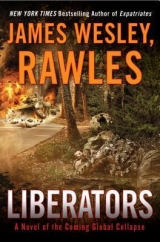
Текст книги "Liberators"
Автор книги: James Wesley Rawles
Жанры:
Триллеры
,сообщить о нарушении
Текущая страница: 2 (всего у книги 29 страниц)
2
THE HISTORIAN
Fear not, but trust in Providence, Wherever thou may’st be.
–Thomas Haynes Bayly
DuPont, Washington—October, the First Year
Phil Adams had met Ray McGregor when they were both deployed in Afghanistan, stationed at Forward Operating Base (FOB) Robinson, in Helmand Province. They both had a fascination with military history. They struck up a conversation in a MWR tent when Phil noticed that Ray was reading the book The Bear Went Over the Mountain, a history of the Soviet army’s invasion of Afghanistan. They were both Christians, and both were politically conservative and viewed politics with a jaundiced eye. They became fast friends.
After leaving active duty, Phil Adams became a counterintelligence contractor at Joint Base Lewis-McChord, in Washington, but he kept in contact with Ray via e-mail and Skype. Ray was the oddball of the McGregor family. After his service with the Canadian army, Ray studied military history at Western University, in London, Ontario. But he had dropped out in his senior year to work on a book about World War II veterans in Michigan. Often living in a fifth-wheel “Toy Hauler” camping trailer towed by his pickup truck, he’d first encamped in Ypsilanti, Michigan, and later in Newberry, in Michigan’s Upper Peninsula.
With the exception of some things that he’d left in storage at his parents’ ranch, everything that Ray owned fit in his pickup and Toy Hauler trailer. This trailer held his enduro motorcycle, a hydraulic wood splitter, two chain saws, fuel cans, and his various woodcutting tools. He also carried a small emergency food reserve in the trailer, which included two Rubbermaid tote bins filled with canned foods and three cases of Canadian military individual meal packs (IMPs). These were packed in heavy-duty plastic-foil retort pouches and were the equivalent of U.S. military MREs.
Ray had already toured the inside of a B-24 at an air show in Georgia. That plane was the world’s only restored flying B-24J, owned by the Collings Foundation. But Ray also wanted to see where they were produced, so he made arrangements via e-mail and completed the short drive to the Willow Run plant. Originally built by the Ford Motor Company, it was an enormous five million square feet in a 1.25-mile-long building. The size of the building was awe-inspiring. At the height of production in 1944, the plant was producing a Liberator at a rate of one every sixty-three minutes, twenty-four hours a day, seven days a week. By the war’s end, the plant had produced 8,685 B-24s. At one point, forty-two thousand people worked at the plant.
After a change in ownership and several repurposings, the plant was finally shut down in 2010. Ray walked through the empty shell of the building, accompanied by a security guard as his tour guide, in the summer of 2013. The guard, who drove Ray between sections of the building in an electric golf cart, was part of a skeleton crew at the plant. The guard was mostly quiet during Ray’s hour-long tour, though he mentioned that most of the people whom he drove around the plant were retired Ford and GM employees. Some of them, he said, had made M16 rifles there, for GM’s Hydramatic Division, during the Vietnam War. But a few were “the real old-timers,” who dated back to the days of B-24 production. As the golf cart hummed them back to the guard office for Ray to sign out, his guide mentioned one last fact: “The lore here is that the turntable two-thirds of the way along the assembly line was put in for tax purposes. That gave each B-24 a ninety-degree turn before final assembly. That way, the company paid taxes on the entire plant to Washtenaw County, because the county taxed at a lower rate than Wayne County did. The airport, you see, is in Wayne County. And you know, General Motors still pays five million a year to Ypsilanti Township in property tax on this building and the 335 acres it sits on.”
Ray was sad to hear that the plant was scheduled to be demolished, and GM was faced with $35 million in environmental cleanup costs.
Other than a few articles that were published in Military History magazine, Ray was a failure as a history writer. He had never found a literary agent, and his four uncompleted book manuscripts had never been published. He made most of his meager living cutting firewood.
When Ray moved near Newberry in Michigan’s Upper Peninsula, he kept his trailer parked at a sprawling farm that belonged to the Harrison family. Four generations of the Harrisons had lived on the farm. Ray had met them when he began a series of taped interviews with Bob Harrison, who had been a B-24 bomber pilot in World War II.
Ray’s own great-grandfather Samuel McGregor was a cattleman. He had been a remittance man from near Greenock, Scotland—a city west of Glasgow. He settled in British Columbia in 1913, and Ray’s family had been there ever since. Ray had two sisters, Rhiannon and Janelle. While Janelle and her husband, Jacob, ran a hardware store in Tavares, Florida, Rhiannon had moved with her family to the Philippines to do missionary work.
The last e-mail that Ray sent to Rhiannon before Internet service was disrupted read:
Dear Rhi:
Things are getting bad here, even in the Upper Peninsula of Michigan. I parlayed the last of my cash into food and fuel. The inflation is so crazy that to wait just one day would mean that I’d only get half as many groceries for my money.
I talked with Mom and Dad, via Skype. (I’m not sure how it is in the P.I., but here in the U.S. the phone lines are getting flaky AND are jammed with calls.) Dad said that they are doing okay, but they sound befuddled by the economic situation. Dad asked me for advice on finding a stock that would be safe to invest in. Ha! I suggested putting all of their remaining cash in food, fuel, salt blocks, baling twine, and ammo.
My old friend Phil Adams told me that I need to “Get Out of Dodge,” ASAP. The plan is for Phil to meet me at the ranch. I’m not sure if I can get enough fuel to get out West though. I think I can trade some ammo for fuel . . . I also have a few silver dimes and quarters, but those are effectively now my life savings. (They are now worth a fortune, at least in terms of the Funny Money U.S. Dollar.)
I’ll be praying for both you and Janelle and your families.
May God Watch Over You,
Ray
3
DAILY GRIND
Of all the modern notions generated by mere wealth the worst is this: the notion that domesticity is dull and tame. Inside the home (they say) is dead decorum and routine; outside is adventure and variety. . . . The truth is, that to the moderately poor the home is the only place of liberty. . . . It is the only spot on the earth where a man can alter arrangements suddenly, make an experiment or indulge in a whim. . . . The home is not the one tame place in the world of adventure. It is the one wild place in the world of rules and set tasks.
–G. K. Chesterton, What’s Wrong With the World
Charles Town, West Virginia—September, the First Year
After serving in the military, Megan LaCroix did her best to keep everything in perspective. It was amazing what conditions a human being could get used to. The right wheel well of the Ford 350 Econoline that she was riding in always prevented her from really getting comfortable on the long vanpool commute from Charles Town, West Virginia, to Fort Meade, Maryland. By the time she hit Frederick, Maryland, she could think only of how incompatible her long legs were with the van. But on days that she did not have to drive, the front passenger seat did offer a power port to plug in her old clunker Toshiba laptop. Megan would access her favorite blogs before leaving the house in the morning and then save them in a date-indexed folder for that day so that she could read up on the blogs and news feeds that she liked, such as the Paratus Familia blog, Patrice Lewis of Rural-Revolution.com, ChrisMartenson.com, and others. Most of her news links came from the DrudgeReport.com, and that particular morning took her a few extra precious minutes to get all the news feeds on Governor Martin O’Malley’s new Comprehensive Safe Citizens Firearm Safety Act, which had caught her attention. Even though she was not a Maryland resident, she did work in that state and ultimately it was its restrictive gun laws that caused her and her former husband, Eric, to choose Kearneysville, West Virginia, as a place to put down roots and raise their family. It was the early 2000s when they were first stationed at Fort Meade/NSA-Washington (NSA-W) together, and they wanted to live away from the hustle and bustle of the Beltway where gas was only $1.43 a gallon and credit was easy.
Megan was a former Marine, and while in the USMC she had been a Marine Corps intelligence specialist. Her career started out rough with an unexpected emergency leave during boot camp, but she quickly excelled in her MOS during her first duty station at Company I in NSA-Hawaii. It was there that she had met Eric Turner, a Navy CTR3. After they’d gotten married and started their family in Hawaii, their respective career detailers assigned them both to Fort Meade, Maryland, otherwise known as NSA-Washington. This was the headquarters of the NSA. Megan was assigned to Company B and continued to progress professionally as an analyst.
Now life was much different for her; she was divorced, a single mom of two young boys, and she was underwater with her home’s value. When her lease was up on her BMW 325i she simplified her life by buying a 1996 Honda Accord for two thousand dollars cash. The car seemed like it always needed something, but despite its multiple kinks would always start up, thanks largely to the maintenance and repair work of Malorie LaCroix, her younger sister.
Although it went against her nature, Megan eventually stopped paying her mortgage. She had tried to communicate with her bank, Bank of America, but they were impervious to working with her at all. So she got their attention the only way people could before the Crunch, by mailing them her house keys. Megan still kept up on the taxes and made sure that the power bill got paid, but she didn’t feel bad about no longer paying the mortgage. By then Bank of America was essentially a “federal utility.”
The federal government tipped over the critical domino that would lead to the inevitable Crunch with the passing of the Troubled Asset Relief Program (TARP) Act. This essentially threw open the doors of the U.S. Treasury and the banking cartel would “plus up” all the bottom lines of their franchise constituents. Banks were no longer concerned with meeting the bottom line; they had access to the tap where the money comes out and “too big to fail” meant all the new “wholly owned subsidiaries” were indeed getting theirs.
The Fed chairman was running the printing press in high gear while the Treasury secretary was trying to find a higher gear yet. Between the two of them they perpetuated their predecessors’ invention. One Beltway pundit called it “Ben and Tim’s self-licking ice cream cone.” This was a monetization scheme euphemistically called Quantitative Easing, wherein one part of the government sold its debt to the other part of the government. It was an ongoing travesty that far eclipsed the brief Fannie Mae and Freddie Mac disasters. The American people, for the most part, lay down for it, and although there was substantive pushback from conservative and libertarian pundits, few elected officials were willing to stop the music. It was, after all, creating a semblance of a “recovery,” and the stock market was soaring.
As the commuter van cruised along, Megan read up on the new gun-grab legislation. “Here I am commuting two hours each way and barely making ends meet, and MOM wants to grab more guns from law-abiding citizens. Soon only the criminals will be able to carry guns,” she mumbled to herself.
Chuck, the man whose turn it was to drive that morning, heard her speaking and said, “What was that?”
“Nothing,” Megan replied, “I was just talking to myself.” She knew better than to open that can of worms with Chuck. Chuck was a committed liberal who had searched on eBay to find a “Kerry-Edwards” sticker to round out the “Hope and Change” motif he had on the back of his Toyota Prius.
The morning commute from Charles Town, West Virginia, to NSA-W averaged two hours, and starting the day with the alarm clock’s buzz at 3:30 A.M. was torturous. The lack of sleep was aging Megan well past her biological age of her late twenties, though not wearing any makeup allowed her to streamline her morning routine. If she hit the rowing machine for twenty minutes, took a shower, downloaded her news feeds, and grabbed a piece of toast with peanut butter on the way out the door it was a good day.
• • •
Malorie LaCroix was usually awake by 6:00 A.M. She would get her young nephews, Leo and Jean, ready for the day, pointed in the right direction to do their chores, fed, and in their seats to start homeschooling by 8:00 A.M. sharp. She had motivated them by saying that they could eat only after the animals did—a lesson underscored when they had to memorize II Thessalonians 3:10 one morning on empty stomachs after refusing to feed and water the chickens and sheep.
Megan’s modest three-bedroom house on six acres offered her the solace on weekends that she desired along with her two sons and Malorie, who lived with them. Kearneysville was a small, quiet town in Jefferson County along Route 9 between Charles Town and Shepherdstown.
Megan bought the house with Eric, who wanted to live out in the country to raise their family. Kearneysville had a downtown consisting of a bank, a post office, an insurance agency, a used car dealership, and a Presbyterian church. The gun laws were much less strict than in neighboring Maryland, and West Virginia offered an incentive for new residents to move in, enticing young professionals with lower taxes.
• • •
Megan was able to briefly tune out Chuck and Carol bantering about some superficial topic by listening to the AudioHopper.com downloads that she had remembered to check her RSS feed for last night. AudioHopper.com was a collection of short podcasts that were popular blogs read aloud and recorded for busy people on the go. As she stared out the window watching the fall colors streak by, she thought about how different life was for her now. She had never imagined she would be in this position: divorced with two young boys, struggling on one income in a job she hated, all while stepping up preparations for an uncertain future.
The commuter van was on I-70 now passing Mt. Airy and traffic was mercifully light. Megan scrolled through more news feeds about North Korea’s saber rattling.
Chuck eased off of the highway to the Canine Road exit and got the van in the queue for the Vehicle Control Point (VCP). The morning pair of DJs on the radio played off each other’s apathy while reading the morning news. Silver was up to forty-four dollars per ounce, France and Poland were petitioning the EU to ban all U.S. GMO crops, oil was trading at $142.88 a barrel, and the stock market was climbing above sixteen thousand points on the Dow Jones Industrial Average.
As Chuck lowered the radio, he said, “Sounds like the president’s reinvestment in the economy really achieved the jobs objective—sixteen thousand thousand points on the Dow! I bet somewhere in Alaska, Sarah Palin is looking for a Russian visa.” Carol giggled, which only encouraged Chuck. “Don’t bother rolling your eyes, Megan. We’re only joking about your Caribou Barbie.”
The NSA cop at the gate dutifully scanned everyone’s badge. One of the advantages of driving in the commuter pools was that the parking was much better. Any car that got on campus after 7:30 A.M., depending on where they worked, would have to park a long way off and negotiate their way to one of the entry points into the Puzzle Palace.
Megan always took the stairs, seven flights up to her office in OPS2A. Her coworkers were not especially cheerful; there had been a lot of lost time and wages with the newly implemented furloughs.
Megan surveyed the milieu in the office and thought, “Wow, they sure are getting a lot of mileage out of this sequestration—it’s still a net increase in spending over last year!” She quietly got to her cubicle before Heidi, the head of the section, spotted her. Megan logged on to the four accounts she had to monitor: NIPRnet, SIPRnet, NSA-Net, and JWICS.
Anywhere within NSA, people noticed the rift between those who wear the blue badge (those trusted civilian servants of the government) and the green-badged personnel—the contractors. For most green-badge people their professional aspiration was to achieve a blue badge by any means. The illusion was that blue badgers were secure, couldn’t possibly be fired, and would retire with full bennies from Uncle Sugar forever—guaranteed by the full faith and credit of the U.S. federal government. However, as the news of the economy only worsened, the furloughs only seemed to clue in the thousands of people who worked for the Agency. Everyone, blue or green badge, could not help but notice that the goose that kept on laying the golden eggs might not be able to keep pace forever.
As Megan brought up her NSA-Net (“high side”) account, the lead story on the NSA-Daily home page was about the budgetary crisis stemming from the lack of an actual budget being passed. As usual, Republican senators were getting the yellow journalism treatment for their unwillingness to just spend the tax. All NSA-ers were urged to contact their elected officials to ask that they pass a budgetary measure to continue to fund national security efforts, especially in the wake of the brewing turmoil with North Korea. “Wow, nothing like appealing to fear,” Megan said to herself as she began to triage her in-box.
4
CHOOSE CIVILITY
At its core, then, political correctness is nothing more nor less than the unjust intimidation of others into thinking and speaking a certain way. As such, it is pure totalitarian mind control.
–David Kupelian
Friedman Auditorium, NSA-W, Fort Meade, Maryland—Six Months Before the Crunch
April was usually warm and humid in central Maryland, but this was one of those countertrend cold snaps that lead to more than a few global warming jokes around the water cooler. It was the monthly Equal Opportunity, “Choose Civility,” and counter-complacency strategy meeting for Megan’s department. Megan was not one for touchy-feely subjective policies, but such was the way of the federal government in those days. “If you want their money, you have to put up with their rules,” she said to herself as she found a seat in the Friedman Auditorium toward the back left. “You never know, I may even be able to make an early discreet exit, this way.”
Megan had given up soft drinks more than two years before, but she was going to need something to keep herself awake for another “insomnia proofing” EO meeting. The speaker giving the talk this morning was late, and the improv MC, who looked like a model for a Calvin Klein ad, was making small talk and asking for everyone’s patience as he gave some statistics about the new Howard County program called “Choose Civility.”
Megan had routinely endured the “moonshine” jokes from her colleagues jeering at the recycled glass jars she used to transport green tea with her to work. Today she was grateful for having given up the chick purse for the “maternal urban assault pack,” as Malorie called it. The large satchel allowed her to carry a lot of valuable things with her, including an Altoids tin filled with small survival items; a six-inch nonmetallic knife with the sheath sewn to the inside of the bag for easy presentation; a Gideon’s pocket New Testament, paper maps of the Maryland, Pennsylvania, West Virginia, and Virginia areas vacuum-sealed in a pouch; a made-in-America Maglite LED XL50; and, of course, baby wipes. “No mom should be caught without them,” she would tell herself. She also carried her green tea sweetened with local honey in the outside pocket of her satchel.
Joshua Kim was a rather laid-back NSA cop. He had made an easy transition from U.S. Air Force Security Forces NCO to work as a “blue badger” at NSA. He still believed in “to protect and to serve” and was driven by an innate sense to help people, which was counter to the training that most law enforcement officers received these days. Typically he arrived before the morning pass-down brief and get breakfast. Getting in early meant that he could traverse the campus easier before the traffic, get a cup of Starbucks coffee from the Sodexo kiosk, and catch up on the news headlines, albeit from the Communist News Network (CNN)—he was sure to keep his filter on.
Joshua happened to be on the Headquarters Building rotation that morning. After being called in to settle a parking dispute between two senior executives over who could get the last coveted parking spot near the Headquarters Building, he resumed his hall patrol. Preferring the stairs to the escalator for the free daily exercise, he would inconspicuously time himself by starting to hum the melody of a hymn on one hallway and seeing if he could finish it by the time he reached the end of the hall on the next floor. It was not uncommon that he was stopped by someone asking for directions; the NSA campus could seem like a maze for a newbie who didn’t know how to carry a map in his head. He finished “How Great Thou Art” in the Elvis Presley style, ascended the third-floor stairs, and took a right at the top landing to enter the Friedman Auditorium.
Joshua saw Megan sitting toward the back of the auditorium and noticed the satchel by her feet and the unintended gleam from the glass jar peeking out from under her satchel’s cover. Unconsciously he had switched from internally singing to audibly humming the melody of the next hymn at the top of the third-floor landing. When he approached Megan to inquire about the glass jar, she recognized the tune first and reflexively asked, “Excuse me, but is that the tune to ‘Be Thou My Vision’?”
“It is. I didn’t realize I was humming out loud. I was hoping to ask the questions here, though. Is that a beverage in your bag?”
“Yes, it is—Officer Kim, you caught me,” Megan admitted, surreptitiously glancing at the name badge on his uniform.
“I’m going to have to ask you to remove it from the auditorium immediately; the signs posted at the entrance prohibit food or beverage.”
“Since you asked so nicely, I suppose that I could throw it away. My office is a long walk from here.”
“However you remove it is fine with me.”
Megan’s hand disappeared for a brief second under the flap to grip the jar, and she blushed a bit as she excused herself past Joshua at the end of the row. Joshua had not previously noticed, but she was wearing a long skirt, what he guessed to be a merino wool top, and Dr. Martens boots, which was not typical of the fashion that most women donned while at the NSA. Joshua had made it down the aisle to the front of the auditorium and was on his way back while the improv MC was starting in on “equal access to marriage rights” in his sugary, heavy lisp. Megan had just come back from her walk of shame to duck into her row when Joshua was returning up the aisle. He was impressed with her modest choice of attire and decided he might try small talk with the woman he had just admonished about the beverage.
“Are those Dr. Martens Aimees?”
“Actually, they are. Are you still asking the questions here, or am I allowed to ask one myself?”
Normally cops eschew sarcasm, but this girl clearly had a knack for it, and he was intrigued and—if he was honest with himself—also attracted to her. He was unfiltered now, and answered with an unconscious eyebrow raise.
“Why were you whistling such an old church hymn earlier?”
“Usually when I’m on foot patrol I pick a hymn and sing it in my head to give me an informal time hack on how much ground I’m covering. ‘Be Thou My Vision’ was the last song that we played at church on Sunday. Plus the tune was so hauntingly beautiful it stuck with me since then. Why the Dr. Martens?”
“You know, usually cops have one hand on their pistol while standing behind the B pillar when they talk to the common citizen. I wear Docs because I learned in the military that the only reliable transportation you will ever have is—”
“Your feet!” Joshua could not believe that he overrode his professional manner to interrupt her like that.
“Yes, Officer Kim. Your feet are the only means of transportation that one can depend on. So I always wear shoes that I can get around in if need be. You can say that I like to be prepared. What church do you attend?”
“I can tell that you’re not into this guy’s presentation here.”
“He’s not even the featured speaker. As a former Marine, I have a thing about punctuality. It’s seventeen minutes after the scheduled start time. Moreover, I just do not get why we have to be lectured on why we should accept the ‘alternative’ lifestyle as legitimate, and if I somehow disagree I have committed the last sin left in society, the sin of intolerance. So are you dodging my question?”
“No, this just isn’t the right venue, and I’d like to speak with you, the common citizen, as you say, in a more informal setting. I take lunch around eleven-forty-five. Would you care to meet me in the OPS1 cafeteria?”
“I usually bring my own lunch, but I’ll consider it. After all, out of the two of us, you’re the only one carrying a pistol here. I suppose that makes your argument somewhat persuasive.”
“Don’t let the pistol persuade you, an argument ad baculum is not persuasive at all—it simply does not follow. A man persuaded against his will remains unconvinced still.”
“Ad baculum. Where did you learn Latin?”
“I went to Catholic school. Eleven-forty-five, I usually sit at a table by the round couch across from Einstein Bros. Bagels—look for the guy with the pistol, and I’ll save you a seat. Good day, citizen.”
Megan smiled and shrugged with noncommitment as he walked away. She wasn’t used to someone who was not put off by her sarcastic defenses and could even dish it out himself. As the featured speaker, a black female who was assistant deputy to the NSA general counsel on EO, finally took the stage a full twenty-three minutes late, Megan mentally checked out of the indoctrination and realized that Officer Kim was both in shape and cute.
Perhaps she could bring her lunch to the OPS1 cafeteria today after all.