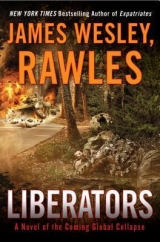
Текст книги "Liberators"
Автор книги: James Wesley Rawles
Жанры:
Триллеры
,сообщить о нарушении
Текущая страница: 1 (всего у книги 29 страниц)
ALSO BY JAMES WESLEY, RAWLES
Patriots: A Novel of Survival in the Coming Collapse
How to Survive the End of the World as We Know It
Survivors: A Novel of the Coming Collapse
Founders: A Novel of the Coming Collapse
Expatriates: A Novel of the Coming Global Collapse


Published by the Penguin Group
Penguin Group (USA) LLC
375 Hudson Street
New York, New York 10014

USA | Canada | UK | Ireland | Australia | New Zealand | India | South Africa | China
penguin.com
A Penguin Random House Company
Copyright © 2014 by James Wesley, Rawles
Penguin supports copyright. Copyright fuels creativity, encourages diverse voices, promotes free speech, and creates a vibrant culture. Thank you for buying an authorized edition of this book and for complying with copyright laws by not reproducing, scanning, or distributing any part of it in any form without permission. You are supporting writers and allowing Penguin to continue to publish books for every reader.
LIBRARY OF CONGRESS CATALOGING-IN-PUBLICATION DATA
Rawles, James Wesley.
Liberators : a novel of the coming global collapse / James Wesley, Rawles.
pages cm
ISBN 978-0-698-16145-0
1. Survival—Fiction. 2. Financial crises—Fiction. 3. Suspense fiction. 4. Dystopian fiction. I. Title.
PS3568.A8437L53 2014
813'.54—dc23
2014020037
This book is a work of fiction. Names, characters, places, and incidents either are the product of the author’s imagination or are used fictitiously, and any resemblance to actual persons, living or dead, business establishments, events, or locales is entirely coincidental.
Version_1
DISCLAIMERS
All rights reserved. Any unauthorized duplication in whole or in part or dissemination of this edition by any means (including but not limited to photocopying, electronic bulletin boards, and the Internet) will be prosecuted to the fullest extent of the law.
This is a work of fiction. All of the events described are imaginary, taking place in the future, and do not represent the world as we know it in the present day. It does not reflect the current geopolitical situation, governmental policies, or the strategic posture of any nation. It is not intended to be commentary on the policies, leadership, goals, strategies, or plans of any nation. This novel is not intended to be predictive of the territorial aspirations tactics of any nation or any planned use of terrorist tactics. Again, it takes place in the future, under fictional new leadership of many nations. Any resemblance to living people is purely coincidental. The making and/or possession of some of the devices and mixtures described in this novel are possibly illegal in some jurisdictions. Even the mere possession of the uncombined components might be construed as criminal intent. Consult your state and local laws! If you make any of these devices and/or formulations, you accept sole responsibility for their possession and use. You are also responsible for your own stupidity and/or carelessness. This information is intended for educational purposes only, to add realism to a work of fiction. The purpose of this novel is to entertain and to educate. The author and publisher shall have neither liability nor responsibility to any citizen, person, or entity with respect to any loss or damage caused, or alleged to be caused, directly or indirectly, by the information contained in this novel.
This novel is dedicated to my excellent wife, “Avalanche Lily,” for her inspiration and encouragement.
CONTENTS
Also by James Wesley, Rawles
Title Page
Copyright
Disclaimers
Dedication
Epigraph
Dramatis Personae
Author’s Introductory Note
1. EXIGENT CIRCUMSTANCES
2. THE HISTORIAN
3. DAILY GRIND
4. CHOOSE CIVILITY
5. WORKFORCE
6. DIFFUSED RESPONSIBILITY
7. THE CROSSING
8. CUP OF JOE
9. TOLERANCE
10. VOLUNTARY DISPLACEMENT
11. YOU CAN’T GET THERE FROM HERE
12. CONVEYANCE
13. DEPARTURE
14. MUTUAL SELF-INTEREST
15. BYPASS
16. THUNDER BAY
17. DEEDS, NOT WORDS
18. IN DEFENSE OF
19. LPCs
20. THE ZONE ONE GATE
21. IN THE 1880S
22. HUNGER
23. SIGNALS COLLECTION
24. END IN MIND
25. PROMISES
26. REFUGE
27. LA MAIN DE FER DANS UN GANT DE VELOURS
28. BRUSSELS CHARADES
29. UN ESSAIM
30. TOP CONDITION
31. STEEL SHIPS AND IRON MEN
32. PUMAS AND GAZELLES
33. COLOR OF LAW
34. SUSPICION
35. THE NEW HIGHWAY PATROL
36. HOOFING IT
37. BLENDING IN
38. PACKING IT IN
39. INGRESS
40. JE NE SAIS QUOI
41. IN A PAST LIFE
42. MILK RUN
43. FERTILE CRESCENT
44. TAKING OUT THE TRASH
45. LE DERNIER COMBAT
46. THE TRAP
47. THE CHEESE
48. EFFRONDREMENT
49. BEIJING CHARADES
50. BLINDING FLASH
51. PROJECT JORDAN
52. TIEBREAKER
53. NI HAO
54. THICKER THAN WATER
55. HINTERBOONIES
56. RECUPERATION
57. BIG TREBLE
58. EBB TIDE
59. FLAMBÉE DAY
60. WEDDING PRAYER
Glossary
Acknowledgments
About the Author
There is no king saved by the multitude of an host: a mighty man is not delivered by much strength. An horse [is] a vain thing for safety: neither shall he deliver [any] by his great strength. Behold, the eye of the LORD [is] upon them that fear him, upon them that hope in his mercy; To deliver their soul from death, and to keep them alive in famine. Our soul waiteth for the LORD: he [is] our help and our shield. For our heart shall rejoice in him, because we have trusted in his holy name. Let thy mercy, O LORD, be upon us, according as we hope in thee.
–PSALM 33:16–22 (KJV)
DRAMATIS PERSONAE
Phil Adams—Defense Intelligence Agency counterintelligence case officer with the Defense Clandestine Service (DCS) Task Group Tall Oak, Washington at Joint Base Lewis-McChord, Washington.
Jacob “Jake” Altmiller—Hardware store manager in Tavares, Florida.
Janelle (McGregor) Altmiller—Real estate agent in Tavares, Florida. Wife of Jacob Altmiller. Sister of Rhiannon (McGregor) Jeffords and Ray McGregor. Daughter of Alan and Claire McGregor.
Lance Alan Altmiller—Son of Jacob and Janelle Altmiller. Eleven years old at the onset of the Crunch.
Terrence Billy—Garbage truck driver, Williams Lake, British Columbia. Member of the Secwepemc tribe.
PO3 Jordan Foster—Navy SEAL BUD/S student, United States Phil Bucklew Naval Special Warfare Center (NSWC), Naval Amphibious Base Coronado, California.
Larry Guyot—Owner/manager of Guyot Railway and Engine Maintenance, Ltd., Prince George, British Columbia.
Jerry Hatcher—Cessna 180G bush pilot, Bonners Ferry, Idaho.
Dustin Hodges—Deputy sheriff, Bradfordsville, Kentucky.
Peter Jeffords—American missionary from New Hampshire.
Rhiannon “Rhi” (McGregor) Jeffords—Missionary originally from Bella Coola, British Columbia. Wife of Peter Jeffords. Sister of Janelle (McGregor) Altmiller and Ray McGregor.
Sarah Jeffords—Daughter of Peter and Rhiannon Jeffords. Seven years old at the onset of the Crunch.
Hal Jensen—Section chief, DCS Task Group Tall Oak, Washington, Joint Base Lewis-McChord, Washington.
Joshua Kim—NSA security officer, Washington, D.C.
Jean LaCroix—Son of Megan LaCroix. Three years old at the onset of the Crunch.
Leo LaCroix—Son of Megan LaCroix. Five years old at the onset of the Crunch.
Malorie “Mal” LaCroix—Younger sister of Megan LaCroix. Former machinist in Kearneysville, West Virginia.
Megan LaCroix—Intelligence analyst NSA contractor at Fort Meade, Maryland. Divorced mother of Jean and Leo LaCroix.
Ken Layton—Former mechanic and member of the Northwest Militia.
Stan Leaman—Dairyman from Anahim Lake, British Columbia.
Sylvia Leaman—Cousin of Stan Leaman. Sixteen years old at the onset of the Crunch.
Kevin Lendel—Member of the Northwest Militia.
Alan McGregor—Retired cattle rancher, Bella Coola, British Columbia. Father of Ray McGregor, Janelle (McGregor) Altmiller, and Rhiannon (McGregor) Jeffords.
Claire McGregor—Wife of Alan McGregor. Mother of Ray McGregor, Janelle (McGregor) Altmiller, and Rhiannon (McGregor) Jeffords.
Ray McGregor—Afghanistan War veteran and military historian. Originally from near Bella Coola, British Columbia. Living near Newberry, Michigan. Son of Alan and Claire McGregor. Brother of both Rhiannon (McGregor) Jeffords and Janelle (McGregor) Altmiller.
Brian Norton—Defense Intelligence Agency counterintelligence case officer and electronics expert with DCS Task Group Tall Oak, Washington at Joint Base Lewis-McChord, Washington.
Scott Paulsen—Defense Intelligence Agency counterintelligence case officer and Russian linguist with DCS Task Group Tall Oak, Washington at Joint Base Lewis-McChord, Washington.
Lamar Simons—Mayor of West Hamlin, West Virginia.
Rob Smith—Cessna Amphibian float plane pilot, Tavares, Florida.
Chad Sommers—Grandson and adoptive ward of Ron and Tracy Sommers. Eight years old at the onset of the Crunch.
Ron Sommers—Rancher and former Marine Corps 3002 ground supply officer, living near Alta, Wyoming.
Tracy Sommers—Wife of Ron Sommers, living near Alta, Wyoming.
Clarence Tang—Defense Intelligence Agency counterintelligence case officer and Chinese linguist with DCS Task Group Tall Oak, Washington at Joint Base Lewis-McChord, Washington.
Aaron Wetherspoon—Retired U.S. Navy chaplain.
AUTHOR’S INTRODUCTORY NOTE
Unlike most novel sequels, the storyline of Liberators is contemporaneous with the events described in my four previously published novels, Patriots, Survivors, Founders, and Expatriates. Thus, you need not read them first (or subsequently), but you’ll likely find them entertaining. For those who have read them, you will find that this novel ties together the four previous books. My regular blog posts are available at: http://www.SurvivalBlog.com.
1
EXIGENT CIRCUMSTANCES
The backbone of surprise is fusing speed with secrecy.
–Carl von Clausewitz
Seattle, Washington—October, the First Year
To Phil Adams, it seemed that his life had become jammed in “fast-forward.” Even though his job as a contract counterintelligence agent with Defense Clandestine Service (DCS) Task Group Tall Oak, Washington at Joint Base Lewis-McChord was already fast-paced, recent global socioeconomic events were spinning out of control. The mass media was abuzz about the inflation jumping above 100 percent, annually. Federal debt obligations had reached absurd numbers, the stock markets had reached dizzying heights, and there were rumblings about foreign repudiations of U.S. Treasury paper.
As he drove toward a routine security paperwork inspection with a defense contractor, Phil Adams had his attention glued to the car radio. He punched the radio’s scan button often, jumping from news report to news report. The stories that he heard this morning were the worst yet: rioting in Detroit and Cleveland and rumors of mass demonstrations being planned by “community activists” in many other major cities. Phil muttered to himself, “This is starting to damage my calm.”
Then Phil got a call on his cell phone from his manager, Hal Jensen.
“I need you to either get back to the Section office or get to a STU phone, pronto!” Hal said.
“I’m on my way to Peregrine Systems for a quarterly,” Phil answered. “I’m just a two-minute drive from there. They’ve got a secure phone. I’ll call you in five mikes or less.”
Just three minutes later, Phil called Hal on the secure line. “What’s so urgent?”
“I just got a priority tasking via the high side. We’ve been ordered to fully update and upload all of our electronic holdings, clean our Section out of the SCIF, degauss and destroy all of the Tall Oak local classified holdings, and turn over the entire SCIF to the FEMA staff. I’ve also been directed to close out all employment contracts—both full-timers and the ad hocs.”
Phil was stunned. After a long pause, he replied, “Okay, I’ll make some excuses here and be back at the office ASAP.”
• • •
Phil drove back to JBLM—still listening to the bad economic news on the radio. Phil was thirty-two years old, of average height, with a handsome face, brown hair, blue eyes, and short-cropped hair that was turning prematurely gray. The gray hair was an advantage on post, where everyone seeing him in civilian clothes assumed that he was either a field-grade officer or a senior NCO who was off duty. Even though he wasn’t tall, soldiers had a tendency to step out of the way when he walked down the hall. His physical bearing triggered immediate respect.
As he walked into the Tall Oak Sensitive Compartmented Information Facility (SCIF), he could immediately feel the tension.
Hal spelled it out tersely: The economic collapse had forced a drastic cutback in federal programs. For the first time ever, intelligence agencies had their budgets axed, and the deepest of those cuts were made to agencies with contractors. They were to destroy all of their holdings and shut down the Section. Their communications equipment would all be handed over to the FEMA staff. However, three of their computers designed specifically for handling SCI traffic would be useless to the FEMA staffers without their removable hard drives. But that was of little concern to the departing Tall Oakers.
Tall Oak had one locked storage cage in the far end of the building that was used to hold their Field SCIF gear. This cage contained some dusty equipment in plain view: two pallets of coiled concertina barbed wire, three folding tables, a half dozen folding chairs, a bundled GP small tent, two sledgehammers, a shovel, a four-wheeled utility cart, a two-wheeled dolly, and a tall stack of galvanized forty-gallon steel trash barrels that could be used as burn barrels. None of this gear had been used in recent memory, and the only time that Phil ever saw it was when he was escorting visiting inspectors. In the context of their work, the Field SCIF gear was essentially a collection of relics and an administrative nuisance—just a few more items to count each time that they had to do a PBO inventory.
Fortunately, with digitization, the volume of hard-copy classified material that DCS Task Group Tall Oak stored had decreased in recent years. Most of their holdings were in the form of magnetic media that could be destroyed by degaussing them—passing them through an intense magnetic field. But the task of destroying all of the paper documents would still be enormous.
Since the SCIF had only three crosscut paper shredders, Jensen decided to set up a temporary Field SCIF in the motor pool area behind the building to burn most of the documents. Stringing the three strands of concertina wire went quickly. They didn’t bother staking it down. Inside the concertina wire enclosure, eight burn barrels were set up in a semicircle. Green plastic Scepter cans of diesel fuel were hauled out and used to stoke the barrels since documents stacked more than five pages thick did not burn well, just by themselves. There were also fire extinguishers nearby, if needed.
Many cartloads of documents were wheeled out of the SCIF and down the hall to the burn barrels. The flames were a hazard (since the barrels had to be stirred regularly with a length of pipe), and the smoke was irritating. Intermittent rain showers made the work miserable as wet ashes began to cling to every surface.
As they worked, Phil’s coworker Clarence Tang listened with earbuds to news reports on a compact FM jogging radio, which he had strapped around his upper arm. He relayed the news headlines tersely and sporadically, half shouting, “There are still riots in progress in New York, Chicago, Atlanta, Dallas, and Los Angeles. Now in California there are also riots and looting in Oakland, Stockton, and San Francisco. So far there is just sporadic looting in Portland and downtown Seattle. They say that Vancouver, BC, seems almost normal, except for a couple of protests by ‘the usual activists.’ They’re describing the freeway traffic like it’s rush hour, but at midday. Seattle traffic is definitely slowing down, and they may be closing Sea-Tac airport since there are riots in so many destination cities. Seems like most metro areas with populations over a half million are in trouble. Part of Miami is in flames, out of control.”
Phil discovered that the reinforced concertina wire–handling gloves worked well at protecting his hands when he stirred the drums of burning documents. Meanwhile, inside the SCIF the bulk degaussers were kept humming, demagnetizing various media. The various “wiped” removable hard disks, disk drives, and tape cartridges were then carried out and smashed with sledgehammers, and then burned for good measure. Hal even had them burn the stacks of generic classified document cover sheets, even though they themselves were not classified. (Jensen always held a “belt and suspenders” attitude about some things.)
Next, they checked the serial numbers of all of their handguns and locked them in one of the GSA high-security drawers. Unlike the others, Phil kept his holster, because it was his personal property. He reminded Hal that he had a SIG P228 at home and asked if he could keep his two issued spare thirteen-round magazines.
Hal nodded. “Sure. Keep them—and here are three more for you. Magazines are classified as ‘expendable’ items and aren’t even listed in our Property Book. Consider them an early retirement gift from Uncle Sam.”
An inventory of all badges and credentials followed. Finally came the SCI debriefing for Phil, Brian, Clarence, and Scott. It seemed strangely surreal, as they sat and watched the same debriefing DVD that they had shown to countless others. They were all exhausted, sweaty, and grimy with ashes, and they smelled like diesel fuel. Once they had signed their DD Form 1848 debriefing memorandums (which reminded them that they were still bound by the strict terms of their DD Form 1847-1 SCI nondisclosure agreements for the rest of their lives), they were officially read off of SCI.
While they were signing their debrief/nondisclosure agreements, two members of the FEMA staff arrived. These men seemed confused and uncertain of what they should do in the Mother of All Emergencies. They soon gravitated to the television and watched CNN, transfixed, like millions of other Americans.
After signing out for the last time and a few handshakes out in the hall, the Tall Oakers simply drove off to an uncertain future.
• • •
Phil returned to his apartment exhausted. He grabbed some leftover sushi takeout boxes from his refrigerator and ate, sipping a bottle of lemon-flavored sparkling spring water. He then resumed organizing his gear—a process that had started a week before. Most of his field gear was sorted into a stack of forest-green Rubbermaid storage totes. Alongside it were his two Pelican long gun cases and nineteen military surplus ammunition cans, six cases of MREs, a tan military surplus water can, and two white cardboard case lots of Tannerite binary exploding target powder.
Phil had two vehicles: a 2012 Chevrolet Malibu, which he used to commute to work, and a 2015 GMC Canyon midsize crew cab four-wheel-drive pickup truck. Just a few months before the Crunch, he’d traded in his blue 2009 GMC Sierra for the Canyon. Outwardly, it looked similar to his old Sierra pickup, but it was scaled down for better gas mileage. Immediately after buying it, he purchased a T.A.G. Crown-S camper shell for his pickup, a common accessory to have in western Washington’s wet climate.
When he first bought the Canyon pickup, it had seemed fairly roomy. But when he did a test load using his storage totes and gun cases, he could soon see that he would have to rethink his “Get Out of Dodge” packing plan. While his plastic totes could be stacked two-deep in his Sierra pickup, there was not quite enough room in the Canyon, so he had to buy a set of half-height totes to use for the second layer.
In his final preparations, Phil had to be selective about what was going with him and what he’d abandon in his apartment. He first pulled a few useful items out of his car, like road maps, a tire-pressure gauge, a digital recorder, a Maglite flashlight, and some road flares. Then he filled up the back end of the pickup almost completely, and crammed some clothing and his extra sleeping bag in the gaps around the bins and ammo cans. He also loaded up both of the seats on the right side of the pickup’s cab. He left only the driver’s seat and a driver’s-side rear seat open, knowing that he’d need room to recline his seat to sleep on the long trip ahead.
He always made a habit of leaving his pickup topped off with gas. This served him well today, since every gas station within fifty miles of Seattle had enormous queues of waiting customers.
Although technically Phil still had DCIPS termination paperwork to complete, as far as he was concerned, that could wait until “normal” times. He said to himself, “They have their SIGs, they have their badges and credentials, and I’ve been read off. Everything else is just piddly paperwork. That can wait.”