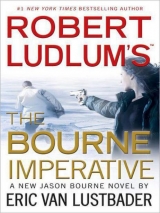
Текст книги "The Bourne Imperative (Крах Борна)"
Автор книги: Eric Van Lustbader
Жанры:
Шпионские детективы
,сообщить о нарушении
Текущая страница: 22 (всего у книги 25 страниц)
When Maceo Encarnación thought of Tlazolteotl, he saw not the various statues of her in stone and jade residing in the National Museum, but Constanza Camargo. Only Constanza had the ability to devour his many, many sins, to cleanse him, to make him whole again. And yet, as she had made clear many times, she would not absolve him of his. The sin he had committed against her was too monumental for even Tlazolteotl, ancient and powerful, to consume.
Maceo Encarnación, thrusting into the flight attendant one last time, fell upon her bare back, trembling and sweating. His heart thundered in his chest, and he felt keenly the pain of dissolution, of a vast emptiness advancing upon him like an army of eternal night, implacable and terrifying. The one thing that frightened Maceo Encarnación was the void—the nothingness that might very well last an eternity. Not for him the constricting Mass, the meaningless platitudes contained in weekly homilies, the treacherous pabulum of “God’s plan.” God had no plan; there was no God. There was only man’s abject terror of the unknown and the unfathomable.
In these unbearably long, unbearably empty moments after completion, Maceo Encarnación ached for Constanza Camargo as he had ached for no one else in his life. The fact that he was exiled from her was like a pain inside him he could neither reach nor cure. That it was his punishment, that it was deserved, made it no easier to bear. On the contrary, it enraged him. Not all his wealth, his dark influence, or his corrosive power was of any use to him. When it came to Constanza Camargo, he might as well be the lowliest beggar in the shit-strewn dirt of a backwater marketplace, sickly and destitute. He could not cajole her, he could not coerce her, he could not reach her.
Stepping back, he zipped his trousers. He felt sweaty and oily. His skin reeked of the flight attendant’s nether regions. She had dressed herself while facing the airplane’s richly fabricked bulkhead, and now strode off on long, powerful legs to resume her regularly scheduled duties, without a backward glance.
Maceo Encarnación, staring at the fabric, saw a mark where her damp forehead had pressed into it with the force of his strokes. Smiling, he caressed the stain with his fingertips. It was a sign of surrender, the stain of sin.
Constanza Camargo possessed her own stain: the sin of her serial adultery. A week after her husband’s death, she had fallen down the stairs of her house, having been roused in the middle of the night by the ghostly sound of his voice, which she had either dreamed or imagined. Her beautiful bare foot had missed the first tread and down she had tumbled.
Crawling along the ground floor runner, she had found a phone and called Maceo. By that time, their affair had burned itself out; he hadn’t heard from her in months. Nevertheless, he hadn’t hesitated. He had found her the finest spinal surgeon in the country, who had promptly repaired the herniated disc caused by the fall. Unfortunately, as happens in a small portion of spinal procedures, she had developed peripheral neuropathy, a painful and degenerative condition that defied treatment. Nevertheless, he had made certain she had tried them all. Now her wheelchair was a constant reminder of how she had betrayed Acevedo Camargo. As it had with her husband, desire had bisected destiny, altering its course.
And what of the surgeon who had operated on Constanza Camargo? Six months after he had announced that her condition was irreversible, he had taken a week in Punta Mita with his mistress. A young man, up early, jogging at the water’s edge through the misty morning, had come across two human heads, neatly severed from their bodies. At first, the police assumed they were a drug dealer and his mistress, a member of a rival gang who had tried to work territory outside his own. When the true identities of the heads came to light, the local police were at a loss as to motive, let alone as to who the perpetrators might be, and the incident was soon buried in hurried paperwork and forgotten.
Maceo Encarnación’s mind returned to the present. Moments after being left alone, having checked his watch, he went down the aisle, past the flight attendant, who was busy making his dinner, and into the cockpit where the pilot and the navigator were listening to cumbiaon their iPads, awaiting his instructions. The pilot spotted him first and removed his earbuds.
“Time to get under way,” Maceo Encarnación said.
The pilot had an unspoken query in his eyes. He knew that Nicodemo had not returned.
Maceo Encarnación nodded, answering his question. “Time,” he repeated, before returning to his seat and strapping in. Up ahead, in the cockpit, he could hear the pilot and navigator talking as they went through their pre-flight checklist.
The pilot contacted the tower, spoke and listened, then spoke again, and taxied the jet into their slot for takeoff.
To be frank, I don’t know why I’m here.”
General Hwang Liqun looked around Yang Deming’s apartment. The old man was the foremost feng shui master in Beijing and, as such, much in demand. He was somewhat taken aback that he was sitting in a spacious apartment in an ultramodern beehive of a building near the Dongzhimen subway station. Filled with shiny surfaces, polished wood, marble, lapis, and jade, it seemed filled to overflowing with reflections. Outside the floor-to-ceiling windows, through the brownish Beijing smog that resembled a sandstorm fixed in time that had blown in off the Gobi, could be made out Rem Koolhaas’s immense CCTV building.
General Hwang Liqun would never admit it, but he was impressed that Maricruz had been granted an appointment, and at such short notice! To be sure, she was married to Minister Ouyang, but still, she was a foreigner, albeit one whose grasp of the delicate intricacies of Mandarin was a damn sight better than many people Hwang Liqun encountered in his daily schedule.
“I think,” Maricruz said to the General, as she accepted a cup of Ironwell tea from Yang Deming’s narrow, blue-veined hand, “that you must very well know why I invited you here.”
At this, the old man smiled, nodded to Maricruz, and, much to the General’s astonishment, kissed her on both cheeks before unfolding himself like an origami stork, and, with bare feet, padding out of the room.
Maricruz indicated the small, squat iron teapot. “Will you join me?”
The General nodded in an officious and rather stiff gesture that telegraphed how ill at ease he was.
After he accepted her offering and they had sipped in an increasingly tense silence, he said, “Now, if you please...”
The General was in his early sixties, older by two decades than Minister Ouyang. Theirs was a friendship born of necessity that had gradually formed its own very real parameters. The two men shared a pleasing and deep-rooted practicality, a vital trait in modernday China. They also had a vision for China going forward into the twenty-first century and beyond. Their real shared bond was the importance of new and innovative sources of energy and the belief that the origin of these new energy sources would come from Africa, a continent that, through the efforts of both men, was fast becoming a Chinese stronghold. There were, of course, obstacles to the two men’s ambitions, both for themselves and for China. The most potent and immediate threat was the reason Maricruz had called this meeting, and why the venue was so unorthodox as to fly under every official Party radar in Beijing.
“We are here, in relative isolation and complete security,” Maricruz said, “because of Cho Xilan.” Cho was the current secretary of the powerful Chongqing Party. After the last Communist Party Central Committee, Cho began his outspoken attacks on the status quo, arguing that ideology was being eroded in the frantic clamor to expand China’s presence abroad. By “abroad,” of course, he meant Africa, and by taking this stance he had put himself in direct opposition to Minister Ouyang and the General. Cho had decided to cleave to a party line of “building a moderately prosperous society, steeped in the ideology of socialism,” and in this way avoid the cultural unrest flaring in the nations outside the Middle Kingdom, an economic divide between the upper and under classes.
“There is a war coming, General,” she said.
“This is China. There are no internal wars here.”
“I can feel it in my bones.”
“Can you now?” the General said with a smirk that spoke of superiority.
“I come from a country steeped in the blood of class warfare.”
This comment served only to more firmly establish his smirk. “Is that what the drug trade is all about?” He produced a strident laugh. “Class warfare?”
“The drug trade here in China was begun by foreigners, foisted on the population of the coast, making it dependent on the fruit of the poppy. On the other hand, we Mexicans control our trade and have done so from the beginning. We sellto foreigners and use the profits to fortify ourselves against the endless corruption of regional governments and the federales. We are people who were born into poverty. We ate dirt with what scraps we could forage, but with every breath we took, we dreamed of a free life. Now that we have that free life, we know how to hold on to it. Can you say the same, General?”
Hwang Liqun sat back, staring at this gorgeous, monstrous creature confronting him like a dark goddess of the underworld. Where had she come from? he wondered. How had Minister Ouyang found her? He and Ouyang Jidan were friends, yes, but there were limits to friendship, areas in which one must not pry. Thus did General Hwang Liqun have only the most superficial knowledge of Maricruz, though he had met her numerous times at parties, official functions, even dinners of a more intimate nature. Nothing in his past experience of her, however, would have led him to suspect that she was capable of this conversation. How much had Ouyang told her of their plans? How did he know she could be trusted? Ouyang trusted no one except the General.
He had assumed that she had called this meeting, on behalf of Ouyang, thus believing he would lose no face by agreeing to attend. Now he understood that Maricruz, deeply and inextricably involved in Ouyang’s—and, therefore, his—business, was speaking for his friend, that he had cannily sent her as his emissary because the stakes were so high, the wartime strategy too fraught to chance a breach in security. Being a foreigner, Maricruz was ignored by Ouyang’s associates and, more importantly, his enemies, who held her in contempt. She was secure, and the General was now grateful for it.
“It is unfortunate, Maricruz,” the General said now, “that I cannot make that claim. Please continue.”
She poured them both more tea. “More than five years ago, you and Ouyang pushed for building the roads and infrastructure in Kenya. You saw the endless wealth in the ground, and you were determined to claim it for China’s growing energy needs. Ouyang predicted that the Kenyans would not ask the price for this desperately needed work, and he was right. And now, as a consequence, he can get whatever he wants out of Kenya—oil, diamonds, raw uranium ore, possibly even rare earth elements.”
The General nodded. “Our gamble will pay off handsomely.”
“And yet,” Maricruz said, “this incredible payoff remains something Cho Xilan, in his overzealous manner, has worked against. Because of him, Zimbabwe is still waiting for China to make good on its infrastructure promises, and Guinea turned over oil rights in exchange for nine billion dollars in housing, transport, and public utilities that have yet to appear. All because of Cho, who has sounded the call for China’s global retreat in order to ‘clean house,’ as he puts it, to sweep aside the entrenched corrupt political hierarchy with a new broom.” She shook her head. “You gave Cho ammunition against you. He unearthed a number of African politicos who were slicing off chunks of money and lining their own pockets.”
The General, slightly nettled, said in a steely voice, “That is the way deals are done in Africa. Nothing new to it.”
“Except when Cho brings evidence of it to the Central Committee. He got them to stop all payments, didn’t he? He built political capital, didn’t he?”
She took a sip of tea, allowed the atmosphere to cool somewhat, then put down the handleless cup. “I’m sorry to be so blunt, General, but time is short. What Cho really wants is a return to the time of Mao, of a central leader, upright, righteous, ideologically dogmatic. He wants nothing less than to rule China, to rule it with an iron fist.”
The General swallowed more tea to calm his teeming mind. Thoughts and ideas chased each other like schools of fish through a coral reef. At length he said, “Let us assume, for argument’s sake, that I agree with your grim assessment of the situation.”
“Sign off on sending a cadre of Ouyang’s men to Lebanon. Our project there is in its final stages. The enormity of the energy opportunities it will bring China is virtually incalculable. Cho doesn’t want either you or Ouyang to gain such power.” She raked him with her eyes. “He will do anything to stop the project from being consummated.”
The General’s eyes began to glaze over as he lost interest. “All this is known to me. There is enough security already in place. Minister Ouyang and I agreed on this aspect of the plan months ago.”
“The situation on the ground has changed,” Maricruz said.
The General cocked his head as a frown deepened into a scowl. “In what way?”
“Jason Bourne has entered the picture.”
Hwang Liqun blew out a small gust of breath. “Yes. He has been traveling with a Mossad agent. But that, by itself, means nothing.” His hand cut through the air in a gesture of finality. “Besides, the Mossad agent is dead.”
Unfazed, Maricruz pressed on. “Bourne has been to Dahr El Ahmar and escaped.”
“This also is old news, Maricruz. Minister Ouyang has made arrangements to take Bourne out should he appear again in Dahr El Ahmar when the deal is consummated.”
“I assume you’re speaking of Colonel Ben David,” Maricruz said. “The trouble is Ouyang doesn’t trust Ben David.”
This came as a surprise to General Hwang Liqun. Now, in a moment of revelation, he knew why Ouyang had arranged such elaborate security, entrusting Maricruz to deliver the intel in person. He looked hard into Maricruz’s eyes. She was right, there wasn’t much time. The deal was due to be consummated nine hours from now. He nodded. “I will sign the order immediately. Tell Ouyang Jidan an unmarked jet will be ready and waiting for his cadre within the hour.”
Are you up for a swim?”
Don Fernando looked at Bourne. “I’m old, Jason, not dead.” He glanced upward at the spinning lights and crowds along the Pont Alexandre III. “The police are making quite a production up there.”
“We’ve got to get out of the area,” Bourne said, “before more come and they lower divers into the water.”
Don Fernando nodded.
“We’ll head downriver. You can see the Pont des Invalides. It’s not far.”
“Don’t worry about me, Jason. I’m always ready for a good swim.” He smiled. “Anyway, quick getaways remind me of my misspent youth.”
“All right, then.”
Bourne slipped off the slimy bridge pier to which they had been clinging like limpets. They had to be careful, as clusters of razorsharp barnacles lived just beneath the waterline. There were spotlights raking the water now, illuminating the area where the car had gone in. All boat traffic had been stopped upriver. A pair of police launches were coming from that direction, loaded with divers, no doubt.
Bourne watched Don Fernando slide in noiselessly. Together, the two men stroked powerfully through the black water, away from the spotlights, the crowds, and the rapidly increasing scrutiny.
By foot, the Pont des Invalides was not a long way off, but in the water their progress was much slower. The water was very cold, and they had been wet for some time. Their sopping clothes did nothing now apart from weighing them down. However, they could not afford to stop to shuck anything off. Besides, they needed to be clothed when they emerged from the water.
Bourne kept up his powerful stroke, and, to his surprise, Don Fernando matched him kick for kick. He might be old, but he was still as strong as a marlin. The farther they went downriver, the farther behind they left the bright spotlights.
However, almost immediately they began to encounter another problem. Away from the bridge, the currents took hold in full force, twisting and turning them, even, on occasion, forcing them under the water. Bourne began to lose feeling in his extremities. The tips of his fingers were frigid, and he could no longer feel his toes at all. Even though they were protected by socks and shoes, his feet had been in the water continuously ever since the car hit the river and the water gushed in.
Slowly, stroke by stroke, they made their way downriver to the Pont des Invalides. Bourne turned just in time to see Don Fernando start to go under. Reaching over, he pulled his head up above the surface, drawing him onto the pier nearest the Right Bank.
Don Fernando’s head hung down, his chin resting on his chest, which heaved like a swimmer’s after he has crossed the English Channel. Bourne huddled him close, arm thrown protectively around the old man’s shoulders.
“Rest for a moment,” Bourne said. “Then we need to swim the last part.”
“The last part? You mean there’s more?”
“You see there—” he pointed “—the river wall comes down in steps to the level of the Seine. We can easily climb up at that point.”
Don Fernando’s head shook back and forth. His long mane of hair hung lankly down either side of his face, which was drawn with exhaustion. “I’m done.” His hands trembled. “I don’t think I can go on.”
“Then rest,” Bourne said. “Watch the light show on the Pont Alexandre III while I make a call.”
That brought Don Fernando out of himself. “Make a call? How are you going to do that? Everything is soaked.”
“A waterproof satphone.” Bourne pulled a small oblong encased in rubber from an inner pocket.
The sight of it brought a small laugh bubbling into the older man’s throat. He shook his head, then abruptly turned away. He was silent for a long time. The water lapped at the pier. Shouts from the police launches in the river at the crash site upriver carried on the night wind.
“You know, Jason, the human race seems to have an infinite capacity for rationalization.” He shook his head again. “There was a time when I had hopes that my son would turn out like you. But he disappointed me. He ended up doing everything wrong, somehow his values ended upside down or inside out. I don’t know.”
“Now’s not the time—”
“Now’s precisely the time, Jason. I don’t think I’ll have the courage to say this at another time.” He turned to Bourne. “I haven’t always treated you well. Often I haven’t told you the truth; at other times I’ve withheld information from you.”
“Listen, Don Fernando—”
He held up a hand. “No, no, let me finish.” With every moment that passed now, he seemed to be gathering strength. “I wish I hadn’t treated you so poorly. I wish I could turn back time. I wish...”
The telltale sound of a helicopter came to them, the noise beating down off the rippled skin of the river. A huge beam of intense light lit up the sky before lancing downward to the water.
“Don Fernando,” Bourne said with no little urgency, “we need to go now. I’ll keep you afloat if need be.”
“I know you will, Jason. I don’t have to think twice about that.” As Bourne was about to slip back into the water, Don Fernando grabbed hold of him. “Wait. Wait.”
In the gloom, his eyes stood out, reflecting the light off the water.
“I know something now,” Don Fernando said. “I know you would never disappoint me.”
Sam Anderson was not a man easily intimidated, even by one of the three principals of DC’s most prestigious law firm. In any event, he had come prepared for any and all possibilities. Now he pulled a document from his inside jacket pocket and handed it to Bill Pelham. While the attorney was reading it, he said to Tom Brick, “You’ll come with us now, Mr. Brick. You’re implicated in a matter of national security. A battalion of lawyers can’t prevent it.”
Brick glanced at Pelham, who nodded at him. “We’ll have you out before dinnertime.”
Brick came around from behind his desk and preceded Anderson and Tim Nevers out of his office, down the corridor, and into the elevator.
On the way down, Anderson said, “Forensics found some interesting material on Richards’s corpse.”
Brick said nothing, staring straight ahead.
“You won’t be home for dinner, Brick.” Anderson smiled. “You won’t be home for a good long time.”
The doors opened, but Brick remained in place, even when Nevers stepped forward to keep the doors from closing.
“You two are so full of shit,” Brick said.
“You can share your opinion with Secretary Hendricks.” Anderson came around so he could see Brick’s expression. “He’s the one who wants to see you.”
In the car, Nevers slid behind the wheel, while Anderson sat beside Brick in the backseat.
“You’re right about one thing,” Anderson said as Nevers pulled out into traffic. “It’s too early for forensics to tell me anything definitive.”
Brick smiled. “That’s the first true thing you’ve said since you stomped your way into my office.”
“On the other hand,” Anderson said, “the electronic relay I planted that connected with the keylogger tracking Richards’s dirty work on the Touchstone servers has been traced back to the Core Energy network, where the activation codes for the virus he planted were stored for safekeeping.”
“I had nothing—”
“Shut it,” Anderson snapped. “You had everything to do with it, Brick, and we’re going to prove it.”
Li,” Ann Ring said, “what will you do now?”
Li Wan, whose brain had been slowly exploding ever since Ann had revealed Natasha Illion’s true identity, was in the bind of his life. He could not possibly reveal this to Minister Ouyang. He’d never be trusted again, and rightly so. His desperate mind tried to calculate how much intel he had inadvertently revealed to Tasha in bed or wherever else they had fucked. The dreadful truth was he could not remember. His career was stymied and in danger of not only backsliding, but being terminated with extreme prejudice. The truth was that he needed immediate help.
He looked at Ann Ring, opened his mouth once, closed it, then said, “My current situation is intolerable.”
“I couldn’t agree more.” Her eyes were steady on him.
There ensued a short silence that nevertheless seemed to boil with thoughts and ideas. After ending the meal in a shocked near-silence, Ann, perhaps intuiting that what he needed was a change in venue, had suggested that they repair to a late-night bar, where they sat in an old-fashioned high-backed booth, completely separate from the other patrons, who were in any event intent on drinking and watching a soccer match on ESPN.
Li waited in vain for Ann Ring to suggest something. “In this type of situation,” he said at last, “there is only one way to deal with things.” He paused. “You have to protect me.”
Ann Ring’s eyes opened wide. “I’m a United States senator. I don’t haveto do anything.”
Li swallowed. “I can help you in the same way I helped your husband.”
“Really?” Ann Ring swung her head around. “And what did you do for him?”
“Passed on information he was able to use as scoops at Politics As Usual. Those exclusives made his reputation.”
“Why didn’t I know about this?”
“Charles was very good at keeping secrets.”
“Yes. That he was.” Ann considered a moment. “And what did you get from Charlie in return?”
Li passed a hand across his eyes, said nothing.
“I’m afraid I can’t help you, Li,” Ann said, pushing her shot glass aside and gathering her things preparatory to leaving.
“Wait! Please.” He felt suddenly drained. It was a measure of the severity of his circumstances that he was even considering disclosing what he had needed from Charles. “Tell me, Senator Ring, have you heard of SILEX?”
Ann screwed up her face in concentration. “I have, but at the moment I cannot think in what context.”
“SILEX stands for the separation of isotopes by laser excitation,” Li said. “It’s a true game-changer when it comes to quickly creating enriched fuel for nuclear reactors.”
“Now I remember,” Ann said. “The process was bought by GE, who formed a partnership with Hitachi. They said they could envision a SILEX plant that could enrich enough uranium per year to service sixty reactors. That would be enough to power a third of the United States.”
“Then the government got involved,” Li said.
“We were worried about the proliferation of weapons-grade uranium if the SILEX formula was stolen.”
Li nodded. “My sole interest was in receiving up-to-the-minute reports on how SILEX was progressing.”
Ann frowned. “Why is the Chinese government interested in our progress on SILEX?”
“I can’t tell you,” Li said, “because I don’t know.” That was the truth; Minister Ouyang had not confided in him. As never before, Li could appreciate the wisdom of such compartmentalization.
Following a short silence that to Li didn’t seem short at all, Ann nodded.
“Okay, how can I help you?”
I’m getting nowhere fast,” Soraya said.
“Going the long way around won’t work,” Peter said. “We don’t have the time to contact every Treadstone asset in the field by secure satphone.”
“I know. I’ve been trying to access our remote server in Gibraltar.”
Soraya watched the screen of the laptop that had been sent over from Treadstone HQ. The IT team assigned to her and Peter during their stay at the hospital had hooked her up to a speedy wideband connection. They had Bluetoothed her mobile into the connection as well.
“So far, no luck.”
“I hope to God not,” Peter said. “That server is supposed to be unhackable, even if someone outside Treadstone knew of its existence.” “Well, don’t worry,” she said glumly. “It is.”
“What worries me...”
“Peter.” Her head came up. “What is it?”
“Nothing.” He looked away.
“Don’t tell me ‘nothing.’” Setting her laptop aside, she crossed the small space between their beds. The hospital had moved them to a large, bright room that they could share, along with the electronic equipment the Treadstone IT team had installed.
Settling herself on the edge of his bed, she took his hand. “What is it?”
“I...” His eyes came back to hers. “My legs hurt. Phantom pain.”
“How do you know it’s not real?”
“The doctors—”
“Fuck the doctors, Peter. They don’t know everything.”
“I have no nerve response, Soraya. My legs are dead.” She squeezed his hand.
“Don’t say that!”
There were dark circles under his eyes that had never been there before, no matter how hard he worked or how tired he’d been. Soraya’s heart broke.
Perhaps Peter, knowing her so well, intuited something of what she was feeling. “The sooner I get used to the fact,” he said, “the better.”
She leaned in toward him. “We’re not giving up.”
“No one’s giving up, I promise.” He produced a watery smile.
“What else have you been up to on that laptop of yours?”
“Trying to Skype Jason. I thought maybe he might know why Core Energy shut down our intelligence network.”
“And?
“He isn’t online. I’ve left him messages on his mobile’s voicemail.”
“Why don’t we concentrate on what we can control, like how in hell Brick managed to get Richards past our vetting process.”
“Maybe he got to him after he came to work for us.”
Peter shook his head. “No way. Remember, I was with both of them in Brick’s Virginia house. Theirs was a longer-standing relationship
than that.”
“Which means he was providing Brick with intel from NSA, possibly from the president himself.”
“We’ll have to interrogate Brick,” Peter said, “as soon as Sam brings him in.”
“You’re joking, right?” She gestured. “Look at us, Peter. We’re going to have him brought here? For interrogation? In our condition?”
She shook her head. “No. Sam is going to have to stand in for us. We can patch into the closed-circuit TV network at the office. We’ll be in constant touch with Sam via wireless earbuds. Any questions occur to us, we can tell Sam. Okay? Peter?”
He nodded, clearly reluctant. The sunlight seemed to have gone out of him, leaving him gray and bereft. She had reminded him of his condition. She was sorry about that, but there was no alternative. To make matters worse, it was going to happen again and again in the weeks and months to come.
She watched him steadily for some time. “You know, my child is going to need a male presence, a father figure.”
Peter barked a brittle laugh. “Right! I’m just the one—”
“But you are, Peter.” Her eyes were bright as she willed him to engage with her. “Who else would I want my baby to know so well?”
When Jacques Robbinet, the French minister of culture, received the call from Jason Bourne, he was sitting in the back of his armorplated Renault. In the front seat were his driver and his longtime bodyguard. It was precisely 9:32 pm. Robbinet was on his way to dinner with his mistress, which was why he almost didn’t take the call. On the other hand, the Renault was stuck in traffic, and he had become antsy and bored in equal measure.
“Jason,” he said with genuine heartiness, “where are you?”
“On the stairs of the Right Bank river wall directly opposite the Pont des Invalides.”
Instantly, Robbinet, whose title of minister of culture masked his real job as head of the Quai d’Orsay, the French equivalent of Central Intelligence, clicked into gear. “Was that you involved in the incident on the Pont Alexandre III?” Robbinet had received the report twenty minutes ago and had dispatched a pair of his agents to assist the police in their investigation. It wasn’t every evening that a car crashed over the side of a Paris bridge, and with the heightened security in place, he wasn’t one to leave any stone unturned.
“There was an abduction and murder attempt,” Bourne said to his old friend. “We swam downriver.”
“‘We’?”
“I’m with a friend. Don Fernando Hererra.”