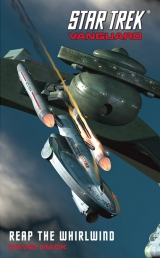
Текст книги "Reap the Whirlwind"
Автор книги: David Mack
Жанр:
Научная фантастика
сообщить о нарушении
Текущая страница: 20 (всего у книги 29 страниц)
From millions of kilometers away, only the barest flickers attested to the antimatter-fueled cataclysm that was transforming the planet into a sphere of molten rock and radioactive glass.
All around Khatami, her crew hung their heads in shame and sorrow. She kept her head up and her eyes on the screen. You’re the captain. You gave the order. You don’t get to look away. You have to watch…and you’ll have to remember.
23
Wounded and clutching the signal dampener to his mauled torso, Terrell had passed his hours of painful solitude crawling under the foliage back to the campsite where he and Niwara had been attacked nearly twelve hours earlier. It hadn’t taken as long to get back as he had expected it would; following the river’s edge, he dragged himself across the hundred-fifty-odd meters of muddy ground in just a couple of hours.
Little was left of Niwara, and most of their equipment had been destroyed. To his relief, his tricorder remained intact, and from the shredded remains of his pack he retrieved an intact canteen of clean water. In the swiftly rising temperatures of the jungle, he was grateful for every drop of potable liquid. The sun had begun its slow descent from the midheaven; by his best estimate, dusk was only a few hours away.
His communicator beeped. In the eerie silence of the jungle it sounded conspicuously shrill. He plucked it quickly from his belt and flipped it open. “Terrell here,” he said, and was struck by how tired and hoarse he sounded.
“Get ready for evac, Clark,” Captain Nassir said. “Your ride should be arriving any second.”
“It’s about time,” Terrell joked, smiling through the pain.
A powerful rumbling of maneuvering thrusters and turbo-fans went from barely audible to deafening in a matter of seconds. Terrell closed his communicator and tucked it back on his belt as a peculiar-looking, mottled-gray spacecraft appeared above his wrecked campsite. The ship’s nose was a narrow wedge, its belly a fat and blocky mass, its warp nacelles short and squat. Distorted above a curtain of heat radiation, it hovered for a few seconds and lowered vertically to the ground, kicking up a massive cloud of dirt and debris. The moment its landing struts touched down, its aft ramp lowered, and a trim young man with short sandy hair jogged out and peered into the dusty haze.
“Over here!” called Terrell, who weakly waved his arm.
The young man ran to him and kneeled at his side. He had to shout over the piercing whine of the engines. “Can you walk?”
“No,” Terrell said, hugging the signal dampener.
The young man spoke into a small communications device clutched in his left hand. “Get down here and give me a hand!” Moments later another man scrambled out of the ship. He was older and out of shape, with long, unkempt bone-white hair.
He greeted Terrell as he took hold of his arm. “Cervantes Quinn, captain of the Rocinante,” he said. “Nice to meet ya.”
As the duo lifted Terrell to his feet and carried him back to the ship, the younger man nodded and said simply, “Tim Pennington, at your service.”
They portered Terrell adroitly up the ramp into their ship. Quinn thumped a control panel with the side of his fist as they passed by it, and behind them the aft ramp lifted shut with a deep grinding noise.
The scruffy pilot asked Terrell, “Hammock or chair?”
“I’ve been lying down all day,” Terrell said. “Chair.”
Leading with his head, Quinn said to Pennington, “Into the cockpit, then. We’ll put him in the navigator’s seat.”
With surprising dexterity and gentleness, they lowered Terrell into a wide, deep, and well-padded seat on the starboard side of the vessel’s roomy cockpit. He pulled his tricorder away from his hip and let it rest on his lap next to the signal dampener as he settled into the seat. “Thank you, gents,” he said. “Much longer out there, and I’d have been in real trouble. What brings you boys out this far, anyway?”
Quinn replied, “A friend from Vanguard sent us.” He grinned and did a turning flop into his own seat, the most deeply creased and cratered of the four in the cockpit. “No offense, but we’d better motor if we’re gonna get you back to your ship in time to bug out.”
“They’re leaving?” he asked, surprised at the news.
Pennington and Quinn traded questioning glances before Quinn answered, “Yeah, that ship took a hell of a beating. And believe me—I’m a man who knows what an ass-kicking looks like.”
Perhaps noticing Terrell’s disappointment, Pennington asked, “Why, mate? Some reason they ought to stick around?” His slight Scottish accent was more noticeable now that he had stopped shouting to be heard.
“One of our people got swept downriver,” he said. “We—” His mind afflicted him with the memory of Niwara’s gruesome slaying. “We were looking for her when we got attacked.” His hands closed around the tricorder, and he lowered his head. “Still, I suppose it doesn’t make much sense to go on. I don’t even know if she’s alive or how far the river might’ve taken her by now.” This time he noticed a silent debate being volleyed between his two rescuers, with Pennington clearly arguing the yes side of the matter while Quinn championed the cause of no.
“Would you gentlemen care to let me in on whatever you’re pretending not to argue about?”
Quinn’s shoulders slumped with defeat, and he started the liftoff sequence. Pennington swiveled his chair to give Terrell a clear view out the front of the cockpit’s canopy. “Right, mate—you might want to have a look at this.”
Terrell leaned forward and focused his eyes past the rain and the roiling clouds. In the darkness below the storm lurked a city of titanic curves and twisting shapes, its undulating ribbons of light concealed by steady ground strikes of forked lightning.
The river he had been following flowed directly into the heart of the alien city, as did several others that snaked through the jungle valley. Pennington nodded at the sinister vista. “If your missing gal was riding the river, that’s where she’ll be.”
Terrell’s mind was racing. The young Scotsman was right, but with all the interference that had garbled his tricorder’s sensors, he couldn’t be sure Theriault was alive or, for that matter, where in that vast metropolis she might be. If only I could break through the noise and get a clear reading. Then he looked around at the cockpit itself. “Mr. Quinn, can I access your ship’s sensors from this console?”
“Um, yeah,” Quinn said. “Why?”
Terrell said, “I’m going to patch my tricorder into your sensors. You’ll provide the power and the hardware to give me the range I need; the tricorder’s software will make sense out of the signals it gets from your ship.” Activating the tricorder, he added, “If Ensign Theriault’s alive, we’re going to find her right now.”
Quinn raised his eyebrows in surprised admiration of the tricorder. “That little gizmo can do all that?”
“And a lot more,” Terrell said as he made the necessary adjustments to slave the Rocinante’s sensor array to the tricorder. It was a fortunate side effect of the signal dampener’s fading power that its effective range had shrunk to less than two meters, which would prevent it from interfering with the Rocinante’s sensor hardware.
A faint human life sign appeared on the tricorder’s screen.
“She’s alive,” Terrell said. “And she’s in there. Bearing zero-zero-three, range fifteen-point-two kilometers.”
Quinn grimaced with doubt as he looked at the churning mountain of black clouds atop a city under constant siege by heaven’s artillery. “In there?”
Pennington goaded his friend, “We’ve come this far, mate. Might as well go the distance.”
The scruffy older man frowned at Terrell, who simply repeated, in an imploring tone, “She’s alive.”
“Well,” Quinn said, “I guess that settles it, then.” He keyed the ship’s main thrust and accelerated toward the storm. “Strap in, kids. This is gonna be a rough ride.”
Me and my big mouth, Pennington lamented as turbulence rocked the Rocinante.
Wind buffeted the small ship and tossed it like a toy. The wings bobbled, and the nose dipped, threatening to knock the ship into one of the massive, organic-looking towers that it was dodging between. A steady stream of low curses attested to Quinn’s growing frustration at trying to hold a steady course.
The downpour had become so intense that visibility ahead of the ship was reduced to a few dozen meters. Jagged forks of lightning flashed across their path, flooding the cockpit with blinding light as godhammers of thunder pounded the hull.
A split-second to a collision. “Look out, mate!”
Quinn banked the ship hard to port, barely tilting the starboard nacelle clear of what would have been a shattering impact with a mist-mantled spire.
“Good call,” Quinn said. “Keep it up.”
An updraft nearly stalled their forward motion. Then it ceased, and they plummeted into a nosedive. Quinn struggled with the controls, and the engines howled as the ship fought its way back to level—only to find the airspace ahead blocked by a network of open causeways. Gunning the ship’s thrusters into overdrive, Quinn forced the ship into a steep climb. “I love this part,” he said through a clenched jaw.
“Bear to starboard when we’re clear,” Terrell called out over the roar of the engines. “We’re close to her, maybe two kilometers. I’ve got her life signs locked in.”
“Roger that,” Quinn said as he kept the ship’s nose up.
Pennington imagined that he was leaving finger dents in his seat’s armrest as he watched the city’s curved, sloping architecture pass within meters of the ship. The Rocinante cleared the coil of causeways and slipped between two majestic towers, then it barrel-rolled back to level flight—just as a crimson thunderbolt speared its aft hull.
An explosion rocked the ship. Sparks fountained from all the cockpit consoles, which then belched acrid smoke. The engines’ whine fell in pitch and volume, and Pennington felt their sudden reduction in speed. “Overload in the impulse motivator!” Quinn shouted. “Gotta set her down, fast!”
The helm controls stuttered on and off as Quinn guided the jerking, wobbling ship toward a wide, hollow space with a level floor inside one of the towers. Broad causeways stretched away from the tower in three directions, linking it to the center of the city as well as the outer reaches. The sides of the hollow looked alarmingly close as the groaning hulk of the Rocinante approached for an awkward, half-powered landing.
Pennington made a nervous, dry swallow and glanced at Quinn. “Sure you can make that?”
“I’ve made worse,” Quinn said.
“So that’s a yes?”
“It’s a maybe.”
A final tap on the thruster controls brought the ship to a rough and sudden stop inside the hollow tower. Quinn released his safety harness and scrambled out of his seat. “I gotta get the motivator fixed,” he said. “If we’re lucky, I can get us airborne in fifteen minutes.” Lifting his chin in a half-nod at Terrell, he added, “You got that long to find your gal, then we’re leaving.”
“Wait a second,” Terrell said, and to Pennington’s surprise Quinn stopped and listened. “We need the ship to find her.”
Hooking one thumb over his shoulder, Quinn said, “Pal, we’ll be lucky to punch through the storm and get back to orbit. Two more minutes gettin’ hammered in this mess, and we’ll be done for. This ride’s over.”
“What am I supposed to do?” Terrell asked sarcastically, waving his hand over his mauled body. “Run in and get her?”
Pennington glared at Quinn. Don’t say it. With all his wished-for psychic ability he commanded him, Don’t say it.
“Send the newsboy,” Quinn said.
Damn you, I told you not to say it.
Terrell turned his desperate gaze to Pennington. “Please, we’re her only chance. She probably doesn’t even know we’re out here.” He held up the tricorder. “This is locked on to her signal; you can follow it right to her. She’s only…” He checked its display. “One-point-nine-three kilometers away, toward the city center, almost on the same level.” Pennington stared at the tricorder and hesitated to answer. Going alone into an alien city under siege by rain and lightning, to face who knows what, was not the story he’d hoped to find by coming back to Jinoteur. Then Terrell repeated simply, “Please. You’re her only chance.”
He took the tricorder from Terrell. “Right,” he said, slinging the device’s strap diagonally across his torso, as he had seen the Starfleeters do on Vanguard. “I’m on it.”
Terrell handed him his communicator. “Take this, too. Contact us as soon as you find her.”
“Will do, mate.” Pennington tilted his head toward Quinn and said to Terrell, “Don’t let him leave without me.” He unlocked the aft ramp. The platform lowered with a pathetic series of metallic shrieks. The white noise of pounding rain and the constant rumbling of close thunder filled the main cabin.
As Pennington started down the ramp, Quinn called out, “Tim!” When the reporter looked back, Quinn added simply, “Good luck.”
Pennington nodded his thanks to the older man and hurried down the ramp. He checked his bearings, then sprinted across the rain-slicked, lightning-flanked causeway toward the fog-shrouded grandeur at the heart of the alien metropolis.
Halfway across the bridge, sprinting through the deluge, deaf from the cannonades of thunder, he realized that he was laughing. He knew that there was a good chance his beau geste would get him killed and end in failure, but the journalist in him had to admit the obvious: this was the most amazing thing he had ever seen, and this was the best thing he had ever done.
And that had to count for something.
“I’ll hold the plasma conduit steady,” Threx said to Torvin. “You lock it in. And make it fast.”
Before the spindly young Tiburonian engineer’s mate could explain to Threx that hefting the end of a plasma conduit by hand without an antigrav was impossible, the burly Denobulan had already done it. “Threx,” he said. “That’s not possible.”
Forcing words through a pained grunt, Threx snapped, “Just lock it in, Tor!” His gruff instruction drew the attention of nearly the entire crew, including Captain Nassir, who was pitching in to speed the repairs.
Torvin put aside his fascination with Threx’s display of raw strength and rapidly sealed the mag clamps that would secure the starboard nacelle’s plasma line to the ship’s warp core. Halfway through the job he stopped and strained to pick out a muffled sound from behind the clatter of work on the top deck and the ambient low-frequency warble of the river.
Threx quickly grew annoyed as Torvin stood motionless and stared blankly at the overhead. “Dammit, Tor, would you hurry—”
“Shh,” Torvin hissed. “I hear something. Outside.”
Ilucci, overhearing their exchange, told everyone on the deck in a sharp whisper, “Hold the work! Quiet!” In seconds a hush fell over the crew, and Torvin closed his eyes to concentrate on the sounds that were all around them. He tuned out the huffs of the others’ breathing, the gentle humming of the computer core, even the sound of the river itself.
Then his delicately sensitive ears found it, far off but getting closer: irregular percussive tremors, throbbing along the riverbed, through the ship’s hull, and into his feet. “Impacts,” he said to the captain. “Something punching through the water and hitting the bottom, over and over again. And it’s coming this way. I’d say we’ve got ten minutes, tops.”
“Trying to flush us out,” Nassir said. “Crude search-and-destroy tactics.”
“Crude but effective,” Ilucci said. “Time to brainstorm, people. No idea’s too stupid. Whatever you got, let’s hear it.”
Most of the time, Torvin was content to let the others formulate the plans. He was the youngest, least experienced member of the crew. It felt presumptuous to him to think that he could suggest something they hadn’t thought of, but the notion that he’d been toying with since returning to duty after the crash was too compelling for him not to share. He raised his hand and haltingly said, “I have an idea.”
Ilucci made a broad gesture and said, “The floor’s yours, kid. Whatcha got?”
“The dampening frequency we used in our shields when we entered the system,” he said, looking around at the others, who watched him with patient expectation. “It worked for a while, but it wasn’t enough to keep the Shedai from coming after us. But what if it was more concentrated? We could set the phaser emitters to the same frequency. We’d only get one shot before burnout, but a really good dose might back them off.”
Captain Nassir nodded and smiled approvingly. “The best defense is a good offense, eh? I like it. What do you think, Master Chief?”
“I think it sounds like a plan, Skipper,” Ilucci said. “Sayna, Sorak, Razka—you’ll do the honors. Cahow, reroute the battery power from shields to phasers.” He clapped his hands. “Move with a purpose, people! Clock’s ticking!”
Everyone snapped into action. Sorak, zh’Firro, and Razka went forward toward the access crawlspace for the phaser systems, and Cahow went aft toward the battery power taps. As Torvin turned back to help Threx finish connecting the port plasma conduit, Ilucci gave the young man a friendly pat on the back. “Good work, Tor,” he said with a brotherly smile, and he moved on.
Threx’s knees trembled under the burden of holding the half-secured plasma conduit, and fat beads of sweat rolled down his scruffy face. “Proud of you, Tor,” he said through a voice pulled taut with effort. “Now get this thing secured before my guts end up on the deck.”
Sharp cracks of breaking stone surrounded Theriault and the Apostate as they traversed a long enclosed passageway. Outside, massive slabs of the city’s ramparts and towers slid away into the yawning chasms between the steeply sloped structures, like icebergs calving from a glacier. Inside, fissures spiderwebbed across the massive arched ceilings, raining fine gray dust on Theriault’s red hair.
“The city’s falling apart!” she said, ducking stone debris.
Several heavy chunks of the ceiling were deflected by a nimbus of energy that sprang into being above the Apostate. Only belatedly did she realize that he had enlarged himself and now towered mightily over her. “The Colloquium contracts,” he said. “Something terrible has occurred.” A malicious gloating darkened his aspect. “I warned them not to underestimate your kind.”
“You mean my shipmates?” she asked.
He signaled her to follow him as he continued down the rib-walled passage toward the dome-shaped structure he had called the First Conduit. “No. Others like you, on a planet far from here. Many thousands, and several of your starships.” She jogged along beside his enormous but ghostly form, grateful for the shelter he offered from the jagged boulders of broken obsidian that fell from the crumbling ceiling. “A great commitment of power was made there, to serve as a warning…and an example.” Again, that cruel amusement. “It does not appear to have produced the result that the Maker intended.”
The Apostate halted without warning. Theriault stumbled to a stop beside him. “What’s wrong?”
“Others draw near,” he said. “Your presence has become known to the Colloquium.” As if summoned by his words, eight hulking black shapes separated from the walls behind and ahead of them, as if shadows had been transmuted into stone. They were the deadly killing machines that Xiong had warned them about.
Watching the dark crystalline giants lumber forward, Theriault instinctively drew her phaser. As she did so, eight more identical obsidian sentinels grew from the floor, even closer than the others. Her finger tensed in front of the firing stud. Then she held her fire—the newly arrived sentinels moved to intercept the others. She looked up at the Apostate, hoping for good news. “Are they with you?”
“They are me,” he answered as the battle was joined. Shards of crystalline shrapnel filled the air as the sentinels mercilessly hammered one another to pieces. Every few seconds, one of them shattered and fell to dust, only to be replaced by another from the ceiling or walls. It was a brutal stalemate. Then the tide of the melee shifted, and the attackers began losing ground; the circle of safety around the Apostate widened.
Huddled in his penumbra, Theriault watched the struggle with wonder. “You can control multiple bodies at once?”
“Several limbs, several bodies,” he said. “One mind. It is a difference not of kind but of degree. They are the Nameless, limited to one form at a time. I am Serrataal. I am legion.”
A tremor-inducing rumble drew swiftly near. At the far ends of the passage in which she and the Apostate stood, hundreds of sentinels emerged from between the ribs of the passageway’s sloped walls. “Um, I think we have company.”
The Apostate stretched one spectral hand ahead of them and the other behind. His fingertips glowed bright red, and his eyes burned with the same infernal hue. “These are not avatars of the Nameless,” he said, his voice of thunder even more ominous than before. “One of the Serrataal has come…. The Warden.”
She tried to flash an ironic smile, but her fear turned it into a faltering grimace. “All this for little ol’ me?”
“He has not come for you,” said the Apostate. “He has come to face me. It has begun.”
“Whoa, hold on,” she said. “What’s begun?”
“The war,” he said. “For control of the Shedai.” He thrust his hand toward the nearest wall, and a beam of indigo fire shot from his palm and cut a wide, round tube that reached through to a parallel corridor. He looked down at Theriault and hushed his voice. “Flee, little spark. While you can.”
Fearful of leaving his circle of protection, Theriault took another look at the battalion of faceless sentinels closing in on them. Then she did as he said and ran as fast as she could.

Pennington bounded off the causeway onto a curving promenade only a few seconds before the slender bridge fractured loudly and fell away toward the distant, fog-smothered ground.
Shapes were animating out of the façades of the structures all around him. Some were vaguely humanoid in form. Others adopted insectile bodies, and some were simply bizarre—wild amalgamations of multihinged limbs and undulating trunks that crawled across vertical surfaces; diaphanous clusters that rode the wind and trailed violently snaking translucent flagella; serpentine coils of glowing vapor that turned solid in flashes of motion and struck with enough force to obliterate anything they hit.
His first sight of them had carried a rush of terror, which persisted even though it had become apparent that the bizarre beings were paying no attention to him. He dodged for cover from the fallout of their battle, which dislodged towering blocks of crystal and stone from the walls and catapulted them in a variety of directions. Despite his best efforts to capture video of this fantastic place with his portable recorder, he couldn’t stay still long enough to get a steady shot of anything. Every few seconds he was forced to sidestep or duck another rolling, falling, or ricocheting hunk of debris.
Under his feet, the flat surface of the promenade that ringed the central cluster of buildings was changing. Its surface was shifting color, veining with cracks, and becoming translucent. The change in its structure spread in front of him faster than he could hope to run; he looked back and saw that it was retreating behind him just as quickly. The transformation was a metastasizing cancer, creeping across walls and bridges, turning everything pale and brittle. It’s spreading like an infection, Pennington realized. This whole place is one big body. He ducked through an archway into a cavernous passageway that led deeper into the heart of the city. Its ribbed and curving walls made him shudder to think that he was sprinting down some titanic monster’s gullet.
On either side of him the walls became infused with dancing motes of energy and took on an almost liquid consistency. Huge heteromorphic creatures cleaved themselves from the walls and lunged at one another. Pennington barely weaved past them and continued his mad scramble down the passage. His thoughts flooded with alarm. Good Lord! They don’t come out of the walls—they are the walls. This isn’t where they live—this place is them. The sensation that he was running headlong into the belly of the beast took on a renewed and distinctly palpable horror.
He checked the tricorder reading. She’s close, he realized, less than four hundred meters away. A rib in the wall cracked and fell across the passage. He hurdled over it and coughed through a cloud of silicate dust as he kept on running. I just hope I find her before this place buries us alive.