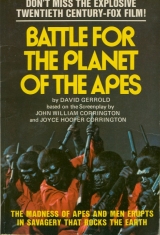
Текст книги "Battle for the Planet of the Apes "
Автор книги: David Gerrold
Жанры:
Альтернативная история
,сообщить о нарушении
Текущая страница: 2 (всего у книги 8 страниц)
TWO
Caesar’s house was large and airy, its architectural style simple and clean. It was decorated with wood and paper and plaited screens. The impression was that of a rich tropical forest brought indoors.
Caesar’s wife, Lisa, a pretty young chimpanzee, was preparing a meal of fruit, nuts, and vegetables for her husband and his adviser, MacDonald. A young, attractive serving girl was working with her.
Occasionally, Lisa would cast a motherly glance out the window. Directly outside was a collection of swings, vines, and perches on which Cornelius was playing with a human boy.
At the moment, Cornelius was poised on a perch. “Hey, Jimmy, d’you want to play follow-my-leader?” And with that, he executed a series of complicated flips, landing easily on a lower limb.
Jimmy watched sourly. When Cornelius stopped and looked at him questioningly, he made a disgusted face. “No. You’re always the leader.” He reached down and picked up a stick about rifle length; he pointed it at Cornelius, “Tchang, tchang! I got you!”
Cornelius clutched his breast, fell backward off the limb to the ground, uttering a loud cry of agony.
Almost immediately, Lisa stuck her head out the window. Seeing Cornelius lying on the ground, she hurried outside. “Cornelius, are you hurt?”
Cornelius rolled over and opened his eyes. He looked up at her. “No, Mother. I’m just dead.”
“Dead?”
At this, Jimmy hid the makeshift gun behind his back, then dropped it quietly to the ground.
Cornelius grinned and explained, “We were playing gorillas.”
Lisa frowned. First at her son, then at Jimmy. Was this human child teaching Cornelius bad habits? Jimmy sidled off backward, looking ashamed and defensive. “You were playing what?” she asked.
Cornelius stood up. “We were playing war.”
“War?” Now Lisa was upset. She straightened abruptly. The sudden motion startled Jimmy. Already thoroughly intimidated, he turned and ran. Lisa watched him go in annoyance, then turned back to her son. She spoke icily. “Cornelius, hasn’t your father explained to you many times that war isn’t a game, except to pear-shaped old generals sticking colored pins in a map three thousand miles behind the firing lines?”
Cornelius looked properly abashed. “Yes, Mother.”
“And hasn’t he forbidden you to play with guns or to make a game of killing?”
“Yes, Mother.”
“Then you’ll stop it?”
“Yes, Mother.”
Satisfied, Lisa turned and reentered the house. Caesar and MacDonald had come in while she was dealing with Cornelius. They had seated themselves at the dining room table and were talking quietly. Lisa moved to help the serving girl finish the dinner preparations.
MacDonald was saying, “You handled that situation with Aldo very adroitly, Caesar.”
Caesar sighed and shook his head. “I wish I had been educated to be a ruler.”
MacDonald looked puzzled. Didn’t Armando . . .?”
Caesar shook his head again. “My dear, dead human foster-father—when he wasn’t training me to be a bareback rider in his circus—taught me the sum of all human virtues. Which is that we must love one another or die. The lion-tamer was allowed to crack his whip, provided he didn’t whip the lion.”
“And if the lion attacked the tamer?”
“The lion never did. That’s how I thought it would be in the world outside. If my father and mother had only lived, they might have taught me whether it was right to kill an evil enemy so that good should prevail.”
“Well,” said MacDonald. “History shows . . .”
Caesar cut him off sharply. “Human history! Not ape history. Ape never kills ape!”
Chastened, MacDonald shut up.
Caesar said, a little more slowly, reaching out to his friend, “We are making a new kind of world, MacDonald. We cannot replace one master with another; we must do away with those old human ideas of masters and slaves altogether. There must be no killing, no violence, no oppression of any kind. Human history says it’s all right to kill. Apes must make a new kind of history, and we have no precedents to guide us, man friend.”
MacDonald bit his lip; he wanted to speak but was holding himself back. He knew that Caesar was wrong on this point. There had been good men and noble precedents in human history—there would always be good men; apes could not have freed themselves without the help of good men. MacDonald’s own brother had once aided Caesar, saved him from the governor of the city.
But there was no way he could convince Caesar that there were noble precedents in human history. Caesar was convinced he was bringing a new idea to the world. MacDonald sighed to himself. He wished he could get it through to the chimpanzee that what he thought was new thinking was only ignorance of the past.
Lisa brought the food to the table then. The bowls were rough cut out of wood, as was the table, almost refectory style. She and the serving girl placed the meal, totally vegetarian, before the chimpanzee and the man.
MacDonald took advantage of the interruption to try to change the mood. He exclaimed hungrily, “Mmm, I could eat a horse.”
Lisa stopped in startlement and looked at him. “A horse?”
Caesar looked up, realizing her misconception, and joked, “You remember, Lisa. They used to eat all sorts of things—dead cattle, dead chickens, dead pigs, dead fish . . .”
“Fish I can understand, just barely,” said Lisa. “But horses! If horses, why not hippos? Where do you draw the line?”
MacDonald sighed. He took a nut and looked knowingly at the serving girl. She caught his look but turned away. Caesar was watching. MacDonald crunched the nut slowly while thinking what to say. He’d been through this argument before with other apes. Chimpanzees and orangutans couldn’t understand that human beings liked meat, that meat was one of the foods that men needed because they had evolved to need it. He muttered, “If there were any hippos around, Lisa, they would be safe now. Now we eat fruits and nuts at our master’s command.”
Caesar frowned. “We are not your masters,” he said angrily.
MacDonald was unabashed. He looked calmly back at Caesar. “We’re not your equals.”
Caesar did not take it as a rebuke. The remark had not been intended as such. He returned MacDonald’s even stare. “MacDonald, I believe that when you come truly to know and trust a person as I know and trust you, you can’t help but like him. Once my people come to know and trust yours, we shall all become equals and stay so . . . until the end of the world.”
MacDonald nodded glumly. “That may be sooner than you think.”
The statement caused an abrupt silence. Lisa was just dismissing the serving girl, but she turned to stare. Caesar paused with his hand halfway to his mouth. Something about the way MacDonald had said it . . . “You’re a pessimist.” But he said it without force.
“Or a prophet,” corrected MacDonald.
Lisa came back to the table smiling. “You’ve been at the fermented coconut milk again,” she chided. “They say it makes you very happy at night and very gloomy in the morning.”
“Now that apes are at the helm,” Caesar said, “Earth will sail safely through space until the end of time. And Virgil says that time is circular, that it has no end.” Caesar declared almost petulantly, “I don’t believe what you say.”
“Would you believe it if you heard it from the lips of your own parents?” Almost immediately MacDonald regretted saying the words.
Caesar looked at him stunned. “That’s not possible.” And then, “Is it?”
MacDonald bit his lip. He had said too much already.
“Is it?” demanded Caesar. “Is it possible?”
MacDonald nodded, almost imperceptibly, and whispered, “It is.”
Caesar leaped to his feet, and his chair fell behind him with a crash. He leaned over the table toward MacDonald. “Are my parents still alive?”
“No. But their images and their voices are.”
“MacDonald, don’t talk in riddles! Can I see them? Can I hear them? Armando told me only that they came out of the future. Can they give me . . . knowledge?”
MacDonald straightened up. There was no way to hide this from Caesar. And he did have a right to know. “You can see them,” he said. “And you can hear them. And they can give you knowledge.”
“How?”
“Under the dead city,” the man explained, “in the archives near the old command post, there are tapes, sealed tapes of Cornelius and Zira being examined by officials of the American government. When my brother was Governor Breck’s assistant, he told me about them. I know where they are. And I know that they concern Earth’s future, from which your parents came.”
“But the city was flattened. The bombs left nothing.”
MacDonald’s face creased thoughtfully, the black skin wrinkling into a frown. “The archives section—indeed, many sections of the underground city—were designed to survive the impact of a ten-megaton blast. I suspect . . .” he let the sentence trail off.
But Caesar caught his meaning anyway. “Then the tapes and the pictures of my parents . . .”
“Yes,” MacDonald said. “They might still be down there.”
Caesar was excited now. “I want to see what they looked like, MacDonald. I want to hear what they thought and knew.”
“The city is still radioactive.”
Caesar waved that away in annoyance. “I want to go anyway. Besides, who among your people knows anything about radioactivity?”
MacDonald sighed. Most of the real scientists had been killed nine years ago in the ape uprising. “No one,” he admitted.
“And,” chided Caesar, “among my people, is there one?”
MacDonald knew what Caesar was driving at. “Who knows everything about everything?”
“Right. Go find Virgil.” Caesar made a decision. “We will leave before dawn.”
MacDonald nodded in acquiescence. He didn’t like it, he didn’t want to go, but he knew that Caesar would not be satisfied until he had found the truth about his parents and his future. Virgil, of course, would be delighted—Virgil was always pleased at the prospect of discovering new knowledge. But MacDonald had misgivings. He didn’t know why, but he felt uneasy about the whole venture. Perhaps it was because of the danger—not to himself, but to Caesar and to Ape City. If anything were to happen to the chimpanzee leader, there would be no one; there would be nothing to stop General Aldo from taking over.
And if that happened, it would not be good for anyone. Not for humans, not for chimpanzees, not for orangutans. Only for General Aldo and his gorillas.
MacDonald’s misgivings stayed with him all evening. Even after he returned home. Doctor, who lived in the same house as MacDonald, noticed his troubled demeanor immediately and left him alone. And when Teacher showed up for dinner, he too noticed MacDonald’s brooding, but he said nothing.
The house was crude, cruder than the average ape house. The room was plain with a rough fireplace. On the mantel were a few fresh flowers in an antique Coke bottle and a yellowing photograph of Martin Luther King in a corroded frame. Above the mantel hung a diploma from a black university, long since crumbled into ashes. There was also a photo of MacDonald’s dead brother, the one human being who had helped Caesar. MacDonald had loved his brother—and he loved Caesar now—but there had been many moments since the ape uprising when he had longed for the old days.
MacDonald knew that slavery was wrong, he knew it instinctively, but if there had to be slaves and masters, he would much prefer to be a master. But then, every time he found himself thinking that way, he remembered a statement that Abraham Lincoln had made around 1851 or so, that if there was to be a difference between the black race and the white race, he, Abe Lincoln, would much prefer that the white race be the superior. The thought always made MacDonald smile. History had conveniently forgotten that statement of Lincoln’s and remembered him primarily for the Emancipation Proclamation.
Caesar was a lot like Lincoln, too. He wanted apes and humans to be equal, but if there had to be slaves and masters, he would much prefer to be among the masters. The sentiment was universal, and because of it there were times when MacDonold’s longing for the old days was especially fierce.
Like now, for instance.
The table was set for three. A single candle glowed in its center. There were rusty knives and forks and chipped enamel plates.
Teacher was putting two blankets over the window. “Apes have such an acute sense of smell,” he was muttering.
MacDonald smiled and cautiously shut the outer door. He tested it and put a chair under the handle so no one could enter abruptly. Then he moved to the window and double-checked Teacher’s precautions.
Satisfied, he opened the door to the other room and called, “Okay, Doctor, we’re ready. Bring it in.”
“I’m on my way,” she answered. A moment later, she entered, carrying in one hand a flat black leather case and in the other a dish on which reposed “One roast bootleg rabbit!”
“Shhhh! Not so loud,” said teacher.
Cautiously, she set down the dish and opened the leather case. She began extracting surgical instruments to carve the rabbit. The two men watched each cut intently.
She stopped and looked at both of them, amused. Her scalpel was poised in mid-stroke. “I’m being as fair as I can.” She began filling their plates.
“I’m salivating like one of Pavlov’s dogs.” Teacher began stuffing his face.
MacDonald ate hungrily too. “Mmmf,” he said around a mouthful. “I just hope there’s enough to go around. I’m famished.”
She smiled at him as she sat down to eat. “Don’t worry. There’s plenty more.” She cut herself a bite and ate it. “Not bad, if I do say so myself.”
Both MacDonald and Teacher nodded but kept eating. These meals of meat were rare and always very secretive. It wasn’t that rabbits were hard to catch—they weren’t, they were very plentiful—it was just that the apes didn’t allow the killing of any animal for any reason whatever. Not even for food. But rabbit tasted so good . . . Doctor had outdone herself; the rabbit had been seasoned just right. If MacDonald closed his eyes and pretended very hard, it almost tasted like chicken. Almost . . .
He snapped back to reality and reached for another forkful. The plate was almost empty. He sighed in disappointment and tried to make the last mouthful last. He hadn’t remembered eating all that meat. But he had, he must have. The others’ plates were empty, too. That was the trouble with rabbit—there was always enough to taste but never enough to fill. He laid the fork down regretfully. “I had hoped not to be marching on an empty stomach tomorrow, but that’s an awful lot to demand of just one rabbit.”
“Marching?” Teacher looked up. “Where?”
MacDonald lowered his voice. “Tomorrow, Virgil and I are taking Caesar to the city.”
“The city? It must still be crawling with radioactivity.”
“I know, but Caesar wants to go. Has to go.”
“But there’s nothing there! The city is dead.”
“And so will you be,” Doctor cut in sharply. “Unless you take a Geiger counter. Why are you going?”
“I told Caesar that there are tapes of his parents. He wants to see them.”
Teacher dropped his fork on the plate with a clatter. “That’s a stupid reason to risk your life.”
“There’s more to it than that,” said MacDonald. “Something that I didn’t tell Caesar, but something that I must find out. We must find out,” he corrected.
“What is it?”
“I’m not sure. It’s something that my brother told me, something that Caesar’s parents said about the future. About . . . the end of the world. We have to know what that is. I have to hear the tapes myself.”
He thought back, to when he had been a boy, to a time when men had gone to the moon. And beyond . . .
It had been an exciting time. The greatest mission of all had been when three men and a woman were launched into space to try to reach a nearby star. They had never returned, but the ship had come back, crashing off the California coast.
There had been three chimpanzees in it.
That had been the beginning of the end for the human race.
One of the chimpanzees had been killed, but two had survived, a male and a female named Cornelius and Zira. They had startled the world by their ability to speak, and they had revealed what had happened to Captain Taylor and the others, who had vanished on that fateful mission.
The ship had traveled not to another star but to the Earth’s own future. Taylor had survived and discovered that the roles of apes and men were reversed. Apes were intelligent, and men were speechless animals, kept in cages. Discovering this, Taylor had fled into the wilderness to seek other men—civilized men.
Another spaceman had come after Taylor, and he too had vanished into the wilderness. Cornelius and Zira had discovered Taylor’s spaceship, repaired it, and used it to travel back to Taylor’s time.
They told what they knew, but the information was dangerous. Something they had said about the future, the immediate future, had frightened the government, and they had been sequestered. Zira had become pregnant, and to save the life of their baby, the two apes had escaped. But they had been discovered and killed, the baby chimpanzee with them.
Or, had the baby chimp been killed? A young chimp had been killed, but was it Cornelius’ and Zira’s? It would be years before the truth became known.
Half a generation later, the world was a different place. Cornelius and Zira had been forgotten—almost. One of their predictions had already come true: a plague had wiped out almost all of the dogs and cats in the world, and human beings had turned to apes and monkeys to take their place.
The government had become monolithic and totalitarian, fearful of its own future; it was a repressive and all-controlling state, and as such, it needed slaves. As the intelligence of chimpanzees and orangutans and the strength of gorillas became recognized, apes were given more and more work to do. Scientists worked to raise their intelligence level, and apes began to approach human levels of understanding. They became the slaves the government needed to keep its real slaves—the people—content.
And then the second prediction had come true: an ape had said “No” to his human masters. The ape was Caesar. He had been raised in secret by Armando, the owner of a traveling circus, who had brought him to the city to see and to fulfill his destiny. Armando had been killed, but Caesar had stayed free long enough to lead the apes in revolt against their human masters. He had been captured by Governor Breck and almost killed. But he had been rescued by MacDonald’s brother. Caesar had led his people to freedom, and the world had plunged into war, and the cities had been flattened.
The few survivors, men and apes alike, returned to a simpler life. They lived in the forests, and the apes were the masters.
Now, today, nine years later, Caesar was going to go in search of his parents’ image. And MacDonald, with him, was going to search for the truth—just what was it that Cornelius and Zira had said that had frightened the government so badly and turned it into a dictatorship? Was it really the end of the world? Two of their predictions had already come true . . .
Just as Caesar had to know, so did MacDonald.
He came out of his reverie, realized that Doctor was looking at him, “Is this journey really necessary?” she asked.
He nodded slowly. “Yes. Yes, it is.”
She accepted that. She got up out of her chair and came around to him. “Be careful, Mac,” she said. “Please.” She kissed him long and hard. “Come back.”
He looked at her. “I have to know the truth.”
She lowered herself to his lap and put her arms around his neck. “Mac,” she whispered. “Life is more important than truth. If it costs you your life to find out the answer, what good will that do any of us?”
He couldn’t answer her question, not the way she had phrased it. Instead, he kissed her and said, “I’ll come back. And I’ll come back with the answers.”
And on the other side of Ape City, in a different house, an ape house, the same scene was being played between two apes.
“Caesar,” Lisa was saying. “Don’t go. Please don’t go.”
“Lisa, you remember your parents. I was too young when they died to remember mine.”
Lisa stiffened. “I don’t want to have to remember my husband. I want to love you now.”
He took her outstretched hand against his cheek, then he took her into his arms and rubbed his muzzle against hers. “Lisa, Lisa, dear. My parents left me knowledge, I must go find it. Perhaps they left me the knowledge that I need to lead our people. Apes must be better than humans ever were. Apes must build a world of peace and justice, freedom and equality. My parents came from the future; they came from such a world. They came from a world of apes—it must have been a time of graciousness and plenty. I need to know how such a world was built; perhaps they brought me the answer. I must take the chance. I must be the kind of leader that my people need, and to do that, I must have the knowledge that a leader needs. Lisa, my love, my wife, you are important to me—you are the most important thing in my life. But I have a mission with our people. I cannot shirk that responsibility.”
Lisa did not answer; she just lowered her eyes in sorrow.
Caesar kissed her. “I will take care, Lisa. I will.”
Lisa looked up at her husband. Her eyes were moist. “Say good morning to Cornelius, then, but not good-bye. I don’t want him to know that I’m afraid.”
Caesar smiled and nodded and rubbed her muzzle again in an affectionate chimpanzee kiss. Then he went into his son’s bedroom. Cornelius slept on a raised pallet beside a table; on the table was his favorite pet, a caged squirrel.
Caesar laid an index finger lightly on Cornelius’ forehead, Cornelius opened his eyes.
“Cornelius, I’m going on a journey.”
Drowsily, the little chimp asked, “What will you bring me back?”
“What would you like?”
Cornelius pointed at his squirrel, “Some special nuts for Ricky. He’s getting bigger.”
Caesar smiled affectionately. “So are you.” He touched his son’s face. “One day you’ll be as tall as a king.”

![Книга Ave, Caesar! [ Аве, Цезарь!] автора Варвара Клюева](http://itexts.net/files/books/110/oblozhka-knigi-ave-caesar-ave-cezar-246831.jpg)