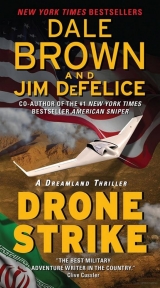
Текст книги "Drone Strike"
Автор книги: Dale Brown
Жанры:
Боевики
,сообщить о нарушении
Текущая страница: 21 (всего у книги 27 страниц)
6
Iran
“TRUCK DESTROYED,” CAPTAIN VAHID TOLD THE ground commander as he headed for the airfield.
“Are there survivors?”
“I don’t think so,” said Vahid. “I took a pass but the smoke was so thick I couldn’t see anything. The vehicle split into several pieces.”
“Acknowledged, Shahin One.”
“I’m rather low on fuel,” said Vahid. “I’ve already sent my wingman to make an emergency landing.”
“We’ll proceed to the site. Thank you for your help.”
“I can do one last run if you want.”
“Negative, Captain. Thank you for your help. God is great!”
“You’re welcome. God is great!” he repeated, with more enthusiasm than he had mustered in some time.
7
CIA campus, Virginia
“THEY DON’T SEEM TO BE MOVING ANYMORE,” SAID Breanna, staring at the screen where Turk’s position was marked. “They’re only a few miles south of Qom—are the Guard units responding there?”
“The Iranians are still trying to figure out what’s going on,” said Jonathon Reid, who’d gone over to the console where a digest of NSA intercepts were being displayed in near-real time. “They’re very confused.”
The intercepts, compiled from a variety of sources, were translated by machine and color-coded for source. A program in the network applied various filters, showing Whiplash only the information that corresponded to a set of keywords and geographic locations. The sheer volume of the intercepts as well as the Iranians’ own confusion made it doubly difficult to figure out what was going on.
“What about that Pasdaran colonel who was assigned to handle the investigation into the first attack?” asked Breanna. “Where is he?”
“I’m not sure at the moment,” said Reid. “We’re working on it.”
“There’s one nano-UAV remaining,” said Teddy Armaz. “It was the unit with the malfunctioning sensor. It has about five minutes of flight time left.”
“Can we self-destruct it?”
“No. The X-37B is well out of range.” Armaz looked over Bob Stevenson’s shoulder at the status panel. “It should destroy itself on its own in about five minutes, since it hasn’t had a command.”
Breanna nodded. The self-destruct protocol was one of several safeguards that had been instituted throughout the military’s UAV fleet following an accident in 2012 that allowed a Stealth drone to descend into Iran practically without damage. Ironically, the capture of the drone and the subsequent sale of its technology to China had spurred the development of several more advanced American UAV projects, including the Hydras. Iran would have been better off simply letting the Stealth UAV alone.
“I don’t like the fact that Turk’s not moving,” Breanna told Reid.
Reid was concentrating on the screen. “The WB-57 pilot has been recovered. Well that’s one of ours back, at least.”
“What about Turk?”
“He’s moving in the area,” answered Reid, zooming his screen. “He’s still alive. For how long is anyone’s guess.”
8
Iran
TURK HEARD THE VEHICLE COMING AS SOON AS HE reached the rifle. He grabbed it and the ruck with the control unit and ran back to Grease.
The sergeant was lying exactly as Turk had left him. His eyes were closed. If it weren’t for his groans, Turk would have thought he was dead.
The truck was just reaching the wreckage. Rather than stopping, though, it kept going. Turk felt a slight bit of relief, then remembered the airplane was still above somewhere.
He had one more nano-UAV, didn’t he? Where was it?
Pulling the control unit from the backpack, he unfolded it and turned it on. The Hydra was circling above, descending in a gradually tightening spiral. Because it hadn’t been contacted in a half hour, it had begun its self-destruct sequence. In twenty-eight seconds it would blow itself up.
“Computer, establish direct control,” said Turk. “UAV 1.”
“Control established.”
The destruct panel cleared. Turk checked the aircraft’s status. It was in perfect order, except for the defective gauge, which still indicated it was overheating.
The aircraft had an infrared sensor. Turk scanned the feed, looking for the Iranian aircraft. But the sky near the Hydra was clear; the MiG had moved on.
The sound of the truck interrupted him. He crawled to the side of the small mound of dirt, squinting into the distance as the vehicle stopped near the wreckage. Men appeared from the truck, casting long shadows as they stepped in front of the low sun. There were six. They split up and moved around the wreckage methodically.
Turk calculated his odds with the AK-47.
He had only one magazine. One three-round burst per man—he’d have to be incredibly good—and lucky.
The shadows of the men danced wildly. They ran to the vehicle.
They’ve missed me, thought Turk.
Then he saw the truck back up and turn in his direction.
Turk turned around and looked at Grease. The Delta sergeant was in no shape to move.
“I’m not going to abandon you,” said Turk, patting Grease’s shoulder. “I just need a better vantage point to fight from.”
Six against one? Even Grease would have trouble with those odds.
Turk started to go back to the side of the hill, thinking he would ambush the men when they got out of the truck. Then he had a better idea.
He pulled over the control unit and took command of the UAV.
“Target vehicle,” he said. “Destroy.”
Turk looked up from the screen. The UAV was 3,000 feet above, banking around in a turn. He strained to see it, but the bright sky wouldn’t give it up.
He raised his rifle, steadying his aim on the truck. Suddenly, an ear-piercing whistle broke the silence. As the shriek grew unbearable, it was overrun by a sharp crack. The UAV exploded point-blank in the cab of the truck rushing toward him.
Turk grabbed the rifle and ran forward, gun hard against his side, legs churning. The truck was on fire. Someone stumbled out of the passenger side. Turk raised the nose of his gun and fired.
The man fell.
Running to his right, Turk circled the truck, finger ready against the trigger.
There was no one to shoot. There’d been six in the vehicle; five died in the explosion and fire. The lone survivor lay gut-shot on the ground nearby, dead by Turk’s burst.
Something popped. Turk dropped to his haunches, spinning toward the road.
Ammo cooking off.
There’d be more. He looked for another weapon but saw none.
Best to go, he told himself, best to get the hell out of there before their friends come.
He ran back to Grease.
THE SERGEANT HAD PROPPED HIMSELF UP ON ONE elbow by the time Turk returned. Only his left eye was open.
“Grease,” said Turk, lowering himself next to him. “Hey.”
“I screwed up,” said Grease.
“No. We got them. We got them. Their labs are destroyed.”
“You did that. That was your mission.”
“No. We both did it.”
Grease coughed. “I . . .” His arm slipped and his head collapsed to the ground. He was having trouble breathing. “I . . .”
“It’s all right,” Turk told him. “Save your strength.”
“I didn’t complete mine.” Grease’s voice was a hoarse whisper. “I’m sorry.”
“We’ll get out. Don’t give up.”
“I . . .”
“We’re going to make it, Grease. I’ll get us to that next safe house or whatever you mentioned. Then tomorrow night we’ll go to the coast. We’ll make it.”
“I was supposed to kill you,” muttered Grease. “I just . . . supposed to . . . can’t, but . . . I just . . . I . . . failed . . . I failed. I’m too weak . . .”
Turk jerked back, a shudder running through him. By the time he recovered, Grease was dead.
REFUGEE
1
The White House
IT WAS, IN MANY WAYS, A PHILOSOPHICAL QUESTION.
Was it better to leave some portion of doubt in your enemy’s mind, or did you enhance your position by taking full credit for their turmoil?
Christine Mary Todd had never been a devotee of Sun Tzu, the Chinese philosopher on warfare, who would have counseled doubt. She did, however, know her Machiavelli. The early fifteenth century Italian writer counseled judicious use of both brute force and deception, a philosophy with which she agreed.
Barely an hour had passed since the second lab and its weapons had been destroyed, but already there had been two reports about earthquakes in the region. It would soon be well known that the seismographic signal indicated these were not earthquakes; from there, even the dimmest reporter would connect it to the still unexplained incident a few days ago and declare that something was going on with the Iranian nuclear program.
The only question was what.
Todd feared that the Iranians, realizing their program had been destroyed, might attempt to claim they had tested a bomb, and make some geopolitical hay out of that, perhaps bargaining for a full lift of sanctions in return for “dismantling” the now destroyed program. The calculated yield would indicate that if it was a test, the bomb had not lived up to its potential, but an atom bomb was still an atom bomb.
“My feeling is that we must declare that we did it,” Todd told the others gathered around the conference table in the White House basement. “The question is how many details to give.”
“Tell them,” said the Secretary of State, Alistair Newhaven. “Demonstrate the aircraft. If you don’t go into enough detail, it’s very likely the Iranians will claim that we used nuclear weapons on them.”
“The scientific data will show that the explosions were too small to be our nukes,” answered Blitz, the national security advisor.
“Not the second one,” countered the Secretary of State. “And they might claim that the explosions came from our warheads. Frankly, I’m amazed that the Iranians haven’t said anything yet. We’ve been lucky.”
“They’re too confused. As I predicted,” retorted Blitz. “I’m still against making any statement. It’s an invitation to be attacked. And even the most generic remarks may give away secrets. Why give the enemy information when there’s no need? I say, no announcement at all.”
“We went over this weeks ago,” said Newhaven, frustration creeping into his voice. “They will simply assume it was us in any event. If you were worried about retaliation—a valid fear, I might add—then you should have been against the attack in the first place.”
“Enough,” said Todd. “We will say that we conducted a series of covert operations using technology that was designed to minimize casualties. I believe that’s bland enough to get the job done without going into details. And there will be no details.”
She looked at the Secretary of Defense, whose staff she was certain was just dying to go off the record to polish their boss’s image. He was sure to be one of the candidates to succeed her.
He was as vain as he was indecisive. He would make a particularly lousy President. She had to keep him from that.
“Is that understood?” Todd said pointedly.
“I have an informational question,” said the Secretary of State. “Are our people safe?”
Todd realized that Newhaven was actually asking whether the Iranians might capture the team and use them for their own propaganda purposes.
“I’m told that all efforts to recover them are proceeding,” said Todd, keeping to herself for now the fact that only two were still alive. “Are you arguing that we wait until they are recovered?”
“No, it makes no sense to wait,” said Newhaven. “Not in the scheme of things. I’m just . . . concerned.”
It was amazing how many platitudes and clichés could be rolled out, Todd thought, when you were trying to justify sacrificing your people.
FIFTEEN MINUTES LATER PRESIDENT TODD ENTERED the Oval Office. A pool camera had been manned after the news and cable networks were alerted that an important announcement was coming from the President. Reporters were waiting in the hallway to witness her statement. They’d been told it would be very brief and she would take no questions afterward.
David Greenwich, her chief of staff, was waiting near her desk.
“Mr. Reid and Ms. Stockard need to have a word,” he said.
“Good. I need to speak to them as well,” she said, sitting. Todd picked up the phone and told the operator to put the call from Whiplash through. “You have an update for me?” she asked.
“We still haven’t been able to contact Captain Mako,” said Breanna Stockard. “He’s moving.”
“I see. And Sergeant Ransom?”
“We have no other information.”
“Are they likely to be captured?” asked Todd.
Reid cut in. “As I said earlier, the odds on any of the team making it out alive are very long.”
“But Captain Mako is definitely alive?” asked Todd.
“He’s definitely moving,” answered Reid. “That’s as much as we can say. We’re reluctant to call him, since we don’t know the circumstances. It may give him away.”
“His capture would not be optimum,” said Todd.
“Absolutely not. We are pursuing our final alternative.”
“I would certainly prefer that he escapes alive,” said the President. There was no need to continue. Todd drew a deep breath. “Let me reiterate—job well done. Both of you.”
“Chris, I assume you’ve decided to announce that we were responsible,” said Reid. Even if he hadn’t used her first name—a severe break in protocol—she would have known from the shift in his tone that he was making a plea based on their long friendship. “I– It would be better for our people if there was no announcement yet.”
“I understand. Unfortunately, if we let the Iranians announce the attack, there will be other repercussions. I’m sorry.”
“Thank you, Madam President,” said Reid stiffly.
Todd hung up the phone and looked up at David Greenwich, near the door. “Ready?”
“That’s your call, ma’am.”
Todd took the paper with her statement from the folder and looked at it. There hadn’t been time to put it on the teleprompter, but that was just as well—better, she thought, to do this the old fashioned way. It would give things a formal feel.
She reached into her bag and took out her reading glasses. She didn’t actually need them to see the statement, but they were a useful prop.
“You can let them in,” she told Greenwich. Then she leaned back in the seat, folding her hands together in her lap. She gave a smile to the technicians and the press corps as they entered—her “schoolmarm smile,” as her husband put it.
The reporters and technical people came in and began milling around, checking equipment and taking their places. Finally, all was ready.
“The light will come on, and we’ll be live,” said the technical director. He was actually a White House employee who worked for the communications staff. He pulled the headset on, adjusted the microphone, and told the man coordinating the network connections that they were ready to go.
“My fellow Americans, I come to you tonight with important and serious news.” Todd felt the slightest tickle in her throat as she started, but pressed on. “As you are aware by now, Iran has moved forward with its program to develop nuclear weapons, despite sanctions and universal disapproval from the international community.”
Todd paused. She was looking straight into the camera—the statement was brief, and she knew it by heart, not least of all because she had written it herself.
“What you don’t know,” she continued, “is that the Iranian program was much further along than most people have speculated publicly. A few days ago I learned definitively that the Iranians had constructed a small number of devices and were planning to make them operational.”
She paused again. There was no smile on her face now. Her mouth was set, her gaze determined.
“Realizing how grave the situation was, I authorized our military to conduct a measured attack to destroy the bombs in their bunkers. Those operations have now been carried out. I am sure that you will understand if I do not give the exact details of those military operations, but let me assure you, and the world, that we did not ourselves use nuclear weapons in the process.”
Todd took off her glasses.
“The fruits of the Iranian program have been destroyed. Rest assured that we will continue to monitor the Iranian government’s actions, and take whatever corrective or punitive measures are necessary. We have no argument or dispute with the Iranian people themselves, as I hope they will realize from the pinpoint precision and limits of our action. But we will not allow nations to violate international law or go against the wishes for peace by the world at large.”
Todd, face still stern, practically glared into the camera.
“We’re off,” said the director.
As she rose, the press corps began asking questions.
“We’ll have a full statement in an hour at the regular briefing,” she told them. “Until then, I’m afraid I have quite a bit to do, and there will be no further statement from myself or my staff.”
2
Over India
MARK STONER LISTENED TO THE SILENCE OF THE MACHINE. It was not like a human silence, nor was it an absolute absence of sound. It was more a very soft hum, filtered through wires and circuit boards.
He heard the same silence in his head sometimes.
“Download is complete,” said the machine. “Awaiting instructions.”
“Proceed with separation sequence as preprogrammed,” said Stoner. “Prepare to launch.”
“Affirmative. Proceeding.”
Six and a half minutes passed. Stoner watched them drain off the counter in his visor. He could tap into any number of different sensors, displaying them on his screen in dozens of preconfigured combinations. But he preferred not to. He preferred the gray blankness of the screen. And so the only thing he saw were numbers, draining slowly in the left-hand corner of his vision.
The computer announced that they were reaching the final launch checkpoint. Stoner had not received an order to abort, and so he told the computer to proceed. He was past the point of no return for this orbit. If he didn’t go, he’d have to wait roughly two hours before being in position again. And there was no sense in that.
One hundred twenty seconds later the computer announced that it was starting the separation countdown, beginning with sixty seconds. Stoner took a long, slow breath when the numbers on the computer reached ten.
Lying facedown in a pod attached to the belly of a hypersonic X-37B, Stoner at that moment was above the Bay of Bengal, moving at several times the speed of sound. His launch capsule was considered highly experimental, and doctors had not cleared it officially for human use due to the high g stresses and temperature variations it subjected its passengers to. Stoner was not immune to these—one could not flaunt the laws of gravity entirely—but his body could deal with stresses well beyond those of the average human. In a sense, he was an athlete’s athlete, though no athlete would have accepted the trade-offs it had taken for his body to reach such a state.
Tucked into the belly of the X-37B, Stoner’s capsule was as lean as its passenger. From the outside, the vehicle looked like a flattened shark, with faceted, stubby wings and no tail surface. From the inside, it looked like a foam blanket, squeezed tight against Stoner’s body and equipment packs.
He was some 2,200 miles from his tentative landing target. It was time to launch.
Three, two, one . . . Stoner felt a thump, but otherwise had no sensation of falling or even slowing down. Encapsulated in his pod, he was still a satellite moving close to eight times the speed of sound.
The exterior geometry and the coating made the pod difficult to track from the earth, especially in the shadow of its mother ship above. Within seconds the pod had steered itself toward a keyhole in the Iranian radar coverage, taking a course that would avoid the country’s few radars capable of finding high-flying aircraft and missiles. It aimed toward a point the mission planners called Alpha, where the pod ceased being a satellite and turned into a flying rock, plummeting toward the earth.
Stoner didn’t know the specifics about the radars he was avoiding or the maneuvers that the craft would take. To him, Alpha was just a very sharp turn down, one that would press his flesh against his bones. He readied himself for the maneuver, slowing his breathing further, until even a yogi would have been envious. The pure oxygen he breathed tasted sweet, as if his lungs were being bathed in light honey. He saw a white triangle in his mind, a cue that told his body to relax. He had worked hard over the past several months to memorize that cue—relaxing was the hardest thing to learn.
“Ten seconds to Alpha,” said the computer.
Physically, Stoner couldn’t move. In his mind he leaned forward, welcoming the plunge.
The craft tipped and spun sharply. Now he was a bullet, plunging to earth. The gauge monitoring the hull temperature appeared on the information screen as the friction spiked. The temperature was yellow, above the safe area.
“Faster,” he whispered, and pushed his thoughts ahead.
“Leveling,” declared the computer a few seconds later.
The pod became an airplane, extending its stubby wings as far as they would go. It was now over central Iran.
Stoner got ready for the next phase of his flight—leaving the pod.
“Countdown to separation beginning in ten seconds,” said the computer.
Stoner started to exhale. As he pushed the last bit of air from his lungs and contracted his diaphragm, the floor below him swung back. He fell immediately, the capsule maneuvering to increase the force pulling him away.
He pulled his arms tight against his body, falling into a sitting position as he descended into the night. He was still relatively high—sixty thousand feet—and had he not been breathing pure oxygen would have passed out. He saw nothing, just blackness.
“Helmet,” he said in as strong a voice as he could manage.
The visor image snapped to a synthetic blue, then flashed and gave way to a panoramic view of the ground he was falling toward. The optical image was captured by one of the stereoscopic cameras embedded in the shell. A small GPS guidance indicator and an altitude ladder appeared at the right. The numbers said he was falling at a rate of 512 knots, not quite supersonic.
Slower than he had in practice.
The sun was brilliant. The cloud cover looked like a tufted blanket below him.
Stoner tucked his head toward his chest like a diver and rolled forward until he was head first, his legs behind and slightly above him. As he pushed them upward and sharpened the angles of his descent, he slowly spread his arms. The thick webbing that had been folded between them and his chest fanned out. Then he extended his legs, stretching the carbon and titanium webbing between them.
Mark Stoner was now a human parachute. Or, as one of his instructors had once quipped, a breathing brick with stubby wings.
He pushed his body around, aiming to get in the general direction of his target. To avoid the long-range radars, he had dropped south and west of his preferred landing zone. Now he needed to move back north. The course change took some time to accomplish.
His landing zone bordered an area well protected by the radar. His smart helmet had radar receiving circuitry—a “fuzz buster” that could detect and alert him to radar waves. Slightly more sophisticated than the latest circuitry in fighter jets, the miniaturized radar detector indicated the closest radar signal was well off to his right.
Stoner shifted his body. The suit he was using had been pioneered by Danny Freah in the 1990s. Working with Freah on the newer version, he’d received quite a number of tips on how to get the most from the lightweight titanium rods and their small motors. Without them, even Stoner’s overmuscled body would have found the fall exhausting.
The visor display highlighted Istgah-E Kuh Pang, the closest named village to his landing target. It was built along a railroad; the only roads were hard-packed dirt and trails through scrub and rolling desert bordering it.
“Locate target subject,” he told the computer.
The screen flashed, put up a map, then zoomed back. The Whiplash locating system showed his position and that of Turk Mako’s. Turk was sixty-seven miles away, across chalky, uneven hills, and several valleys that passed for fertile in this arid land.
Still roughly where he had been earlier.
This will be easy, Stoner thought.
The edge of a radar coverage area was to his right, barely a mile away. The arc extended forward—Stoner maneuvered left to avoid it.
The computer advised him to lower his speed. He pushed his elbows out, increasing the resistance. He had to begin bleeding off speed now if he was to survive the landing without broken bones. He dipped his left arm gently, banking in the direction of an open valley, then dipped in the opposite direction, lining up toward the town. But there was another radar, and then suddenly the display began flashing—he was being picked up by an aircraft, extremely close, flying in the shadows of the mountains.
Stoner pressed his head down, moving a little faster.
“Visual,” he told the computer.
The hills popped into view.
“Eight times magnification,” he told the computer. Stoner wanted to see details of the terrain he was flying over. “Locate aircraft.”
“Aircraft ten miles south,” said the helmet, calculating from the RWR; it was too far for the infrared viewer to pick it up.
“General course?”
“South by southwest.”
Not something to worry about, he decided, moving his arms out farther to slow his descent.
The suit flapped slightly at his shoulder where it was fitted beneath his backpack, but otherwise it was a snug, tight fit. He felt good, in control through 20,000 feet, though still moving a little faster than he should.
Stoner tilted to his left and pushed his legs out, intending to begin a wide spiral to slow his momentum before dropping into the target area. With every second, he got closer to becoming an ordinary flying human.
He turned through the circuit a second time, his altitude passing through 15,000 feet above ground level. The radar warning detector began to bleep urgently. Red blossoms appeared on his screen.
Tracers.
He stared at them. They were red—Russian-made ammunition, slightly different than the orange typically used by Americans and NATO. They looked like fountains, sputtering and then dying.
They thought he was a plane. A line of red appeared in front of him, a slash in the sky revealing blood.
Now great bursts of red pummeled the thin blue around him. Angry fingers groped toward his body.
He was being fired at. And the bullets were coming from the direction he needed to go through to reach his target.