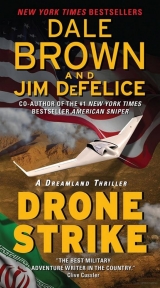
Текст книги "Drone Strike"
Автор книги: Dale Brown
Жанры:
Боевики
,сообщить о нарушении
Текущая страница: 12 (всего у книги 27 страниц)
15
Omidiyeh, Iran
CAPTAIN VAHID SPENT THE MORNING AFTER THE ATTACK in an administrative “freeze.” While the rest of his squadron conducted a patrol around the scientific research area, the pilot was told to prepare a personal brief for the area air commander. That meeting was scheduled for 8:00 A.M.; it was postponed twice, then indefinitely “delayed.” He sat the entire time in a vacant room next to the squadron commander’s office, waiting with nothing to read or do. The only furniture were two chairs, both wooden; one was sturdy but uncomfortable, the other so rickety that he didn’t dare to use it even as a foot rest.
A pair of plainclothes guards from the interior ministry stood at the door. He wasn’t under arrest, but he wasn’t allowed to leave either. He wasn’t given anything to eat.
Vahid had reviewed his mission tapes, and knew that what he had shot down was some sort of light plane, not a drone and certainly not a B-2. It seemed impossible that the plane had made any sort of attack itself, or been involved in one. He had a host of theories, but they boiled down to this: either there had been a genuine earthquake, or the nuclear program had a major accident.
He favored the latter.
Vahid sat in the uncomfortable wooden chair until his butt was sore, got up and paced around until he tired of that, then sat back down. He repeated the ritual until after two in the afternoon, when one of the squadron commander’s aides appeared in the doorway to tell him that the general was finally on his way.
Vahid straightened his uniform. In the days of the Shah—long before he was even born—the Iranian air force was a prominent organization, equipped with the finest fighters in the world—F-14s and F-4 Phantoms. They trained with the Americans, and while the larger Israeli air force might claim it was better, many rated the Iranians just as good. The branch was an elite part of the Iran military and its society.
The overthrow of the Shah hurt the air force tremendously. An order for F-16s was canceled. Needed parts became almost impossible to get. Worse, though, were the questions, innuendo, and accusations leveled at the pilots and the service in general. The air force had supported the Shah to the bitter end, and in the Revolution’s wake, many of the officers were shunned, purged, and worse.
The service regained a measure of respect with the blood of its members during the Iran-Iraq war, where its aces shot down a number of Iraqis and carried out many successful bombing missions. But some thirty years later, the air force continued to be viewed with suspicion by many, especially the government and the Revolutionary Guard, which was jealous of any entity that might have a claim to power and influence.
Politics had always been a distant concern for Vahid, who joined the air force only because he wanted to fly. But the longer he sat in the little room with its bare walls and blue-shaded fluorescents, the more he came to realize that he was a pawn in something he didn’t understand. So when the door opened and General Ari Shirazi—the head not of his wing or subcommand but the entire air force—entered, Vahid was far less surprised than he would have been twenty-four hours before.
The general studied him for a moment.
“You’re hungry,” Shirazi said, more an order than a statement. “Come and eat.”
Vahid followed him from the room, falling in behind the general’s two aides and trailed by a pair of bodyguards. They walked out of the building to the cafeteria, where the VIP room had been reserved for the general. Two sergeants were waiting near the table, already stiff at attention, as the general entered. Shirazi ignored them, gesturing to Vahid to sit before taking his own chair. He folded his arms, worked his eyes slowly across the pilot’s face, then turned to one of the sergeants.
“Get the captain some lunch,” said the general.
“Sir, for you?” asked one of the sergeants.
“I am not hungry.”
The general placed his hands on his thighs and leaned forward. Energy flooded into his face, and determination.
“Tell me, in your own words, everything that happened,” said the general. “Hold nothing back. Begin with the alert.”
“I was with my plane . . .” started Vahid.
He spent the next thirty minutes relaying every detail he could, ignoring the food that arrived. The general listened without interrupting; when Vahid paused too long, he gestured with his index finger that he should go on. Finally, Vahid was back on the ground, taxiing to the hangar area. He recounted the debriefings quickly, adding that he had not had a good look at the damage to the plane himself.
“Do you have the identification of the ground unit that fired at you and struck your plane?” asked the general.
“No, sir. I—I’m not even sure if it was a ground unit.”
“What else would it be?”
“I wondered if an airplane had been far above and fired down from a great distance, random shots, or a missile that went undetected—”
Vahid stopped. The theory was too ridiculous to be credible. The way he remembered the incident, he had been struck from above. But it was impossible. His mind surely had been playing games.
“We’ve looked at the damage,” said the general. “Multiple shots from larger caliber antiaircraft weapons. There is a Sa’ir battery south of Natanz. The weapon was fired; undoubtedly that was your assassin. Fortunately,” he added dryly, “the battery is a Sepa¯h unit.”
Sepa¯h was the shortened term for the Sepa¯h-e Pa¯sda¯ra¯n-e Enqela¯b-e Esla¯mi, the Revolutionary Guard. The general’s implied slur would have been daring in a lesser man; Shirazi was obviously sure of his position—or planning to have the pilot executed shortly.
Vahid was not sure which.
“You will leave us, and close the doors,” the general told the servers. They quickly ducked back into the kitchen. He glanced at the guards and his aides; they stepped out, too.
“There was an accident at their facility,” the general told Vahid. “It is clear from the seismic data. But they are trying to cover it up. That is impossible. Scientists are already explaining about their information. There are some near the president—”
The general stopped abruptly, considering his next words very carefully.
“Some members of the project are claiming that the Americans blew up the facility,” said the general. “They have no evidence for this, of course. On the contrary, we know that was impossible—there were no bombers in the air, or missiles. They would have been on our radar. And you would have seen them.”
“Yes, General.”
“The reports of B-2s—you saw none.”
“None. Yes.”
“You’re sure.”
“Yes.” Vahid nodded. And then he thought: This is odd. It’s the truth, and yet saying it feels like a lie.
“Clearly, it was an accident,” continued the general, “but those jackals will do anything to keep themselves alive. They take no responsibility. Nothing. None.”
The general’s face reddened, blood flowing with his anger. It happened in a flash, as if he were a computer image changed by the flick of a button. Vahid lowered his gaze to the table. He was helpless, really, trapped by powers that regarded him as little more than an ant.
With the grace of the one true God, thought Vahid, they will shoot me and I will die quickly.
“I am going to make use of this incident, son, as others will. I tell you this because I want you to have confidence—others will pressure you to change your story. But you will stick to the truth. Because if you do stick to the truth, you will have a powerful protector. Do you understand?”
“I think I do.”
“Just stick to the truth. To what you saw.”
“Yes, General.”
“Once an announcement is made, then that will be the government’s position,” continued the general, his tone now heavy with sarcasm. “There will be questions for you. Simply trust that I will watch out for you. And that your career will proceed accordingly.”
Vahid faced a truly Faustian bargain. If he did what the general said, he could well be targeted by the backers of the nuclear program, including the Guards. Shirazi, so confident in an air force base, might not be nearly as powerful out in the wide world. Hitching his career, and more likely his life, to the general could prove disastrous.
On the other hand, what was the alternative? Going against Shirazi was simply impossible.
I just want to fly, thought Vahid. I don’t want to be in the middle of this at all.
“Are you OK, son?” asked the general.
“Yes, General.”
“We’re agreed?”
“Of course. I can only tell the truth.”
Shirazi leaned back from the table. “You’re feeling well, now that you’ve eaten?”
“Yes, sir.”
“So, why are you not back in the air, then?” asked the general.
“I . . . was waiting to speak to you, sir.”
“Good, very good.”
The general started to rise. Vahid shot to his feet. “Sir—the plane?”
“Which plane?” asked the general.
“The light plane that I encountered.”
“Ah. A spy for the Israelis—delicious—a member of Sepa¯h. The plane was stolen from Isafahan. It flew south, then to the Esfahan region, southeast of the Natanz complexes. A body has been recovered. You don’t think he was trying to bomb the plant, do you, Captain?”
It would make a great propaganda story, thought Vahid, and he would be the hero, as he had shot down the aircraft. But anyone with any knowledge of aircraft and their capabilities would scoff and point to a thousand inconsistencies.
“No,” said Vahid.
“Good. Because there were no bombs or evidence of any aboard. There may have been a passenger. We’re searching. As are the Pasdaran.” The general gave him a fatherly pat on the shoulder. “Get back in the air, son. The sooner you fly, the better you will feel.”
16
Iran
THE BUS’S BODY WAS BATTERED, BUT ITS DRIVE TRAIN was in top condition; Turk had trouble keeping up as they drove back to the site where the rest of the team was holed up. The troopers accepted the appearance of the bus without comment, as if they’d been expecting one all along. Turk told Granderson all that had happened as they carried Green into the back of bus. It started in disconnected bits, punctuated by gasps of air. Even to Turk it sounded unreal.
“Was it just a cock-up?” asked Granderson. “Or were they looking for us?”
“It might have been—I don’t know.”
“Doesn’t matter now.”
They got the wounded inside the bus, then took off, Granderson in the lead at the wheel of the school bus, followed by the Israeli alone in the pickup, and Gorud, Grease, and Turk together in the car. They let the bus get a little ahead, figuring it would be what the Iranian authorities would be looking for; the others would close the gap if there were trouble.
Gorud had plotted a route east of the city over mining and desert roads that would keep them away from most towns. But the roads were nearly as treacherous as driving through the town would have been. Soon after they started, they hit a long stretch of hard-packed pavement completely covered with sand. Even though the bus and truck passed over it without a problem, Gorud lost traction for about twenty yards until the front wheels found the hard surface again.
“Maybe one of us should drive,” suggested Turk, noticing that Gorud’s injured arm had given him problems.
“Yeah,” said Grease.
“Let me,” added Turk. “You can watch with the gun.”
“I’m OK to drive,” protested the CIA officer.
“It’s better this way,” said Turk, tapping him on the shoulder. “Come on.”
They changed places. Turk, too, had trouble with the loose sand. Once on the highway, the car steadied and he settled down a bit. He didn’t relax—his heart still pounded like a racehorse nearing the finish line. But his view expanded, the cloud of fear lifting slightly. It was as if the horizon had pushed back—he could see farther out and plan before reacting.
Then, almost imperceptibly, either seeking relief from the present or simply lulled into a relaxed moment, his mind began to wander. He thought of Li and their last moments in the hotel room. He ached to see her. He felt her weight against his shoulder. He wanted to brush his fingers across her breasts.
Grease’s voice interrupted his thoughts. “You getting tired of driving?”
“No, I’m good.”
“Careful where you are on the road.”
Turk steered back to the lane gently, trying to stay in control. He glanced over his shoulder; Gorud was dozing in the back. He was tempted to ask Grease if he thought they’d get out of this, but the question seemed too defeatist, as if it implied he’d already decided they wouldn’t.
“They’re looking for a place to change the bus,” Grease said after talking to the others by radio. “I don’t know if we’re going to reach your target area by tonight.”
“Yeah, I was thinking that myself.”
“You have to talk to them, don’t you? You haven’t checked in.”
“Oh, God.”
“Keep driving. They’ll wait.”
Turk hunched forward, leaning toward the wheel as if that would help him focus. He needed to use his pilot’s head—he needed to be clear and precise, not dreamy, not distracted. Being on the ground unhinged his concentration.
No more thinking of Li. No more thinking, period. Except for the job.
“Road,” said Grease.
This time Turk jerked back. His fingers gripped the wheel so tightly they started to cramp.
“I’m thinking maybe we just abort,” said Grease, his voice almost a whisper. “Go straight north while we still can.”
Shocked, Turk jerked his head. “No fuckin’ way.”
Grease stared at him for half a moment, face blank. Then, though the rest of his face hinted at sadness, the ends of his lips peaked upward ever so slightly. “You’ve been hanging around with us too long.”
THE FIRST PLANE PASSED NEARBY ABOUT AN HOUR LATER.
They were south of Sar-e-Kavir, a small town in the shadow of the desert hill where Highway 81 connected with the east-west highway they needed to take. Turk couldn’t see the aircraft, but from the sound he knew it was propeller-driven, something small, very likely similar to the aircraft they had crashed the night before. It didn’t linger, but that was small consolation; for safety’s sake they had to conclude they had been spotted.
Not that they had many options.
Granderson turned up a mountain path about two miles from the town. The steep and rocky path turned out to be a driveway to a pair of small farms dug into the rock outcroppings. Both had been abandoned some years before, though when they first drove up they didn’t know that, and they spent ten minutes checking and clearing the dilapidated far buildings on the larger of the two properties. Sure they were secure, they took the bus into the barn, where there was just barely enough room amid the clutter of old crates and a dilapidated trailer to hide it.
They parked the pickup under a lean-to roof shed at the side; the rear poked out a little, but it would be hard to see even directly overhead. Turk drove the car fifty yards down the hill to what had once been a grove of pomegranate trees but was now mostly a collection of dried stumps. Here and there green shoots and a leaf struggled from the twisted gray trunks, nature refusing to give up even though the underground spring that once supplied the crisscross of irrigation ditches had dried to bone.
He got out of the car and walked a short distance away before using the satellite radio to check in.
Breanna Stockard herself answered. “Turk, are you OK? Where have you been? Why haven’t you checked in?”
“We had a setback in Jandagh,” he told her. “The police—there was an incident in town. A lot of our guys are hurt. We escaped with a bus.”
“The mission tonight, can you—”
“We won’t make it in time.”
Breanna went silent.
“I’ll be in place tomorrow,” said Turk. “Tonight’s going to be too tough. We’re still pretty far away. And we’re pretty banged up.”
“All right. All right. Listen, I know where you are. We have intercepts from the Iranian police and the interior ministry about a stolen bus in one of the towns where you spent time. Is that you?”
“Must be.”
“All right. Stand by.”
Turk heard another aircraft in the distance. This was another propeller plane, but larger; two engines, he thought.
“The report concerning the bus stolen in Jandagh talks about terrorists,” said Breanna. “They’re looking for Russians.”
“That fits with our cover. Do they mention the other vehicles?”
“Negative. The descriptions are vague: three Russian males. Some of these communiqués claim it’s a robbery.” Breanna paused, obviously skimming through screens of data. “They haven’t made a connection with the attack.”
“OK.”
“Turk, what kind of condition are you in?”
“I’m fine. Not a scratch.”
“Your team?”
“Very shot up,” he said. “Only Grease, me, and Granderson are really at full strength. We have two guys—no, three now—who are just immobile. Coming in and out of consciousness. Everybody else is hurt to some degree, though they can still fight.”
“Have you considered aborting?”
“No.”
“You’ve already completed the mission you were sent on.”
“We . . .” Part of him wanted to say yes, they were through; it was time to go home, time to bail.
But the larger part wanted desperately to complete the mission—the next phase. Because the object was to stop the Iranian weapons program. If there was another site, they had to hit it.
So much of a sacrifice, though. For all of them. Was it worth it? Couldn’t they just send in bombers and be done with it?
There was no guarantee they’d make it out alive in that case either. Better to go ahead. Better to do his duty.
At such a cost.
“I can do this, Bree,” Turk insisted. “We just have to get to the other side of the desert. And if they don’t really know what we’re up to—”
“I can’t guarantee that they won’t,” Breanna told him. “The reaction force can’t reach you that far deep in Iran.”
“It’s all right. I’ve done harder things.”
In the air, perhaps, but not on the ground. Definitely not on the ground. But Breanna didn’t call him on it.
“I want you to contact me at the top of the next hour,” she told him. “Do you understand?”
“I will if I can. Sometimes—”
“No. You are to check in every hour. I need to know you’re still alive.”
“I will call you if I can,” he said, hitting the end call button before she could respond.
17
CIA campus, Virginia
BREANNA TURNED TO REID AS SOON AS THE TRANSMISSION from Turk ended. “They’ve taken heavy casualties. I think we should pull them out.”
“It’s not our decision, Breanna.”
“They’re all shot up.”
“He’s not.”
“Let the bombers go in. If they stay, it’s suicide.”
“It already is suicide.” Reid picked up the phone and told the computerized operator to get him the President.
TWENTY MINUTES LATER BREANNA AND REID WERE ON Lee Highway, speeding toward the White House. As a security precaution, the driver had always to follow a different route; at four in the morning traffic was not a particular concern, and for once they were going on a relatively direct route.
Reid stared out the darkened window at the cars passing in the distance. The lights in the parking lots of the buildings and on the signs and streets melted together in a blur.
He would tell the President that they should continue. It would inevitably mean the death of his officer, Gorud, of the Whiplash pilot, and whoever remained from the rest of the team. The Israeli operative, a deep, valuable plant with an impeccable cover. And a family.
But Reid knew absolutely that this was the right thing to do. The nano-UAVs had done a perfect job on the first strike; they would succeed here as well. The result would be far more desirable than a missile strike. No matter what the Iranians did, the scientists who rebuilt the program would never be sure whether there had been an attack or a critical flaw.
Delaying the strike twenty-four hours would increase the odds of success. Even if the analysts didn’t identify which of the two sites was the one with the bomb—or if they decided both had enough material to be a threat—the delay would give Rubeo and his people more time to work on the programming for the mission.
The scientist had demurred when asked for a prediction about the outcome of a split attack. The first strike had been heavily modeled. This one was still being calculated.
“Lovely night,” said Breanna. It was first time she’d spoken since they got in the car.
“It is.” Reid forced a smile. He had grown to like the younger woman, though he felt at times she was too easily influenced by her Pentagon superiors. “Though it’s almost morning now.”
“Technically, it is morning.”
“How’s the senator?”
“Still stubborn as ever,” said Breanna. “And still swooning over the Nationals. Their losing streak has him in the dumps.”
“I hear there’s talk he might run for President.”
“God help us.”
The words were so emphatic that Reid didn’t know how to respond. He remained silent the rest of the way to the White House.
PRESIDENT TODD HAD MANAGED BARELY AN HOUR OF sleep, but she felt a surge of energy as Breanna completed briefing the current situation, ending with a PowerPoint slide showing the general vicinity of the two possible targets.
Charles Lovel, the Defense Secretary, opened his mouth to speak. Todd cut him off.
“The question comes down to this,” said the President. “If we wait twenty-four hours, do we guarantee success?”
“There are no guarantees for anything, ever,” said Blitz, the national security director.
“The odds will be greatly improved,” said Reid, sitting next to Breanna. “Getting our pilot in place helps if there is a problem with the units. True, they were impeccable in the first strike, and compensated well. But I think, as Ms. Stockard said, the human factor increases the chances of success. Plus, we may be able to narrow down the possible targets. At a minimum, we’ll have a better plan for dealing with both facilities.”
“I don’t know that we can afford to guess which of the sites is the real target,” said Blitz. “Not at this point.”
“On the other hand, the odds of the ground team being discovered will also be higher,” said Reid. “And if they’re discovered, we lose them.”
“We may lose them anyway,” said Lovel.
“The Iranians may close the sites,” said the Secretary of State, Alistair Newhaven.
“Twenty-four hours is not enough time to do that,” said Reid.
“If the attack fails—”
“If it fails, we go ahead and we eliminate both sites with B-2 attacks,” said the President, cutting in. “That’s an easy decision.”
“I would vote to launch a B-2 attack now,” said Lovel. “Why wait?”
“Nothing has happened at that site—at either of the possible sites,” said Reid.
“We were rushing to strike tonight,” said Lovel, “because we needed to hit quickly. Now we’re going to delay another twenty-four hours. The sooner we get this over with, the better. For everyone.”
“Not for our people,” said Breanna. “If we strike, if the bombers go in, we’re writing them off. Because they’ll know that the first attack was launched by us, and they’ll be on the alert.”
“I agree it increases their risk,” said General Maximillian Fresco, the head of the Joint Chiefs of Staff. Fresco had only been on the job for a month, and was still feeling his way—a disappointment to Todd, who had selected him because he seemed determined and, like her, prone to err on the side of hawkishness rather than caution. But maybe he would come around.
“They are already at considerable risk,” said Reid dryly. “No matter what.”
“I think we should pull them out,” said Breanna, her voice quivering. “Then send the bombers in.”
Todd was surprised. She looked at Reid. His expression showed he clearly disagreed. Ordinarily, they were in lockstep; she couldn’t remember a time when they had offered even slightly different opinions.
“Our best chance, overall, is to use the nano-UAVs,” said Reid. “We know they work. We haven’t seen the bunker busters yet. This is our best chance.”
Fresco started to object, but Reid cut him off.
“The Hydras work. They leave no trace of our involvement; they raise no moral or ethical questions if there is a mistake. They limit the casualties strictly to those involved in the program.” Reid sounded like a college professor, summing up a semester’s worth of instruction. “The benefits are obvious. At worst, we have the bombers in reserve.”
Todd agreed. She saw from the corner of her eye that the Secretary of State was going to say something—probably, she thought, questioning Reid’s statement about moral questions: they were, after all, setting off a nuclear explosion, even if it was the Iranian’s own bomb.
There was no need for that debate now.
“I think I’ve heard enough,” she said quickly, raising her hand. “We will delay for twenty-four hours. After that, the bombers will be authorized to attack.”
IN THE CAR ON THE WAY BACK TO THE CIA CAMPUS, Breanna fiddled with her personal phone, thumbing through text messages from the past several days, even though she’d read them already. She longed to talk to Zen about the operation but couldn’t.
Her only acceptable alternative was Reid, and she didn’t want to talk to him about anything.
“Why did you change your mind?” asked Reid.
Breanna looked up. “I’m sorry?”
“You’re opposed to the operation now. You weren’t earlier.”
“I’m not opposed.”
“You sounded like you are. Your tone was negative. Even in the presentation.”
“No. I was trying to be neutral. My concern—I just want to get our people out. I feel responsible for them.”
Reid looked at her, his old-man eyes peering into her soul. He was beyond retirement age, and at times like this—deep into an operation, under heavy stress—he looked even older.
He reminded her of her father, once commander of Dreamland, now a virtual recluse.
“Your guilt is misguided,” said Reid.
“I don’t feel guilty.” The words spit out quickly, beyond her control. They weren’t true. “Why would I be guilty?”
“You’re not. That’s my point.”
“I’m responsible for my people. It’s my job to think of them.”
“We are,” said Reid softly. He turned his head toward the driver in the front seat, separated by a thick, clear plastic barrier that made it impossible for him to hear. “But our first responsibility is to the mission. The nano-UAVs are clearly the best choice.”
“Yes,” said Breanna reluctantly. “I can’t disagree.”