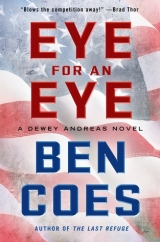
Текст книги "Eye for an Eye"
Автор книги: Ben Coes
Жанры:
Триллеры
,сообщить о нарушении
Текущая страница: 24 (всего у книги 28 страниц)
“They’ll examine my shoulder,” said Dewey.
Smythson looked at Dewey, then to Calibrisi and Chalmers. Dewey’s eyes followed hers.
“That part will be real.”
Dewey sat back, saying nothing.
“You’ll take the place of Xiua Koo,” said Smythson. “You’ll be exfiltrated today and flown to China. That’s the part of the operation you’ll have to architect, Dewey. It is our belief that soon after your arrival, either at the airport or when you get to the hospital, Bhang will visit you. Of course, he’ll think he’s visiting Koo, the ministry hero who killed his nemesis. What you do at that point, what tools or weapons you may or may not improvise, that will be solely up to you to innovate. Perhaps break his neck or strangle him.”
“What if he doesn’t visit?” asked Dewey.
“He will,” said Chalmers. “The agent who succeeds in assassinating you receives the highest award the ministry has. Bhang is awarding it in person. This is all going to go down quickly—right when you arrive or soon thereafter. But if you miss the opportunity, they’re going to find out sooner rather than later. Then you’re dead, and Bhang lives on.”
Dewey leaned back.
“Sounds like I’m dead no matter what.”
“You wanted your shot at Fao Bhang,” said Calibrisi. “Now you’ve got it.”
“You can still back out,” said Katie. “You don’t have to do it.”
“She’s right,” said Chalmers. “We’re going to do everything we can to figure out how to get you out of China. But there are no guarantees, and I would be lying if I said the odds of rescuing you are good.”
Dewey thought of Jessica. She wouldn’t want him to do it, of course. Were she alive, the operation would’ve been killed in its infancy. But she wasn’t alive, and Hector was right: he did want a shot at Bhang. He wouldn’t be able to live with himself if he didn’t take it, even if the odds were low and the aftermath fatal.
Deep down, it wasn’t about Jessica anymore, it was about him. It was about being a man. Dewey knew he’d rather die than spend the rest of his life knowing what it felt like to be a coward.
Dewey stood up. “Let’s go.”
* * *
Chalmers and Smythson led Dewey into the kitchen. Lacey James was standing next to the island, sleeves rolled up.
“Take a seat.”
James’s steel trunk lay open on the ground. Inside, it was lined with bottles and canisters of various sizes, shapes, and colors.
“What are you doing?” asked Dewey.
“We need to make a mold of your face,” said James.
James reached into the trunk and pulled out a see-through polycarbonate case. Inside was a mask of a Chinese man. Other than the fact that it had no eyes, hair, ears, or teeth, it looked exactly like Koo.
“We need something to adhere the life cast of the Chinese agent to,” said James, holding up the mask of Koo. “Otherwise, it will fall off. The cast of your face lets me build a positive of your features. Then I attach the mask to it. It’s the same thing as wearing a mask on Halloween, only this time the mask looks and feels like it’s real. We glue it to your face and, voilà, you’ll be Chinese, at least for a few days.”
“What’s it made of?”
“Silicone,” said James. “We use medical adhesive. It’s safe, and perhaps more important, has the same texture as skin. Now sit down.”
James pulled out two gallon-sized canisters, both labeled BODY DOUBLE. He unscrewed the lids. Inside the first canister was a thick, gooey pink liquid; the other held a similar-looking liquid, only it was blue. He poured equal amounts into a bowl and mixed them. The liquid turned purple.
Next, James immersed a small stack of damp plaster strips in the purple liquid. He waited a few seconds, then lifted a strip into the air.
“This is going to feel somewhat disgusting,” said James. “I apologize in advance.”
He leaned over and wrapped the wet strip across Dewey’s forehead. Working quickly, he covered Dewey’s entire face with wet purple plaster strips.
James then removed a pair of specially designed blow dryers, plugged them in, and blow-dried Dewey’s face until the color was gone, indicating the strips were dry, replaced by a dull, translucent hue. He took a small plastic tool that looked like a spatula and inserted it between the dried cast and Dewey’s chin. He gently worked the end of the tool around the edge of the cast. When he finished a full circle, he popped the cast from Dewey’s face.
Smythson nodded to Dewey.
“Let’s go. We don’t have a lot of time.”
78
WASHINGTON, D.C.
The limousine carrying Ji-tao Zhu sped quickly along Rock Creek Parkway. It exited at Connecticut Avenue, then moved up Connecticut until it was in front of a large art deco apartment complex called the Kennedy-Warren. Zhu’s driver pulled into an underground parking garage. Zhu climbed out the back of the limousine alone and took the elevator to the top floor. He walked to the door marked 1809.
Zhu rang the doorbell. When no one answered, he rang it a second time. Finally, he heard footsteps. The door opened. Standing in the doorway, dressed in a blue bathrobe, wearing a pair of worn-out Timberland construction boots, his curly blond hair in a wildish Afro, was Wood Uhlrich.
“You’re two hours early,” said Uhlrich.
“The plane was faster than I anticipated, Mr. Secretary,” said Zhu. “May I come in?”
Uhlrich opened the door.
“Why not.”
Zhu followed Uhlrich into a spacious, light-filled apartment, its windows overlooking the treetops of Rock Creek Park.
“I’ll be right back,” said Uhlrich. “Do you want coffee?”
“No, thank you. I won’t be here long enough to enjoy it.”
Uhlrich disappeared into the kitchen, where he poured himself a cup of coffee. He returned to the living room.
Zhu scanned Uhlrich’s outfit as Uhlrich stood staring at the much-shorter Zhu, who was neatly attired in a plain-looking black business suit and tie.
“You gonna say something?” asked Uhlrich.
“Thank you for seeing me on such short notice,” said Zhu.
Uhlrich took a sip of coffee but didn’t say anything.
“This concerns our last conversation,” said Zhu.
“Yeah, I figured that. The one where you told me, and the United States, to go to hell.”
“That’s not exactly what I said, Wood. I said that China will not lend you any more money.”
“It’s the same thing,” said Uhlrich, “and you know it.”
Zhu smiled, then looked at the window.
“Such a nice view, Wood. I am very jealous. It must be such a joy to wake up every day and see the trees.”
“Cut the bullshit.”
“I said we’d be in touch. The conditions for China’s continued lending to the United States. Remember?”
Uhlrich sipped, staring at Zhu with a blank stare.
“What do you want?” asked Uhlrich.
“There’s an American citizen,” said Zhu. “He is wanted by my country. He has committed certain crimes against my country.”
“What the fuck does this have to do with the United States Treasury or the People’s Bank?” asked Uhlrich, turning red.
“Nothing, except that unless he’s handed over, we will not lend America any more money. So I suppose it has very much to do with you and me, yes, Wood?”
Uhlrich stared into Zhu’s eyes for several pregnant moments.
“He’s a criminal,” added Zhu, smiling. “A common criminal. A thug. You will be happy, I’m quite sure, to be rid of him.”
“What’s his name?” asked Uhlrich.
“Andreas. Dewey Andreas. Have you heard of him, Mr. Secretary?”
A smile crossed Uhlrich’s lips as he nodded to Zhu.
“I’ve heard of him.”
“Perhaps that will make it easier to find him.”
Uhlrich said nothing as he watched Zhu smile, then squirm uncomfortably. Finally, after taking another sip from his coffee cup, Uhlrich pointed to the door.
“Get the hell out,” said Uhlrich, calmly. “American heroes aren’t for sale.”
79
CASTINE
Sam descended the tree in silence, each step a delicate, slow-motion progression toward the forest floor. He needed to act before it was too late. In his hand, he held his red Swiss Army knife, blade out.
Could he stab someone? He couldn’t imagine actually doing it, and yet it was the only option he had.
The knife abruptly fell from Sam’s hand. He watched it as it plunged toward the ground. But it didn’t make a sound. The knife handle jutted up in the air. The blade had stabbed straight into an exposed root of the big tree. His temporary relief was ruined, however, by the realization that he didn’t have a weapon. He kept going.
When he reached the bottom branch of the tree, Sam was at the point of no return. His next step would be on the ground, atop dried leaves. Noise was inevitable.
Sam arched his head around the trunk, spying. The gunman was no more than ten or twelve feet away, motionless, clothing blending perfectly into the green and brown forest floor. The gunman was tight against the sniper rifle, eye to the scope, right hand gripping the trigger.
There was only one option left. He had to jump and run, then try to tackle the gunman before he turned and shot him.
You’ll never make it.
* * *
“Should you call Hobey?” asked Margaret Andreas.
Sam’s grandmother was kneeling on the ground next to a tomato plant, kneepads strapped on, clutching a pair of hand trimmers.
She looked at her husband. He was at the corner of the garden and had his right boot on top of a shovel, about to push down and lift another pile of dirt out of the ground. Perspiration covered his face.
“Stop worrying, Marge. He’ll be along.”
* * *
Dao breathed slowly in and out, staring at John Andreas through the scope. His chest was dead center in the crosshairs of the scope. She preferred a head shot, but his digging, which caused him to move up and down, made this more difficult. A chest-tap would have to do.
The sequence was obvious. Shoot John Andreas, swivel the weapon slightly right, then take out the woman. Drive to the brother’s house and kill him too. Get out of Castine—out of Maine—out of the United States—as quickly as possible.
Without moving her eye from the scope, Dao moved the safety off. She put her right index finger on the trigger. She pulled it back.
* * *
Sam sat on the lowest branch of the maple tree, just a few feet above the ground. Suddenly, like a gymnast, he fell backward, letting his arms, head, and torso fall down toward the ground, so that he was upside down, his legs still over the branch, keeping him from tumbling to the ground below. Sam’s head was inches from the ground. He stretched out his right arm. He grabbed his golf club, which was resting on the leaves. He lifted it gently up, then pulled himself back up to the branch.
Sam stood on the branch and leaned around the trunk of the tree, studying the gunman. The ground surrounding the gunman was a carpet of dried leaves, which he knew would make noise no matter how delicately he tried to tiptoe across them.
He looked up and studied a large branch at least fifteen or twenty feet in the air, which extended out directly over the gunman. Sam climbed to the branch as quietly as he could, as he felt the adrenaline charging through every part of his body.
He put the golf club between his teeth, biting down. He reached up and grabbed the big branch with his right hand, then his left. Slowly, quietly, Sam moved down the branch, hand over hand, out into the air above the gunman.
When he was directly over the gunman, he could feel his arms burning in pain. It was a pain unlike anything he’d ever felt before, a pain he would remember for the rest of his life. It was the pain of the fight, the pain that came when you risked everything, when you challenged death itself.
Sam let go with his left hand, holding himself aloft with his stronger right arm. He dangled silently in the air. He took the golf club into his left hand.
Sam began a slow, deliberate swinging motion, his feet and legs moving back and forth in the air above the killer. As his momentum picked up, he suddenly kicked his feet. Both flip-flops went sailing through the air, over the gunman, landing atop dead leaves just in front of the muzzle of the rifle.
Clutching the branch in his right hand and the golf club in his left, Sam watched from above as the gunman raised up from the weapon, frantically searching for whatever had caused the noise. Sam let go of the branch, falling through the air, swinging his right hand to the club, where it joined the left. By the time his bare feet landed on the ground, he was already swinging the nine iron through the air with every ounce of strength he had in his thirteen-year-old body. He clubbed the gunman—who was searching in the opposite direction—in the back of the head. A loud scream came from the ski mask as the gunman fell to the ground. It was a woman. She hit the ground, rolled over, then tried to stand up. Sam swung again, whiffing completely as she ripped off the ski mask, revealing short black hair and the eyes of a Chinese woman.
The killer touched the back of her skull, then looked at her fingers. They were drenched in blood. She said something in a language Sam couldn’t understand, then ran at him.
He swung again just as she leapt. The club landed with a brutal thud on the side of her head. Blood shot from her face as she fell to the ground, screaming. Sam stepped closer and raised the club again. He brought it down in a fierce axing motion. The club struck the woman’s forehead. Her eyes shut as she went limp, blood suddenly gushing from a small crack in her skull.
Sam stood, drenched in sweat, staring at the woman. He raised the club again but didn’t swing. He stared at her limp body for almost a minute, club raised over his head in case he needed to use it again.
“Sam?”
Sam’s eyes glanced right. Standing at the edge of the woods was his grandfather.
“We heard screaming. What the hell is going on?”
His grandfather ran toward him. His eyes bulged as he saw the blood-covered skull of the Chinese woman lying on the ground. Then he registered the rifle on the rock, aimed up at the farmhouse, and did a double take. He followed the trajectory of the muzzle and realized it had been aimed at the garden.
He turned to look at Sam. They were both quiet for a few seconds, then the older man spoke.
“That was very brave of you, Sam.”
80
HÔTEL LE BRISTOL
RUE DU FAUBOURG SAINT-HONORÉ
PARIS
Dewey climbed out of the taxi in front of the hotel. He walked a few feet from the door and pulled a pack of cigarettes from his coat.
In the distance, he could see soldiers guarding the Élysée Palace, home of France’s president.
A parking valet was milling about the entrance to the hotel. It wasn’t Vonnes, the informant.
“Un feu?” he asked.
The man pulled a lighter from his pocket and lit Dewey’s cigarette.
It looked like it was going to rain, with dark, gray clouds creating a foreboding roof over the Paris afternoon.
Dewey glanced about, looking for the man. Finally, he finished the cigarette, just as a white Maybach pulled up to the hotel’s entrance. A man in a black uniform climbed from the front seat; another parking valet, bringing someone’s car around. Dewey recognized him. He made eye contact, then looked away, watching from the corner of his eye as the man pulled a cell phone from his pocket and started typing.
* * *
“May I use your restroom?” Koo asked the woman.
She looked at him with a snobby sneer. All of the people at Hermès were like that.
“The restrooms are reserved for customers,” she replied.
Koo held up a small orange bag, inside of which was a tie Koo had just purchased for two hundred euros. The last thing he would ever buy in Paris, he realized.
In the restroom, Koo locked the door. He pulled out his QSZ-92, a suppressor jutting from the muzzle, inspecting it. He looked at the small camera near the site.
He felt his iPhone vibrating. He pulled it from his pocket.
“Il est ici.” He’s here.
Koo put the QSZ back in his trench coat. He checked his watch, unlocked the door, then walked unhurriedly out from the back of the store and up rue du Faubourg Saint-Honoré.
* * *
Dewey stepped through the glass entrance door of the Bristol Hotel. He glanced at his watch: 3:58 P.M.
“Bonjour, monsieur,” a concierge said as he stepped inside the lobby. “Welcome to the Bristol.”
Dewey scanned the lobby, then stepped to the front desk.
“Checking in?” asked a young woman, smiling at Dewey.
“Yes,” said Dewey. He pulled a wallet out and took a black American Express card and handed it to the woman.
“Welcome to the Bristol Hotel, Mr. Walker. I have you here for six nights, correct?”
“That’s right.”
“City view suite.”
The woman reached into a file and pulled out a piece of paper. She placed it down in front of Dewey, handing him a pen to sign.
“Does this look correct, sir?” she asked.
Dewey flashed his eyes to the paper without reading it, then took the pen and signed.
“Looks good.”
Over the woman’s shoulder, to her right, ran a sweeping set of marble stairs. A little past the stairs was the lounge. It was filled with people, seated at luxurious sofas and chairs—couples, a few businessmen, a family; drinking espresso, tea, or coffee as the afternoon sun splayed cuts of soft yellow through a massive window.
Back against the far wall, sitting down, Dewey saw a woman with short blond hair wearing a bright orange blouse, her arms bare; turning quickly, teacup in hand, their eyes met: Katie.
The woman swiped Dewey’s Amex, then handed it back to him.
“There you are.”
“Thank you.”
“How many keys would you like, Mr. Walker?”
“One.”
* * *
“Premier Li was using me as a messenger,” said Qingchen, looking at the ground but speaking to Bhang. They were seated in their usual place, atop the roof of the Ministry of Defense. “He is savvy enough to know I am an ally of yours. He is also savvy enough to understand I will deliver a message, which I’m doing.”
“That I am to be pushed into retirement?” asked Bhang, calmly enraged.
“He was extending an olive branch. The next time it won’t be an olive branch.”
“So what are you saying, General?” asked Bhang. “Is this what you think I should do? I would never resign. Li and his minions will have to kill me first.”
“You misunderstand me,” said Qingchen. “You’re still too impatient. No, I see today’s meeting as a grave error on the part of our leader. Today he revealed his weakness. He let us know that he has become aware of the impending transition away from him to you. He is less worthy an adversary than I had expected. He abandoned politics today, his field of expertise, and now would like to engage us on the battlefield of deception and power. In my opinion, power is now ours; all that’s left is for you to take it.”
“How long will it require?” asked Bhang.
“Hours.”
“I’m ready when the PLA is ready.”
“Good,” said Qingchen. “I would ask one favor of you as I move ahead with the preparations. Please, whatever happened in Portugal, as with London, the sloppiness of your activities only makes it harder. Understand, Fao, you are but a vehicle for a change which must take place no matter what. I would like it to be you, but it doesn’t have to be.”
“I understand, General,” said Bhang.
Just then a steady beeping noise came from Bhang’s phone. Emergency. Bhang pulled the phone from his jacket, then read the coded text:
16/339-2
G1-y
Andreas had been found; he’d triggered an alias, using a credit card in Paris, and every ministry asset in the city had been notified, nine in all.
Bhang put the phone away.
“That little problem is about to go away,” said Bhang, trying to contain his excitement. “I can promise you there will be no further interruptions. Now, if you’ll forgive me, General, I must go.”
* * *
Dewey opened the door to room 1011. He went inside, bolted the door, then threw the leather bag to the bed. He pulled off his sweater and T-shirt. He put on the blue from the bag. He took the small ceramic ring and put it on his left thumb.
Dewey went to a large mirror. He stared for a moment at his week of stubble, coating his cheeks and chin. His heart was starting to beat faster, he could feel that now for the first time. He stared into the mirror, into his blue eyes. The man who looked back at him looked tired, sad, but mostly just blank and emotionless. Inside, Dewey felt a combination of emotions—anger, grief, nervousness, fear, excitement—which he allowed to build, pool up, to grow into a single feeling: desire. Desire for vengeance.
He shut his eyes, took a deep breath, then moved to the door.
* * *
Katie held a newspaper, a copy of Le Figaro, as she scanned the lounge with trained calm. Her legs were crossed in front of her.
On the blue-green chintz sofa cushion next to her, her slightly worn toffee-colored Hermès Birkin bag sat on its side. For all pretenses and purposes, she looked like any other young, stunning, wealthy French woman, out for an afternoon espresso.
Inside the bag was an MP7A1. It had been sanitized by MI6, in case the operation went south. A snub-nosed suppressor jutted from the muzzle. The MP7 was a terrific close-quarters combat firearm, with lethal kill power, accuracy, and reliability. She also had a Glock 30, in case she burned through the MP7’s magazine.
Katie checked her watch. In the reflection off the face of the watch, she saw Tacoma’s unmanageable hair. He was seated a few tables away, sipping water.
* * *
Lijun—along with eight other ministry agents assigned to Paris—received the text as he was in the middle of a bite of a ham sandwich at a café on Montparnasse.
8U 8U Di7
Lijun jumped up so fast that he knocked over the table, sending dishes, glasses, and silverware crashing to the sidewalk.
Two minutes later he was in the back of a Citroën taxicab as it moved across the Pont Neuf, the black water of the Seine underneath. A few minutes later, the Louvre’s signature glass and steel pyramid appeared to the right. To his left spread the ordered birches, gardens, and walking paths of the Tuileries Gardens. But he wasn’t admiring the scenery.
Lijun made sure the driver wasn’t looking, then popped open his briefcase. Inside was Lijun’s Steyr TMP, a select-fire 9x19mm machine pistol, in essence a handheld, extremely compact submachine gun. He attached a custom snub-nosed suppressor, upon which was attached a small camera, then inserted a thirty-round magazine.
He checked his watch. Finally, he removed his cell phone. He typed in:
R5 999
That told Beijing he was approximately four minutes from the target. It also engaged the small camera at the end of his weapon. He tucked the Steyr TMP against his chest, then zipped up his Windbreaker.
* * *
Dewey took the elevator to the lobby, where it opened to the left of the lounge. He walked across the marble floor and stepped to the entrance of the lounge. A tuxedoed waiter approached him, held his arm out, and pointed to a table in the middle of the crowded lounge.
To the right, against a far wall, Dewey saw Katie.
Next to Dewey’s table, where the waiter now held out a seat, was Tacoma, drinking water, reading the International Herald Tribune. Their eyes met briefly; Tacoma looked calm.
“May I get you an aperitif?” asked the waiter. “Perhaps a coffee or glass of wine?”
“Coffee,” said Dewey.
* * *
Koo received the text from the ministry as he crossed rue de Miromesnil. He waited for a large group of schoolchildren to pass by before replying. In the distance, he could see the entrance to the Bristol Hotel, the flag of France, of the EU, and of several other countries, all billowing in the wind above the entrance.
He removed the Hermès tie from its bag, folded it, and stuffed it in his pants pocket. He threw the bag in a trash can. Then Koo typed into his iPhone:
P+ KK1 8U
The code activated the camera on the end of his QSZ, which he felt sticking into his side. His words also communicated something to Beijing: “I am within one minute of target.”
Koo put the iPhone back in his coat pocket, crossed Miromesnil, and walked toward the Bristol.
* * *
As the cab moved up Avenue Matignon, Lijun was sweating, his body a live wire, filled with tension and nervous energy. In the distance, he saw soldiers standing at the gates of the Élysée Palace.
The taxi turned onto Faubourg Saint-Honoré. To the left, a short line of cabs sat waiting in front of the Bristol. Multicolored flags, tossed by a breeze, waved above the majestic entrance canopy. Then Lijun saw someone he recognized: Cao Chong, another agent, running down the sidewalk from the opposite direction toward the hotel door. In Chong’s hand, swinging in the air, was a black steel handgun, a suppressor sticking from the end.
Lijun did not wait for the taxi to get to the hotel, instead he ripped the door open and leapt from the back, leaving the briefcase behind, going into a hard sprint toward the hotel entrance.
* * *
The waiter walked toward Dewey with a tray in his hand. As he was about to arrive at the table, Dewey’s eyes were drawn across the lobby to the glass doors at the hotel’s entrance.
Through them walked a man with dark hair in a tan trench coat. He was tall. His eyes scanned the lobby. There was no question: it was Koo.
“Monsieur—”
“I changed my mind,” said Dewey, raising his hand to stop the waiter. “A glass of wine.”
From the corner of his eye, Dewey watched as Koo crossed the lobby quickly, moving like an athlete. As he descended the marble steps near the lounge, his arm reached inside his trench coat. He ripped a sidearm from inside the coat, walking with it at his side as he approached.
Dewey felt the small button on the thumb ring.
“Very good, monsieur,” said the waiter. “What kind of wine would you like?”
“Anything,” said Dewey, impatiently. “Red.”
Koo came to the lounge entrance. His dark eyes scanned the room. In his right hand he clutched a suppressed QSZ-92.
“Bordeaux, monsieur? Beaujolais?”
“Anything,” said Dewey. “I trust you.”
“Very good.”
As the waiter moved from in front of Dewey, Koo’s eyes scanned a moment longer, then found him, then locked. Koo’s arm flew up, the black suppressor swung in line, and found Dewey.
* * *
Bhang stood before the plasma screen, which was divided into three separate views: the live shots from the cameras on the weapons of Koo, Chong, and Lijun.
Bhang’s suit jacket was removed, as was his tie. His sleeves were rolled up to the elbows. He was smoking a cigarette. The room was filled with at least a dozen other men, all transfixed on the plasma.
On another screen was a map of Paris with live GPS locations on all nine ministry agents in the city, indicated by flashing green lights. Bhang studied the map quickly. The three green lights—Koo, Chong, Lijun—were clustered in and around the Bristol.
“Tell the others to hold back,” said Bhang calmly. “Three agents should be enough.”
Bhang, recalling his meeting with Qingchen, didn’t want to create any more violence than necessary.
“Don’t enter the hotel unless we tell them to.”
Bhang went back to the screen showing the live video feeds. Koo was on the left. He was now inside the hotel, walking across the lobby. The view was grainy but clear. He came to a stop at the front of a lounge full of people, seated at tables.
In the middle screen, Chong was entering quickly through the door. To the right, Lijun’s view was dark; he still had his weapon concealed, but he’d activated it. Suddenly, his section of the plasma lit up. The back of Chong, running across the hotel lobby, was plainly visible.
* * *
Dewey lurched forward, tossing the table over, lunging in the direction of Koo, as a woman to Dewey’s left suddenly started screaming. Dewey leapt at Koo, his arms outstretched. But before he could reach him, Koo fired.
The mechanical staccato of the suppressed weapon played low, beneath the screams, in the same moment Dewey pressed the button on the thumb ring twice. Dewey’s shirt exploded in a riot of dark red above his heart. His forward motion was halted. He tumbled sideways, down to the ground, onto his back, chest sopped in crimson.
Tacoma leapt up from his chair, pulling his P226 from his shoulder holster. In one fluid motion, he swung it toward Koo and fired, missing, the sound of Tacoma’s unsuppressed sidearm only adding to the screams, the sense of chaos, that now filled the lounge.
Koo swung the QSZ to the right and fired at Tacoma. Tacoma was struck in the center of his chest as he grunted loudly and was kicked backward, tumbling to the ground, his T-shirt abruptly ruined in dark red.
Screams filled the Bristol lounge; patrons ran toward the back of the lounge and dived under tables for cover.
From the lobby, a commotion ensued, voices raised, then suddenly there was more gunfire, this time from near the entrance to the hotel.
Koo stepped above Dewey, weapon trained at his chest. Dewey looked up at the agent. His mouth moved, but no sounds came out. Koo fired once, twice, three more times as, behind him, through the lobby, another man stormed toward the lounge, running with a weapon outstretched in his hand, a long black suppressor sticking out from the muzzle.
The loud, unmuted sound of Tacoma’s gun exploded as Tacoma got off a round from the ground. Koo lurched backward, clutching his left shoulder, falling to the ground, screaming in pain.
Katie saw the second gunman as he came into view, near the front of the lounge. He was running fast, weapon out. Katie stood up. She ripped the MP7 from her bag just as the gunman rounded the entrance, saw Dewey on the ground, and swung his weapon.
Katie triggered the submachine gun, full auto. A hail of slugs tore into Chong, arresting his forward motion and kicking the back of his skull out in a spray of blood. He fell in a contorted heap to the marble floor, dead.
For the first time, sirens pealed in the distance from somewhere outside the hotel.
Katie moved to Dewey, crouching at his side. Suddenly, her eye was drawn to the lobby. Another man was charging. In his left hand, he clutched a squat black CQB machine gun, which she recognized: Steyr TMP.
From the ground next to Dewey, Katie swept the MP7, trigger flexed, and sprayed slugs across the agent’s torso, ripping holes through him before he could even fire, felling him a few feet behind the other gunman, the wall behind him abruptly splattered in red.
* * *
Koo ran through the lobby, toward the entrance, clutching his weapon. He pushed through the now-abandoned doors.