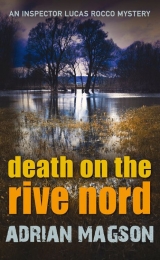
Текст книги "Death on the Rive Nord"
Автор книги: Adrian Magson
Соавторы: Adrian Magson
Жанры:
Триллеры
,сообщить о нарушении
Текущая страница: 3 (всего у книги 22 страниц)
CHAPTER SEVEN
In Es Sénia, Samir Farek left the building where his men were preparing to dispose of the dead taxi driver, Abdou. The body would be transported in an old packing crate and eventually found in a convenient alleyway in the old town. A robbery victim, sniffed over by dogs and rats. Unfortunate, but it happened all the time.
‘Find me the Calypsoa,’ he said, walking towards his Mercedes. ‘Find the agent who dealt with the addition of passengers on board. I want to know where the ship went from here and what stops it was due to make along the way.’
Bouhassa shuffled heavily along beside him, djellaba flapping around his huge belly. He nodded and licked his lips. ‘The agent. Right. Then what?’
‘Then kill him, of course.’
Later, at his home in Al Hamri, Farek walked through every room, feeding the anger that had begun when he returned from a lengthy business trip to Cyprus to find his wife gone. There was no trace of her here now, save for some clothing and a few cheap trinkets. The good jewellery was all gone, as was the emergency cash from his desk drawer.
And the boy.
She had left him. He couldn’t believe it.
The place was so quiet. He found that strange until he remembered how she had always been playing music on the radio; mindless modern pap, mostly.
He ended up in the bedroom, and standing breathing in the atmosphere of her perfume, found himself wondering whether she had ever soiled this place with another man.
He shook off the idea and went to the living room, staring at the expensive furnishings, the leather and polished hardwood, the glistening floor tiles and rugs from Afghanistan, the magazines from Paris and New York which she had persuaded him to buy her.
Felt the fury beginning to tip over as he thought about his generosity while ignoring the times he had gone with other women, soiled his own promises to her, threatened her very life for daring to question any decisions he made.
He kicked out, sending a fragile coffee table spinning across the room, smashing an ornate mirror from Florence. They were nothing, merely trappings; he could buy a dozen, a hundred more like them if he chose.
She had betrayed him. It was all he could see, all he could think about. Betrayed and made a fool of him in the eyes of the world. But she also knew too much, his whore of a wife. And in betraying him, she had brought about her own destruction.
He picked up the telephone to call first his brother Lakhdar, in Paris, then Bouhassa. Because of her betrayal he was going to have to bring forward his plans. It was earlier than he would have liked, but maybe this was a sign from the gods.
How did that saying go? Faire d’une pierre deux coups. Yes, he liked that. It was strangely appropriate.
Kill two birds with one stone.
CHAPTER EIGHT
Rocco recognised the smell the moment he stepped from his car. It was one he’d encountered all too often whenever a ‘floater’ – often a misnomer but darkly descriptive – surfaced after a period underwater.
He walked down a narrow footpath, where he found Claude Lamotte in conversation with two men in work clothes, breathing vapour and slapping gloved hands against the cold rolling off the canal. The call to Amiens had come from a café in the next village, where Claude, huddled in rubber boots and a heavy hunting jacket and wearing a cap with ear flaps jammed down over his head, had sent a messenger. His uniform shirt was just visible at the lapels, proving that he had, at least, made an effort to meet official dress requirements.
‘What have we got?’ asked Rocco.
Claude pointed into the murky water at the barge’s stern, to where a bundle of dark-green cloth was visible just below the waterline. Further down was the outline of a bare foot, the skin dark and shrivelled. ‘The boatman said he felt it being dragged by something in the water. He thought it might be a submerged log or a dead cow.’ He met Rocco’s sceptical look with a shrug. ‘It happens, believe me. Cows are good at getting into the canal but not so clever at climbing out again. After a while they give up and drown.’ As a rural policeman, part of Lamotte’s job was monitoring the canal and other waterways in the area, which meant taking calls involving accidental deaths by drowning.
‘Hell of a surprise for him, then.’
‘He hooked the cloth and gave it a tug, but it was stuck. The clothing must have snagged on a loose rivet. The body surfaced briefly before going under again. Says he got a good look at it before it got dragged under again. It gave him a turn so he left it alone and called me. He’s had a few drinks since then, so I wouldn’t stand too close – and don’t light a cigarette; he’ll go up like a Roman candle.’
Rocco nodded. The boatman was short, grubby and grizzled, with a tangle of grey beard and a head topped by a battered peaked cap. ‘I’ll pass, in that case. But I need to know where he’s come from and where he thinks he might have picked it up.’
‘Easy.’ Claude pointed along the canal, which ran straight for several hundred metres before bending away out of sight behind a line of poplar trees. ‘He set out from two kilometres away early this morning, this side of Poissons. It’s all straight from there, with no locks for a long way,’ he gestured behind them with his thumb, ‘and he reckons it was about half a kilometre back when he felt the barge’s nose coming round, like she’d grounded. Is a barge a ‘she’ or a ‘he’, d’you think?’
‘If she won’t do what you want,’ Rocco countered dryly, ‘what do you reckon?’ He studied the vessel, which was about fifteen metres long and sitting low in the water like a giant slug. It looked a brute of a workhorse, battered and scarred and weighed down with sacks of coal, and not the least bit feminine. ‘Would he have noticed it in a thing this size?’
‘Sure.’ Claude nodded. ‘Apparently they can tell by feel when a barge isn’t running right. He said it was pulling to one side.’
Rocco took his word for it. His own experience with boats had been confined to jumping in and out of assault craft. He looked along the canal in the direction the barge was facing. It wasn’t an area he was yet familiar with. ‘Where does this lead?’
‘It’s part of the River Somme. It goes through Amiens and up to Abbeville.’
‘OK. Let’s get the body out of there. We can’t tell what happened until we see it properly. Make sure you hook the clothing.’
Claude asked the boatman to get his boathook. But after much arguing, it was obvious the man was too unsteady on his feet to be of any help. Claude jumped on board and found the tool himself, then began tugging at the submerged body. After a few minutes, he managed to work the clothing free and carefully manoeuvre the corpse clear of whatever was holding it in to the bank. Rocco enlisted the help of the two bystanders to haul it dripping onto the towpath.
‘It’s been there a while,’ Rocco commented. The smell was immediate and rancid, driving the other men back more effectively than any police barrier might have done. Rocco, however, had seen it all before and was almost immune. Even so, he had to take a deep breath before making an examination. The body was bloated, straining against the clothing like an overstuffed andouille, the skin covered with a slimy film. He pulled a pair of orange rubber gloves from his pocket and slipped them on, a habit picked up from a member of the river police in Paris. Then he checked the pockets. He found a wallet in the jacket, empty save for a photo discoloured beyond recognition and a square of pulpy paper with faint traces of ink. It might have given a clue to the man’s origins, but fell apart as soon as he touched it.
He turned his attention to the dead man’s face. He estimated his age at somewhere between thirty and forty years, but it was difficult to be sure, given the conditions. Even with the swollen, discoloured skin, he looked swarthy, with thick, rough-cut hair. Definitely of North African or maybe Spanish origin, though. He flipped the jacket open, but there were no labels to indicate where it might have been bought.
It reminded him of another body that had been discovered near Poissons on his first day in the region. Then, it had been a young woman in the military cemetery outside Poissons, and equally difficult to age or identify.
‘He’s not local,’ said Claude emphatically.
‘You know that for sure?’
Claude pointed at the man’s other foot, which was encased in a heavy leather sandal with a thick sole. ‘It’s too cold here for that footwear. It’s the sort of thing you see in the flea markets down south. Or in North Africa.’
Rocco looked at him. He’d never thought of Claude having served overseas. On the other hand, conscription into the French army took men to strange places.
‘I did a tour there once,’ Claude explained. ‘Can’t say I was impressed.’ He flapped a hand in front of his face and cleared his throat. ‘What do we do with him? He’ll only get worse out here.’
‘Get a wagon out from Amiens. We’ll let Rizzotti take a look. I’ll follow it in.’ Rocco pulled off the gloves and dropped them by the body. He had a spare pair in the car.
‘And Capitaine Haddock?’ Claude nodded in the direction of the barge owner, who seemed to be sinking slowly into a gentle stupor and becoming detached from everything around him, even the cold.
‘Pour a couple of litres of coffee down his throat and take a statement. Then let him go.’
‘Shouldn’t we keep him around?’
‘He’s not going far in that thing, is he? And I doubt he ran the man down – not at speed, anyway.’
‘Stabbed to death. One thrust to the chest.’ Dr Rizzotti stepped back from the body on his examining table and coughed discreetly. In spite of the tang of chemicals in the room, even the doctor was looking slightly green around the eyes. ‘Dead when he went in, probably been that way for three to four days. The water in the canal would be very cold at this time of year, so it might have been longer.’ He shrugged apologetically. ‘It’s a science. But for me, not a precise one, I’m afraid.’
‘Age?’ Rocco wanted more than his own guesswork, and wondered who had killed the man and when. At least Rizzotti’s conclusion ruled out a drunken tumble down the canal bank. Now all he had to do was find out who the man was, where he’d come from … and who had disliked him enough to stick a knife into his chest.
‘Mmm. Late thirties, something like that.’ Rizzotti touched the man’s bare chest, finger resting just beneath a three-centimetre stab wound. The skin was puckered and open like a pair of lips. ‘No scars that I can see apart from this wound.’ He lifted one of the hands. ‘As to what he was, a manual worker, I’d say; strong, blunt fingers and broken nails suggests agricultural – at least, was recently.’
‘Not a factory hand?’ There were several manufacturing plants in the area employing casual, unskilled workers. If any one of them were missing a member of the workforce, it would be a quick step closer to solving the case.
Rizzotti ruled it out. ‘No. There are three types of production around here: metal-working, which produces oil and swarf – sharp metal coils to you – which cut and stain the skin; assembly-line operations which leave the hands roughened but clean; and tyre factories which leave traces of rubber under the nails. I’d say this man’s been nowhere near any of those.’ He hesitated, which made Rocco look up.
‘There’s a but?’
‘The knife that killed him. I’m not really experienced enough to tell, but it was probably a double-sided, narrow blade with a good point.’
‘A hunting knife?’
‘Could be. But definitely not a kitchen knife, which would have a single-sided blade.’ He pointed at the wound. ‘This has been sliced on both sides.’
‘A dagger?’
‘Possibly. It narrows the field, but that’s all I can tell you. Sorry.’
Rocco accepted his summation. Rizzotti had come a long way since they had first met. Initially defensive and reluctant to admit his lack of experience, being merely a local practitioner on loan to the police, he had slowly come to accept Rocco’s experience and suggestions and was now more forthcoming with his own views, right or wrong.
‘Fair enough,’ said Rocco. ‘Can you check the inside of the clothing?’
‘Of course.’
‘I mean inside the material. Slice it open; check for hidden papers.’
‘Am I looking for something specific?’
‘I’m only guessing, but if he came from further south, he might have papers hidden on him. It’s a trick common among illegals to prevent theft of personal documents.’
‘Good point. I’ll see to it.’
‘Anything else?’ Rocco was frustrated by the lack of clues. This man had died because of – what? An argument? Robbery? Being in the wrong place at the wrong time? Maybe that was a stretch, but he’d seen too many similar cases before in busy cities where, for want of turning a different corner, of taking an alternative route home, someone’s life might not have been cut short.
Except that the canal near Poissons wasn’t a crowded city. How random could it be in such a quiet location?
Rizzotti turned towards a side table and picked up a bundle of wet cloth which turned out to be the man’s trousers. They were dark green, with a rough weave and badly finished hems, and a cheap, woven leather belt. Rizzotti pointed to a ragged tear in one leg. ‘This piece of the trouser leg is missing.’ He tugged at some long strands of cloth. ‘The cloth wasn’t cut away – it was ripped by considerable force. It’s cheap material but tough and not easy to tear. It could have been recent, that’s all I’m saying.’ He looked apologetic, as if the lack of clear evidence was his failure and his alone.
‘I’ll bear it in mind.’ Rocco stood cogitating for a moment, running the facts through his mind but coming to no clear conclusion. ‘Do we run to a decent camera here?’
‘Yes, we do.’
‘Can you take some photos of our mystery man? Headshots will do. I need a batch printed up for distribution.’
Rizzotti glanced at the body. ‘I can do that, no problem. I’ll see if I can tidy up the face a little first.’
‘Good work, Doctor.’
CHAPTER NINE
He arrived back home in Poissons to find Claude waiting for him, pacing up and down impatiently, eager for the chase. Mme Denis, his immediate neighbour, elderly and grey-haired, was keeping watch from her garden. She waved cheerily, signalling all was well, but scowled at Claude. Rocco returned the smile, aware that petty rivalries here were a way of life and had to be managed carefully.
‘I think I know where our swimmer may have entered the water,’ the garde champêtre announced urgently, ignoring Mme Denis’s look. He jumped in the passenger seat before Rocco could kill the engine and stretched, showing an expanse of hairy belly. While Rocco was in Amiens talking to Rizzotti, he had instructed Claude to check the canal all the way back as far as the last lock on the other side of Poissons. If the dead man had been tipped in approximately where the barge owner had first noticed his vessel misbehaving, there might be signs on the banks or the towpath. Even dragging a body a short distance left some marks behind. All one had to do was look closely.
‘Where?’
‘I’ll show you.’ He pointed back towards the village and gave Mme Denis a casual salute as they roared off. She frowned and stomped off into the house.
Ten minutes later, Rocco stopped his car where Claude indicated. They were on an empty stretch of road bordering the canal, with fields undulating away on either side, empty save for a few cows chewing disconsolately on meagre tufts of grass. Claude got out and led the way through a wooden gate to a parapet which acted as a footbridge over the water. He pointed at a metal railing embedded in the concrete. Brownish stains showed on the metal and rough brickwork, and further down, a piece of cloth had been caught on a protruding bolt head.
‘I saw it by chance,’ Claude admitted. ‘If you were to tip a body over here,’ he demonstrated heaving a heavy load over the parapet just above the bolt head, ‘it might catch as it went down.’ He shrugged. ‘Of course, it might be nothing to do with the poor unfortunate—’
‘It is,’ said Rocco. Even from here he could see it was a match for the material of the dead man’s trousers. ‘The weight would be enough to rip the material. Well spotted.’
While Rocco held him, Claude leant through the railing and managed to recover the scrap of cloth. Then Rocco went back to the car for his boots. They checked the canal for a hundred metres on both sides, studying the area close to the banks where reeds flourished and the current was at its most static. He was hoping to find something which might have been swept off the body as it moved along, but the water was too murky from the recent flow of rain running off from the fields. Whatever evidence might have been there had long gone, covered by a cloud of shifting silt. He returned to the area inside the gate, but found nothing of significance other than their own footprints in the soft ground. He was about to give up when he noticed a handful of torn grass stems lying to one side. Breaking a stick from the hedgerow, he bent and turned the grass over. There were brown stains on the underneath, where the rain had not penetrated and washed them clean.
Dried blood.
‘Somebody ripped this up to wipe their hands.’ He stood back and studied the immediate area, and saw a stake with a white triangle on top lying crushed into the earth at the bottom of a long depression.
‘Looks like a vehicle parked here,’ said Claude. ‘Heavy one, too, like yours.’ He nodded at Rocco’s black Citroën Traction, where the front tyre had sunk into the soft, water-soaked soil.
Rocco agreed. ‘Heavier, though. Bigger tyres, too. A truck.’ The tread of his car tyres had sunk by maybe six centimetres; this depression was considerably deeper and wider. He tugged at the stick, which had been broken in the middle and bore a faint zigzag pattern of a tyre across its surface. ‘Ever seen a marker like this before?’
Claude shook his head. ‘It’s not official, I know that. And I’m pretty sure none of the locals would use anything like it. You think it’s relevant?’
Rocco stood up. ‘Not sure. But if there’s one thing I’ve learnt over the years, if something looks out of place, it’s because it is. That makes it relevant.’
‘The Calypsoa sailed to Barcelona with a cargo of rope.’ Bouhassa heaved himself into the passenger seat of an old Renault van. Farek was at the wheel, waiting. The vehicle tilted under the fat man’s weight, the springs creaking in protest. He was breathing heavily and sweating profusely after walking just a hundred metres. He reached for a bottle of water under the seat and took a long drink. ‘After that she goes to Greece to pick up a cargo of cement, then heads for Lebanon.’
‘I don’t care what she carries or where she is supposed to be going,’ muttered Farek. ‘I want to know what passengers were on board and are they going to put into a port which isn’t on the list.’
He was staring at a shabby, brick-built dock administration office overlooking Oran’s Vieux Port. Across from the building was the quayside with a line of weathered and rust-flaked vessels tied up in a row. A steady roar of motors battered the air as cranes and winches loaded and unloaded cargos, and men shouted a relay of instructions from the decks. A smell of diesel and motor oil overlaid with the rank stink of stale seawater drifted in through the Renault’s windows, and the shriek of seabirds scavenging for food echoed around the dockyard.
Nobody paid Farek or Bouhassa any attention. Vans like this were commonplace and therefore unremarkable, entirely appropriate for this place. It was one of several Farek kept for moving around when he needed to pass unnoticed; anything cleaner or newer, such as the Mercedes, would have attracted too much attention for what he was about to do.
‘Why do you care?’ asked Bouhassa. He knew how his boss felt about his wife. She was little more than a convenience.
‘I don’t.’
‘Yet you are going to all this trouble to find her.’
Farek felt a prickle of irritation, but ignored it. Bouhassa was probably the only person in all of Oran who could voice such an opinion without immediate and violent retribution. They had been through much and in Farek’s eyes that counted for something. ‘She knows too much,’ he said softly after a few moments. ‘She has seen too much. Such a woman, in her anger, can be dangerous to us all.’
Bouhassa shrugged. So, she was to be disposed of. Fine by him. He had never had relationships, had never seen the need. They were complications he could do without. He swilled water around his mouth for a few seconds, then swallowed noisily and belched. ‘The agent said there are no passengers apart from an engineer going to Greece. I saw the man – he is of no account. The agent also said his friend the police chief would not like questions being asked. I think maybe he has forgotten who you are.’
Farek agreed. To use the local chief of police as a defence was a stupidity. Farek had been paying him for months, and controlled him absolutely. But it showed there had been a shift of perceived power here in the city since the French left. It was a perception he would have to change. He checked his watch. Midday. Activity around the boats was already dropping off and men were heading away for somewhere cool to take their lunch, laughing and joking.
‘Is it still Selim?’ He knew most of the officials on the waterfront, but it had been a while since he’d needed to come down here in person. Normally his lieutenants dealt with the day-to-day movement of goods through the port and across the country’s borders. Selim was the senior agent, and ruled his fiefdom with official backing. It was the duality of things here that allowed the legitimate and non-legitimate movement of goods to carry on virtually side by side, unhindered as long as the due fees were paid.
‘Yes. He has grown rich and fat.’ If Bouhassa was aware of the irony in that statement, he didn’t show it.
Farek knew all about Selim’s ‘administration’ charges on everything going through the port. The amount for shipments not covered by the correct paperwork was usually larger, to take account of officials also taking a slice for looking the other way, and depended on the value of the cargo. Selim’s take over the years was sufficient to have made him a wealthy man. ‘It has been this way for a long time,’ Farek murmured almost philosophically, before adding dryly, ‘maybe too long. Bring the gun.’ He climbed out of the van and approached the building with Bouhassa in tow. He felt no guilt at what he was about to do. Neither sadness nor regret. It was business.
Personal business.