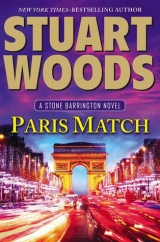
Текст книги "Paris Match"
Автор книги: Stuart Woods
Жанр:
Политические детективы
сообщить о нарушении
Текущая страница: 8 (всего у книги 15 страниц)
29
Stone picked up the phone. “Now listen,” he said to Holly, “you have to keep your mouth shut while I’m on the phone with Mirabelle, do you understand?”
“Not a word,” Holly said.
Stone chose Mirabelle’s number from his list of Favorites, and it began ringing. Finally she picked up. “Ah, it’s the American spy!” she said. “To what do I owe this invasion?”
“I’m sorry if I’m invading,” Stone said, “but I have to talk with you about your brother.”
“What could you possibly say to me about my brother? You don’t even know him.”
“Let’s just say that I know people who know him—and respect him—and I have some information for him that he might find very interesting.”
“And you want me to give him this information?”
“If you could pass it along, I’m sure he and I would both be very grateful.”
“Is this police business?”
“Sort of, I guess.”
“Then it would be better if a policeman spoke to him. He has contempt for people who are not policemen.”
“That’s a very large group of people,” Stone said.
“Nevertheless.”
“Nevertheless what?”
“Nevertheless, he has contempt for non-policemen.”
“Tell you what: if we can arrange a meeting, I will supply a bona fide policeman with whom he can speak, while ignoring all non-policemen.”
“I am having a drink with him at six o’clock this evening. You may join us at a lovely sidewalk café near the Boulevard Saint-Germain.”
“I’m afraid that the security arrangements that have been made for me preclude exposing my person to the evening air. How about if you both come to l’Arrington for a drink in my suite, at six o’clock.”
“Who will be there?”
“A policeman and, if he wishes, a member of our intelligence services.”
“All right, I will arrange it. Be sure to have pastis—that is all he drinks. Au revoir.” She hung up.
“Were you referring to me?” Holly asked.
“I was.”
“Oh, good. I want to get a good look at her.”
“Holly . . .”
“Didn’t I behave myself while you were on the phone with her?”
“Well, yes . . .”
“I will behave myself while in the same room with her, as well.”
“All right,” he said, “but I will unceremoniously throw you out if you let your worse nature get the better of you.”
“Fair enough. And, by the way, don’t you think you’d better inform the policeman in question that his services are required?”
“Right you are.” Stone called Dino.
“Hey.”
“Where are you?”
“Exiting a dull meeting.”
“Can you be here at six—you and Viv—for a drink with a Paris cop?”
“Sure, I guess. Who is he?”
“One Jacques Chance.”
“I shook his hand yesterday.”
“Good, that will help. Be here at a quarter to six. I have to brief you on what to say.”
“What do I have to say?”
“I’ll tell you at a quarter to six.”
“Okay.”
Stone hung up, called room service and asked for a bottle of pastis.
“What is pastis?” Holly asked.
“Some sort of French booze. It’s all Chance drinks, apparently.”
The waiter arrived in record time, clutching a bottle.
Stone invited him in. “How do I prepare a drink with this?”
“You just add cool water,” the man said. “Four or five to one of the pastis.”
“Got it.”
“Or you might offer your guests a small pitcher—such as the one in your bar—filled with water, and let them decide how much.”
Stone slipped the man a fifty-euro note. “I’m grateful to you,” he said. The man left, very happy.
Holly opened the bottle and took a small swig, then screwed up her face. “Holy shit!”
“He said to mix it with four or five parts of water.”
“I didn’t hear that part.”
“That’s what you get for drinking from the bottle.”
“It’s how I was brought up,” she said.
30
Dino and Viv let themselves into the sitting room from their adjoining bedroom on time, and Stone sat them down and gave them a drink while he briefed Dino on what to say.
“Got it,” Dino said, sounding bored.
“Why does Dino have to do this, instead of you?” Viv asked.
“Because Chance, to put it in the words of his sister, ‘has contempt for non-policemen.’”
“That’s a little stiff, isn’t it?”
“Nevertheless,” Stone said, quoting Mirabelle further.
At precisely six o’clock there was a sharp rap on the door; Stone answered it and ushered in his guests. “M’sieur Prefect,” he said, “may I present the police commissioner of the city of New York, Dino Bacchetti? Commissioner, this is Prefect Jacques Chance, of the Paris police.”
“We met yesterday,” Chance said, with a small smile as he shook Dino’s hand.
“May I also present Vivian Bacchetti, the commissioner’s wife, and also Madame Holly Barker, who is an important official of my country’s Central Intelligence Agency.”
“Enchanté,” Chance said, lightly kissing the hands of both women.
“Charmed, I’m sure,” Holly said drily.
Stone gestured toward Mirabelle. “And this is the prefect’s sister, Madame Mirabelle Chance, the famous Parisian couturier.” Dino, to Stone’s astonishment, kissed her hand.
Everyone took a seat.
“May I offer you a pastis, M’sieur Prefect?” Stone asked.
“You may,” Chance said.
“And Mirabelle?”
“Vodka martini, straight up, two olives stuffed with anchovies,” Mirabelle replied. “If you please.” Mirabelle well knew the contents of Stone’s bar.
Stone quickly mixed the martini, then poured a substantial pastis and offered both drinks on a tray, along with a small silver pitcher of water, containing one ice cube. They accepted the drinks, and the prefect added a judicious amount of water from the pitcher.
“I was very impressed with your presentation earlier this week, Commissioner,” Chance said. “You gave me some ideas for my own jurisdiction.”
“Thank you, Prefect,” Dino said. “Tell me, being an American, I am uncertain of the difference between your office and that of your father.”
“My father, Michel, is prefect of the national police, of the whole country. I am prefect of the police of the city of Paris, plus three other adjoining departments, much as your own jurisdiction includes Manhattan, plus four other boroughs,” Chance explained.
Mirabelle spoke up. “Jacques likes to think that his job is by far the more difficult and important of the two jurisdictions.”
The prefect managed a slightly haughty laugh. “It is my sister, not I, who has . . . How do you put it? Delusions of grandeur?”
Everyone chuckled appreciatively.
“Now,” Chance said, “I have been informed that you, Commissioner, have some information of interest to me to convey.”
“Yes, Prefect,” Dino said. “But first, having heard that you enjoy the company of other policemen, I should tell you that Madame Bacchetti is a retired detective first grade of the NYPD, and that Madame Barker, before joining her present employer, was a military police officer of the United States Army and the chief of police of a significant city in our state of Florida.”
“I am very impressed, Commissioner,” Chance said. “How is it that M’sieur Barrington comes to be in such distinguished company?”
“My friend Stone is a veteran of fourteen years of the NYPD,” Dino said, “ten of them as a detective and my partner during those years. He also held the rank of detective first grade.”
“Ah,” Chance said, “so we are all colleagues here.”
“Except me,” Mirabelle said, a little too sweetly.
“Yours is a more intriguing profession,” Holly said to her, “and I’m sure you come by more intelligence each day than I do in my job.”
Everyone chuckled appreciatively.
“Now,” Dino said, “may I call you Jacques?”
“Oh, please.”
“And I am Dino to my colleagues. Now, Jacques, it has come to my attention, through Madame Barker’s intelligence service, that there appears to be a highly placed person in your prefecture who is also employed by a Russian criminal organization, and who reports to them on the activities of your prefecture on a regular basis.”
Chance’s expression remained frozen, except that his eyebrows shot up. “If your information is correct,” he said, “then it is most distressing to me. How, may I ask,” he said, turning toward Holly, “did your agency come by this knowledge?”
“We learned that a four-man team of professionals were hired to interrogate a member of the Russian organization, in order to learn the name of the person in your prefecture.”
“Ah! And what is the name, according to the interrogatee?”
“I’m afraid that the interrogatee, who, unknown to his interrogators, had a serious medical condition, died before he could reveal the name, in spite of having been questioned under stressful conditions for three hours. He refused to speak at all.”
Chance threw up his hands. “Well,” he said, “that is most disappointing. Perhaps if his interrogators had come to me I might have been able to help in the interrogation, without actually killing the interrogatee.”
“It was unfortunate,” Holly said, “but beyond the scope of my agency. We learned of the situation only after the fact, from a confidential informant.”
“Perhaps, if I could speak to your informant?”
“I’m told that he has left France, and his name is unknown to me.”
Dino spoke up. “I should say that, in spite of the disappointing nature of this information, it has revealed, to the satisfaction of the Agency, that this spy in your prefecture exists, and that is important intelligence in itself.”
“Important, but frustrating,” Chance said. “Tell me, was this Agency able to learn any details of this spy, other than he is, as you say, ‘highly placed’?”
“Regrettably,” Holly said, “we have no other information about him, but we thought it important, as well as a necessary professional courtesy, to tell you what we had learned.”
“Of course, I appreciate your professional courtesy,” Chance said, “and I would be most grateful if you would continue to pass along any further information that you might acquire in the future.”
“Certainly, we will,” Holly said. “However, all of us in this room will be leaving France quite soon, so I will ask our Paris station chief, Richard LaRose, whom I understand you know, to communicate directly with you should he come into new information.”
Chance looked at his watch. “If you will excuse me,” he said, rising, “I have another engagement.” He turned to Mirabelle, who was showing no signs of moving. “And so do you,” he said pointedly.
Reluctantly, Mirabelle got to her feet. Goodbyes were said, hands were kissed, and Prefect Chance and his sister made their exit.
“Well,” Holly said after they had gone, “she was really quite interesting, wasn’t she?”
31
As they were finishing their drinks, Holly’s cell phone rang, and she answered it. “Yes? Hi.” She listened for a moment, then covered the phone. “Lance is on the phone. He wants us to have dinner with him.”
“Do we have to?” Stone asked.
“He says he has more information about Simpson.”
“Dino? Viv?”
They both shrugged and nodded.
“Okay, where?”
Holly asked the question and was answered. “At Le Restaurant de L’Hôtel,” she said. “Thirteen Rue des Beaux-Arts.”
“At the restaurant at the hotel?” Stone asked. “Sounds pretty generic.”
“L’Hôtel is the hotel where Oscar Wilde died, Lance said. I suppose Le Restaurant is their restaurant. He’s on his way there now.”
Stone summoned the van, and they went downstairs. “I’ve begun to think of this thing as my hearse,” he said, as they boarded. Ten minutes later they drew to a halt in a narrow street, and waited while the two men up front cased the block and pronounced it safe.
They entered the hotel, where someone at the front desk told them to proceed straight ahead. They passed through a comfortable bar and emerged into a small but lushly decorated dining room. Lance sat at a table in the rear of the room, and he waved them over. Stone noted that, in contrast to his appearance that morning, he was now freshly groomed and wearing a beautifully tailored suit. Lance seated the party so that the women were on either side of him, and he ordered their drinks from memory.
“I thought you would like to know that there is a restaurant in Paris that stocks Knob Creek,” he said to Stone.
“I’m relieved to hear it,” Stone replied. “I managed to force the bar at l’Arrington to serve it, but it’s scarce on the ground in this town.”
Their drinks arrived and they were given menus. “It’s a short menu,” Lance said, “but everything on it is good. They have a star from Michelin, and I’m sure they’d have another, if they could expand the carte.
“How did your meeting with M’sieur Chance go?” Lance asked after they had ordered.
“It was brief,” Stone said, wondering how Lance knew of the meeting. “I had been told that Chance detests people who aren’t policemen, so I asked Dino to give him what news we had.”
“And his reaction?”
“Annoyance that we didn’t give him more,” Stone said. “He as much as said that, if he had been conducting the interrogation of the Russian, we would now know everything.”
“Who’s to say he’s wrong?” Lance asked.
“I was told you now have more information about John, no middle initial, Simpson.”
“I do,” Lance said, “by the simple expedient of releasing his service record to myself. Unfortunately, because of its restricted reading list, I can’t show it to any of you, but I can tell you what’s in it—there’s no restriction on that, as long as the recipients of the information are properly cleared, and I have the power to clear you all, just like that!” He snapped his fingers, then made the sign of the cross. “You are, as of this moment, all cleared, my children. Your clearance expires when the bill for dinner arrives, and you must never reveal anything I have told you, on pain of a polite refusal at the gates of heaven.”
“Why don’t you just give us the high points, Lance?” Stone asked.
“I’m afraid there aren’t any high points, Stone, only low ones. It seems that ‘Simps,’ as he was called by those who pretended to be his friends, lived his life moving from one low point to another. I am ashamed that such people are an absolute necessity if one expects to operate an effective intelligence service.”
“I’ll take your word for it,” Stone said.
“Can you summarize, Lance?” Holly asked.
“Well, let’s see: he was, as you know, brought to our attention by Our Man in Afghanistan, who had seen him maim and kill his way through the various mountain passes and villages, then sit down at dinner and eat two steaks. He arrived at the Farm for training having already learned just about everything one needs to know about killing another. He was especially adept at the use of almost any sort of blade. One of his trainers said that with a couple of weeks’ training, he could have won Olympic Gold with the épée. That amounts to high praise from such a figure.”
“Not the guy you’d want to meet in a dark alley,” Dino said.
“Not the guy you’d want to meet anywhere,” Lance said. “In the army, he fired expert with every weapon they handed him, and at the Farm, he amazed his tutors by hitting everything he saw from the hip—no actual aiming of a weapon. As they got to evaluate him and know him better they found they had discovered a man, not only with no conscience but with no scruples or, for that matter, pity, either. One instructor entered the following in his training record: ‘He is the kind of man to whom you could say, go kill these three people and report back in a week, and he’d be home for supper, wiping the blood off his hands.’”
“Jesus,” Holly said.
“Quite. And when you think of the sort of people who wrote these evaluations, who are not easily impressed by the capacity for mayhem of others, it all becomes especially chilling. Every fitness report written by everyone he ever reported to makes note of, as one supervising officer put it, ‘not his courage, but more his absolute lack of fear of anything or anybody.’ The two things are very different—the latter, I think, tends to be psychotic.”
Dinner arrived, and they approached their food more gingerly than they might have before Lance’s report. While they waited for dessert, Lance continued.
“So, I think we all see the kind of man Simps was, and we can all be happy that he is in a pauper’s grave in some French cemetery. It is astonishing to me that he met his end in the kitchen of a cottage, at the hands of a small woman with a very old shotgun. If my Agency had a medal that covered those circumstances, I would award it to her without hesitation.”
“Lance,” Stone said, “do you now have any idea what Simpson was doing there?”
“Well, it seems obvious that he went there to kill at least one, perhaps both of the other people present in the cottage that night. Certainly, if he had killed one, and the other had witnessed it, he would have had no hesitation in making the score two–love.” Lance paused and took a deep breath. “Unless, of course, he had been instructed not, under any circumstances, to kill the other. Do you see where this is leading us?”
“Wait a minute,” Holly said, “was Simpson freelancing for anyone who’d pay his price? Is that what you’re saying?”
“I think,” Lance said, “that it is impossible not to come to that conclusion, and, apparently, he had been freelancing for some time. Simpson had a bank balance, back in Virginia, of more than two hundred thousand dollars, and he didn’t earn it on a civil servant’s salary. It also seems that, after the death of the unfortunate Russian gentleman at Simps’s hands, he had all the time in the world to report to the man who hired him, before he rejoined his colleagues at their hotel. He had been to Paris three times on earlier occasions that we know about, so he had every opportunity of meeting and being hired by someone there.”
Stone spoke up. “Let’s get back to where all this is leading us. What are your conclusions?”
Lance spread his hands. “I conclude, from the available evidence—which would not convict anyone in any honest court—that Simpson was hired to kill you, Stone, not the sister of the man who hired him.”
32
Stone stared at Lance, unbelieving. “Lance, are you saying that Jacques Chance hired Simpson to kill me?”
“After what I’ve told you,” Lance said, “can you come to any other conclusion? He certainly didn’t hire the man to kill his sister, whom he loves deeply and, gossip has it, perhaps too much.”
Holly perked up. “I want to hear about that part, please.”
“Chance has a history, going back to his late teens—around the time that Mirabelle achieved puberty—of an extreme overprotectiveness toward his sister, and of dealing harshly with any male who had even the least of designs on her. A highly qualified psychiatrist I spoke to told me that his behavior is indicative of an obsession with his female sibling, though that doesn’t mean that he ever did anything about it. By the way, Jacques has never married, nor has he ever exhibited an interest in another woman, except for the most immediate sorts of gratification, not all of them affectionate. Since her teens he has lavished affection on Mirabelle, giving her expensive gifts, escorting her to public events, and backing her financially in her business—in short, the sort of attention that most Frenchmen bestow on a mistress, rather less on a wife.”
Dino raised a finger. “So, Jacques wants Stone killed because he sees him as a threat to his relationship with his sister?”
“How beautifully you cut to the chase, Dino,” Lance said, flicking a bread crumb off his cuff with his napkin. “There is another possible motive, though: Jacques Chance is very likely the person who you have just told him is giving information on police operations to a Russian mob. He very probably hired the freelance team from the Berlin station to interrogate a member of that mob, to see if he would be exposed. Once the interrogatee died without having exposed him, Jacques felt more comfortable in his position as a spy. Until Stone came along.”
“Why would he see me as a threat to his position?” Stone asked.
“Because Jacques shares his father’s loathing of American intelligence operatives, and he has grossly overrated your importance in that regard.”
“So you have two motives,” Dino pointed out. “Which do you favor?”
“Both, actually,” Lance said. “They are not mutually exclusive, and taken together, they at least double his resolve to remove Stone from the scene. I expect there may even be a synergistic effect.”
“Sounds as though I should get out of town,” Stone said.
“I’m afraid that wouldn’t help, Stone. My psychiatric colleague believes that Jacques is now so fixated upon your removal from the corporeal plane that he would likely pursue you to the proverbial ends of the earth.”
“Lance,” Stone said, “do you have a resolution to this situation in mind, or should I just offer myself up for sacrifice?”
“Well, the easy way out would be just to make Jacques disappear—ironically the sort of job for which Mr. Simpson would have been so well suited. That sort of action, however, is fraught with peril—legal, political, congressional, et cetera, et cetera. I think a better course might be to simply expose the prefect for what he is: a hater of his father and the authority over him that the old man represents. That, incidentally, is his motive for selling out to the Russians.”
“And how would that be accomplished?” Stone asked.
“I had at first thought that a word in the shell-like ear of a well-placed French journalist might do, but the libel laws in Europe are so much more difficult to deal with than back home, and of course, there would be the fear of personal retaliation from Jacques, who is fully capable of that.”
“So?”
“I think the answer might lie with the peculiar gifts of one Howard Axelrod.”
Stone made a groaning noise.
“There, there, Stone,” Lance said, reaching over and patting his hand, “I know your experience with Mr. Axelrod—that is not his real name, of course—has not been favorable, but you are, unfortunately, living evidence of the power the man wields. A couple of days ago you were a semi-anonymous New York lawyer. Now half the world believes you to be the sire of the child now carried by the putative Next President of the United States. Need I say more?”
“You need not,” Stone admitted.
Holly leaned in. “What is Howard Axelrod’s real name, Lance?”
“Now, now, Holly, if that were revealed, then I would not have the leverage with Mr. Axelrod that I need to ensure his cooperation in this noble effort.”
“You have a point,” Holly admitted. “But later, I’m going to make you tell me.”
“Certainly exposing Howard Axelrod for who he is would be great fun,” Lance said, “but not until I have persuaded him to expose Jacques Chance for who he is. Which brings me to a point: Stone, between the time the first story about Jacques begins to circulate, and the time at which the facts have made him harmless to you, there lies a period of as yet undetermined length when Jacques will be made more dangerous than ever to your continued existence. There will come a moment, though, when it will be propitious for you to flee Paris and Europe. I will get word to you when that moment arrives. In the meantime, however, do not travel except in the coach and six provided for you, and make arrangements for an instantaneous departure when the word comes.”
“You bet your ass,” Stone said with conviction.
“One thing, Lance,” Holly said.
“Yes, Holly?”
“Do not spring Stone from Paris until after the grand opening of l’Arrington.”
“Why not?”
“Because Stone is taking me, and I have spent a month’s salary on a gown for the occasion. If Stone vanishes, then I will get you.”
Lance laughed uproariously. “And that would be a fate worse than Stone’s at the hands of Jacques Chance! All right, Holly, I’ll see that you get to wear your gown.”