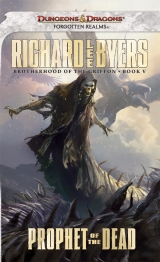
Текст книги "Prophet of the Dead"
Автор книги: Richard Lee Byers
Соавторы: Richard Lee Byers
Жанр:
Классическое фэнтези
сообщить о нарушении
Текущая страница: 2 (всего у книги 20 страниц)
The pain also reminded him that he needed to address his own immediate problems. Otherwise, nothing happening hundreds of miles to the north was likely to matter, at least not to him.
He could tell his neck was getting worse. Pain jabbed and scraped at him with every move he made. He wouldn’t be able to do anything else to help himself until he obtained healing, and the only place to seek it was inside the keep a stone’s throw away from the crypt.
He felt singularly unready to go exploring. He’d expended too much of his magic fighting the undead in Rashemen. Even the petty enchantments bound in his tattoos, on which he generally depended to stave off pain, chill, and fatigue, were inert.
Still, waiting and resting seemed the poorer option. What if he did and his condition so deteriorated that he couldn’t move at all? In his years as a legionnaire and sellsword, he’d seen plenty of untreated wounds and injuries that steadily worsened over time.
Stifling a groan, he clambered to his feet and crept back to the wrought-iron gate he’d broken previously. Looking for sentries, or anyone who might cry an alarm, he peered out at the graveyard with its drifts of gray, sooty snow, the courtyard beyond, and the high walls and battlements enclosing it all.
Nyevarra trailed along and watched with a jaundiced eye as Pevkalondra conducted a tour of the cold, echoing, and palely phosphorescent vaults and tunnels under Beacon Cairn. A pearl gleamed in the left orbit of the ghoul’s withered, flaking face, tiny silver scorpions crawled like fleas in the folds of her faded velvet gown, and she stank of rot. It all made her affecting the manner of a house-proud hostess particularly grotesque.
As the reanimated Raumviran clapped her hands, a metal arachnid fell from the hem of her sleeve and scuttled back toward the pointed toe of her shoe. Then a steaming, clinking bronze crayfish the size of a plow horse crawled through a doorway in the right-hand wall. It stank of oil, and its pincers opened and closed repeatedly with a smooth metallic noise like the sliding sound of scissors.
“Impressive,” Uramar said. Hulking, misshapen, and mottled, the patchwork warrior had a hole in his mail shirt that exposed the gray flesh beneath where Aoth Fezim’s spear had pierced him, but the wound didn’t appear to trouble him. Nyevarra felt renewed appreciation for his strength and wondered again how his cold blood tasted. Perhaps, once they’d conquered Rashemen, she could coax him out of his shyness and find out.
“There are dozens more,” Pevkalondra said. “You simply have to reanimate enough of my countrymen to control them to best effect. Then, my lord, I’ll give you the victory the idiot Nars threw away in the Fortress.”
Nyevarra chuckled. “Is that the story we’re telling now, since Falconer isn’t here to speak up for himself and his folk?” The Nar demonbinder was the one true leader of the conspiracy who’d fallen to the enemy.
The Raumviran glared with her single eye. Or perhaps the pearl glared too. It seemed to shine brighter than before.
“The Nar’s inability to defend himself,” she said, “simply proves my point.” She turned back to Uramar. “Raise Raumvirans. Raise all you can find. After the debacle in the Fortress, you need a new army, and I promise you one that will win.”
“When the war is over,” Nyevarra said, shifting her grip on the antler-axe she’d taken from the fallen Stag King, “and the realm is full of Raumvirans with only a sprinkling of durthans, Nars, and travelers from Uramar’s country, I wonder just who will actually rule. What sort of land it will be.”
Uramar frowned. Like every other expression that played across the blaspheme’s lopsided face, it had an uneven quality to it.
“Within the Eminence,” he said, “all undead are equal.”
He appeared to believe that lofty sentiment too. But Nyevarra had a more realistic perspective, and she intended to make sure that, although perhaps swearing abstract fealty to some distant authority, it was she and her sisters who would truly control Rashemen. It had always been a unique land of witches and fey, and so it must remain, even if the witches were ghosts and vampires, and the spirits were greedy and cruel. The thought of mechanical insects and other such unnatural contraptions infesting the lonely hills and sacred forests was loathsome to her.
“Of course,” she said. “You’ve explained as much, my friend. It’s just that old habits of thought die hard. Still, the truth is, we don’t need an army of the sort Lady Pevkalondra describes. What we need is all the durthans we can muster.”
The ghoul made a spitting sound. “You really think this feckless scheme will work?”
“It isn’t ‘feckless.’ It’s cunning. Although it doesn’t surprise me that a relic of a vanquished, vanished realm can’t tell the difference.”
“Enough!” Uramar said. It truly seemed to upset him when his allies bickered. Perhaps, in his distant homeland, the Eminence stood united in perfect amity, although given what Nyevarra knew of human-and undead-nature, she doubted it.
“We’ll proceed with the strategy we all agreed on,” the patchwork swordsman continued. “Despite any second thoughts you may be having, Lady Pevkalondra, I still think it’s a good one. But you’re right that we need to rebuild our force of arms in case the plan goes awry. We’ll be vulnerable until we do. So of course we’ll reanimate more of your folk, more durthans too, and everybody else who can be of use. And we’ll ask for fresh help from Nornglast.” He paused to survey them both. “Does that satisfy you?”
“Of course, my lord.” Pevkalondra gestured her companions onward. “Come this way, and I’ll show you one of the largest Raumathari war devices ever made. It slaughtered hundreds of Nars in its day.”
“That sounds fascinating,” Nyevarra drawled. “But I must go and prepare to begin the realwork of conquest.” She gave Uramar a smile, squeezed his forearm, and turned away.
As she walked along, the butt of the antler weapon clicking of the floor, she hoped she remembered her way out of the maze of tunnels. It would mar the insolent effect of her departure if she had to come back and ask for directions.
1
Aoth didn’t see anyone moving around the courtyard. He supposed he had the cold and the early hour to thank.
From his limited vantage point inside the tomb, he couldn’t see anybody on the walls either, but assumed there was probably a sentry or two up there somewhere, maybe sheltered in the corner turrets. With any luck at all, though, they’d be peering outward, not in.
Next, he looked for religious symbols in the ornate, soot-blackened stonework or any other sign that suggested the location of a chapel. For healing was the province of clerics even when, as was likely in the nightmarish land Szass Tam had made of Thay, the priests in question were dreadmasters of Bane, Lord of Darkness.
But Aoth failed to spot a shrine. A wry smile tugged at his lips when it occurred to him that, for a man whose vision was sharper than a griffon’s, he was doing a poor job of finding anything he looked for.
In fact, it would be unfortunate but not surprising if there were no shrine. Most of the lords with citadels in High Thay were Red Wizards, and in his experience, such folk, devoted as they were to esoteric knowledge, often had little use for faith.
He took a deep breath. The air smelled and tasted of burning sulfur, the taint of the volcanoes whose smoke also darkened the sky. He swung open the creaking iron gate and, trying to stay low, hobbled across the graveyard.
He didn’t like it that he was leaving tracks in the snow, but there was nothing he could do about it. He’d just have to hope nobody would take any notice of them.
By the time he reached the keep, the pain in his neck had spread across his shoulders, all the way down his back, and into his hips, making all the muscles ache and bunch. Struggling to block the clenching torment out, he tested one of the lesser doors.
It was unlocked, and when he cracked it open, there was no one in view on the other side, just a kind of vestibule with five doorways around the walls. Maybe, he told himself-unconvincingly-his luck was finally changing. The Smiling Lady knew it was past time.
It was somewhat warmer indoors, although still chilly and drafty in the part of the castle where its master likely never ventured and the humble folk who saw to his comforts lived and toiled. Those servants and slaves had risen with the dawn to take up their tasks, and Aoth scurried past doorways and crouched behind barrels to keep them from spotting him.
Eventually, he found a small storeroom containing only dusty, cobweb-shrouded crates that, plainly, no one cared about anymore. The space was beyond easy earshot of the chambers where yawning servants were starting the day’s baking, mending, and washing, yet not so distant that there was little hope of anyone wandering by. He limped inside and stood beside the door where no one would see him.
After that, time dragged, slowed by the pain and anxiety that were gnawing away at him. Finally, he heard footsteps padding along. Just a single pair if he could trust his ears. He waited for them to pass by, then stepped out into the passage.
As he hoped, he was looking at only one creature, a stooped, olive-skinned orc dressed in rags. The marks of multiple floggings, some ridged and old, others raw and recent, showed through the rips in the slave’s shabby tunic.
Aoth didn’t know all the ways Thay had changed since Szass Tam became its sole master-and deeply regretted that he wasn’t being allowed to preserve his ignorance-but in the homeland of his youth, pig-faced brutes like the one before him had mostly been soldiers, not common thralls. Maybe the orc had started out that way but then so disgraced himself that his master reduced him to bondage.
“Turn around slowly,” Aoth growled in his best menacing cutthroat voice, “and don’t cry out.” And as the orc pivoted, Aoth tried to look like the war mage and sellsword captain who’d slain dragons and devils in his time and not like the creeping invalid that fearsome fellow had become.
His superficial appearance might help. He still had his squat, muscular frame, his leveled spear and armor, and luminous blue eyes framed in their mask of tattooing. It might take a keen observer to see past all that to the pain and weakness underneath.
The orc had had his tusks pulled, maybe because he’d been in the habit of biting and goring with them. He glowered at Aoth with a certain caution but no overt fear. It all reinforced the sellsword’s suspicion that the creature had once been a man-at-arms.
Aoth jerked his head toward the little storeroom and tried not to react to the resulting stab of agony in his neck. “In there. Fast.”
The slave obeyed, and Aoth closed the door behind them. “Whose castle is this?” he asked.
“Lord So-Remas.”
The name meant nothing to Aoth. “A Red Wizard?”
“Yes.” The orc’s piggy, bloodshot eyes narrowed. “You don’t even know whose fortress you sneaked into?”
Aoth sighed. “It’s a long story. Does So-Remas have a healer who attends him?”
The orc grunted. “He doesn’t need one. He’s undead.”
Curse it! “Then who tends the members of the household when they fall sick?”
“If it’s somebody So-Remas cares about, he gives him a potion to drink. The rest of us just either get well or die.”
Aoth frowned, considering. Healing elixir was valuable, all the more so in a remote fastness where it was apparently the only magical remedy available. “Where does your lord keep his jewels and talismans and such?”
The orc snorted. “You think he’d tell somebody like me?”
Aoth raised the spear a hair to remind the thrall of the threat it represented. “I think you at least have a guess, and I recommend you share it. As soon as you stop helping me, you become a problem with an obvious solution.”
The orc sneered. “But maybe not an easy one. Not for a human standing funny and sweating rivers even in this cold, a human who tells me straight out that he needs a healer.”
Aoth stared his captive in the face. “If you want to try me, go ahead.”
After a long moment, the orc broke eye contact. “What for? Out of loyalty to the master who treats me so well?” He spit.
“Then stop posturing and tell me where he keeps his treasure.”
“In his chambers, I guess. I don’t know where else it would be.”
“Does he sleep during the day?”
“Mostly. I think. I mean, he doesn’t have to. I’ve seen him when the sun is up. But not very often.”
Aoth frowned. “I guess that will have to do. Take me to his quarters. Choose a route where people won’t see us this time of day.”
As they climbed a steep, narrow set of back stairs, and his neck and back fairly screamed with the punishing exertion, Aoth said through gritted teeth, “Exactly what kind of undead is So-Remas?”
The orc shrugged. “I’m not a necromancer. I don’t know all the different kinds.”
“Is he solid or shadowy? Man-shaped or otherwise? What does he eat or drink?”
“He looks like a white-faced, shriveled-up, dead old man. He eats and drinks the same things as living people do. Just, not much.”
Not a vampire or a specter, then. That was good as far as it went, but it left plenty of other nasty creatures that So-Remas could be.
“Quiet, now,” the orc continued. “We’re almost there.”
They stepped from the stairs onto a landing on one of the uppermost floors of the keep. Ornately carved with scenes of a handsome young wizard slaying cloud giants, raising a tempest, and commanding the obedience of groveling pit fiends-a highly embellished depiction of So-Remas’s early career, most likely-the double doors to the master’s apartments were locked.
Drawing on his dwindling store of arcane power, Aoth inserted the tip of his spear into the keyhole and whispered a charm. The point pulsed with green light, and the lock clicked open.
He cracked the door and peeked in at a chamber with drawn curtains and closed shutters behind them. The space would have been entirely dark if not for the red embers glowing in the hearth. But he didn’t need good light-or any light-to discern the high-backed leather chairs, lanceboard table, and collection of ancient Mulhorandi coins, curios, and sculpture. The air smelled of both dry rot and the floral perfume the undead nobleman apparently used in an effort to mask his stink.
There was a bookshelf built into the wall. It didn’t hold enough volumes to fill it, and that was by design. A square of minute cracks outlined the empty section and a hint of silvery phosphorescence crawled on top of it.
Tiptoeing, Aoth led the orc inside, eased the door shut behind them, and then crossed to the hidden panel. He tried to slide and then push it open, but it wouldn’t budge.
The slave was plainly nervous with his owner sleeping in the next chamber, but even so, curiosity or skepticism prompted him to whisper, “How do you know anything’s there?”
Aoth pointed to his lambent eyes. His truesight would have found a mundane lock as easily as the cracks if there had been one. Unfortunately, though, So-Remas had secured the panel with enchantment. That was the source of the argent glimmer.
MaybeAoth’s charm of unlocking would work as it had before, but maybe not. He’d match his thunderbolts and showers of acid against those of any wizard short of Szass Tam, but the spell of opening wasn’t a part of the potent system of battle magic he’d mastered as a youthful legionnaire. It was just a trick he’d picked up in the years since, and he wasn’t proficient with it.
Still, he’d have to pit it against So-Remas’s ward. He couldn’t simply smash through the panel for fear of waking the mage.
He whispered the words and touched his spear to the surface much as he had before. The panel didn’t move.
Maybe pain was interfering with his concentration. He took several long, slow breaths and tried to exhale it from his body, then focused his will anew and made sure to murmur the words with the exact cadence and pronunciation they required.
The panel still wouldn’t move.
“Come on!” whispered the orc.
Aoth tried again. And thrice more.
Then the double doors to the landing crashed open, and two spearmen in mail and crested helmets rushed into the room. An instant later, So-Remas, withered, bone-white, and milky-eyed, his mostly bald skull sporting white hair like dandelion fluff, stepped to the threshold of his bedchamber. The nightshirt and nightcap lent a grotesque and even comical note to his appearance, but there was nothing funny about the slim ebony wand in his clawlike hand.
Cera felt taut as a bowstring while Sarshethrian stood motionless-well, except for the constant stirring of his ragged corona of shadow-and seemingly entranced. For the moment, eager hope trumped the loathing the demon’s proximity engendered.
“The darkness is responding to him,” murmured Jhesrhi, standing at her side with the top of her brazen staff burning like a torch and the stag men hovering close. “I see the ripples, and I hear the voices.”
“Good,” Cera said, and in her thoughts, she prayed to Amaunator even though she could barely sense him.
For her, that, not the gloom, the cold, or even the knowledge of being lost and trapped, was the greatest horror of this place: It attenuated her link to the god to whom she’d pledged her life and soul. If it frayed away entirely, it was hard to imagine she could withstand the loss.
Sarshethrian turned his gaze on the mortals. “Your friend Aoth is gone.”
Cera felt a jolt of alarm. “What do you mean?”
The creature shrugged. The shoulder of the uninjured arm hitched up and down normally while the other barely twitched. “He mayhave found a way out of the deathways by himself, although I very much doubt it. Someone else may have removed him. He may have been alive or dead when it happened. All I know is, he isn’t here anymore.”
Jhesrhi scowled. “You’re sure?”
“Well, admittedly, my kingdom is extensive. In theory, if the man traveled a very long way in just a short time … I’ll tell you what. I want us all to be friends, so I’ll keep checking from time to time as we move about. But for now, let’s tentatively agree that one provision of our bargain has been fulfilled.”
“Not by you,” Cera said. “You didn’t help him.”
“And as yet,” the fiend replied, an edge coming into his voice, “you haven’t done anything to help me either. So be happy you got what you wanted and let it go at that.”
“We’ll honor our contract,” Jhesrhi said. “And the more we know about what’s going on, the better we can help you.”
Sarshethrian smirked. “And the more likely it is that you can find your own way home?”
“I thought you claimed we’d never figure it out, no matter what,” Cera said.
The pale creature chuckled. “A fair touch, sun priestess. I did, and I do.” He glanced around, found a black marble sarcophagus with a lid carved in the form of a sleeping lady holding a lily to her chest, and perched on the edge. Then he waved the humans to the stone coffin opposite it. “So make yourselves comfortable and ask your questions.”
Jhesrhi seated herself, and after a moment’s hesitation, Cera did the same, although it felt strange and wrong to flop down casually across from the demon when, in any sane world or set of circumstances, she’d be scourging it with the radiance of the Yellow Sun and a chant of exorcism.
“I want to know three things,” Jhesrhi said. “What is this place, what are you, and who are our mutual enemies?”
Sarshethrian nodded. “Let me tell you a story that will explain all of that by the time it’s through.
“At the beginning-my beginning,” the creature continued, “I came into being in this place. Perhaps it came into existence at the same instant, or perhaps it existed before me. I can’t be certain. All I can say is that so far as I’ve ever been able to determine, no one ever heard of it before I appeared to claim it for my own.
“I also don’t know how long I’ve wandered here. How could I? At first, nothing changed to mark the passage of time, and I didn’t even know what time was. But gradually, language and knowledge formed inside me like a pearl accreting in an oyster.
“Eventually, they prompted me to attempt to define myself. Was I perhaps a devil, or maybe a demon? It didn’t appear so, not in the technical sense, anyway, for although I still didn’t fully comprehend the nature of my home-it’s difficult to take the true measure of a place when you’ve only ever seen it from the inside-it didn’t seem to be a part of the Hells or the Abyss either.”
“Get to the point,” Cera said.
Sarshethrian snorted. “A priestess should be more interested in mysteries. Don’t you realize you’re receiving a bona fide mythno cleric of the light has ever heard before? But never mind. I promise, I am coming ‘to the point.’
“Although I might not have been precisely a baatezu or a tanar’ri, I had quite a bit in common with them, both in terms of my abilities and my awakening desires. And because the latter were cravings I could never satisfy in isolation, I strived ever harder to understand the nature of my home and how it could be made to connect to the greater universe I sensed around it.”
“And eventually, you found out it could connect through tombs and crypts,” Jhesrhi said.
Sarshethrian nodded. “Exactly. Perhaps because it’s a kind of reflection or echo those places strike in Shadow. Or maybe because it’s the perfect, reified idea that every vault and mausoleum in the mortal world expresses in its own limited way … but I’m forgetting that the sunlady is impatient with metaphysics.”
Or you want to make sure you don’t let slip anything that might help us escape, Cera thought.
“Suffice it to say,” the pale fiend continued, “in time, I learned how to step from my world into the funerary places of yours, only to discover I could venture no farther. A realm so full of life was inhospitable to me and would remain so unless I persuaded some of the indigenous creatures to worship me and so provide me with a foothold.”
“And because you could only make your presence felt in tombs,” Cera said, “the only ‘indigenous creatures’ you could talk to were undead.”
Sarshethrian inclined his head. “Exactly so. At first, no one was particularly interested. The lowliest lacked the wit to understand me. Others were content with their existences or skeptical of my ability to improve their circumstances, and perhaps reasonably so. I soon realized it’s fairly common for fiends to try to entice ghouls and wraiths into their service.
“But I persevered and eventually stumbled on a being so desperate for companionship that he was willing to listen to anything and everything I had to say. His name was Lod. Once, he was one of the serpent folk called nagas, and in undeath, he retained all the vast intelligence he’d enjoyed in life. That intellect notwithstanding, the necromancer who reanimated him could think of no better use for him than to seal him up alone in a crypt to guard the grave goods for eternity, and he found the solitude and tedium hellish. He would have done anything to escape them.”
“And so you had your first disciple,” Jhesrhi said. The flames dancing on the head of her staff further gilded her blond hair and tawny skin.
“Yes,” Sarshethrian said, “and I made good on all my promises. Together, we devised magic to break the mystical chains that held him to his endless task, and then to help achieve his grander dreams.”
Cera felt another twist of loathing down in her stomach. “ ‘Grander dreams’ that led to a menace nobody ever heard of attacking Rashemen?”
“Yes,” Sarshethrian said. Then he broke off talking and sat up straight. It reminded her of a hound reacting to a noise its masters couldn’t hear.
“What is it?” Jhesrhi asked.
“I feel them,” the demon said, hopping down from the sarcophagus, “here inside the deathways, and that means the rest of the story can wait. You don’t have to know who they are to kill them.”
Vandar had no doubt that it was only the preternatural vitality he drew from the red weapons that had enabled him to pull himself from the frozen river, and he suspected it was all that was keeping him alive now. But the magic had its limits. Shivering, teeth chattering, he felt colder than ever in his life, and the pale sun in the gray sky seemed to mock him with its lying promise of warmth.
But it did reveal the Fortress of the Half-Demon, visible as a dark nub on the northern horizon, and the sight helped to keep him trudging onward. In the castle, he’d surely find dry clothes, provisions, and a room where he could build a fire and rest out of the snow and the frigid, whistling wind for as long as it took to recover his strength.
Then he’d run to Immilmar as fast as his legs and his rage could carry him, and if the Three truly cared about justice, he’d arrive in time to catch Mario Bez and his sellswords.
Numb feet sliding, he labored to the top of the next rise. Half buried in snow, two more dark objects lay in the hollow before him.
For a moment, in his weariness, he failed to recognize them as anything more noteworthy than the brush, evergreens, and other stunted trees dotting the snow. Then a long, mottled limb, some patches of hide charred black and others glistening raw with a few feathers still clinging to them, rose sluggishly and flopped back down.
Startled, Vandar jumped and leveled the crimson spear. But neither the creature with the burned wing nor what he now recognized to be a man lying beside it moved any farther.
By the rose and scythe, was Vandar looking at Jet and Aoth Fezim? How had they vanished from the Fortress only to reappear out here, and what disaster had befallen them?
Vandar hurried down the slope. When it noticed his approach, the winged creature struggled to its feet, snow spilling from its back and flanks as it did. For an instant, the berserker stillwasn’t sure he was looking at Jet. The griffon was too badly burned over too much of his body, and his halting, palsied movements in no way reflected the strength and speed of the beast that had accompanied Vandar and his brothers on the march north. But the smoldering blood-red eyes were still the same.
“What happened?” Vandar asked.
“Bez,” Jet rasped.
“I suspected as much. He attacked the lodge too. I may be the only one left.” Vandar pivoted. “Is Aoth …?” He faltered when he saw that the burned man half hidden in snow wasn’t the Thayan after all but rather Dai Shan. Somehow, despite the lodge’s efforts at secrecy, everycontender for the wild griffons had found his way north, not that the Shou had any reason to be glad he’d undertaken the journey.
“Captain Fezim’s alive,” said Jet, “somewhere. I can feel him across our link. But he’s busy, and it could make the danger worse if I distract him. We’ll talk when he’s safe. Or if that imp”-the griffon stabbed his beak in Dai Shan’s direction-“wakes up first, maybe he can tell me where Aoth is.”
“I understand you want to find him,” Vandar said, “but once you do, you need to carry both of us back to Immilmar. It’s our best hope of reaching Bez before he claims his prize and disappears into the south.”
Jet laughed. The sound had always been so bloodcurdlingly harsh that it had taken Vandar a while to realize what it was, but now it held a bitter note that was new.
“I’ve always known that humans are blind and stupid,” the griffon said, “but you take the prize. Open your eyes and look.”
With a grunt, he extended his wing as far as he evidently could, which was about halfway. It bent in places and at angles where it shouldn’t, and in two spots, jagged bone stuck out through the skin.
“I can’t fly anybody anyplace,” the griffon said.
“Curse it!” Vandar said. “But all right. I was going to trek back to Immilmar on foot, and if I still have to, I will. But first, I’m going to double back to the Fortress. You might want to follow and lay up there for the time being. Good luck.”
Vandar turned away and took five crunching steps in the snow. Then Jet said, “Berserker.”
Vandar looked around. “Yes?”
“I don’t know if you think of us of the Brotherhood as your rivals or your comrades. You humans have a way of complicating everything that should be simple. If we’re your rivals, then leave. But if we’re your friends …” The familiar faltered in the manner of a proud creature unaccustomed to needing to ask for anything. “I told you I can’t fly. Truly, I’m so weak, I can barely stand, and without my feathers, I’m nearly frozen through. If you go, I’ll die, and the merchant too, not that he matters.”
Inside, Vandar flinched. “The warriors of the lodge were my brothers. The Halruaans murdered them.”
Jet nodded. “Go get your revenge, then.” He lowered himself back down into the snow.
Vandar tried to turn away once more. Plainly, avenging the lodge was the honorable course. Even Jet realized it and had just acknowledged as much.
And yet …
Jet was a griffon, the lodge’s totem in the flesh.
And believing himself justified, Vandar had turned his back on the outlanders once already, and it was possible that if he’d chosen otherwise, his brothers would still be alive.
Moreover, if he focused his attention inward, he could feel the wordless nudging of the fey spear and sword, strangely warm in his hand and on his hip, urging him on toward the possibility of battle, vengeance, and, perhaps still, even glory. The effect was subtle because it merely reinforced his own innate desires. Yet it was an influence nonetheless, and though he prized the virtues of the weapons as much as ever, he was learning to question the inclinations of the strange sentience that had tangled itself with his own like ivy wrapped around a post.
He heaved a sigh. “I have flint and steel, and there’s wood about. We can make a fire and find somethingto eat, and then, when you’re up to it, we’ll hike back to the fortress together.”
Aoth leveled his spear, and even that simple action made his neck, shoulders, and back spasm. He rattled off words of command, and the shriveled mage in the nightcap and nightshirt did the same, meanwhile sketching isosceles triangles with his wand. The ebony rod left streaks of amber phosphorescence in the air.