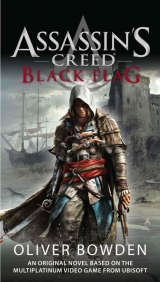
Текст книги "Assassin's creed : Black flag "
Автор книги: Oliver Bowden
Жанр:
Исторические приключения
сообщить о нарушении
Текущая страница: 7 (всего у книги 24 страниц)
NINETEEN
“Sir?” I said.
Thankfully, Dolzell was too preoccupied with developments to wonder what I was doing standing behind Captain Pritchard’s chair. “Privateers are coming,” he cried.
In terror I looked from Dolzell to where I’d just untied Captain Pritchard’s hands.
Pritchard revived. Though he had the presence of mind to keep his hands behind his back, he couldn’t resist taunting Dolzell, “It’s Edward Thatch, come to our rescue. You’d better run, Captain. Unlike you, Edward Thatch is a privateer loyal to the Crown, and when I tell him what has taken place here . . .”
In two long strides, Dolzell darted forward and thrust the point of his sword into Pritchard’s belly. Pritchard tautened in his seat, impaled on the blade. His head shot back and upside-down eyes fixed on mine for a second before his body went limp and he slumped in the chair.
“You’ll tell your friend nothing,” snarled Dolzell as he removed his blade.
Pritchard’s hands fell to hang limply by his sides.
“His hands are untied,” Dolzell’s accusing eyes went from Pritchard to me.
“Your blade, sir, it sliced the rope,” I said, which seemed to satisfy him. He turned and ran from the cabin. At the same time the Emperor shook—I later found out that Thatch’s ship had hit us side-on. There were some who said the captain had been rushing towards the fight and that the impact of the privateers’ ship had knocked him off the deck, over the gunwale and into the water. There are others who said that the captain, with images of Execution Dock in his mind, had plunged off the side in order to escape capture.
From the Navigation Room I took a cutlass and a pistol that I thrust into my belt, then dashed out of the cabin and onto the deck.
What I found was a ship at war. The privateers had boarded from the starboard, while on the port side the crew of the Amazon Galley had taken their opportunity to fight back. We were hopelessly outnumbered and even as I ran into the fray with my sword swinging I could see that the battle was lost. Sluicing across the deck was what looked like a river of blood. Everywhere I could see lay men I had been serving with either dead or draped over the gunwales, their bodies lined with bleeding slashes. Others were fighting on. There was the roar of musket and pistol, the day torn apart by the constant ring of steel, the agonized screams of the dying, the warrior yells of the attacking buccaneers.
Even so, I found myself strangely on the outside of the battle. Cowardice has never been a problem with me, but I am not sure I exchanged more than two sword strokes with one of the enemy, before it seemed the battle was over. Many of our men were dead. The rest began to drop to their knees and let their swords fall to the deck, hoping, no doubt, for the clemency of our invaders. Some still fought on, including the first mate, Trafford, and by his side a man I didn’t know, Melling, I think his name was. As I watched, two of the attacking buccaneers came at Melling, at once swinging their swords with such force that no amount of fighting skills could stop them and he was driven back to the rail, slashes and cuts opening up in his face, then screaming as they both stabbed into him.
Blaney was there, I saw. Also, not far away, was the captain of the privateers’ ship, a man I would come to know as Edward Thatch, and who in years later the world would know as Blackbeard. He was just as the legend would know him though his beard was not so long back then: tall and thin, with thick, dark hair. He had been in the fray; his clothes were splattered with blood and it dripped from the blade of his sword. He and one of his men had advanced up the deck and I found myself standing with two of my ship-mates, Trafford and Blaney.
Blaney. It would have to be him.
The battle was over. I saw Blaney look from me to Trafford then to Thatch. A plan formed and in the next instance he’d called to Captain Thatch, “Sir, shall I finish them for you?” and swept his sword around to point at me and Trafford. For me he reserved an especially evil grin.
We both stared at him in absolute disbelief. How could he do this?
“Why, you scurvy bilge-sucking bastard!” yelled Trafford, outraged at the treachery. He leapt towards Blaney, jabbing his cutlass more in hope than expectation, unless his expectation was to die, for that’s exactly what happened.
Blaney stepped easily to one side and at the same time whipped his sword in an underhand slash across Trafford’s chest. The first mate’s shirt split and blood drenched his front. He grunted in pain and surprise but that didn’t stop him launching a second yet, sadly for him, even wilder attack. Blaney punished him for it, slashing again with the cutlass, landing blow after blow, catching Trafford again and again across the face and chest, even after Trafford had dropped his own blade, fallen to his knees and, with a wretched whimper and blood bubbling at his lips, pitched forward to the deck and lay still.
The rest of the deck had fallen silent; each man left alive was looking over to where Blaney and I stood between the invaders and the entrance to the captain’s cabin. It felt as though we were the only men alive.
“Shall I finish him, sir?” said Blaney. Before I could react the point of his sword was at my throat. Again he grinned.
The crowd of men seemed to part around Edward Thatch as he stepped forward.
“Now”—he waved at Blaney with his cutlass, which still dripped with the blood of our crew—“why would you be calling me, ‘sir,’ lad?”
The point of Blaney’s sword tickled my throat. “I hope to join you, sir,” he replied, “and prove my loyalty to you.”
Thatch turned his attention to me. “And you, young ’un, what did you have in mind, besides dying at your ship-mate’s sword, that is? Would you like to join my crew as a privateer or die a pirate, either at the hands of your crewmate here, or back home in Blighty?”
“I never wanted to be a pirate, sir,” I said quickly. (Stop yer grinning.) “I merely wanted to earn some money for my wife, sir, honest money to take back to Bristol.”
(A Bristol from which I was banished and a wife I was prevented from seeing. But I decided not to bother Thatch with the little details.)
“Aye,” laughed Thatch, and threw out an arm to indicate the mass of captured men behind him, “and I suppose I could say this for every one of your crew left alive. Every man will swear he never intended a career in piracy. Ordered to do it by the captain, they’ll say. Forced into it against their will.”
“He ruled with a rod of iron, sir,” I said. “Any man who said as much would be telling you the truth.”
“How did your captain manage to persuade you to enter into this act of piracy, pray tell?” demanded Thatch.
“By telling us we would soon be pirates anyway, sir, when a treaty was signed.”
“Well he’s right most likely”—Thatch sighed thoughtfully—“no denying it. Still, that’s no excuse.” He grinned. “Not while I remain a privateer that is, sworn to protect and assist Her Majesty’s Navy, which includes watching over the likes of the Amazon Galley. Now—you’re not a swordsman, are you, boy?”
I shook my head no.
Thatch chuckled. “Aye, that is apparent. Didn’t stop you throwing yourself at this man here though, did it? Knowing that you would meet your end at the point of his sword. Why was that then?”
I bristled. “Blaney had turned traitor, sir, I saw red.”
Thatch jammed the point of his cutlass to the deck, rested both hands on the hilt and looked from me to Blaney, who had added wariness to his usual expression of angry incomprehension. I knew how he felt. It was impossible to say from Thatch’s demeanour where his sympathies lay. He simply looked from me to Blaney, then back again. From me to Blaney, then back again.
“I have an idea,” he roared at last, and every man on the deck seemed to relax at once. “Let’s settle this with a duel. What do you say, lads?”
Like a set of scales, the crew’s spirits rose as mine sank. I had barely used a blade. Blaney, on the other hand, was an experienced swordsman. Settling the matter would be the work of a heartbeat for him.
Thatch chuckled. “Ah, but not with swords, lads, because we’ve already seen how this one here has certain skills with the blade. No, I suggest a straight fight. No weapons, not even knives, does that suit you, boy?”
I nodded yes, thinking what would suit me most was no fight at all, but a straight fight was the best I could hope for.
“Good.” Thatch clapped his hands and his sword shuddered in the wood. “Then let us begin. Come on, lads, form a ring, let these two gentlemen get to it.”
The year was 1713, and I was about to die, I was sure of it.
Thinking about it—that was nine years ago, wasn’t it? It would have been the year you were born.
TWENTY
“Then let us begin,” Thatch commanded.
Men had climbed the rigging and clung to the masts. Men were in the rat-lines, on the rails and the top decks of all three ships—every man-jack of them craning to get a better view. Playing to the crowd, Blaney stripped off his shirt so that he was down to his breeches. Conscious of my puny torso, I did the same. Then we dropped our elbows, raised our fists, eyed each other up.
My opponent grinned behind raised forearms—his fists were as big as hams and twice as hard. His knuckles like statues’ noses. No, this probably wasn’t quite the sword fight Blaney wanted, but it was the next best thing. The chance to pulverize me with the captain’s consent. To beat me to death without risking the taste of a cat-o’-nine-tails.
From the decks and rigging came the shouts of the crew keen to witness a good bout. By which I mean a bloody bout. Just from the catcalls it was difficult to make out if they had a favourite, but I put myself in their position: what would I want to see if I were them? I’d want to see sport.
So let’s give it to them. I brought my own fists up and what I thought about was how Blaney had been a huge pain in the arse from the moment I had set foot on board. Nobody else. Just him. This thick-as-pigshit cretin. All my time on ship I’d spent dodging Blaney and wondering why he hated me because I wasn’t snot-nosed and arrogant then, not like I’d been back home. Life on board had tamed that side of me. I dare say I’d grown up a bit. What I’m saying is, he had no real reason to hate me.
Right then it came to me the reason why. He hated me because. Just because. If I hadn’t been around to hate, he would have found someone else to fill my shoes. One of the cabin boys, perhaps, one of the black sailors. He just liked hating.
And for that I hated him in return, and I channelled that feeling, that hate. Perplexed at his hostility? I turned it into hate. Staying out of his way day after day? I turned it into hate. Having to look at his stupid, thick face day after day? Turned it into hate.
Because of that, the first strike was mine. I stepped in and it seemed to explode out of me, using my speed and my size to my advantage, ducking beneath his protecting fists and smashing him in the solar plexus. He let out an oof and staggered back, the surprise more than the pain making him drop his guard, enough for me to dance quickly to my left and drive forward with my left fist, finding a spot above his right eye that, just for one delicious second, I thought might have been good enough to finish him off.
A roar of approval and blood-lust from the men. It had been a good punch, enough to open a cut that began to leak a steady stream of blood down his face. But no, it wasn’t enough to stop him for good. Instead, the look of angry incomprehension he always wore became even more uncomprehending. Even angrier. I’d landed two punches, he precisely none. He hadn’t even moved from his spot.
I flitted back. I’ve never been one for fancy foot-work, but compared to Blaney I was nimble. Plus I had the advantage. First blood to me and with the crowd on my side. David versus Goliath.
“Come on, you fat bastard,” I taunted him. “Come on, this is what you wanted to do the minute I came aboard the ship. Let’s see what you got, Blaney.”
The crew had heard me and shouted their approval, perhaps for my sheer gumption. From the corner of my eye I saw Thatch throw back his head and laugh, with his hand at his belly. To save face, Blaney had to act. You have to give it to him. He acted.
Friday had told me that Blaney was skilled with his blade and was an essential member of the Emperor’s boarding party. He hadn’t mentioned that Blaney was also good with his fist and I, for some reason, never assumed he had much in the way of boxing skills. But one bit of nautical wisdom I had learnt was “never assume” and, on this occasion at least, I ignored it. Once again my arrogance had got me into trouble.
How quick the crowd was to turn as Blaney struck. Never go down in the fight. It’s the one golden rule. But I had no choice as his fist made contact and bells rang in my head as I went to the deck on my hands and knees and spat out teeth on a string of blood and phlegm. My vision jarred and blurred. I’d been hit before, of course, many times, but never—never—as hard as that.
Amid the rushing of my pain and the roaring of the spectators—roaring for blood, which Blaney was going to give to them, with pleasure—he bent to me, putting his face close enough for me to smell his rancid breath, which spilled like fog over black and rotted teeth.
“‘Fat bastard,’ eh?” he said, and hawked up a green. I felt the wet slap of phlegm on my face. One thing you have to say about a “fat bastard” taunt—it always gets them going.
Then he straightened, and his boot was so near to my face I could see the spider-cracks in the leather. Still trying to shake off the pain, I lifted one pathetic hand as though to ward off the inevitable kick.
The kick, though, was aimed not at my face but squarely at my belly, so hard that it lifted me into the air and I was deposited back to the deck. From the corner of my eye I saw Thatch, and perhaps I had allowed myself to believe that he favoured me in the bout, but he was laughing just as heartily at my misfortune as he had been when Blaney was rocked. I rolled weakly to my side as I saw Blaney coming towards me. The men on the decks were shouting for blood by then. He lifted his boot to stamp me, looked up to Thatch. “Sir?” he asked him.
To hell with that. I wasn’t waiting. With a grunt I grabbed his foot, twisted it and sent him sprawling back to the deck. A tremor of renewed interest ran through the spectators. Whistles and shouts. Cheers and boos.
They didn’t care who won. They just wanted the spectacle. Blaney was down and with a fresh surge of strength I threw myself on top of him, pummelling him with my fists at the same time as I drove my knees into his groin and midriff, attacking him like a child in the throes of a temper tantrum, hoping against hope that I might lay him out with a lucky blow.
I didn’t. There were no lucky blows that day. Just Blaney grabbing my fists, wrenching me to the side, slamming the flat of his hand into my face and sending me flying backwards. I heard my nose break and felt blood gush over my top lip. Blaney lumbered over and this time he wasn’t waiting for Thatch’s permission. This time he was coming on for the kill. In his fist shone a blade . . .
There was the crack of a pistol and a hole appeared on his forehead. His mouth dropped open, and the fat bastard fell to his knees then dead to the deck.
When my vision cleared I saw Thatch reaching to help me from the deck with one hand. In the other a flint-lock pistol, still warm.
“I got a vacancy on my crew, lad,” he said. “Do you want to fill it?”
I nodded yes as I stood and looked down at Blaney’s body. A wisp of smoke rose from the bloody hole in his forehead. Should have killed me when you had the chance, I thought.
TWENTY-ONE
MARCH 1713
Miles away in a place I had never visited and never would—although, after all, it’s never too late—a bunch of representatives of England, Spain, France, Portugal and Holland were sitting down to draft a series of treaties that would end up changing all our lives, forcing us to take a new direction, shattering our dreams.
But that was to come. First I found myself adjusting to a new life—a life I liked very much.
I was lucky, I suppose, because Edward Thatch took to me. A scrapper, was what he called me and I think he liked having me around. He used to say that in me he had a trusted hand, and he was right, he did, for Edward Thatch had saved me from embarking on a life of crime under Captain Dolzell—well, either that or be thrown overboard like those other poor fellows. It was thanks to his intervention and being taken under his wing that I could make something of myself, return to Bristol and to Caroline as a man of quality, head held high.
And yes, just because you and I know that it didn’t work out that way doesn’t make it any less true.
Life at sea was very much the same as it had been before, but with certain attractive differences. There was no Blaney, of course. The last I’d seen of that particular barnacle on my life was him slipping into the sea like a dead whale. There was no Captain Alexander Dolzell, as he ended up being condemned to death by the British in 1715. Without those two, life on ship was an immediate improvement. It was the life of a privateer. We engaged the Spanish and Portuguese when we could, and took prizes when we were victorious. Along with the skills of a sailor I began to refine the craft of combat. From Thatch I learnt better sword skills and how to use pistols.
Also from Edward Thatch, I learnt a certain philosophy on life, a philosophy that he in turn had learnt from another, older buccaneer, a man under who Edward served and who would also be my mentor. A man named Benjamin Hornigold.
And where else should I meet Benjamin but at Nassau.
• • •
The Port of Nassau on New Providence Island was a kind of heaven for us. I’m not sure that we ever thought of that port, that little bit of the Bahamas, as ever really “belonging to us,” because that wasn’t our way. Nassau featured steep cliffs on one side flanking its long, sloping beach that swept down to a shallow sea—too shallow for Her Majesty’s men-of-war to get close enough for a bombardment. Its fortress on the hill overlooked a motley collection of shanty homes, huts and crumbling wooden terraces, the quayside where we discharged our booty and supplies. Benjamin Hornigold was there—of course he was, he had helped establish it with Tom Barrow. Nassau had a wonderful harbour, where our vessels enjoyed shelter from the elements and from our enemies. Making an attack even more difficult was the ships graveyard, where beached galleons and men-of-war—ships grounded by shallow waters—grounded, looted, burned, in many cases, their skeletal remains a warning to the unwary.
I liked Benjamin, of course. He had been Blackbeard’s mentor just as Blackbeard was mine, and there was never a better sailor than Benjamin Hornigold.
Although you may think I’m only saying this because of what subsequently happened, you’re going to have to believe me when I swear it’s true. I always thought there was something apart about him. Hornigold had a more military bearing, a hawk nose like a tuft English general, and he dressed more like a soldier than a buccaneer.
But still, I liked him, and if I didn’t like him as much as I liked Thatch, well, then I respected him as much, if not more. After all, Benjamin was the one who had helped establish Nassau in the first place. For that, if nothing else, I liked him.
I was sailing with Thatch in July 1713 when the quartermaster was killed on a trip ashore. Two weeks after that we received a message and I was called to the captain’s quarters.
“Can you read, son?”
“Yes, sir,” I said, and I thought briefly of my wife back home.
Thatch sat at one side of his navigation table rather than behind it. His legs were crossed and he wore long black boots, a red sash at his waist and four pistols in a thick leather shoulder belt. Maps and charts were laid out beside him but something told me it wasn’t those he needed reading.
“I need a new quartermaster,” he said.
“Oh, sir, I don’t think . . .”
He roared with laughter, slapped his thighs. “No, son, I don’t ‘think’ either. You’re too young, and you don’t have the experience to be a quartermaster. Isn’t that right?”
I looked at my boots.
“Come here,” he said, “and read this.”
I did as I was asked, reading aloud a short communication with news of a treaty between the English, the Spanish, Portuguese . . .
“Does it mean . . . ?” I said, when I had finished.
“Indeed it does, Edward,” he said (and it was the first time he’d ever called me by my name rather than “son” or “lad’—in fact, I don’t think he ever called me “son” or “lad” again). “It means your Captain Alexander Dolzell was right, and that the days of privateers filling their boots are over. I’ll be making an announcement to the crew later. Will you follow me yourself?”
I would have followed him to the ends of the Earth but I didn’t say so. Just nodded, as though I had a lot of options.
He looked at me. All that black hair and beard lent his eyes an extra penetrating shine. “You will be a pirate, Edward, a wanted man. Are you sure you want that?”
To tell you the truth, I wasn’t, but what choice did I have? I couldn’t go back to Bristol. I didn’t dare go back without a pot of money, and the only way of making money was to become a pirate.
“We shall set sail for Nassau,” said Thatch. “We pledged to meet Benjamin should this ever happen. I dare say we shall join forces, for we’ll both lose crew in the wake of this announcement.
“I’d like you by my side, Edward. You’ve got courage and heart and skill in battle, and I can always use a man with letters.
I nodded, flattered.
When I went back to my hammock, though, and was alone, I closed my eyes for fear that tears might squeeze out. I had not come to sea to be a pirate. Oh, of course, I saw I had no other choice but to follow that path. Others were doing it, including Thatch. But even so, it was not what I had wanted for myself. I’d wanted to be a man of quality, not an outlaw.
Like I say, though, I didn’t feel I had much choice. From that moment on, I abandoned any plans I had of returning to Bristol as a man of quality. The best I could hope for was to return to Bristol as a man of means. My quest became one of acquiring riches. From that moment on I was a pirate.