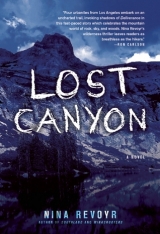
Текст книги "Lost Canyon"
Автор книги: Nina Revoyr
Жанры:
Путешествия и география
,сообщить о нарушении
Текущая страница: 5 (всего у книги 21 страниц)
Oscar wondered if Gwen was having the same thought that he was—stray dogs, in his neighborhood, were often of the unneutered pit bull variety.
“I took this trip two years ago where the craziest thing happened,” Tracy continued. “I was alone in the backcountry north of Kings Canyon, ten or fifteen miles off trail. I was camping at one of those lakes up there that doesn’t have a name. One afternoon a huge thunderstorm rolled in, crazy torrential rain, and all the little streams that fed the lake swelled up into rushing waterfalls. There was a big-ass bear across the river from me and I was keeping an eye on him. Then a deer comes tumbling over the falls, legs and head flailing. It fell about two hundred feet. At first I thought I’d imagined it, but then some other debris came over and then the water got real brown, full of mud. A river bank must have given way up there and swept the deer with it. Anyway, I’m looking at this, not believing my eyes—and then the bear stomps over to the river and picks up the deer. He drags the carcass up the side of the mountain. He’s got it by the neck and it’s broken and limp, and he keeps stepping on it, trying to carry it up. He finally hides it behind a boulder, and then he looks back at me as if I’m going to challenge him for it. I’ll tell you . . .” She whistled and shook her head. “That was a moment when I felt the power of nature. That was a sight I won’t forget.”
Everyone was quiet. What was the point of this story, Oscar wondered, except to freak them the hell out?
They got off at Visalia and took a two-lane road to the north. Here, in the eastern part of the valley, there were hundreds of citrus groves. Lemons and oranges were plump in the trees, in rows that extended to the horizon. Every mile or two, they saw a makeshift fruit stand. The citrus groves were broken up by low, open fields; there were signs for squash and bushels of cucumbers. With the opening up of the landscape, the small quiet roads, Oscar felt more of the city fall away. The old wood-frame houses had tall, square structures behind them that looked like guard towers.
As they approached the junction with the highway that led up to the mountains, there was a cluster of buildings—a diner, flanked on one side by a dozen trailers. Across the narrow two-lane road stood a rectangular brick structure, the Franklin Cash Store.
“Let’s stop here,” Tracy said. “We can eat and grab some last-minute supplies.”
She parked in the dirt lot in front of the diner and they all stumbled out of the car. Gwen put her hands on her hips and leaned back, stretching; Oscar bent to touch his toes; Todd spinwheeled his arms like a batter on deck, loosening up his shoulders. “That was long,” he remarked.
“Yeah, I know, sorry guys,” Tracy said. “I was so pumped up to get here, I lost track of time.”
They had lunch in the diner, where the clientele was equally divided between locals—farmers and ranchers—and people headed up to the mountains. When they were finished, they walked across the road and over to the Franklin Cash Store. The building was boxlike, one story. It was painted white, or at least it had been white at one time; age and weather had stripped a layer of paint away. In the window there was a picture of the store in a previous incarnation, when it was the depot of a backwater train station. Tracy pulled the door open, which caused a bell to ring loudly, and they all stepped inside.
The place was chock full of stuff, so crammed with odds and ends that Oscar didn’t know where to look. Right in front of them was an old-fashioned punch-button cash register, and all around the store, on a continuous ledge that ran two feet below the ceiling, there were bottles and boxes and tins, everything from Morton’s Salt containers to SPAM tins to Hershey’s boxes to colored bottles of liquids and medicines that hadn’t existed since his grandparents’ time. Old street signs were mounted on lateral beams, and there were hand-painted messages on every wall. Don’t forget to be happy, one of these read. Never give up or grow up.
Oscar saw built-in shelves filled with random, haphazardly arranged goods—wooden signs with religious sayings painted on them, hand-knit scarves and socks, weird contraptions made from pieces of farm equipment, stacks of old paperbacks, colored soaps in the shape of feet, a display of local honeys and jams. Glass-fronted cabinets were stuffed with old newspapers and magazines, and flip-flops waved from a circular rack. There was a cluster of metal watering cans beside a bright pink piano decorated with black and white polka dots, and a bench with a leopard-skin cushion. There was an elaborate candleholder with half-burned candles, a pile of straw hats, a stuffed boar head wearing sunglasses, a cloth pig with an arrow through its shoulder. Right beside them a small refrigerator had a handwritten sign that read, Nightcrawlers and red worms. Fish love ’em! Straight ahead, on the back wall, was a collection of orange crate labels, and the railroad sign from the picture in the window. To the left, there was an old drugstore counter and a half dozen red-topped stools. A tall woman of indeterminate age stood behind the counter, and two middle-aged men in farm clothes and baseball caps sat facing her, nursing Coors Lights. A yellow sign on the wall behind her read, Danger: Men Drinking. A small black dog was perched on the end stool, watching them.
“Howdy!” the woman said cheerfully. “Come on in and take a look around!”
“Wow,” Gwen exclaimed. Her expression changed from uncertainty to wonder. She stepped in and wandered cautiously down one of the aisles.
“It’s unbelievable,” said Todd, equally happy, and Oscar looked at him. What was wrong with them? This was the store of crazy people. This was the store of someone who was not right in the head. Then he saw something else behind the counter: a display of Green Bay Packers paraphernalia—Topps cards, schedules, four or five felt banners, pictures of players from Paul Horning to Charles Woodson, a Sports Illustrated cover from their Super Bowl win in 1997. In the center of it all was a huge life-sized cutout of Brett Favre, who looked about twenty-five. The whole display was ten or fifteen feet wide and extended from the floor all the way to the ceiling.
Todd walked over to the counter, smiling. “This is the last place I’d expect to find a Packers fan,” he said. “Are you from Wisconsin?”
“No sir,” the woman said. “I just love ’em. I’ve always loved ’em.”
She was like an oversized bird, all wings and splayed feet, dressed in overalls, with a plaited pink and white shirt underneath. Oscar thought he detected a Midwestern twang, but maybe this was just the sound of rural white people everywhere.
“I grew up in Oconomowoc,” Todd said. “About two hours from Lambeau Field.”
“Are you an Aaron Rodgers fan or a Brett Favre fan?” the woman asked. “We have a lot of debates around here.” She glanced at the men on the stools, one of whom nodded at Todd and raised his glass.
“I’m both,” Todd answered. “I loved Brett, but it’s kind of hard to argue with Rodgers winning a Super Bowl. Plus he’s a California boy.”
The woman nodded, as if he’d passed some kind of test. “That’s Henry and Carl,” she said. “We call Henry the mayor of Franklin. Of course, Franklin only has ten people, and two of them are dead, so it’s not saying much.”
Both men chuckled and sipped from their beers.
“And Carl’s the grandpa of the town, but don’t call him old. And I’m Annie.”
“Sweet Annie,” one of the men corrected.
“And that there,” she continued, pointing at the dog, “is Vince Lombardi.”
Todd grinned. “It’s nice to meet you all.”
Oscar slipped down another aisle to escape forced social interaction; he suspected that the men at the counter would take one look at him and try to drag him out to the fields. But even from thirty feet away, he could hear the conversation. He learned that the store had opened in 1918 as a train depot, and had been converted into a dry goods store in the 1930s. Sweet Annie’s family had always run it, and she lived in the small house in back. They operated on a cash-only basis, with the occasional barter arrangement for locals. Sweet Annie had never visited San Francisco or Los Angeles; the biggest city she’d ever been to was Fresno. “What do they have in those places that they don’t have here?” she asked. “Smog, crime, and traffic.”
And Todd said, “You’re absolutely right.”
“And we even have crime here, or at least we did once. See those?”
She pointed to the high windows above the counter, where there were three jagged holes in the glass, spaced several inches apart.
“Are those . . . ?” Todd started.
“Yep. Bullet holes. We had some excitement around here about a year ago. Did you happen to see those trailers across the street?”
“Yes.”
“Well, turned out some no-good youngster was cooking up some of that meta amphetamine. When the sheriff and his men came to arrest him—we don’t have police here in Franklin, on account of it’s so small—they got into a shoot-out. A deputy was shot and killed right out on the street there. And we got those three bullets in the window as a souvenir. I was hiding in the back—the cops told me to clear out—but the guys working in the fields next door had bullets whiz right past their heads.”
“Wow,” Todd said.
“It’s a real shame, if you ask me.”
“A real shame,” Henry echoed.
“All those drugs and things coming up this way where it’s always been so quiet. We haven’t had something happen like that my whole life,” Annie said. “But it just goes to show you, there’s good and evil everywhere. And you can’t get away from trouble if it wants to find you.”
“That’s for sure,” Todd said.
Now Gwen appeared at the end of the counter, looking hesitant. “Sorry to interrupt, but can I ask a question?”
Sweet Annie turned to her. “Sure, honey. Hey, where are you all going anyway?”
“We’re going backpacking,” Gwen said. “Up in the mountains.”
“Backpacking! Adventurers, huh? Which trail are you taking? Booth Valley?”
“No, actually, we’re going up to Cloud Lakes.”
“Cloud Lakes? That’s supposed to be beautiful, although I’ve never done it myself. Like I said, everything I need’s right here in Franklin.”
“We’re really excited,” Todd said.
“Well, it’s the bears that scare me,” Sweet Annie continued. “One of them made it all the way to Franklin one time. Walked in and helped himself to the worms right there in the refrigerator. You’re braver than I am, that’s for sure.”
Gwen asked, “Do you have any washcloths?”
Sweet Annie shrugged. “I think so, honey. We have just about everything. You just have to look a little while to find it.”
And seemingly, they did have everything else. Oscar found a display of mugs from national parks—the Grand Canyon, Yellowstone, Glacier, the Everglades. He saw a box of daguerreotypes of unidentified people. Then a rack of back issues of Field & Stream and American Marksman, mixed in with Ladies’ Home Journal and Highlights. There were cleaning supplies in dusty packages that had never been opened. There was a toy rocking horse, a wood stove, a phonograph. He could not remember when he had ever seen such clutter. And yet Todd and Gwen looked totally content—Todd still talking with the proprietor and the men at the counter, Gwen picking up various handcrafted things, smiling, placing them back on the shelves. He didn’t understand this—what exactly did she find so charming? Why wasn’t she freaked out by these goofy rednecks?
Then Tracy swept past him, holding a flashlight and two bundles of firewood. “Let’s go.” She stood impatiently at the cash register until Sweet Annie noticed her and ambled over to ring her up.
Gwen paid for a washcloth and a little embroidered pillow that read, Every day is a beautiful day. Todd bought a postcard—the same picture as the one on the door—and fished in his wallet until he came up with a small folded rectangle of colored paper. It was the Packers schedule from last season. He handed it to Sweet Annie. “To add to your collection,” he said.
When they were back on the highway, Oscar shook his head. “Well, that’s not a place I need to go back to.”
“I thought it was sweet,” said Gwen. “It reminded me of the country stores my great-aunt used to tell me about in the South.”
“Really? That woman seemed a little off to me. And those two guys weren’t exactly rolling out the welcome mat.”
“Oh, they were fine,” Todd said. “They’re just locals. They’re probably not used to seeing city people.”
Oscar was about to ask what exactly Todd meant by “city people” when Tracy looked over her shoulder and into the back.
“And did you catch that story about the police shoot-out?” she asked. “Geez, it makes you wonder.”
“It does,” Gwen agreed. “And those folks were friendly. But I sure wouldn’t want to break down out here in the middle of the night. There are a lot of white supremacist and militia groups in the Central Valley, you know.”
“Really?” Todd said. But judging from his tone, Oscar thought, what he meant was, Oh, come on!
“Seriously. The Visalia area is a Klan stronghold, and other groups are active out here too. Two of them were convicted a couple of years ago for murdering a black kid.”
“The Klan,” Todd repeated, not disguising his skepticism.
“Really,” Gwen said. “You can Google it.”
Oscar’s earlier irritation at Gwen was gone, and now he felt aligned with her, protective. He didn’t appreciate Todd’s questioning of her. And he resolved that however unprepared she might be for this trip, he would take it upon himself to watch out for her.
“Well one good thing,” Todd said. “Those methed-out creeps that lady was talking about don’t have the chops to backpack in the mountains.”
“That’s for sure,” Tracy remarked. “Hey, how do you know all this, Gwen?”
“One of my coworkers brought a bunch of kids up to Sequoia last summer. He found all this stuff on the Internet and was a little freaked out.”
“Well, whatever creepy folks there are down there, we’re away from them now,” said Tracy. “Check it out. We’re going uphill.”
And they were. The flat straight strip of country highway was now curving and winding upward, a lush valley opening to the right of them. They went up and up, beyond the chaparral and oak-lined hills and into the pines, and as the trees changed, the air did too, and they rolled their windows down to breathe it in. It smelled like forest and rich wet earth; it smelled fresh; it smelled like mountain. Oscar’s unease and irritation both faded, and he was excited again. He stared out the window and took in the view—the deep green valley with the river winding through it, the snowcapped peaks behind. This is what I came for, he thought. This is why I’m here.
Chapter Six
Todd
When they finally pulled up to Redwood Station, Todd couldn’t contain himself; the car had barely come to a stop before he was out of it. The ranger station was a miniscule one-story cabin, painted a red-chocolate brown. He loved how well these buildings blended in with their surroundings. The structure looked especially small at the foot of all the grand cedars and pines; no sun broke through the canopy of branches. Tacked up on the walls were trail maps, pictures of bear canisters, warnings about proper food storage, and examples of items—food wrappers, sunscreen, deodorant, toilet paper—that had to be packed out of the woods. About half a dozen people were lined up at the counter, waiting to get their permits. Another three or four backpackers were splayed out across benches that had been cut from logs, with heavy packs, water bottles, and bags of trail mix scattered around them. Judging from their sunburns and dirt-streaked clothes, they had just come in from the backcountry.
Tracy took the reservation letter they’d exchange for their permit and got in line. Gwen and Oscar ran off to use the restrooms. Todd walked out of the parking lot and toward a grove of sequoias he’d spotted from the road. He was glad to have a few minutes alone. All morning he’d been wondering if he should have stayed behind. Why hadn’t the Pattersons told him they were cancelling? If he’d known ahead of time, he might have made his own excuses. But he didn’t find out until he’d arrived at Tracy’s, and by then it was too late. Now, several hours into the trip, he wasn’t sure how this was going to work. He felt weird being the only white person in the group, but that was just the start of his discomfort. Tracy’s usual intensity, which was great for the gym, had kicked into overdrive—and spending a structured hour with someone a couple times a week was very different than being with her all the time. He liked Gwen, and she was easy to look at too—she had dark lovely skin, strong cheekbones, warm brown eyes, and wavy hair that was tied back in a ponytail. She watched everything cautiously, as if looking out from behind a curtain, but when she smiled, it lit up her entire face.
Oscar, on the other hand, had an edge—as if he suspected Todd of something just because he was white. He’d been so cagey at that wonderful store in Franklin, slinking around the aisles like he was getting ready to steal something. With his slicked-back hair and big tattoos, he would have caught Todd’s attention too. And that ridiculousness about the men in Franklin, and come to think of it, even Gwen’s remarks in the car. The Ku Klux Klan? Really? In 2012? He had a hard time understanding this kind of oversensitivity, but it wasn’t worth getting into it. So he’d kept his mouth shut—well, mostly.
As they took the winding road up the gradual slope of the Western Sierra, he’d finally begun to relax. Then they drove down into a canyon, as if through a gateway into an entirely different world. Near the bottom, he’d spotted a great blue heron flying over the river, neck extending and retracting, chest jutting out as far as its head. Its long graceful legs were trailing behind, tapered and liquid dark, like the ink-dipped tip of a fountain pen. His heart had swelled as he watched it swoop down toward the water.
And now, here he was with these magnificent trees. Several dozen giant sequoias with beautiful red-brown bark, each as big around as a building, as a whale. Their skin looked soft and contoured and he wanted to touch them, but to do so would have felt like sacrilege. They gave off a deep silence, as if they absorbed all sound, and their very presence made the noise and clutter of Todd’s life—of all human dealings—seem trivial, superficial, and temporary. Walking among them, Todd felt like he had entered a cathedral—the grandiose beauty, the quiet, the suggestion of time beyond knowing. He loved the Sierra in all of its seasons—the snow in winter that made the trees seem even redder in contrast; the dogwood blossoms in spring, their broad white petals suggestive of movement, like his daughter’s pinwheel toy. The stillness of the forest made something still in him too. He remembered his first trip to the Sierras when he was twelve, with his mother and stepfather. It was seeing the sequoias for the first time—more even than seeing the ocean—that made him feel he’d arrived in California.
He pulled his cell phone out of his pocket—no reception. What a joy it was to be beyond the reach of that tyrannical thing, of incessant e-mails, of connectivity. He understood that his recent thoughts about changing careers were part of some midlife crisis, and he felt like a bit of a cliché. But at least he’d avoided making a fool of himself by buying a fast car or messing with younger women. He knew that women still noticed him—like Rachel, his junior associate, who often stayed late, and whom he’d turned down when she suggested a drink after work because he didn’t quite trust himself. He’d burned off his restlessness and frustration by throwing himself into exercise. And by dreaming of coming up to the mountains.
In most ways Todd still felt the same as he had in his twenties, but he realized that wasn’t how others saw him. At the firm’s picnic last summer, he’d played in the interoffice softball game, Downtown versus Century City. He’d been an All-Pac Ten second baseman in college, and he made sure that everyone knew it. But when he dove for a sharp grounder and landed on his belly, the third baseman and pitcher came running over to make sure he was all right. And when, in the final inning, he ran full tilt from second base, rounded third, and barreled into the catcher at home, players from both teams sprinted over and lay him down on his back to make sure that he was still in one piece.
“I’m fine,” he’d insisted. “Just bruised up a little.”
Then Todd looked up at the circle of faces hovering over him and realized that all of the other players were under thirty. They did not consider him to be one of them. They thought of him as old. It was a moment, all right, and it didn’t help that he’d reinjured his shoulder in the collision at the plate, which is what started him on physical therapy. After that, he worked to get himself back in shape.
He walked halfway through the grove and then looked at his watch. Fifteen minutes had passed since they parked. Reluctantly, he returned to the car, but the others weren’t there. Glancing toward the ranger station, he saw Oscar and Gwen reading the bear and food storage regulations—and then Tracy, who was now second in line.
There were two rangers working—a blond woman with the air of an old-school basketball coach, and a tall, rangy man in his sixties, mustached and sun-weathered, who was exactly what Todd envisioned when he thought of a forest ranger. Todd joined Tracy in line just as the male ranger yelled, “Next!” And the two of them approached the counter together.
“Hello there,” the ranger said, in a deep, mellow voice. His name tag read, Greg Baxter. “How can I help you today?”
“We have a reservation for the Cloud Lakes trail,” Tracy said. She placed her confirmation letter on the counter. “We’d like to rent some bear canisters.”
“Cloud Lakes,” the ranger repeated. “I’m sorry, but a forest fire was spotted up at Merritt Dome this morning, and they’ve had to close the trail.”
Tracy stared at him. “You’re kidding.”
“I wish I were,” Ranger Baxter said. “We saw smoke up there last night, and then our helicopter did a flyover early this morning. The fire’s right in the area where you’re supposed to hike. See, they’re talking about it now.”
An urgent voice crackled over the walkie-talkie clipped to his belt: “. . . the fire has crossed the Cloud Lakes trail. Repeat, the fire has crossed the trail. It is approximately 300 acres now and growing. Do you copy?”
The woman ranger, whose name tag said, Laurie McKay, detached her walkie-talkie from her belt and spoke into it. “This is Redwood Station. Yes, we copy.”
“The fire is currently being held by the Ainley River, but it’ll probably jump the river in these winds.”
“We’re holding all backpackers here,” said Ranger McKay.
“All hikers in the backcountry will have to evacuate,” came the voice over the radio. “Melissa Lakes Station and Dylan Station, do you copy?”
A few seconds, and then a different voice: “This is Dylan Station. We copy.”
Then: “Melissa Lakes. We copy. We’ll evacuate out of the Merritt Dome area and send hikers back toward the trailhead.”
“This is Redwood Station. We copy,” said the ranger. She and Baxter looked at each other. “Bummer,” he remarked.
By now, the other people in line had all crowded around the counter. There was a family—a father and mother with their tall, fresh-faced teenage son. There were two rugged-looking guys in their twenties and a single man in his thirties. The family seemed especially upset—they’d flown out from Massachusetts for the hike—and now Ranger McKay turned her full attention to them, trying to calm them down.
Todd couldn’t believe it. A fire, on the very trail they were supposed to hike? What rotten luck. “Well, what are we supposed to do?”
“We’ve been planning this trip for months,” Tracy added.
Ranger Baxter shrugged, and sighed. “I know, I’m sorry. The Cloud Lakes are spectacular. But there are some other great trips you could take—a couple of other loops and a few in-and-outs.”
Neither Todd nor Tracy answered for a minute. Todd was still envisioning the pictures he’d seen, the beautiful valley, the flower-filled meadow, the photo of the Cloud Lakes at dawn. It was hard to believe he wouldn’t be going there. Behind him, the two young guys turned and left; the family was still talking heatedly with Ranger McKay.
“Well, what would you suggest?” Tracy asked. “We’ve come all the way out here, you know? It would be a shame to just turn around and go home.”
Baxter spread a topographical map out on the counter and pointed to an area that was colored with green and wavy brown lines. “Well, there’s the Boulder Creek route.Most people can do it in six days and five nights.”
“Too long.”
“Then there’s the Brenda Lakes trail.” He pointed to an area where the lines were much closer together. “But that one’s pretty strenuous. Four thousand feet elevation gain the first day, probably twelve thousand feet elevation gain and loss total.”
By now, Oscar and Gwen had joined them. They both looked crestfallen. Tracy glanced at them, then back at Baxter, and said, “That might be a bit too much.”
“Well, where have you been sending other people?” Gwen asked. She sounded disappointed but maybe a little relieved.
“Honestly, most people have just gone home. They’ve had their hearts set on Cloud Lakes. But that’s a shame, if you ask me. There are plenty of other beautiful places to go.” He paused, fiddled with a knob on the walkie-talkie. “Those who have decided to stay have done one of the trails I suggested. They’ll probably be pretty crowded this weekend.”
“All the more reason not to do them,” Tracy said. “Isn’t there anyplace else?”
The ranger stood up and pulled on his scraggly beard, looking thoughtful. “There might be one more place you could try . . .” he said, half to himself. Then, shaking his head, “No, it’s probably not a good idea.”
“What?” Tracy asked, leaning over the counter.
“Well . . .” He looked at them, lifting one eyebrow and then the other. “There’s a real off-the-beaten-path kind of trail just outside of the park. It’s the right length trip for you—about thirty miles. It’s gorgeous, and you’ll get the same variety of landscape as the Cloud Lakes trail—river and meadow, some alpine lakes, then a couple of high passes. And what I believe is the prettiest canyon in the whole Sierra . . . The thing is, no one’s hiked the trail in years. It’s not even marked on this map.”
“How do you know about it?” Todd asked.
The ranger spread the map out with his hands again. They were big, gnarled hands, twisted and aged by years of living in the mountains. “I’ve been up here a long time—over forty years. I’ve been to places that aren’t marked on the Forest Service map or any other. This trail, I hiked it with a buddy once almost thirty years ago. It was one of my favorite trips ever.”
“Well, if it’s so awesome,” Todd asked, “why doesn’t anyone do it?”
The ranger smiled, and his expression was complicated. “It’s real remote, and the road to get to it is a killer. The Forest Service doesn’t maintain it anymore.”
It sounded like there was more to the story, but Tracy was clearly intrigued. “Well, what do you think, guys?” she asked, turning to the others.
“I don’t know . . .” Gwen said. Then to the ranger: “Are you sure it’s okay?”
“Oh, absolutely! I mean, there is a trail; it’s just not been maintained. The most you’re likely to find, though, is some overgrown brush and fallen trees. But it’s beautiful, I promise. Well worth the trouble to get there.”
They all looked at each other. Oscar sighed. “Well, it would be a shame to go home after we’ve come all the way up here.”
“We could at least go check it out,” Todd said.
Tracy turned to Gwen. “How about you?”
“I don’t know. But if the rest of you think it’s okay . . .”
Tracy beamed. “Great! Let’s do it.” Now she turned back to the ranger. “So—where would we be going?”
Ranger Baxter took out another map, which showed the park and the surrounding wilderness area. All four of them crowded the counter to look. “Here,” he said, taking a green highlighter and marking an X in one corner, “is where we are, at Redwood Station. This,” he hovered over a line with his pen but didn’t touch down, “takes you to the end of the road where the Cloud Lakes trail begins. Here,” and now he set the point of the pen down and traced a solid line and then a broken one somewhere north and west of the main trailhead, toward the edge of the map, “is where you’d be going. There’s a primitive campsite about eight miles down at the end of this dirt road, probably a forty-minute drive from the main road. About halfway down there’s a turnoff to the left—but don’t take that, just keep heading straight down. Once you get to the end, there might even be an old fire ring. Trailhead should be right there too.”
Now he stepped away from the counter and ambled over to a small desk, where he opened a drawer and looked through some files before pulling out a single sheet of paper. He came back over and placed the paper on the counter. It was a color copy of a hand-drawn map. There were shaded little triangles for mountains, blue arteries for rivers, stick trees, and pebble-like boulders. There were small notations in blocklike print—Good campsite, Many switchbacks, Lots of fish!—and simple drawings of a deer, a hawk, a bear. At the top of the map were the words Lost Canyon.
“Now this is the best I’ve got as far as a map,” the ranger said. “It’s what I used when I did the loop myself. It was drawn by an old-time ranger.”
The map looked whimsical, cartoonish, which actually gave Todd some comfort. If this earlier traveler created such a charming representation of this route, how hard could it actually be?
“This is all you’ve got?” Oscar asked.
“It’s all you need,” said the ranger. “That, along with a topo map of that area. If one of you guys knows how to read one, you’ll be fine.”