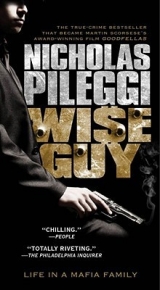
Текст книги "Wiseguy: Life in a Mafia Family"
Автор книги: Nicholas Pileggi
Жанры:
Боевики
,сообщить о нарушении
Текущая страница: 6 (всего у книги 17 страниц)
When Tommy finally got in, it turned out that he only had the big-brand stuff. He had the Chesterfields and Camels and Lucky Strikes, but he didn't have what we called the fill-ins, the less popular brands like Raleighs and L&Ms and Marlboros. Jimmy asked me to go down to Baltimore and pick up the fill-ins. He said if I left right away I could be there early enough to get a load the minute the places opened and be back in plenty of time to sell my stuff before noon. I had a lot of customers who wanted off-brands and I agreed. Lenny, who had been helping me load, wanted to come along. I had about six hundred bucks from the crap game. Jimmy threw me the keys to one of the cars he used and Lenny and I took off.
It was about midnight when we got to Baltimore. The cigarette places didn't open until six in the morning. I had been there before and I knew there were a bunch of strip joints along Baltimore Street. Lenny had never been to Baltimore. We started hitting the joints. We listened to a little jazz. Some B-girls in one place started hustling drinks out of us. We're buying them nine-dollar ginger ales and they're playing with our legs. By two or three in the morning we're pretty smashed. We must have gone for a hundred and fifty bucks with these same two girls. It was very obvious that they liked us. They said that their boss was watching, so they couldn't leave with us, but if we waited outside around back they'd meet us as soon as they got off. Lenny's all excited.
I'm all excited. We go around back and wait. We waited for an hour. Then two hours. And then we just looked at each other and laughed. We couldn't stop laughing. We'd gotten taken like chumps. We were two dumb gloms. So we drove over to the cigarette joints and waited for them to open.
The next thing I know somebody's waking us up at eight o'clock in the morning. We'd overslept. Now we were two hours late getting back for eleven. We loaded five hundred cartons in the car, and there wasn't enough room in the trunk. We had to take the rear seat out and leave it at the wholesaler's. We broke up three cartons evenly and placed a blanket on top of them to look like a rear seat. I started going. We're doing eighty, ninety miles an hour during some stretches. I felt if I could make up fifteen minutes here and ten minutes there I'd knock time off the trip.
We made it all the way to the turnpike Exit 14 in Jersey City. I had seen the speed trap and I jammed on my brakes. Too late. I saw one of the radio cars pull out toward us. When I jammed on the brakes the cigarettes in the rear seat were thrown all over the place. As the cop came closer, Lenny scrambled into the rear and tried to rearrange the blanket, but he couldn't manage too well. The cop wanted my license and registration. I told him the car belonged to a friend of mine. I kept looking for the registration to the car, but I couldn't find it. The cop was getting impatient and wanted to know my friend's name. I didn't know whose name the car was in, so I couldn't even tell him that. It was a brand-new 1965 Pontiac, and he couldn't believe that somebody would lend me the car and I wouldn't even know his name. I tried to stall, and finally I mentioned the guy whose name I thought it might be in, and I no sooner gave him the name than I found the registration, and of course it was in somebody else's name.
Now the guy was suspicious. He finally looked in the back of the car, and he saw cigarettes all over the place. He called for a backup car and they took us in. Now I had problems. I'm going to have the distinction of getting Paul Vario's favorite son his first pinch. I could hear the noise from here. I told the cops that I didn't even know Lenny. I said that I had picked him up on the road, that he was hitchhiking. No good. They brought the two of us in. Lenny knew what to do. He had been groomed. He kept his mouth shut except to give his name. He signed nothing and he asked no questions. I called Jimmy, and he got the lawyer and bondsmen.
By two o'clock in the afternoon we came before a local judge and were held in fifteen hundred bail each. Our lawyers and bail hadn't arrived, so they took us upstairs. We got our bed rolls and were put in with a lot of other guys. We had some cigarettes on us and we gave them to the guys and we just sat and waited. In an hour or so we heard a hack yell, "Hill and Vario! Bag and baggage!" We were free, but now I wasn't worried about the cigarettes. I was worried about Paulie. And I was worried about Karen.
KAREN: He called up and said he'd had a little trouble. It turned out he and Lenny were arrested for transporting untaxed cigarettes. It wasn't a big crime, but he was arrested. I still thought he was a bricklayer. Sure, I knew he was doing some things that weren't absolutely straight. I mean, some of my friends and relatives used to buy the cigarettes. Nobody complained, believe me. One time I remember Henry and his friends came up with some imported Italian knit shirts. They had crates of them. There were four different styles in twenty colors, and all of us were wearing Italian knits for a year and a half. It was a matter of all of Henry's friends being involved and all of their girl friends and wives and children being involved. There were so many of us, and we all tended to only hang out together. There were absolutely no outsiders. Nobody who wasn't involved was ever invited to go anywhere or be a part of anything. And because we were all a part of that life, soon the world began to seem normal. Birthday parties. Anniversaries. Vacations. We all went together and we were always the same crowd. There was Jimmy and Mickey and, later, their kids. There was Paul and Phyllis. There was Tuddy and Marie. Marty Krugman and Fran. We went to each other's houses. The women played cards. The men did their own thing.
But I was mortified by his arrest. I felt ashamed. I never mentioned it to my mother. But nobody else in the crowd seemed to care. The possibility of being arrested was something that existed for anyone who hustled. Our husbands weren't brain surgeons. They weren't bankers or stockbrokers. They were blue-collar guys, and the only way they could ever get extra money, real extra money, was to go out and hustle, and that meant cutting a few corners.
Mickey Burke and Phyllis and lots of the other women kept saying that it was a joke. That nothing was going to happen. That it was just business. Jimmy was taking care of everything. He had friends even in Jersey City. I would see. I would see how dopey I was worrying about such petty stuff. Instead of worrying I should be enjoying myself. Every time I asked Henry what was happening in his case he said Jimmy was handling it. Finally, one day—he must have been home a couple of hours—he asks if I renumbered the Jersey incident. "What happened?" I asked, all upset, like I'm Bette Davis sending her husband to the chair. "I got fined fifty bucks," he said. He was laughing.
Looking back, I was really pretty naive, but I also didn't want to think about what was going on too much. I didn't want my mother to be right. She had been on my back since we eloped. She felt Henry was bad for me, and when she realized I was a couple of months pregnant she had a fit. Morning, noon, and night I heard stories about how he drank too much, hung around with bad people, didn't come home until late, and wasn't a solid kind of man like my father. She didn't like the idea that I kept my job as a dental assistant after I got married. She insisted that Henry made me keep the job for the money. Day after day she was needling me, and day after day I was defending him against her. I would never give her the satisfaction that she was right, but she watched everything he did, and when he was gone she'd bring up the things she didn't like. He slept too late. He came home too late. He gambled. He drank.
We must have been married a little more than a month when one night he didn't come home at all. He had come home after midnight a few times, but this time it was well after midnight and he was still not home. There wasn't even a call. I was waiting upstairs in our apartment. My mother, who was like a shark smelling blood, began to circle. She had been downstairs in bed, but she had apparently been awake waiting to hear what time Henry got home. I'll bet she stayed awake every night waiting to see what time he got home. When it got to be one o'clock in the morning, she was on full alert. By two o'clock she knocked at my door. By three o'clock we're all in the living room waiting for Henry.
My parents' house had a big front door, and my mother, my father, and I were seated in a semicircle right behind it. "Where is he?" she asked. "Your father would never stay out this late without calling," she said. My father was a saint. He never said a word. In the forty years they were married my father never stayed out all night. In fact, he rarely went out at all without telling my mother where he was going. He never once missed the train he was supposed to be on, and when he drove in to work he was never more than five or ten minutes late getting home. And then he'd spend half the night explaining how bad the traffic was and how he couldn't get through.
She kept it up. He wasn't Jewish—what did I expect? By four o'clock in the morning she started to scream that we were keeping my father up. Good thing he didn't have to work in the morning. It just kept going on and on. I thought I was going to die.
It must have been six-thirty in the morning when I heard a car pull up. We were all still sitting in the living room. It was like a wake. I jumped up and looked out the window. It wasn't his car, but I saw him in the backseat. I saw that Paulie's son, Peter Vario, was driving and that one of Lenny Vario's sons was in the car too. My mother had already opened the front door, and the minute he hit the sidewalk she confronted him. "Where were you? Where have you been? Why didn't you call? We were all worried to death! A married man doesn't stay out like this!" She was yelling at him so fast and so loud that I don't think I said a word. I just stood there. I was nineteen and he was twenty– two, but we were such kids.
I remember he stopped, he looked at her, looked at me, and then, without a word, he got back in the car and drove away. My mother just stood there. He was gone. I started to cry. "Normal people don't live this way," she said.
HENRY: I was so smashed that night, all I remember is getting out of the car and seeing Karen's mother standing on the porch screaming at me. So this is being married? I thought and sank back in the car. I went to Lenny's to sleep. I was starting to realize that Karen and I were going to have to move. I waited until later in the day before calling Karen. I told her the truth. I had been at Lenny's son Peter's bachelor party. We'd taken Petey out drinking. We'd been drinking from early afternoon. We'd been to Jilly's, the Golden Torch, Jackie Kannon's Rat Fink Room. I didn't tell her about the hookers on First Avenue, but I did tell her about going for a steam bath at two in the morning to sober up and still being too drunk to drive myself home.
We made a date for dinner. When I picked her up at the house she ran out the door before her mother knew I was there. Having her mother as a common enemy brought us together. It was like our first date.
KAREN: Some of the marriages were worse than others. Some were even good. Jimmy and Mickey Burke got on. So did Paul and Phyllis. But none of us knew what our husbands were doing. We weren't married to nine-to-five guys. When Henry started making the trips for the cigarettes, for instance, I knew he'd be gone a couple of days at a time. I saw the way all the other men and their wives lived. I knew he wasn't going to be home every night. Even when we were keeping company, I knew on Friday night he was going to hang out with the guys or play cards. Friday was always the card-playing night.
Later I found out that it was also the girl friend night. Everybody who had a girl friend took her out on Friday night.
Nobody took his wife out on Friday night. The wives went out on Saturday night. That way there were no accidents of running into somebody's wife when they were with their girl friends. One Saturday Henry took me to the Copa. We were walking to our table when there was Patsy Fusco, big as a pig, sitting with his girl friend. I really got upset. I knew his wife. She was a friend of mine. Was I supposed to keep my mouth shut? I didn't want to be put in this spot. Then I saw that Henry was going to go over and say hello to Patsy. I couldn't believe it. He was going to put me right in a box. I refused to go. I just stood there between the tables in the lounge and wouldn't budge, at least not in Patsy's direction. Henry was surprised, but he could see I was serious, so he just nodded to Patsy and we went to our own table. It was one of those minor things that reveal a lot. I think that for a split second Henry was going over to see Patsy because he forgot he was with me. He forgot it wasn't Friday night.
=SEVEN=
BACK IN THE EARLY 1950s the Idlewild Golf Course in Queens was converted into a vast 5,000-acre airport. Within a few months the local hoods from East New York, South Ozone Park, Howard Beach, Maspeth, and the Rockaways knew every back road, open cargo bay, freight office, loading platform, and unguarded gate in the facility. The airport was a huge sprawling area, the equivalent in size of Manhattan Island from the Battery to Times Square. It came to employ more than 50,000 people, had parking facilities for over 10,000 cars, and had a payroll of over a half a billion dollars a year. Wiseguys who could barely read learned about bills of lading, shipping manifests, and invoices. They found that information about valuable cargo was available from a stack of over a hundred unguarded pigeonholes used by shipping brokers in the U.S. Customs Building, a chaotically run two-story structure with no security, located a mile from the main cargo terminals. There cargo brokers, runners, clerks, and customs officers dealt daily with the overabundance of paperwork required for international shipments. There were over forty brokers employing a couple of hundred runners, many of them part-time workers, so it was not difficult to slip orders from the shelves or copy information about valuable cargo, to pass on to whoever wanted it.
By the early sixties, when cargo worth $30 billion a year was passing through Kennedy Airport, the challenge of relieving airlines of their cargo and freight carriers of their trucks had become the principal pastime for scores of local wiseguys. Jimmy Burke was the king. Furs, diamonds, negotiable securities, even guns were routinely pilfered or hijacked from the airport by Burke and his crew.
Information was channeled to Jimmy from every corner of the airport. Cargo handlers in debt to loan sharks knew they could work off their obligations with a tip on a valuable cargo. One Eastern Airlines truck driver indebted to one of Jimmy's bookies agreed to "accidentally drop" some mail pouches along the road leading from behind the plane loading area to the post office. The pouches turned out to contain $2 million in cash, money orders, and stocks. The airport was also an ideal place to use stolen credit cards to buy thousands of dollars' worth of airline tickets, which could then either be cashed in for full reimbursement or sold at 50 percent discounts to willing customers. The customers were often legitimate businessmen and show business celebrities whose travel costs were high. Frank Sinatra Jr.'s manager, Tino Barzie, was one of the crew's best customers. Barzie, whose real name is Dante Barzottini, bought more than fifty thousand dollars' worth of tickets at half their face value and then used them to transport Sinatra and a group of eight persons accompanying him around the country. Barzie was eventually caught and convicted of the charges.
Incidents of larceny were a daily occurrence at the airport, and those imprudent enough to talk about what was going on were routinely murdered, usually just days after going to the police. Corrupt cops on Jimmy Burke's payroll tipped him off about informants and potential witnesses. The bodies, sometimes as many as a dozen a year, were left strangled, trussed, and shot in the trunks of stolen cars abandoned in the long-term parking lots that surrounded the airport. With Henry Hill, Tommy DeSimone, Angelo Sepe, Skinny Bobby Amelia, Stanley Diamond, Joey Allegro, and Jimmy Santos, an ex-cop who did tune for a stickup and decided to join the bad guys, Jimmy Burke raised robbing the airport to an art form.
Occasionally a criminal savant finds a particular field in which he excels and in which he delights. For Jimmy Burke it was hijacking. To watch Jimmy Burke tear through the cartons of a newly hijacked trailer was to watch a greedy child at Christmas. He would rip into the first few stolen crates until his passion to possess and touch each of the stolen items abated. Then he would peer inside the crates, pat their sides, sniff the air around them, lift them in his arms, and begin to carry them off the trucks, even though he always hired neighborhood guys for the heavy lifting. When Jimmy was unloading a truck, there was almost a beatific contentedness glowing on his sweat-drenched face. Henry often thought that his friend Jimmy was never happier than when unloading a freshly hijacked truck.
In addition to his uncanny talent for making money, Jimmy Burke was also one of the most feared men in the city's organized-crime establishment. He had a reputation for violence that dated back to his early years in prison, when he was rumored to have done killings there for mob chiefs who were in prison with him at the tune. His explosive temper terrified some of the most terrifying men in the city, and the stories about him left even his friends a little chilled. He seemed to possess a bizarre combination of generosity and an enthusiasm for homicide. On one occasion Jimmy is said to have given the elderly, impoverished mother of a young hood five thousand dollars. The woman's son was said to have owed his mother the money but had refused to pay her. Jimmy was apparently so incensed at this lack of regard for motherhood that he gave the woman the five thousand in the morning, claiming it was from her son, and then allegedly killed the woman's son before dusk. In 1962, when Jimmy and Mickey decided to get married, he discovered that Mickey was being bothered by an old boyfriend, who was calling her on the phone, yelling at her on the street, and circling her house for hours in his car. On the day Jimmy and Mickey Burke were married the police found the remains of his wife's old boyfriend. The body had been carefully cut into over a dozen pieces and tossed all over the inside of his car.
But it was Jimmy's talent for making money that clearly won him a place in the hearts of the mob's rulers. He was so extraordinary that, in an unprecedented move, the Colombo crime family in Brooklyn and the Lucchese family in Queens negotiated to share his services. The notion that two Italian-run crime families would even consider having a sit-down to negotiate the services of an Irishman only added to the Burke legend.
Still, none of his friends ever really knew very much about Jimmy Burke. In fact, even Jimmy didn't know very much about himself. He never knew exactly when and where he was born, and he never knew either of his real parents. According to the records of the Manhattan Foundling Home, he was born July 5, 1931, to a woman named Conway. At the age of two he was designated a neglected child and entered into the Roman Catholic Church's foster-care program. For the next eleven years he was moved in and out of dozens of foster homes, where, psychiatric social workers would later reveal, he had been beaten, sexually abused, pampered, lied to, ignored, screamed at, locked in closets, and treated kindly by so many different sets of temporary parents that he had great difficulty remembering more than a few of their names and faces.
In the summer of 1944, at the age of thirteen, Jimmy was riding in a car with his latest set of foster parents. When he began to act up in the rear seat, his foster father, a stern man with an explosive temper, turned around to slap him. The car suddenly went out of control, crashed, and killed the man instantly. Jimmy's foster mother blamed him for her husband's death and began to beat him regularly, but the Vanguard Childcare Agency refused to move Jimmy into another foster home. Jimmy began running away and getting into trouble. Two months after the accident Jimmy was arrested for juvenile delinquency. He was charged with being disorderly in a Queens playground. The charge was later dismissed, but the next year, at the age of fourteen, he was charged with burglarizing a house near his foster home and with taking twelve hundred dollars in cash. He was placed in the Mount Loretto Reformatory, a juvenile jail for incorrigible youngsters, on Staten Island. It was supposed to have the same isolating effect on young people as Alcatraz was alleged to have on noncompliant adults. In truth, serving time in Mount Loretto's was almost a badge of honor among the youngsters with whom Jimmy Burke had begun to travel.
In September of 1949, after innumerable beatings and arrests at the hands of the police and after a number of stints in various juvenile jails, including Elmira, Jimmy was arrested for trying to pass three thousand dollars' worth of fraudulent checks in a Queens bank. Because of his youth and innocent appearance Jimmy had been used as a "passer" by Dominick Cerami, a Bensonhurst, Brooklyn, hood who headed a gang of professional check cashers. In the squad room on the second floor of the 75th Precinct in Queens, detectives cuffed Jimmy's hands behind his back and began punching him in the stomach in an effort to get him to implicate Cerami in the scheme. Jimmy took the beating and refused to talk. He was sentenced to five years in Auburn for bank forgery. He was eighteen. It was his first trip to an adult prison. The day he walked into Auburn, a huge stone prison with steel gates, set in a frozen stretch of upper New York State, Jimmy was greeted by over a dozen of the prison's toughest inmates. They had been awaiting his arrival in the prison reception area. Two of the men approached Jimmy. They were friends of Dominick Cerami, and they were grateful for what he had done on Cerami's behalf. They told him that if he had any problems in Auburn, he should come to them. Jimmy Burke had met the mob. "The thing you've got to understand about Jimmy is that he loved to steal. He ate and breathed it. I think if you ever offered Jimmy a billion dollars not to steal, he'd turn you down and then try to figure out how to steal it from you. It was the only thing he enjoyed. It kept him alive. As a kid he stole his food. He rolled drunks. All those years he was really living on the streets until he'd get picked up and turned over to the foundling home. Then he'd go to another foster home or a reform school until he ran away again. He used to sleep in parked cars. He was a little kid. He had a couple of places to sleep and wash in the backstretch at Aqueduct. Between the ages of sixteen and twenty-two Jimmy had only been out of jail a total of eighty-six days. Jimmy's childhood was spent either behind bars or on the lam and stealing. It got so that the bars didn't bother him. They made no difference to him whatever. He didn't even see the bars. He was invulnerable.
"By 1970 Jimmy owned hijacking at Kennedy Airport. Of course he had Paulie's okay, but it was Jimmy who decided what and when shipments and trucks were worth taking. It was Jimmy who picked the crew for each job, Jimmy who lined up the fences and drops.
"You've got to understand, we grew up near the airport. We had friends, relatives, everybody we knew worked at the airport. To us, and especially to guys like Jimmy, the airport was better than Citibank. Whenever Jimmy needed money he went to the airport. We always knew what was coming in and what was being shipped out. It was like the neighborhood department store. Between boosting cargo and hijacking trucks, Kennedy Airport was an even bigger money-maker than numbers. We had people working for the airlines, people with the Port Authority, we had clean-up crews and maintenance workers, security guards, the waiters and waitresses at the restaurants, and the drivers and dispatchers working for the air-cargo trucking companies. We owned the place.
"Sometimes a trucking company boss or some foreman would get suspicious that one of their employees was tipping us off and try to fire them. If that happened, we'd talk to Paulie, who would talk to Johnny Dio, who ran the unions, and the guy would always keep his job. The union would make a grievance out of it. They'd threaten a walkout. They'd threaten to close the trucker down. Pretty soon the truckers got the message and let the insurance companies pay."
In 1966, at the age of twenty-three, Henry Hill went on his first hijacking. It was not a true hijacking in that the trucks were parked in a garage rather than traveling along the road when they were robbed, but it was a first-class grade-B felony nevertheless. Jimmy Burke invited Henry along on the heist. Jimmy had found out about three cargo trucks filled with home appliances that were being stored over the weekend in one of the freight garages just outside the airport. He also had a buyer, a friend of Tuddy Vario's, who was going to pay five thousand dollars per truck.
As always, Jimmy had great inside information. The garage had very little security, and on Friday nights there was only one elderly watchman on duty. His job was mostly to prevent vandalism by youngsters. On the night of the robbery Henry had no difficulty getting the watchman to open the gate. He simply told the man that he had left his paycheck in one of the trucks. The moment the gate swung open, Henry poked his finger in the man's back. He then tied the watchman to a chair in a nearby shack. Jimmy knew exactly where the keys were kept and the trucks parked. Within minutes Henry, Jimmy, and Tommy DeSimone were driving the trucks through the industrial roads of Canarsie on their way to Flatlands Avenue, where Tuddy and the fence were waiting. It was simple and sweet. It was the easiest five grand Henry had ever earned. Within an hour he and Jimmy and Tommy were on their way to Vegas for the weekend. Earlier that day Jimmy had made reservations for the three of them in phony names.
"Most of the loads hijacked were sold before they were even robbed. They were hijacks to order. We knew what we wanted and we knew where it was going before the job was done. We used to get two or three jobs a week. Sometimes we'd get two a day if we wanted money bad. We'd get up in the morning and go to Robert's, a bar that Jimmy used to own on Lefferts Boulevard, in South Ozone Park. Robert's was perfect. There were three card tables, a casino craps table, and enough bookmakers and loan sharks to cover all the action in town. There were barmaids who drank Sambuca in the morning. There was 'Stacks' Edwards, a black credit-card booster who wanted to join the 'May-fia.' He played a blues guitar on weekends. It was a hangout for truck drivers, freight handlers, cargo dispatchers, and backfield airport workers who loved the action and could drop their Friday paycheck before Saturday morning. But a tip on good cargo loads could make up for a lot of paychecks and buy back a lot of IOUs. Robert's was also convenient. It was next to the Van Wyck Expressway and just minutes from the Kennedy cargo area, Aqueduct Race Track, Paulie Vario's new office in a trailer on Flatlands Avenue at the Bargain Auto Junkyard, and the Queens County courts, where we got our postponements.
"The customers were often legitimate retailers looking for swag. There was also a whole army of fences, who bought our loads and then sold pieces of the loads to guys who had stores or sold the swag off the backs of their trucks or at factory gates or to a whole list of customers who usually retailed the swag themselves to their relatives or to the people they worked with. We were a major industry.
"Lots of our jobs were called 'give-ups'—as opposed to stickups—which meant the driver was in on it with us. For instance, you own the driver who leaves the airport with a $200,000 load of silk. An average score, but nice. Somewhere along the road he stops for coffee and accidentally leaves the keys in the ignition. When he finishes his coffee he discovers that the truck is gone, and he immediately reports the robbery to the police. The 'give-up' guys were the ones we always had to get Johnny Dio to protect when their bosses tried to fire them.
"The guys with the guns who did the actual hijackings usually got a fixed rate. They'd get a couple of grand just for sticking a gun in the driver's face, whether it was a good score or lousy, whether the truck was full or empty. They were like hired guys. They didn't share in the loot. In fact, even Jimmy, who hired most of the guys who did the stickups, didn't share in the ultimate sale of the loot. We would usually sell pieces of the load to different buyers, wholesalers and distributors and discount-store owners, who knew the market and had the outlets where they could get near a retail price.
"On an average hijacking we'd know the truck number, what it was carrying, who was driving it, where it was going, and how to circumvent the security devices, like triple lock alarms and sirens. We usually tailed the driver until he stopped for a light. We'd make sure that he wasn't being followed by backup security. We used two cars, one in front and one behind. At the light one of the guys—usually Tommy, Joey Allegro, or Stanley Diamond—would stick a gun in the driver's face and put him in the car while other guys drove the truck to the drop. Tommy always carried his gun in a brown paper bag. Walking down the street, he looked like he was bringing you a sandwich instead of a thirty-eight.