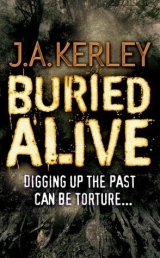
Текст книги "Buried Alive"
Автор книги: Jack Kerley
Жанры:
Триллеры
,сообщить о нарушении
Текущая страница: 9 (всего у книги 19 страниц)
24
We returned to the road and drove for several miles before anyone spoke, Cherry taking the honor.
“What happens when Taithering mentions the cop who let him go?” she whispered. “Me.”
“He won’t mention our visit,” Jeremy said. “I suspect that, given Mr Taithering’s mental state, he’ll …” Jeremy paused, settled back in the seat. “Never mind.”
A hushed and pensive Cherry drove back to Woslee, turning down into the hollow to drop Jeremy off, then to my place where I picked up a lonely Mr Mix-up and followed Cherry to the ECKLE office. Whatever was happening in Augusta would get back to her soon enough.
The hour hand swept slowly and the sun dropped in the sky. There was a field behind the office and I walked its perimeter with my dog. He seemed to have absorbed my tension, padding at my side rather than bounding madly through the furrows of earth. Twice I saw Cherry wandering outside her small dank office, as if needing sunlight to clear the shadows left by William Taithering’s tale of menace and grief at the hands of Sonny Burton.
I wasn’t convinced we’d done the right thing in not bringing Taithering back to Woslee. But that was part of the potency of my brother: he had with spellbinding wizardry created a scene where we had bonded with Taithering, a sort of reverse Stockholm syndrome.
I kicked a clod of dirt, sending Mix-up racing after broken clumps of earth. I turned back toward the highway, saw Cherry waving frantically from the door of her trailer office.
News had arrived.
I was running by the time I got to her, Mix-up churning at my heels. Cherry’s face was blank.
“You heard something?” I asked, climbing the metal steps, stepping into the trailer.
“Taithering’s dead.”
“What happened?” I blurted. “How?”
She laughed without humor. “Krenkler put everyone on her team and the Woslee PD to calling florists shops in an expanding radius.”
“The flower box Taithering brought.”
“Had to come from somewhere, right? The calls crept outward, county by county. Someone at a florist shop in Augusta recalled selling a single rose to a man named William Taithering. It stuck in her mind because he asked for a larger-sized box to hold a single flower.”
“The Feds raced up there on that info alone?”
Cherry waved her hand, wait. “Taithering’s purchase seemed odd, so they looked closer at his most recent credit-card purchases. He’d been at a sporting-goods shop two days ago. Guess what he bought?”
My head drooped. “A ball bat.”
“They also found that, an hour before the attack, Taithering purchased fuel and antacids at a gas station eight miles north of the church.”
I remembered my phone conversation with John Morgenstern. He’d said Krenkler was thorough. I hadn’t expected her to be fast. I didn’t like the woman, and because of it had underestimated her.
“Anything else?”
“Here’s where it gets a little sketchy. I called my buddy again, the ex-cop from the area. Seems Krenkler radioed the locals that she was coming, making it sound like a visit from the Queen. The Augusta cops were to put all their resources at her fingertips. Except the sheriff up there isn’t Roy Beale. The guy has a backbone. Plus he knew Taithering – the guy did his taxes – and he wanted a pow-wow to see what the Feds had on Taithering. If it looked solid, the sheriff himself was planning on visiting Taithering, letting his people handle the take-down and trying for peaceful.”
“That didn’t sit well with Krenkler, I take it?”
“Long story short: the Feds bypassed the locals and surrounded Taithering’s house. Krenkler did the bullhorn bit for a few minutes, then they tossed in the flash-bangs and tear gas and stormed the place.”
“Taithering?”
“His body was swinging from a joist in the basement. He’d hanged himself with a loop of electrical wire. By the way, there was another loop on the joist beside the first one: broken clothes line.”
I saw the picture, felt my heart fall away.
“Yep,” Cherry said, seeing my stricken face. “The tragic little man even screwed up his first suicide attempt. The cheap rope broke, so he had to cut the cord off a lawn edger. ”
Cherry looked at me and her eyes were wet. I wanted to hold her and tell her nothing was her fault. That the sad and broken man named William Taithering had his fate sealed two decades ago in a snack truck parked outside a youth camp. That there was only one person responsible for the tragedy of Taithering’s life, and that was the grinning and malevolent beast known as Sonny Burton. I wanted to go with Donna Cherry to a place where everything was still and quiet and we could share the feeling of another human heart inches away.
But a voice called between the hearts and said I was using the sorrow of another to gain a momentary pleasure. That it was my way, part of my condition.
I told Cherry I hoped to see her soon and retreated without looking back.
25
I took Mix-up to the cabin, then reluctantly returned to Jeremy’s. It was full night and a gibbous moon blazed above. I knocked and entered. The electric lights were out, a smattering of white tapers lighting the downstairs, my brother’s favorite form of illumination. I had long ago recognized that candlelight best approximated the darting shadows and darkened recesses of my brother’s head. Nothing was quite real nor visible in the round.
Jeremy was sitting in a chair in the corner, in deep shadow. He wore his gardening outfit, white shirt and dark Levis, with the long white gardener’s jacket that reached to his knees.
“Taithering’s dead,” he said.
I nodded.
“Tell me how it happened,” Jeremy’s voice was a ragged whisper, sorrow or anger or a mixture of both. I recounted the story. It took under a minute. My brother stood and walked to the nearest candle, on a tabletop. He stooped to blow it out, as if there was too much light in the room.
“Why did Taithering kill himself, Jeremy?” I asked. “Was it shame?”
“William didn’t make it all the way to redemption, Carson.”
“But that’s what he did with the beating: danger, destruction, display. A symbolic way of gaining the upper hand. That’s what you said.”
Jeremy continued to the next candle, on a counter between the living space and the kitchen. He snuffed it dead between spit-wet fingertips, moved down the counter and extinguished another.
“I said it’s what William started. He wasn’t finished. Taithering saw himself as insignificant, Carson. A man without significance can’t judge whether his private symbolism holds the potency to shatter the past. Even though he’d handled everything in his ritual correctly, the presence of risk, the destruction of the face, the public display, Taithering was lacking the final element.”
Jeremy walked to the fourth and fifth candles, on a shelf beside the stairs. Blew them dead. The only lit candle was the shivering taper on the table at my feet. Jeremy stepped back into the shadows. Outside, in the forest dark, barred owls were calling one another through the trees.
“What the hell element was left?” I asked.
“The validation of a higher authority.”
“Are you talking about God?”
“I’m talking about judgment from a guide who knows the forest, Carson.” He held his hand out into the light, thumb to the side like an emperor. He turned it down, then up.
My brother’s remarks were typically cryptic, and anger welled in my gut, at my brother and at myself. Yet again I was asking a mentally ill man for insights into the mental conditions of my fellow humans, again sucked into a world where image and symbol thudded together like blind whales in a black sea.
I stood, shaking my head. The past twenty-four hours had been nightmarish.
“I’m going back to Mobile,” I said.
“What?”
“I’m going home, Jeremy. I’m packing tomorrow, leaving the following morning.”
A long pause. “I bought you more time, Carson.”
“Ask for your money back, Jeremy. I’m gone.”
For the second time in the evening, I retreated from another human being, this time gladly. Back at the cabin I showered off the day and started to gather my belongings, but weariness overcame me like a wave and I fell asleep on the couch, a pile of clothes and a dog at my felt.
Morning brought the rude awakening of a siren outside my window. I bounced up to the window, saw Cherry behind the window of another cruiser, same color and vintage, like the Kentucky State Police had cornered the market on dark Crown Vics. Mix-up and I stumbled to the porch as Cherry cut the siren. I stared through hazy eyes and pushed hair from my face.
“Jeez, what now?”
“Sorry about the wake-up,” Cherry said, stepping from the cruiser. “Something’s happened and I thought you should know,” she said. “Zeke Tanner’s gone missing.”
My mind’s-eye showed me two medics leaning back from a corpse, putting away the cardiac paddles.
“Gone? Uh, isn’t he dead?”
“The state’s forensics people were sending transport this morning, taking him from the funeral home to the morgue in Frankfort. When the funeral director went to prepare the body for the trip, it was gone. A window got busted for entry.”
I shook my head; weirdness piled on weirdness. Cherry said, “Right now I’m running up to the funeral parlor to get a statement.” She nodded toward the passenger seat. “You in?”
“I’m planning to head back home. I’m packing today and leaving tomorrow.”
She looked stunned, caught it fast. “You’re booking in the middle of the battle?”
“This isn’t my war, Cherry.”
She pushed a half-smile to her face and shot a thumbs-up. “Gotcha. I understand. I’d do the same thing.” The smile started to waver.
“Maybe I could use a break from packing,” I said.
* * *
The owner and director of the funeral establishment was Harold Caldwell, a portly man in his fifties with a fleshy chin-wattle bobbing above blue tie and white shirt. Though the parlor air seemed as cool as the storage units, he was sweating as I re-questioned him about the lost body. Caldwell was one of those folks who, when rattled, find security in detail.
“What time did you notice Mr Tanner’s disappearance, Mr Caldwell?”
“Like I told Detective Cherry, I always stop at McDonald’s for breakfast, carry-out, coffee, two Egg McMuffins and a—”
“Time?”
“Six fifteen. I came early to prepare the papers for the transport. There are seven forms to fill out, the one for—”
“Who was the last person here last night?”
“Wendell Nockle. He’s the janitor, or I guess today they’re called maintenance staff or—”
“Nockle left when?”
“He always leaves at seven thirty. Blanche’s Diner closes at eight. They always save Wendell a piece of pie. Apple. Or banana cream. Or cherry. I don’t mean you, Detective Cherry, I mean cherry like in the pie filling—”
I dismissed Caldwell before he started in on the fifteen-bean soup.
“You come up with anything?” I asked Cherry, the detective, not the filling.
“The parking lot’s in back. It’s not well lit, nor openly visible from the street. The perp could park back there, grab the corpse, drive away. All without arousing attention. It’s flat-out dead around here after eight at night, nothing to do.”
I studied the surroundings from the parlor parking lot, saw the backs of a couple warehouses, an antique store, a used-car lot. But less than the distance of a football field, I saw the rear of a small trailer park. There were a lot of windows faced this way.
Stanton was in the county adjoining Woslee and Cherry had a far better relationship with the cops than with Beale. Three uniformed patrolmen were happy to go door to door in the park, asking if anyone happened to be watching the parking lot behind them last night. They got a hit: a man named Gable Paltry.
Mr Paltry was a sallow and skinny man in his mid-sixties with a brown theme – brown eyes, brown teeth, thinning brown hair, brown scrofulous patches on his cheeks. His sleeveless T-shirt was stained with something brown, as were his pants. His shoes were brown. He was dipping snuff or chewing tobacco, and when we entered his living room he spat a thick glob of something brown into a paper cup.
“I’ll deal with Mr Charm,” I whispered to Cherry.
“I owe you one,” she said.
The guy looked sad when Cherry claimed she needed to make a call and peeled away. I pulled a chair close as possible without getting into the splash zone, pulled out my notepad.
“I saw a semi-rig,” Paltry wheezed, looking past me, hoping for another shot of Cherry. “It was red, old. Silver trailer. Sometimes drivers pull off the highway and use the lot to snooze. I saw me a big RV pull in there and stop. Stayed maybe ten minutes. Light color. Had bikes and crap roped to the back. A barbecue grill tied up top, too.”
A vacationer, I figured, checking a map or grabbing a quick snack and a few minutes of respite from the nighttime drive. Like the semi driver, probably.
“Anyone else?”
“Yeah. A couple parked back there, man and woman. It was maybe one in the a.m. She had red hair, but I couldn’t see much of the guy. They were there a half-hour or so and never got out of the car that I saw.”
I looked over the distance to the funeral parlor. Imagined it at night.
“You said she was a redhead, Mr Paltry?”
“Kinda long hair. Had on one of those tight tops. Halter top, pink. She was on the side facing me, passenger. She had a pretty decent set of—”
“What power are your binoculars?” I asked innocuously.
“What? I wasn’t spying on no one.”
The blast of red to his face confirmed my diagnosis. I figured Mr Paltry had been hoping to see a little action. A darkened parking lot just off the highway seemed the perfect venue for a fast pullover for high school kids with dates, or older types who can’t take the date home because the spouse would object.
It might have even been Paltry’s hobby: see a vehicle in the back lot and run for the binocs hoping for suggestive head bobbing or – joy of joys – a drunked-up couple that stumbles from the car and does it on the hood.
I gave him my squarest chin and most stentorian voice, the image I employ – infrequently – when receiving commendations from professional and civic groups.
“I encourage citizens’ watch groups to use the best equipment possible to assist in the fight against crime, sir. People should always pay attention to strangers in the area.”
Paltry puffed out his sunken chest, held up a finger, meaning back in a second, and padded into the next room, returning with a stubby black tube mounted on a tripod, stroking it like a kitten.
“Here’s my baby, a Bushnell spotter’s scope. See a gnat at a hunnert paces.”
I pretended to admire the instrument. “And you say the couple never got out of the car?”
“I had to pee a time or two while I was watching. It takes me a while cuz I’ve got the prostrate. And sometimes I couldn’t see them but figured it was because, ah, they was, uh …”
“Engaged in seditious acts of horizontal alliance,” I said. “Flagrant concupiscent involvement.” I took his scrawny claw and shook it. “God bless citizens like you, sir.”
He puffed out his chest even further. “One time I even saw a buncha Mexicans being sneaked down the highway. I called the cops.”
“Really, sir?”
“They was in a farm truck fulla dried cob corn. It was night and I was looking for, uh, things like you said. The driver got out and lifted a tarp on back. The corn started moving and three Mexicans stood up. They were eating and drinking some stuff when the cops rolled up.”
I flicked a well-done salute and walked away. Stopped. Something moved in my mind, but I didn’t see what it was, just that a thought had been ignited somewhere. I frowned its direction, saw Mexicans pushing from corn. Farm. Hidden. Farms have tractors and… hay.
I pulled my phone and called Harry Nautilus, my partner back in Mobile.
“I think I know how Bobby Lee Crayline got away,” I said.
“That was over six months ago, Carson. It took you this long to figure it out?”
“I’m not missing your humor, Harry. Odd, I know. The farmer’s name was something like Oakes. That’s it, Farley Oakes …”
“You think that really happened?” Harry Nautilus said after I’d laid out my thoughts.
“If it went down as I suspect, there are two possible reasons: coercion or a willing accomplice. Either way, the best approach assumes willingness.”
“He just drove away?” Harry confirmed. “The farmer?”
“It was dumb, but everyone got so busy with the dead guards and chasing a motorcycle with Crayline aboard that … well, it just happened.”
“I’ll see if I can’t get Babe Ellis and Sandhill in on this,” Harry said. “Could be fun. How’s the vacation?”
“Right now I’m helping look for a corpse that walked away from a funeral home.”
“Aren’t there more vacation-type things to do? Are there no pretty women in the area?”
“There’s one. I’m helping her look for—”
“—a corpse that escaped from a funeral home. Gotcha.”
Cherry was leaning against her vehicle when I walked up. “Anything?” she said, face hopeful.
“Thanks to the old letch, I might have figured out how a psychotic named Bobby Lee Crayline escaped while being transported to prison.”
“How does that help us here?”
“It doesn’t. And neither did anything else.”
We got back on the road and were on the Mountain Highway just east of Stanton when Cherry pulled out a notepad, studied it, exited down a ramp.
“Where we going?” I asked.
“Quick trip to tie up a loose end. I want to see if anyone’s home at the house on the lane leading to Tandee Powers’s death scene. The creek. No one was home the day we checked.”
I recalled the small house. It was probably too far from the road for an occupant to have heard anything.
“You said you knew the occupant?”
“An elderly lady. Hell, for all I know, she passed. Like I said, she was in her eighties. This’ll take a few minutes, then I’ll get you back to your packing.”
Looking over at Cherry I had a moment of doubt. But staying here would mean being sucked deeper into the black hole of my brother’s mind.
“I’ve got to get on that,” I affirmed. “I want to be Mobile-bound at daybreak.”
26
We wound down roads growing tighter and tighter. Turned on to the long slender band of crumbling asphalt that ended at the creek where Crayline had left Tandee Powers’s body floating in the water. We both knew nothing would come of the trip, but it was one of those investigative motions that had to be made, a box checked off.
“This is the only house on the road back,” Cherry said, slowing at a bend. “Let me see if the lady’s home.”
It was the small and rickety frame dwelling with a big silver propane tank at its side and the maples filled with birdhouses. A single rocking chair sat on the porch. As we pulled in the drive I thought I saw a motion at a window curtain, as though the occupant had heard us a mile back.
“Wait in the car,” Cherry said. “Some folks live deep in the woods because they fear, or don’t particularly care for, people. Strangers, especially.”
I did aghast. “Are you telling me I’m strange?”
“Sit, cowboy.”
I waited as Cherry knocked on the door. It occurred to me to put on a big yellow happy face so as not to threaten whoever, but I figured Cherry kept the happy face in the trunk with the bullhorn.
The front door opened. Cherry spoke for several minutes. I couldn’t hear her words, only her tone, like a traveler bringing news to an isolated settlement. I figured Cherry’s accent – which I was beginning to view as “richly textured” instead of “grating” – permanently marked her as a member of the mountain tribe, a powerful asset in a culture where outsiders had always been viewed with suspicion, generally for good reason.
Cherry walked back to the car, told me to come to the house. She stayed tight to my side as we approached, a hand over my shoulder. She’d never been so close or touched me, and I realized her nearness symbolized sanction. Cherry was giving me her approval so that Miz Bascomb could see that I was safe, a man who brought neither shadow nor harm.
Leona Bascomb was a tiny woman with bottle-thick glasses and few teeth remaining in a head that had seen at least eighty years of life. Her gray hair was full and fell past her waist. She wore a faded gingham dress under a starched white apron. Her brown and gnarled hands seemed constructed entirely of knuckles.
The room was Spartan in furnishing: a rocking chair, a small sofa, a pair of TV trays beside the furniture. It was the walls that drew my eyes. They were covered with sheets of cheap simple paper, the kind run through copiers. Each sheet displayed colors arranged in a variety of ways. Some colors were hard and disparate shapes, others merged and flowed. Many pages recalled works by Kandinsky, others Chagall.
There were at least a hundred such paintings taped to the walls. It took a moment to catch my breath, startled by the surprise.
“Your walls are covered with beauty, Miz Bascomb,” I said.
“They’re my birds,” she replied.
“Birds?”
She looked embarrassed. “I know they don’t look a bit like birds, an’ I cain’t he’p it. Whenever I tried to draw a bird like a pitchur, it didn’t look right. I couldn’t see birds real good anyway cuz my eyes was always on the low side. So I started drawin’ how they sound.”
I studied the walls again and began to see the music, the rhythmic bursts of color. The shading of notes gliding into others, or tapering off as a trill must have tapered into the air. One compelling picture displayed a three-color arc: blue, becoming a sideways, bottom-weighted crescent of purple, transmuting into a wavering series of lines, blue again. The background was coal black, providing a stillness behind the color, the sense of a night sky. I’d heard those colors recently.
“This one,” I said, pointing to the picture. “It’s a whip-poor-will, right?”
Cherry’s eyes turned to me with surprise. Miss Bascomb stared through the thick lenses, canting her head as if bringing me into focus. She walked to me, took my hand in hers. Her hand felt like driftwood.
“You’re the first person to ever see one right,” she said, leading me past the walls like at a gallery opening, pointing out towhees, starlings, robins, crows – a nervous jitter of black and yellow – martins, several varieties of thrushes and finches, bluebirds, cardinals, willets, grebes, plovers, and dozens more. When the tour was finished, a smiling Leona Bascomb went to fetch tea and cookies.
“How did you do that, Ryder?” Cherry whispered when the bird artist had retreated to her tiny kitchen, clattering dishes. “How did you know those splotches were a whip-poor-will?”
“I couldn’t imagine it being anything else.”
When Miz Bascomb returned, Cherry steered her into our questions. I sipped tea and nibbled a sugar cookie, happy to be out of the limelight.
“I wasn’t here that morning the poor woman’s body got found,” Miz Bascomb said to Cherry. “The health service came by real early and took me to the clinic for my six-month look-see. I’m good, praise God.”
“You mentioned hearing a car the night before?”
“It was almost midnight. I was up, puttering. Cain’t never sleep no more, just doze. I heard a car out on the road. Sounded big. I can tell by the sounds of the motors. I cain’t see hardly none any more, but God gave me ears as good as they git.”
“Is that common, Miz Bascomb, nighttime traffic on the road?” Cherry asked.
“Any traffic ain’t real common. Nothing back there but the ol’ logging camp. In the daytime, local kids sometimes go back there in summer to splash around. But most of ‘em goes to the divin’ rock over in the Red River. Water’s deeper and there’s other kids to show off for. I did the same myself, when I was a girl.”
“So the vehicle on the road caught your ear?” Cherry asked.
“I was waiting for it to come back out. It did, ’bout two hours later.”
“The same vehicle?”
“No way to tell that perzactky. Same kind of one, to tell by the sound.”
Cherry made some notes in her pad. “So a vehicle went in around midnight, came out around two. Possibly the same vehicle.”
The old woman nodded.
Cherry looked at me. It fit the timeline, given what we’d learned from the lab about time of death. Tandee Powers was probably taken from her home around eleven, driven past Leona Bascomb’s house, then another desolate mile to the creek. She’d been dressed in a sexually suggestive manner, dragged into the water, tortured by being pulled under and then released back to the surface. This could have gone on for an hour and a half. Perhaps longer.
“No other vehicles went back down the road after that?” Cherry asked.
The birdsong artist frowned, trying to discern a memory. “I drowsed off around four in the morning. Something popped my eyes open just afore six. I’m purty sure it was a car, but I was sorta drifty. It seemed like it was going west toward east, like driving away.”
Cherry looked at me and shook her head. Not the car. It didn’t fit the timeline, the sun rising by six. It was the midnight ride that carried Tandee Powers to her death.
We stood and bid our farewells, Miz Bascomb seeming loathe to see me go, offering more tea and cookies, or dinner. I again complimented her work as we withdrew toward the door. I paused, turned, a sudden thought lighting my head.
“One more thing, Miz Bascomb,” I said. “The sound the earlier vehicle made. Do you think you could draw it for me?”
A smile crossed her face, as though the challenge was amusing.
“Why not? Lemme git my workings.”
Leona Bascomb walked to a cabinet, withdrew a sheet of paper and a box of bright pastel crayons.
“I got a daughter lives up in Louisville sends me my colors from an art store,” she said, sitting in the rocker and placing the sheet on the TV tray. She thought for a full minute and I saw her lips move as the sounds replayed in her head. Her ancient fingers whisked over the colors, selected.
The gnarled hands began drawing.
Two minutes later she handed me the paper. I saw a vibrating line that ran a few inches in yellow, turned green, jumped into blue and stayed the same until running off the edge of the page. I peeked out the window and confirmed the bridge that had slowed Cherry’s vehicle three hundred feet away. After crossing the bridge the vehicle would have accelerated to the speed the potholed road could bear, twenty-five or thirty miles per hour. The colors in Miz Bascomb’s drawing shifted abruptly, as the sounds must have changed.
“A standard transmission,” I said. “I see it shifting.”
Cherry stared at me.