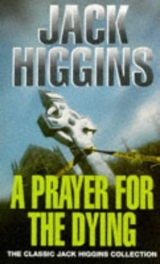
Текст книги "A Prayer for the Dying"
Автор книги: Jack Higgins
Жанры:
Боевики
,сообщить о нарушении
Текущая страница: 6 (всего у книги 13 страниц) [доступный отрывок для чтения: 6 страниц]
7
Prelude and Fugue
Fallon recognised Miller for what he was instantly and waited, shoulders hunched, hands in the pockets of his trenchcoat, feet apart, ready to make whatever move was necessary. There was an elemental force to the man that was almost tangible. Father da Costa could feel it in the very air and the thought of what might happen here filled him with horror.
He moved forward quickly to place himself between Fallon and the two policemen as they approached. Anna paused uncertainly a yard or two on the other side of the altar rail.
Miller stopped, hat in hand, Fitzgerald a pace or two behind him. There was a slight awkward silence and da Costa said, 'I think you've met my niece, Superintendent. He has Inspector Fitzgerald with him, my dear.'
'Miss da Costa,' Miller said formally and turned to Fallon.
Father da Costa said, 'And this is Mr Fallon.'
'Superintendent,' Fallon said easily.
He waited, a slight, fixed smile on his mouth and Miller, looking into that white, intense face, those dark eyes, was aware of a strange, irrational coldness as if somewhere, someone had walked over his grave, which didn't make any kind of sense – and then a sudden, wild thought struck him and he took an involuntary step backwards. There was a silence. Everyone waited. Rain drummed against a window.
It was Anna who broke the spell by taking a blind step towards the altar rail and stumbling. Fallon jumped to catch her.
'Are you all right, Miss da Costa?' he said easily.
'Thank you, Mr Fallon. How stupid of me.' Her slight laugh sounded very convincing as she looked in Miller's general direction. 'I've been having trouble with the organ. I'm afraid that, like the church, it's past its best. Mr Fallon has kindly agreed to give us the benefit of his expert advice.'
'Is that so?' Miller said.
She turned to Father da Costa. 'Do you mind if we start, Uncle? I know Mr Fallon's time is limited.'
'We'll go into the sacristy, if that's all right with you, Superintendent,' Father da Costa said. 'Or up to the house if you prefer.'
'Actually, I'd rather like to hang on here for a few minutes,' Miller told him. 'I'm a pianist myself, but I've always been rather partial to a bit of organ music. If Mr Fallon has no objection.'
Fallon gave him an easy smile. 'Sure and there's nothing like an audience, Superintendent, for bringing out the best in all of us,' and he took Anna by the arm and led her up through the choir stalls.
From the darkness at the rear of the little chapel to St Martin de Porres, Meehan watched, fascinated. Billy whispered, 'I said he was a nutter, didn't I? So how in the hell is he going to talk his way out of this one?'
'With his fingers, Billy, with his fingers,' Meehan said. 'I'd put a grand on it.' There was sincere admiration in his voice when he added. 'You know something. I'm enjoying every bleeding minute of this. It's always nice to see a real pro in action.' He sighed. 'There aren't many of us left.'
Fallon took off his trenchcoat and draped it over the back of a convenient choir stall. He sat down and adjusted the stool so that he could reach the pedals easily. Anna stood at his right hand.
'Have you tried leaving the trumpet in as I suggested?' he asked.
She nodded. 'It made quite a difference.'
'Good. I'll play something pretty solid and we'll see what else we can find wrong. What about the Bach Prelude and Fugue in D Major?'
'I only have it in Braille.'
'That's all right. I know it by heart.' He turned and looked down at Father da Costa and the two policemen on the other side of the altar rail. 'If you're interested, this is reputed to have been Albert Schweitzer's favourite piece.'
No one said a word. They stood there, waiting, and Fallon swung round to face the organ. It had been a long time – a hell of a long time and yet, quite suddenly and in some strange, incomprehensible way, it was only yesterday.
He prepared the swell organ, hands moving expertly – all stops except the Vox Humana and the Celeste and on the Great Organ, Diapasons and a four foot Principal.
He looked up at Anna gravely. 'As regards the Pedal Organ, I'd be disinclined to use any reed stops on this instrument. Only the sixteen-foot Diapason and the Bourdon and maybe a thirty-two-foot stop to give a good, solid tone. What do you think?'
She could not see the corner of his mouth lifted in a slight, sardonic smile and yet something of that smile was in his voice. She put a hand on his shoulder and said clearly, 'An interesting beginning, anyway.'
To her horror he said very softly, 'Why did you interfere?'
'Isn't that obvious?' she answered in a low voice. 'For Superintendent Miller and his inspector's sake. Now play.'
'God forgive you, but you're a terrible liar,' Fallon told her, and started.
He opened with a rising scale, not too fast, allowing each note to be heard, heeling and toeing with his left foot in a clear, bold, loud statement, playing with such astonishing power that Miller's wild surmise died on the instant for it was a masterly performance by any standard.
Father da Costa stood at the altar rail as if turned to stone, caught by the brilliance of Fallon's playing as he answered the opening statement with the chords of both hands on the sparkling Great Organ. He repeated, feet, then hands again, manual answering pedals until his left toe sounded the long four bar bottom A and his hands traced the brilliant passages announced by the pedals.
Miller tapped Father da Costa on the shoulder and whispered in his ear, 'Brilliant, but I'm running out of time, Father. Can we have our chat now?'
Father da Costa nodded reluctantly and led the way across to the sacristy. Fitzgerald was the last in and the door banged behind him in a sudden gust of wind.
Fallon stopped playing. 'Have they gone?' he asked softly.
Anna da Costa stared blindly down at him, a kind of awe on her face, reached out to touch his cheek. 'Who are you? she whispered. 'What are you?'
'A hell of a question to ask any man,' he said and, turning back to the organ, he moved into the opening passage again.
The music could be heard in the sacristy, muted yet throbbing through the old walls with a strange power. Father da Costa sat on the edge of the table.
'Cigarette, sir?' Fitzgerald produced an old, silver case. Father da Costa took one and the light that followed.
Miller observed him closely. The massive shoulders, that weathered, used-up face, the tangled grey beard, and suddenly realised with something close to annoyance that he actually liked the man. It was precisely for this reason that he decided to be as formal as possible.
'Well, Superintendent?' Father da Costa said.
'Have you changed your mind, sir, since we last spoke?'
'Not in the slightest.'
Miller fought hard to control his anger and Fitzgerald moved in smoothly. 'Have you been coerced in any way since this morning sir, or threatened?'
'Not at all, Inspector,' Father da Costa assured him with complete honesty.
'Does the name Meehan mean anything to you, sir?'
Father da Costa shook his head, frowning slightly, 'No, I don't think so. Should it?'
Miller nodded to Fitzgerald, who opened the briefcase he was carrying and produced a photo which he passed to the priest. 'Jack Meehan,' he said. 'Dandy Jack to his friends. That one was taken in London on the steps of West End Central police station after he was released for lack of evidence in an East End shooting last year.'
Meehan, wearing his usual double-breasted overcoat, smiled out at the world hugely, waving his hat in his right hand, his left arm encircling the shoulders of a well-known model girl.
'The girl is strictly for publicity purposes,' Fitzgerald said. 'In sexual matters his tastes run elsewhere. What you read on the sheet pinned to the back is all we have on him officially.'
Father da Costa read it with interest. Jack meehan was forty-eight and had joined the Royal Navy in 1943 at eighteen, serving on minesweepers until 1945 when he had been sentenced to a year's imprisonment and discharged with ignominy for breaking a Petty Officer's jaw in a brawl. In 1948 he had served six months on a minor smuggling charge and in 1954 a charge of conspiracy to rob the mails had been dropped for lack of evidence. Since then, he had been questioned by the police on over forty occasions in connection with indictable offences.
'You don't seem to be having much success,' Father da Costa said with a slight smile.
'There's nothing funny about Jack Meehan,' Miller said. 'In twenty-five years in the police force he's the nastiest thing I've ever come across. Remember the Kray brothers and the Richardson torture gang? Meehan's worse than the whole damn lot of them put together. He has an undertaking business here in the city, but behind that facade of respectability he heads an organisation that controls drug-pushing, prostitution, gambling and protection in most of the big cities in the north of England.'
'And you can't stop him? I find that surprising.'
'Rule by terror, Father. The Krays got away with it for years. Meehan makes them look like beginners. He's had men shot on many occasions – usually the kind of shotgun blast in the legs that doesn't kill, simply cripples. He likes them around as an advertisement.'
'You know this for a fact?'
'And couldn't prove it. Just as I couldn't prove he was behind the worst case of organised child prostitution we ever had or that he disciplined one man by crucifying him with six-inch nails and another by making him eat his own excreta.'
For the briefest of moments, Father da Costa found himself back in that camp in North Korea – the first one where the softening up was mainly physical – lying half-dead in the latrine while a Chinese boot ground his face into a pile of human ordure. The guard had tried to make him eat, too, and he had refused, mainly because he thought he was dying anyway.
He pulled himself back to the present with an effort. 'And you think Meehan is behind the killing of Krasko this morning?'
'He has to be,' Miller told him. 'Krasko was, to put it politely, a business rival in every sense of the word. Meehan tried to take him under his wing and he refused. In Meehan's terms, he wouldn't see reason.'
'And a killer was brought in to execute him publicly?'
'To encourage the others,' Miller said. 'In a sense, the very fact that Meehan dares to do such a thing is a measure of just how sick he is. He knows that I know he's behind the whole thing. But he wants me to know – wants everyone to know. He thinks nothing can touch him.'
Father da Costa looked down at the photo, frowning, and Fitzgerald said, 'We could get him this time, Father, with your help.'
Father da Costa shook his head, his face grave. 'I'm sorry, Inspector. I really am.'
Miller said in a harsh voice, 'Father da Costa, the only inference we can draw from your strange conduct is that you are aware of the identity of the man we are seeking. That you are in fact protecting him. Inspector Fitzgerald here, himself a Catholic, has suggested a possible explanation to me. That your knowledge is somehow bound up with the secrets of the confessional, if that is the term. Is there any truth in that supposition?'
'Believe me, Superintendent, if I could help you I would,' Father da Costa told him.
'You still refuse?'
'I'm afraid so.'
Miller glanced at his watch. 'All right, Father, I have an appointment in twenty minutes and I'd like you to come with me. No threats – no coercion. Just a simple request.'
'I see,' Father da Costa said. 'May I be permitted to ask where we are going?'
'To attend the post mortem of Janos Krasko at the city mortuary.'
'I see,' Father da Costa said. 'Tell me, Superintendent, is this supposed to be a challenge?'
'That's up to you, Father.'
Father da Costa stood up, suddenly weary. His will to resist was at a new low. He was sick of the whole wretched business. Strangely enough the only thing of which he was aware with any clarity was the sound of the organ, muted and far away.
'I have evening Mass, Superintendent, and supper at the refuge afterwards. I can't be long.'
'An hour at the most, sir, I'll have you brought back by car, but we really will have to leave now.'
Father da Costa opened the sacristy door and led the way back into the church. He paused at the altar, 'Anna?' he called.
Fallon stopped playing and the girl turned to face him. 'I'm just going out, my dear, with Superintendent Miller.'
'What about Mass?' she said.
'I won't be long. As for the organ,' he added, 'perhaps Mr Fallon would come back after Mass? We could discuss it then.'
'Glad to, Father,' Fallon called cheerfully.
Father da Costa, Miller and Inspector Fitzgerald walked down the aisle, past the chapel of St Martin de Porres, where Jack Meehan and his brother still sat in the shadows, and out of the front door.
It banged in the wind. There was silence. Fallon said softly, 'Well now, at a rough estimate, I'd say you've just saved my neck. I think he suspected something, the good Superintendent Miller.'
'But not now,' she said. 'Not after such playing. You were brilliant.'
He chuckled softly. 'That might have been true once, as I'll admit with becoming modesty, but not any more. My hands aren't what they were, for one thing.'
'Brilliant,' she said. 'There's no other word for it.'
She was genuinely moved and for the moment it was as if she had forgotten that other darker side. She groped for his hands, a smile on her face.
'As for your hands – what nonsense.' She took them in hers, still smiling, and then that smile was wiped clean. 'Your fingers?' she whispered, feeling at them. 'What happened?'
'Oh, those.' He pulled his hands free and examined the ugly, misshapen finger-ends. 'Some unfriends of mine pulled out my nails. A small matter on which we didn't quite see eye to eye.'
He stood up and pulled on his coat. She sat there, horror on her face and reached out a hand as if to touch him, pawing at space. He helped her to her feet and placed her coat about her shoulders.
'I don't understand,' she said.
'And please God, you never should,' he told her softly. 'Come on now and I'll take you home.'
They went down the altar steps and out through the sacristy. The door closed behind them. There was a moment of silence and then Billy Meehan stood up.
'Thank God for that. Can we kindly get the hell out of here now?'
'You can, not me,' Meehan told him. 'Find Fallon and stick to him like glue.'
'But I thought that was Varley's job?'
'So now I'm putting you on to it. Tell Varley to wait outside.'
'And what about you,' Billy said sullenly.
'Oh, I'll wait here for the priest to get back. Time we had a word.' He sighed and stretched his arms. 'I like it here. Nice and peaceful in the dark with all those candles flickering away there. Gives a fella time to think.' Billy hesitated as if trying to find some suitable reply and Meehan said irritably, 'Go on, piss off out of it for Christ's sake. I'll see you later.'
He leaned back, arms folded, and closed his eyes and Billy left by the front entrance to do as he was told.
* * *
It was raining hard in the cemetery. As they moved along the path to the presbytery, Fallon slipped her arm in his.
'Sometimes I think it's never going to stop,' she said. 'It's been like this for days.'
'I know,' he said.
They reached the front door, she opened it and paused in the porch while Fallon stood at the bottom of the steps looking up at her.
'Nothing seems to make sense to me any longer,' she said. 'I don't understand you or what's happened today or any part of it – not after hearing you play. It doesn't make sense. It doesn't fit.'
He smiled up at her gently. 'Go in now, girl dear, out of the cold. Stay safe in your own small world.'
'Not now,' she said. 'How can I? You've made me an accessory now, isn't that what they call it? I could have spoken up, but I didn't.'
It was the most terrible thing she could have said to him. He said hoarsely. 'Then why didn't you?'
'I gave my uncle my word, had you forgotten? And I would not hurt him for worlds.'
Fallon moved back into the rain very softly, She called from the porch, 'Mr Fallon, are you there?'
He didn't reply. She stood there for a moment longer, uncertainty on her face, then went in and closed the door. Fallon turned and moved back along the path.
Billy had been watching them from the shelter of a large Victorian mausoleum, or rather, he had been watching Anna. She was different from the girls he was used to. Quiet, lady-like and yet she had an excellent figure. There was plenty of warmth beneath that cool exterior, he was certain of that, and the fact of her blindness made his stomach churn, exciting some perversity inside him and he got an almost instant erection.
Fallon paused, hands cupped to light a cigarette, and Billy drew back out of sight.
Fallon said, 'All right, Billy, I'm ready to go home now. Since you're here, you can drive me back to Jenny's place.'
Billy hesitated, then stepped reluctantly into the open. 'Think you're bleeding smart, don't you?'
'To be smarter than you doesn't take much, sonny,' Fallon told him. 'And another thing. If I catch you hanging around here again, I'll be very annoyed.'
'Why don't you go stuff yourself,' Billy told him furiously.
He turned and walked rapidly towards the gate. Fallon was smiling as he went after him.
The city mortuary was built like a fort and encircled by twenty-foot walls of red brick to keep out prying eyes. When Miller's car reached the main entrance the driver got out and spoke into a voice box on the wall. He climbed back behind the wheel. A moment later the great steel gate slid back automatically and they passed into an inner courtyard.
'Here we are, Father,' Miller said. 'The most modern mortuary in Europe, or so they say.'
He and Fitzgerald got out first and Father da Costa followed them. The inner building was all concrete and glass. Functional, but rather beautiful in its own way. They went up a concrete ramp to the rear entrance and a technician in white overalls opened the door for them.
'Good morning, Superintendent,' he said. 'Professor Lawlor said he'd meet you in the dressing-room. He's very anxious to get started.'
There was the constant low hum of the air-conditioning plant as they followed him along a maze of narrow corridors. Miller glanced over his shoulder at Father da Costa and said casually, 'They boast the purest air in the city up here. If you can breathe it at all, that is.'
It was the kind of remark that didn't seem to require an answer and Father da Costa made no attempt to make one. The technician opened a door, ushered them inside and left.
There were several washbasins, a shower in the corner, white hospital overalls and robes hanging on pegs on one wall. Underneath was a row of white rubber boots in various sizes. Miller and Fitzgerald removed their raincoats and the Superintendent took down a couple of white robes and passed one to Father da Costa.
'Here, put this on. You don't need to bother about boots.'
Father da Costa did as he was told and then the door opened and Professor Lawlor entered. 'Come on, Nick,' he said. 'You're holding me up.' And then he saw the priest and his eyes widened in surprise. 'Hello, Father.'
I'd like Father da Costa to observe, if you've no objection,' Miller said.
Professor Lawlor was wearing white overalls and boots and long pale-green rubber gloves, which he pulled at impatiently, 'As long as he doesn't get in the way. But do let's get on with it. I've got a lecture at the medical school at five.'
He led the way out and they followed along a short corridor and through a rubber swing door into the post mortem room. It was lit by fluorescent lighting so bright that it almost hurt the eyes and there was a row of half-a-dozen stainless steel operating tables.
Janos Krasko lay on his back on the one nearest the door, head raised on a wooden block. He was quite naked. Two technicians stood ready beside a trolley on which an assortment of surgical instruments was laid out neatly. The greatest surprise for Father da Costa were the closed circuit television cameras, one set close up to the operating table, the other waiting nearby on a movable trolley.
'As you can see, Father, science marches on,' Miller said. 'These days in a case like this everything's videotaped and in colour.'
'Is that necessary?' Father da Costa asked him.
'It certainly is. Especially when you get the kind of defence council who hasn't got much to go on and tries bringing in his own expert witness. In other words, some other eminent pathologist with his own particular theory about what happened.'
One of the technicians was fastening a throat mike around Lawlor's throat and Miller nodded. 'The medical profession are great on opinions, Father, I've learned that the hard way.'
Lawlor smiled frostily. 'Don't get bitter in your old age, Nick. Have you witnessed a post mortern before, Father?'
'Not in your terms, Professor.'
'I see. Well, if you feel sick, you know where the dressing-room is and please stand well back – all of you.' He turned and addressed the camera men and technicians. 'Right, gentlemen, let's get started.'
It should have been like something out of a nightmare. That it wasn't was probably due to Lawlor as much as anything else. That and the general atmosphere of clinical efficiency.
He was really quite brilliant. More than competent in every department. An artist with a knife who kept up a running commentary in that dry, precise voice of his during the entire proceedings.
'Everything he says is recorded,' Miller whispered. 'To go with the video.'
Father da Costa watched, fascinated, as Lawlor drew a scalpel around the skull. He grasped the hair firmly and pulled the entire face forward, eyeballs and all, like a crumpled rubber mask.
He nodded to the technicians who handed him a small electric saw and switched on. Lawlor began to cut round the top of the skull very carefully.
'They call it a de Soutter,' Miller whispered again. 'Works on a vibratory principle. A circular saw would cut too quickly.'
There was very little smell, everything being drawn up by extractor fans in the ceiling above the table. Lawlor switched off the saw and handed it to the technician. He lifted off the neat skullcap of bone and placed it on the table, then carefully removed the brain and put it in a rather commonplace red, plastic basin which one of the technicians held ready.
The technician carried it across to the sink and Lawlor weighed it carefully. He said to Miller, 'I'll leave my examination of this until I've finished going through the motions on the rest of him. All right?'
'Fine,' Miller said.
Lawlor returned to the corpse, picked up a large scalpel and opened the entire body from throat to belly. There was virtually no blood, only a deep layer of yellow fat, red meat underneath. He opened the body up like an old overcoat, working fast and efficiently, never stopping for a moment.
Father da Costa said, 'Is this necessary? The wound was in the head. We know that.'
'The Coroner will demand a report that is complete in every detail,' Miller told him. 'That's what the law says he's entitled to and that's what he expects. It's not as cruel as you think. We had a case the other year. An old man found dead at his home. Apparent heart failure. When Lawlor opened him up he was able to confirm that, and if he'd stopped at the heart that would have been the end of the matter.'
'There was more?'
'Fractured vertebrae somewhere in the neck area. I forget the details, but it meant that the old boy had been roughly handled by someone, which led us to a character who'd been making a nuisance of himself preying on old people. The sort who knocks on the door, insists he was told to clean the drains and demands ten quid.'
'What happened to him?'
'The court accepted a plea of manslaughter. Gave him five years so he's due out soon. A crazy world, Father.'
'And what would you have done with him?'
'I'd have hung him,' Miller said simply. 'You see, for me, it's a state of war now. A question of survival. Liberal principles are all very fine as long as they leave you with something to have principles about.'
Which made sense in its own way and it was hard to argue. Father da Costa moved to one side as the technicians carried the various organs across to the sink in more plastic basins. Each item was weighed, then passed to Lawlor who sliced it quickly into sections on a wooden block with a large knife. Heart, lungs, liver, kidneys, intestines – they all received the same treatment with astonishing speed and the camera on the trolley recorded everything at his side.
Finally he was finished and put down his knife. 'That's it,' he said to Miller. 'Nothing worth mentioning. I'll go to town on the brain after I've had a cigarette.' He smiled at da Costa,
'Well, what did you think?'
'An extraordinary experience,' Father da Costa said. 'Disquieting more than anything else.'
'To find that man is just so much raw meat?' Professor Lawlor said.
'Is that what you think?'
'See for yourself.'
Lawlor crossed to the operating table, and Father da Costa went with him. The body was open to the view and quite empty. Gutted. Nothing but space from inside the rib cage and down into the penis.
'Remember that poem of Eliot's The Hollow Men? Well, this is what he was getting at or so it's always seemed to me.'
'And you think that's all there is?'
'Don't you?' Lawlor demanded.
One of the technicians replaced the skullcap of bone and pulled the scalp back into place. Amazing how easily the face settled into position again. Quite remarkable.
Father da Costa said, 'A superb piece of engineering, the human body. Infinitely functional. There seems to be no task that a man cannot cope with if he so desires. Wouldn't you agree, Professor?'
'I suppose so.'
'Sometimes I find the mystery of it quite terrifying. I mean, is this all that's left in the end of an Einstein, let's say, or a Picasso? A gutted body, a few scraps of raw meat swilling about in the bottom of a plastic bucket?'
'Ah no you don't.' Lawlor grinned tiredly. 'No metaphysics, if you please, Father, I've got other things to do.' He turned to Miller. 'Have you seen enough?'
'I think so,' Miller said.
'Good, then get this devil's advocate out of here and leave me in peace to finish. It will be the morning before you get the full report now.' He grinned at Father da Costa again. 'I won't shake hands for obvious reasons, but any time you're passing just drop in. There's always someone here.'
He laughed at his own joke, was still laughing when they went back to the dressing-room. One of the technicians went with them to make sure that the robes they had worn went straight into the dirty laundry basket, so there was no opportunity to talk.
Miller led the way back outside, feeling tired and depressed. He had lost, he knew that already. The trouble was he didn't really know what to do next, except to take the kind of official action he'd been hoping to avoid.
It was still raining when they went out into the courtyard. When they reached the car, Fitzgerald opened the door and Father da Costa climbed in. Miller followed him. Fitzgerald sat in the front with the driver.
As they moved out into the city traffic, Miller said, 'I wanted you to see the reality of it and it hasn't made the slightest difference, has it?'
Father da Costa said, 'When I was twenty years of age, I dropped into the Cretan mountains by parachute, dressed as a peasant. All very romantic. Action by night – that sort of thing. When I arrived at the local village inn I was arrested at gunpoint by a German undercover agent. A member of the Feldgendarmerie.'
Miller was interested in spite of himself. 'You'd been betrayed?'
'Something like that. He wasn't a bad sort. Told me he was sorry, but that he'd have to hold me till the Gestapo got there. We had a drink together. I managed to hit him on the head with a wine bottle.'
Father da Costa stared back into the past and Miller said gently. 'What happened?'
'He shot me in the left lung and I choked him to death with my bare hands.' Father da Costa held them up. 'I've prayed for him every day of my life since.'
They turned into the street at the side of the church and Miller said wearily, 'All right, I get the picture.' The car pulled in at the kerb and there was a new formality in his voice when he said, 'In legal terms, your attitude in this matter makes you an accessory after the fact. You understand that?'
'Perfectly,' da Costa told him.
'All right,' Miller said. 'This is what I intend to do. I shall approach your superior in a final effort to make you see sense.'
'Monsignor O'Halloran is the man you want. I tried to see him myself earlier, but he's out of town. He'll be back in the morning – but it won't do you any good.'
'Then I'll apply to the Director of Public Prosecutions for a warrant for your arrest.'
Father da Costa nodded soberly. 'You must do what you think is right. I see that, Superintendent.' He opened the door and got out. 'I'll pray for you.'
'Pray for me!' Miller ground his teeth together as the car moved away. 'Have you ever heard the like?'
'I know, sir,' Fitzgerald said. 'He's quite a man, isn't he?'
It was cold in the church and damp as Father da Costa opened the door and moved inside. Not long till Mass. He felt tired – wretchedly tired. It had been an awful day – the worst he could remember in a great many years – since the Chinese prison camp at Chong Sam. If only Fallon and Miller – all of them – would simply fade away, cease to exist.
He dipped his fingers in the Holy Water and on his right a match flared in the darkness of the little side chapel to St Martin de Porres as someone lit a candle, illuminating a familiar face.
There was a slight pause and then the Devil moved out of the darkness and Father da Costa girded up his loins to meet him.