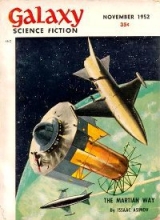
Текст книги "The Martian Way"
Автор книги: Isaac Asimov
Жанр:
Научная фантастика
сообщить о нарушении
Текущая страница: 1 (всего у книги 4 страниц)
The Martian Way
by Isaac Asimov
1
From the doorway of the short corridor between the only two rooms in the travel-head of the spaceship, Mario Esteban Rioz watched sourly as Ted Long adjusted the video dials painstakingly. Long tried a touch clockwise, then a touch counter. The picture was lousy.
Rioz knew it would stay lousy. They were too far from Earth and at a bad position facing the Sun. But then Long would not be expected to know that. Rioz remained standing in the doorway for an additional moment, head bent to clear the upper lintel, body turned half side-wise to fit the narrow opening. Then he jerked into the galley like a cork popping out of a bottle.
“What are you after?” he asked.
“I thought I’d get Hilder,” said Long.
Rioz propped his rump on the corner of a table shelf. He lifted a conical can of milk from the companion shelf just above his head. Its point popped under pressure. He swirled it gently as he waited for it to warm.
“What for?” he said. He upended the cone and sucked noisily.
“Thought I’d listen.”
“I think it’s a waste of power.”
Long looked up, frowning. “It’s customary to allow free use of personal video sets.”
“Within reason,” retorted Rioz.
Their eyes met challengingly. Rioz had the rangy body, the gaunt, cheek-sunken face that was almost the hallmark of the Martian Scavenger, those Spacers who patiently haunted the space routes between Earth and Mars. Pale blue eyes were set keenly in the brown, lined face which, in turn, stood darkly out against the white surrounding syntho-fur that lined the up-turned collar of his leathtic space jacket.
Long was altogether paler and softer. He bore some of the marks of the Grounder, although no second-generation Martian could be a Grounder in the sense that Earthmen were. His own collar was thrown back and his dark brown hair freely exposed.
“What do you call within reason?” demanded Long.
Rioz’s thin lips grew thinner. He said, “Considering that we’re not even going to make expenses this trip, the way it looks, any power drain at all is outside reason.”
Long said, “If we’re losing money, hadn’t you better get back to your post? It’s your watch.”
Rioz grunted and ran a thumb and forefinger over the stubble on his chin. He got up and trudged to the door, his soft, heavy boots muting the sound of his steps. He paused to look at the thermostat, then turned with a flare of fury.
“I thought it was hot. Where do you think you are?”
Long said, “Forty degrees isn’t excessive.”
“For you it isn’t, maybe. But this is space, not a heated office at the iron mines.” Rioz swung the thermostat control down to minimum with a quick thumb movement. “Sun’s warm enough.”
“The galley isn’t on Sunside.”
“It’ll percolate through, damn it.”
Rioz stepped through the door and Long stared after him for a long moment, then turned back to the video. He did not turn up the thermostat.
The picture was still flickering badly, but it would have to do. Long folded a chair down out of the wall. He leaned forward, waiting through the formal announcement, the momentary pause before the slow dissolution of the curtain, the spotlight picking out the well-known bearded figure which grew as it was brought forward until it filled the screen.
The voice, impressive even through the flutings and croakings induced by the electron storms of twenty millions of miles, began:
“Friends! My fellow citizens of Earth…”
2
Rioz’s eye caught the flash of the radio signal as he stepped into the pilot room. For one moment, the palms of his hands grew clammy when it seemed to him that it was a radar pip; but that was only his guilt speaking. He should not have left the pilot room while on duty theoretically, though all Scavengers did it. Still, it was the standard nightmare, this business of a strike turning up during just those five minutes when one knocked off for a quick coffee because it seemed certain that space was clear. And the nightmare had been known to happen, too.
Rioz threw in the multi-scanner. It was a waste of power, but while he was thinking about it, he might as well make sure.
Space was clear except for the far-distant echoes from the neighboring ships on the scavenging line.
He hooked up the radio circuit, and the blond, long-nosed head of Richard Swenson, copilot of the next ship on the Marsward side, filled it.
“Hey, Mario,” said Swenson.
“Hi. What’s new?”
There was a second and a fraction of pause between that and Swen-son’s next comment, since the speed of electromagnetic radiation is not infinite.
“What a day I’ve had.”
“Something happened?” Rioz asked.
“I had a strike.”
“Well, good.”
“Sure, if I’d roped it in,” said Swenson morosely.
“What happened?”
“Damn it, I headed in the wrong direction.”
Rioz knew better than to laugh. He said, “How did you do that?”
“It wasn’t my fault. The trouble was the shell was moving way out of the ecliptic. Can you imagine the stupidity of a pilot that can’t work the release maneuver decently? How was I to know? I got the distance of the shell and let it go at that. I just assumed its orbit was in the usual trajectory family. Wouldn’t you? I started along what I thought was a good line of intersection and it was five minutes before I noticed the distance was still going up. The pips were taking their sweet time returning. So then I took the angular projections of the thing, and it was too late to catch up with it.”
“Any of the other boys getting it?”
“No. It’s ’way out of the ecliptic and’ll keep on going forever. That’s not what bothers me so much. It was only an inner shell.
But I hate to tell you how many tons of propulsion I wasted getting up speed and then getting back to station. You should have heard Canute.”
Canute was Richard Swenson’s brother and partner.
“Mad, huh?” said Rioz.
“Mad? Like to have killed me! But then we’ve been out five months now and it’s getting kind of sticky. You know.”
“I know.”
“How are you doing, Mario?”
Rioz made a spitting gesture. “About that much this trip. Two shells in the last two weeks and I had to chase each one for six hours.”
“Big ones?”
“Are you kidding? I could have scaled them down to Phobos by hand. This is the worst trip I’ve ever had.”
“How much longer are you staying?”
“For my part, we can quit tomorrow. We’ve only been out two months and it’s got so I’m chewing Long out all the time.”
There was a pause over and above the electromagnetic lag.
Swenson said, “What’s he like, anyway? Long, I mean.”
Rioz looked over his shoulder. He could hear the soft, crackly mutter of the video in the galley. “I can’t make him out. He says to me about a week after the start of the trip, ‘Mario, why are you a Scavenger?’ I just look at him and say, ‘To make a living. Why do you suppose?’ I mean, what the hell kind of a question is that? Why is anyone a Scavenger?
“Anyway, he says, ‘That’s not it, Mario.’ He’s telling me, you see. He says, ‘You’re a Scavenger because this is part of the Martian way.’”
Swenson said, “And what did he mean by that?”
Rioz shrugged. “I never asked him. Right now he’s sitting in there listening to the ultra-microwave from Earth. He’s listening to some Grounder called Hilder.”
“Hilder? A Grounder politician, an Assemblyman or something, isn’t he?”
“That’s right. At least, I think that’s right. Long is always doing things like that. He brought about fifteen pounds of books with him, all about Earth. Just plain dead weight, you know.”
“Well, he’s your partner. And talking about partners, I think I’ll get back on the job. If I miss another strike, there’ll be murder around here.”
He was gone and Rioz leaned back. He watched the even green line that was the pulse scanner. He tried the multi-scanner a moment Space was still clear.
He felt a little better. A bad spell is always worse if the Scavengers all about you are pulling in shell after shell; if the shells go spiraling down to the Phobos scrap forges with everyone’s brand welded on except your own. Then, too, he had managed to work off some of his resentment toward Long.
It was a mistake teaming up with Long. It was always a mistake to team up with a tenderfoot. They thought what you wanted was conversation, especially Long, with his eternal theories about Mars and its great new role in human progress. That was the way he said it-Human Progress: the Martian Way; the New Creative Minority. And all the time what Rioz wanted wasn’t talk, but a strike, a few shells to call their own.
At that, he hadn’t any choice, really. Long was pretty well known down on Mars and made good pay as a mining engineer. He was a friend of Commissioner Sankov and he’d been out on one or two short scavenging missions before. You can’t turn a fellow down flat before a tryout, even though it did look funny. Why should a mining engineer with a comfortable job and good money want to muck around in space?
Rioz never asked Long that question. Scavenger partners are forced too close together to make curiosity desirable, or sometimes even safe. But Long talked so much that he answered the question.
“I had to come out here, Mario,” he said. “The future of Mars isn’t in the mines; it’s in space.”
Rioz wondered how it would be to try a trip alone. Everyone said it was impossible. Even discounting lost opportunities when one man had to go off watch to sleep or attend to other things, it was well known that one man alone in space would become intolerably depressed in a relatively short while.
Taking a partner along made a six-month trip possible. A regular crew would be better, but no Scavenger could make money on a ship large enough to carry one. The capital it would take in propulsion alone!
Even two didn’t find it exactly fun in space. Usually you had to change partners each trip and you could stay out longer with some than with others. Look at Richard and Canute Swenson. They teamed up every five or six trips because they were brothers. And yet whenever they did, it was a case of constantly mounting tension and antagonism after the first week.
Oh well. Space was clear. Rioz would feel a little better if he went back in the galley and smoothed down some of the bickering with Long. He might as well show he was an old spacehand who took the irritations of space as they came.
He stood up, walked the three steps necessary to reach the short, narrow corridor that tied together the two rooms of the spaceship.
3
Once again Rioz stood in the doorway for a moment, watching. Long was intent on the flickering screen.
Rioz said gruffly, “I’m shoving up the thermostat. It’s all right—we can spare the power.”
Long nodded. “If you like.”
Rioz took a hesitant step forward. Space was clear, so to hell with sitting and looking at a blank, green, pipless line. He said, “What’s the Grounder been talking about?”
“History of space travel mostly. Old stuff, but he’s doing it well. He’s giving the whole works—color cartoons, trick photography, stills from old films, everything.”
As if to illustrate Long’s remarks, the bearded figure faded out of view, and a cross-sectional view of a spaceship flitted onto the screen. Hilder’s voice continued, pointing out features of interest that appeared in schematic color. The communications system of the ship outlined itself in red as he talked about it, the storerooms, the proton micropile drive, the cybernetic circuits…
Then Hilder was back on the screen. “But this is only the travel-head of the ship. What moves it? What gets it off the Earth?”
Everyone knew what moved a spaceship, but Hilder’s voice was like a drug. He made spaceship propulsion sound like the secret of the ages, like an ultimate revelation. Even Rioz felt a slight tingling of suspense, though he had spent the greater part of his life aboard ship.
Hilder went on. “Scientists call it different names. They call it the Law of Action and Reaction. Sometimes they call it Newton’s Third Law. Sometimes they call it Conservation of Momentum. But we don’t have to call it any name. We can just use our common sense. When we swim, we push water backward and move forward ourselves. When we walk, we push back against the ground and move forward. When we fly a gyroflivver, we push air backward and move forward.
“Nothing can move forward unless something else moves backward. It’s the old principle of ‘You can’t get something for nothing.’
“Now imagine a spaceship that weighs a hundred thousand tons lifting off Earth. To do that, something else must be moved downward. Since a spaceship is extremely heavy, a great deal of material must be moved downward. So much material, in fact, that there is no place to keep it all aboard ship. A special compartment must be built behind the ship to hold it.”
Again Hilder faded out and the ship returned. It shrank and a truncated cone appeared behind it. In bright yellow, words appeared within it: MATERIAL TO BE THROWN AWAY.
“But now,” said Hilder, “the total weight of the ship is much greater. You need still more propulsion and still more.”
The ship shrank enormously to add on another larger shell and still another immense one. The ship proper, the travel-head, was a little dot on the screen, a glowing red dot.
Rioz said, “Hell, this is kindergarten stuff.”
“Not to the people he’s speaking to, Mario,” replied Long. “Earth isn’t Mars. There must be billions of Earth people who’ve never even seen a spaceship; don’t know the first thing about it.”
Hilder was saying, “When the material inside the biggest shell is used up, the shell is detached. It’s thrown away, too.”
The outermost shell came loose, wobbled about the screen.
“Then the second one goes,” said Hilder, “and then, if the trip is a long one, the last is ejected.”
The ship was just a red dot now, with three shells shifting and moving, lost in space.
Hilder said, “These shells represent a hundred thousand tons of tungsten, magnesium, aluminum, and steel. They are gone forever from Earth. Mars is ringed by Scavengers, waiting along the routes of space travel, waiting for the cast-off shells, netting and branding them, saving them for Mars. Not one cent of payment reaches Earth for them. They are salvage. They belong to the ship that finds them.”
Rioz said, “We risk our investment and our lives. If we don’t pick them up, no one gets them. What loss is that to Earth?”
“Look,” said Long, “he’s been talking about nothing but the drain that Mars, Venus, and the Moon put on Earth. This is just another item of loss.”
“They’ll get their return. We’re mining more iron every year.”
“And most of it goes right back into Mars. If you can believe his figures, Earth has invested two hundred billion dollars in Mars and received back about five billion dollars’ worth of iron. It’s put five hundred billion dollars into the Moon and gotten back a little over twenty-five billion dollars of magnesium, titanium, and assorted light metals. It’s put fifty billion dollars into Venus and gotten back nothing. And that’s what the taxpayers of Earth are really interested in– tax money out; nothing in.”
The screen was filled, as he spoke, with diagrams of the Scavengers on the route to Mars; little, grinning caricatures of ships, reaching out wiry, tenuous arms that groped for the tumbling, empty shells, seizing and snaking them in, branding them MARS PROPERTY in glowing letters, then scaling them down to Phobos.
Then it was Hilder again. “They tell us eventually they will return it all to us. Eventually! Once they are a going concern! We don’t know when that will be. A century from now? A thousand years? A million? ‘Eventually.’ Let’s take them at their word. Someday they will give us back all our metals. Someday they will grow their own food, use their own power, live their own lives.
“But one thing they can never return. Not in a hundred million years. Water!
“Mars has only a trickle of water because it is too small. Venus has no water at all because it is too hot. The Moon has none because it is too hot and too small. So Earth must supply not only drinking water and washing water for the Spacers, water to run their industries, water for the hydroponic factories they claim to be setting up—but even water to throw away by the millions of tons.
“What is the propulsive force that spaceships use? What is it they throw out behind so that they can accelerate forward? Once it was the gases generated from explosives. That was very expensive. Then the proton micropile was invented—a cheap power source that could heat up any liquid until it was a gas under tremendous pressure. What is the cheapest and most plentiful liquid available? Why, water, of course.
“Each spaceship leaves Earth carrying nearly a million tons—not pounds, tons—of water, for the sole purpose of driving it into space so that it may speed up or slow down.
“Our ancestors burned the oil of Earth madly and wilfully. They destroyed its coal recklessly. We despise and condemn them for that, but at least they had this excuse—they thought that when the need arose, substitutes would be found. And they were right. We have our plankton farms and our proton micropiles.
“But there is no substitute for water. None! There never can be. And when our descendants view the desert we will have made of Earth, what excuse will they find for us? When the droughts come and grow—”
Long leaned forward and turned off the set. He said, “That bothers me. The damn fool is deliberately– What’s the matter?”
Rioz had risen uneasily to his feet. “I ought to be watching the pips.”
“The hell with the pips.” Long got up likewise, followed Rioz through the narrow corridor, and stood just inside the pilot room. “If Hilder carries this through, if he’s got the guts to make a real issue out of it—Wow!”
He had seen it too. The pip was a Class A, racing after the outgoing signal like a greyhound after a mechanical rabbit.
Rioz was babbling, “Space was clear, I tell you, clear. For Mars’ sake, Ted, don’t just freeze on me. See if you can spot it visually.”
Rioz was working speedily and with an efficiency that was the result of nearly twenty years of scavenging. He had the distance in two minutes. Then, remembering Swenson’s experience, he measured the angle of declination and the radial velocity as well.
He yelled at Long, “One point seven six radians. You can’t miss it, man.”
Long held his breath as he adjusted the vernier. “It’s only half a radian off the Sun. It’ll only be crescent-lit.”
He increased magnification as rapidly as he dared, watching for the one “star” that changed position and grew to have a form, revealing itself to be no star.
“I’m starting, anyway,” said Rioz. “We can’t wait.”
“I’ve got it. I’ve got it.” Magnification was still too small to give it a definite shape, but the dot Long watched was brightening and dimming rhythmically as the shell rotated and caught sunlight on cross sections of different sizes.
“Hold on.”
The first of many fine spurts of steam squirted out of the proper vents, leaving long trails of micro-crystals of ice gleaming mistily in the pale beams of the distant Sun. They thinned out for a hundred miles or more. One spurt, then another, then another, as the Scavenger ship moved out of its stable trajectory and took up a course tangential to that of the shell.
“It’s moving like a comet at perihelion!” yelled Rioz. “Those damned Grounder pilots knock the shells off that way on purpose. I’d like to—”
He swore his anger in a frustrated frenzy as he kicked steam backward and backward recklessly, till the hydraulic cushioning of his chair had soughed back a full foot and Long had found himself all but unable to maintain his grip on the guard rail.
“Have a heart,” he begged.
But Rioz had his eye on the pips. “If you can’t take it, man, stay on Mars!” The steam spurts continued to boom distantly.
The radio came to fife. Long managed to lean forward through what seemed like molasses and closed contact. It was Swenson, eyes glaring.
Swenson yelled, “Where the hell are you guys going? You’ll be in my sector in ten seconds.”
Rioz said, “I’m chasing a shell.”
“In my sector?”
“It started in mine and you’re not in position to get it. Shut off that radio, Ted.”
The ship thundered through space, a thunder that could be heard only within the hull. And then Rioz cut the engines in stages large enough to make Long flail forward. The sudden silence was more ear-shattering than the noise that had preceded it.
Rioz said, “All right. Let me have the ’scope.”
They both watched. The shell was a definite truncated cone now, rumbling with slow solemnity as it passed along among the stars.
“It’s a Class A shell, all right,” said Rioz with satisfaction. A giant among shells, he thought. It would put them into the black.
Long said, “We’ve got another pip on the scanner. I think it’s Swenson taking after us.”
Rioz scarcely gave it a glance. “He won’t catch us.”
The shell grew larger still, filling the visiplate.
Rioz’s hands were on the harpoon lever. He waited, adjusted the angle microscopically twice, played out the length allotment. Then he yanked, tripping the release.
For a moment, nothing happened. Then a metal mesh cable snaked out onto the visiplate, moving toward the shell like a striking cobra. It made contact, but it did not hold. If it had, it would have snapped instantly like a cobweb strand. The shell was turning with a rotational momentum amounting to thousands of tons. What the cable did do was to set up a powerful magnetic field that acted as a brake on the shell.
Another cable and another lashed out. Rioz sent them out in an almost heedless expenditure of energy.
“I’ll get this one! By Mars, I’ll get this one!”
With some two dozen cables stretching between ship and shell, he desisted. The shell’s rotational energy, converted by breaking into heat, had raised its temperature to a point where its radiation could be picked up by the ship’s meters.
Long said, “Do you want me to put our brand on?”
“Suits me. But you don’t have to if you don’t want to. It’s my watch.”
“I don’t mind.”
Long clambered into his suit and went out the lock. It was the surest sign of his newness to the game that he could count the number of times he had been out in a suit. This was the fifth time.
He went out along the nearest cable, hand over hand, feeling the vibration of the mesh against the metal of his mitten.
He burned their serial number in the smooth metal of the shell. There was nothing to oxidize the steel in the emptiness of space. It simply melted and vaporized, condensing some feet away from the energy beam, turning the surface it touched into a gray, powdery dullness.
Long swung back toward the ship.
Inside again, he took off his helmet, white and thick with frost that collected as soon as he had entered.
The first thing he heard was Swenson’s voice coming over the radio in this almost unrecognizable rage: “…straight to the Commissioner. Damn it, there are rules to this game!”
Rioz sat back, unbothered. “Look, it hit my sector. I was late spotting it and I chased it into yours. You couldn’t have gotten it with Mars for a backstop. That’s all there is to it– You back, Long?”
He cut contact.
The signal button raged at him, but he paid no attention.
“He’s going to the Commissioner?” Long asked.
“Not a chance. He just goes on like that because it breaks the monotony. He doesn’t mean anything by it. He knows it’s our shell. And how do you like that hunk of stuff, Ted?”
“Pretty good.”
“Pretty good? It’s terrific! Hold on. I’m setting it swinging.”
The side jets spat steam and the ship started a slow rotation about the shell. The shell followed it. In thirty minutes, they were a gigantic bolo spinning in emptiness. Long checked the Ephemeris for the position of Deimos.
At a precisely calculated moment, the cables released their magnetic field and the shell went streaking off tangentially in a trajectory that would, in a day or so, bring it within pronging distance of the shell stores on the Martian satellite.
Rioz watched it go. He felt good. He turned to Long. “This is one fine day for us.”
“What about Hilder’s speech?” asked Long.
“What? Who? Oh, that. Listen, if I had to worry about everything some damned Grounder said, I’d never get any sleep. Forget it.”
“I don’t think we should forget it.”
“You’re nuts. Don’t bother me about it, will you? Get some sleep instead.”