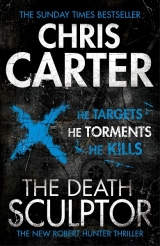
Текст книги "The Death Sculptor"
Автор книги: Chris (2) Carter
Жанры:
Полицейские детективы
,сообщить о нарушении
Текущая страница: 2 (всего у книги 28 страниц)
Five
Doctor Hove pulled down her surgical mask and faced Garcia. ‘He doesn’t know?’
Hunter’s eyebrows arched.
Garcia unzipped his coverall and reached inside his pocket for his notebook once again. ‘Let me talk you through what we know, but for you to fully understand it, I have to take you back to yesterday afternoon.’
‘OK.’ Hunter was intrigued.
Garcia read on. ‘Mr. Nicholson’s oldest daughter, Olivia, came by at around 5:00 p.m. Her younger sister, Allison, arrived half an hour after her. They had dinner with their father and kept him company until about 9:00 p.m., when they both left. After that, Melinda, the nurse, helped Mr. Nicholson into the bathroom, and then tucked him into bed, as she had done every weekend night. It took him about thirty minutes to fall asleep. She never left his side.’ Garcia indicated the chair on the other side of the bed. ‘She sat over there. She had some of her study books with her.’ He flipped a page on his notebook. ‘Melinda then turned off the lights, emptied the dishwasher downstairs, and at around 11:00 p.m. retired to her room in the guesthouse.’
Hunter nodded and his attention reverted back to the wall.
‘I’m getting there,’ Garcia said. ‘Melinda remembers locking all the doors, including the backdoor in the kitchen, but she can’t say the same about the windows. When I got here earlier this morning, two of the ones downstairs were unlocked, the one in the study and the one in the kitchen. LAPD First Response said they didn’t touch anything.’
‘So chances are they were open all night,’ Hunter said.
‘Most probably, yes.’
Hunter glanced over at the sliding glass balcony doors.
‘Those were left ajar,’ Garcia explained. ‘Apparently this room can get a little stuffy, especially during summer. Mr. Nicholson didn’t like air conditioning. The balcony overlooks the backyard and the swimming pool. The problem is, the entire wall outside is covered in Morning Glories – as you probably know, the most-common climbing plant in California. The wooden trellis that supports it is strong enough for a person to climb it. Gaining access into this room from the backyard wouldn’t be difficult.’
‘Forensics will be going over the backyard and balcony as soon as they are done with the house’s interior,’ Doctor Hove added.
‘At around midnight,’ Garcia continued, still reading from his notebook, ‘Melinda realized she’d forgotten one of her study books here in the room. She came back to the house, opened the front door and made her way up the stairs.’ Garcia guessed Hunter’s next couple of questions and offered an answer before he spoke. ‘Yes, the front door was locked. She remembers using the key to unlock it. And no, she didn’t notice anything strange when she came back into the house. No noises either.’
Hunter nodded.
‘Melinda came upstairs again,’ Garcia moved on, ‘and because she didn’t want to disturb Mr. Nicholson, and she knew exactly where she’d left her study book . . .’ He pointed to the mahogany writing desk pushed up against the wall . . . ‘on that desk, she never turned on the lights. She just tiptoed into the room, grabbed her book, and tiptoed back out again.’
Hunter’s stare moved back to the bloody wall next to the bed and his heart skipped a beat as Garcia’s account of what had happened finally started to make sense.
‘Melinda slept through her alarm this morning,’ Garcia carried on. ‘She got up, got ready as fast as she could, and rushed back in here. She said she opened the front door at 8:43 a.m. She checked her watch.’ Garcia closed his notebook and returned it to his pocket. ‘She came straight upstairs, and as she entered the room she was greeted not only by what you see here, but also by that message from whoever was in the room.’ He indicated the wall again.
Among all the splatters, written in large blood letters were the words ‘GOOD JOB YOU DIDN’T TURN ON THE LIGHTS’.
Six
An awkward silence took hold of the room. Hunter took a couple of steps towards the wall and studied the words and the lettering for a long moment.
‘What did the killer use to write this with, a piece of cloth soaked in blood?’ he asked.
‘That would be my guess as well,’ Doctor Hove agreed. ‘But the forensic lab will have a better idea in a day or two.’ She turned away from the wall and faced the bed once again. Her voice trembled with distress. ‘This defies belief, Robert. It’s beyond any case I’ve ever worked on. The killer spent hours in here, first torturing, then dismembering the victim. Not only that, but he then went on to create that thing.’ She pointed to the bloody sculpture. ‘And still found time to leave a message like this behind.’ She looked at Garcia. ‘How old is that girl again? The student nurse?’
‘Twenty-three.’
‘You, better than anyone, know that she’ll need months, maybe years of psychological treatment to get over this, Robert, if she ever does. The killer was in here when she came back for her book. If she had reached for that light switch, we’d have two bodies, and she’d probably be part of that grotesque thing.’ She indicated the sculpture again. ‘Her nursing career is over before it had begun, her psychological stability shaken forever. And the nightmares and the sleepless nights haven’t even started yet. And you know first hand how destructive that could be.’
Hunter’s insomnia was no big secret. He had started experiencing it at the age of seven, just after cancer robbed him of his mother.
Hunter was born an only child to very poor working-class parents in Compton, an underprivileged neighborhood of South Los Angeles. With no family other than his father, coping with his mother’s death proved to be a very difficult and lonely task. He missed her so much it was physically painful.
After the funeral he started fearing his dreams. Every time he closed his eyes he saw his mother’s face. He saw her crying, contorted with pain, begging for help, praying for death. He saw her once fit-and-healthy body so drained of life, so fragile and weak, she couldn’t sit up on her own strength. He saw a face that once had been beautiful, with the brightest smile he’d ever seen, transformed during those last few months into something unrecognizable. But it was still a face he never stopped loving.
Sleep became a prison he’d do anything to escape from. Insomnia was the logical answer his body found to deal with his fear and the ghastly nightmares that came at night. A simple defense mechanism.
Hunter had no reply for Doctor Hove.
‘Who in the world is capable of something like this?’ She shook her head in disgust.
‘Someone with a lot of hate inside,’ Hunter said quietly.
Everyone’s attention was diverted from the room by the loud shouts coming from downstairs. A female voice that was fast becoming hysterical. Hunter looked at Garcia with concern.
‘One of the daughters,’ he said and quickly started moving towards the door. ‘Keep this door shut.’ He exited the room, cleared the corridor in no time and reached the stairs going down. Standing at the bottom, being obstructed by two police officers, was a woman in her early thirties. Her wavy blonde hair was long and loose, falling halfway down her back. She had a heart-shaped face with light green eyes, prominent cheekbones and a small, pointy nose. The expression on her face was of pure desperation. Hunter got to her before she managed to break free from the officers.
‘It’s OK,’ he said, lifting his right hand. ‘I’ll take it from here.’
The police officers let her go.
‘What’s going on? Where’s Father?’ Her voice croaked with fear and anxiety.
‘I’m Detective Robert Hunter of the LAPD,’ Hunter said in the calmest voice he could muster.
‘I don’t care who you are. Where is my father?’ the woman said, trying to push past Hunter.
He subtly stepped back, blocking her path. Their eyes met for an instant and he gave her a delicate headshake. ‘I’m sorry.’
She closed her tearful eyes and brought a hand to her mouth. ‘Oh, God. Daddy . . .’
Hunter gave the woman a moment.
She paused and stared at Hunter as if something had suddenly dawned on her. ‘Why are you here? Why are the police here? Why is there crime-scene tape everywhere?’
Since Derek Nicholson’s doctors diagnosed his illness four months ago, his family had, in a way, been preparing themselves for his departure. His death was expected, and didn’t come as a real surprise to his daughter. Everything else did.
‘I’m sorry, I didn’t catch your name,’ Hunter said.
‘Olivia, Olivia Nicholson.’
Hunter had already noticed the faint, whiter patch of skin around her ring finger. She was either a recent widow, or a recent divorcee. Most widows in America are reluctant to get rid of their wedding rings and discard their husband’s name quickly. Olivia also looked too young to be a widow, bar some sort of tragedy. Hunter’s educated guess was – divorcee.
‘Could we maybe talk someplace more private, Ms. Nicholson,’ Hunter suggested, gesturing towards the living room.
‘We can talk here,’ she replied defiantly. ‘What’s happening here? What’s all this?’
Hunter’s stare moved to the two officers at the bottom of the stairs, who were listening attentively. Both quickly got the hint and moved away, towards the front door. Hunter’s attention returned to Olivia.
‘Your father’s illness didn’t take him.’ He waited for Olivia to fully absorb his words before continuing. ‘He was murdered.’
‘What? That’s . . . that’s ridiculous.’
‘Please, let’s have a seat somewhere,’ Hunter insisted.
Olivia breathed out as tears returned to her eyes. She finally gave in and followed Hunter into the living area. Hunter didn’t want to put her in the same room as the young nurse.
Olivia sat in the light-brown armchair next to the window. Hunter took the sofa opposite her.
‘Would you like a glass of water?’ he offered.
‘Yes, please.’
Hunter waited by the door while an officer fetched them two glasses of water. He handed one to Olivia, who drank it all down in large gulps.
Hunter took his seat again, and in a steady voice explained that in the early hours of the morning someone had gained access to the house and to Mr. Nicholson’s bedroom.
Olivia couldn’t stop shaking or crying and, understandably, was questioning everything.
‘We don’t know why your father was murdered. We don’t know how the perpetrator entered the house. At the moment we have a truckload of questions and no answers. But we’ll do everything we can to find them.’
‘In other words, you don’t have a clue what happened here,’ she fired back angrily.
Hunter kept silent.
Olivia stood up and started pacing the room. ‘I don’t understand. Who’d want to kill my father? He had cancer. He was . . . already dying.’ Her eyes filled with tears once again.
Hunter still said nothing.
‘How?’ she asked.
Hunter looked at her.
‘How was he murdered?’
‘We’ll need to wait for the coroner’s autopsy examination to positively identify cause of death.’
Olivia frowned. ‘So how do you know he was murdered? Was he shot? Stabbed? Strangled?’
‘No.’
She looked perplexed. ‘So how do you know?’
Hunter stood up and approached her. ‘We know.’
Her eyes moved back to the staircase. ‘I wanna go up to his room.’
Hunter gently placed a hand on her left shoulder. ‘Please, trust me, Ms. Nicholson. Going into that room won’t settle any of the questions you have. It won’t ease your pain either.’
‘Why? I want to know what happened to him. What aren’t you telling me?’
Hunter hesitated for a moment, but he knew she had the right to know. ‘His body was mutilated.’
‘Oh my God!’ both of her hands shot to her mouth.
‘I know you and your sister were here last night. You had dinner with your father, right?’
Olivia was shaking so hard she could barely nod.
‘Please,’ Hunter said. ‘Let that be the last memory you have of your father.’
Olivia exploded into desperate sobs.
Seven
Hunter and Garcia got back to their office on the fifth floor of the Police Administration Building in West 1st Street in the middle of the afternoon. The PAB was the new operational headquarters for the LAPD, substituting the nearly 60-year-old Parker Center building.
After hearing the news, Captain Barbara Blake had also come in on her day off and was waiting for both detectives with a parade of questions.
‘Is it true what I heard?’ she asked, closing the door behind her. ‘Someone dismembered the victim?’
Hunter nodded and Garcia handed her a bunch of photographs.
Barbara Blake had been the Robbery Homicide Division captain for the past three years. Handpicked by the ex-captain himself, William Bolter, and sanctioned by the mayor of Los Angeles at the time, it didn’t take her long to gain a reputation for being a no-nonsense, iron-fist captain. Blake was an intriguing woman – stylish, attractive, with long black hair and cold dark eyes that could make most people shiver with a simple stare. She wasn’t easily intimidated, took shit from no one, and didn’t mind upsetting high-powered politicians or government officials if it meant getting the job done.
Captain Blake flipped through the photographs, the look on her face growing more worried with each picture. As she got to the last one, she paused and held her breath.
‘What in God’s earth is this?’
‘A . . . sculpture of some sort,’ Garcia answered.
‘Made of . . . the victim’s body parts?’
‘That’s right.’
Silence ruled the room for the next few seconds.
‘Is it supposed to mean anything?’ Captain Blake asked.
‘Yes, it means something,’ Hunter said. ‘We just don’t know what yet.’
‘How can you be so sure it means something?’
‘Because if you want someone dead, you walk up to them and shoot them. You don’t risk the time it takes to do something like this unless the whole act has a meaning. And usually, when a perpetrator leaves something that significant behind, it’s because he’s trying to communicate.’
‘With us?’
Hunter shrugged. ‘With somebody. We’ll need to figure out its meaning first before we know.’
Captain Blake’s attention returned to the picture. ‘So that would mean that this wasn’t random. The killer didn’t just put this thing together in a burst of sadistic inspiration right there and then?’
Hunter shook his head. ‘Very unlikely. I’d say the killer knew exactly what he would do with Derek Nicholson’s body parts before he killed him. He knew exactly which body parts he needed. And he knew exactly what his horror piece would look like when finished.’
‘Great.’ She paused. ‘And what does this mean?’ The captain showed them a picture of the bloody message left on the wall.
Garcia ran her through the whole story. When he was done, Captain Blake was uncharacteristically lost for words.
‘What the hell are we dealing with here, Robert?’ she finally said, handing the pile of photographs back to Garcia.
‘I’m not sure, Captain.’ Hunter leaned against his desk. ‘Derek Nicholson was a prosecutor for the State of California for twenty-six years. He put a lot of people behind bars.’
‘You think this could be retaliation? Who the hell did he send to prison, Lucifer and the Texas Chainsaw Massacre gang?’
‘I don’t know, but that’ll have to be our starting point.’ Hunter looked at Garcia. ‘We need a list of everyone Nicholson has put behind bars – murderers, attempted murderers, rapists, whoever. Let’s prioritize by anyone who has been released, paroled, or made bail in the past . . .’ he thought about it for a moment, ‘fifteen years . . . and also by severity of crime. Anyone he put away for any type of sadistic crime comes first.’
‘I’ll get the research team on it,’ Garcia confirmed, ‘but it’s Sunday. We won’t get anything until maybe tomorrow evening.’
‘That’s fine. We’ll also need to crosscheck whatever names we get with a list of their immediate family members, relatives, gang members, or whatever; anybody who could be capable of going after Derek Nicholson for revenge on someone else’s behalf. There’s a chance this could’ve been indirect retaliation. Maybe the person Nicholson sent to prison is still there . . . maybe he died in prison, and somebody on the outside is after payback.’
Garcia nodded.
Hunter reached for the pile of photographs and spread them out on his desk. His stare settled on the one with the sculpture.
‘How did the perpetrator put that thing together?’ the captain asked, joining Hunter by his desk.
‘He used wire to hold the pieces in place.’
‘Wire?’
‘That’s right.’
She bent over and studied the photograph again. A sudden chill ran the length of her body. ‘And how do you suppose we’ll figure out what this thing means? The more I look at it, the more freaky and incomprehensible it seems.’
‘The forensics lab will create an exact replica for us. We might bring in one or two art experts and see if they can make anything of it.’
In all her years in the force, Captain Blake had seen the most unimaginable things when it came to killers, but nothing like this. ‘Have you ever seen or heard of a crime scene like this one?’ she asked.
‘I know of a case where the killer used the victim’s blood as paint to create a canvas,’ Garcia offered, ‘but this is in a league of its own.’
‘I’ve never heard or read about anything like this,’ Hunter admitted.
‘Could the victim have been random?’ Captain Blake asked, glancing through the notes Garcia had jotted down. ‘I mean, it looks to me that the sadism of the act, and the creation of that grotesque thing, is what was most important to the killer, not the victim himself. The killer could’ve picked Nicholson because he was an easy target.’ She flipped a page on Garcia’s notebook. ‘Derek Nicholson had terminal cancer. He was weak and practically bedbound. Totally defenseless. He couldn’t have screamed for help if the killer had given him a megaphone. And he was alone in the house.’
‘The captain has a point,’ Garcia agreed, tilting his head from side to side.
‘I don’t buy that,’ Hunter said, moving away from his desk and approaching the open window. ‘Derek Nicholson was an easy target, I agree, but there are plenty of easier targets in a city like Los Angeles – tramps, homeless people, drug addicts, prostitutes . . . If the victim made no difference to the killer, why risk breaking into an LA prosecutor’s home and spend hours doing what he did. Also, he wasn’t that alone in the house. His nurse was in the guesthouse above the garage, remember? And as we know . . .’ he tapped the photograph that showed the message on the wall, ‘. . . she walked in on the killer. Thankfully she didn’t turn on the lights.’ Hunter turned and faced the room. ‘Believe me, Captain, this killer wanted this victim. He wanted Derek Nicholson dead. And he wanted him to suffer before he died.’
Eight
Instead of playing volleyball in Venice Beach or catching a Lakers game, Hunter spent the rest of his day carefully studying all the crime-scene photographs, with one question coming up all the time.
What in the world did that sculpture mean?
He decided to go back to Derek Nicholson’s house.
The body, together with the morbid sculpture, had been taken to the coroner’s office. All that was left behind was a sad and lifeless house full of grief, sorrow and fear. Derek Nicholson’s last few hours alive were splattered all over his room, and it all spelled only one thing – terrifying pain.
Hunter stared at the message the killer left on the wall and felt an empty hole grow inside him. The killer took Derek Nicholson’s life, and in the process devastated three others – both of Nicholson’s daughters’ and the young nurse’s.
The forensic team had lifted at least four different sets of fingerprints from the house, but analysis would take a day or two. They’d also collected several hair and fiber samples from the room upstairs. Hours of sieving through it, the backyard and trellis on the outside wall of Derek Nicholson’s room gave them nothing. There were no signs of forced entry. No windows had been broken, no latches damaged, no doors or locks tampered with, but then again, Melinda Wallis, the weekend nurse, couldn’t remember if she’d locked the backdoor. Two of the windows downstairs had been left unlocked overnight, and the balcony door that led into Mr. Nicholson’s room was left ajar.
Hunter had tried talking to Melinda Wallis, but Garcia had been right, she was psychologically shutting down. Her brain was struggling to cope with the shock of discovering Derek Nicholson’s body inside a room bathed in blood, but more than that, her mind was doing its best to shelter her from the knowledge that she had been only a hair away from death.
Hunter spent all of his time back at the house studying the room upstairs, looking for clues that he might’ve missed earlier on. He didn’t find anything the forensics team hadn’t already found, but the savagery of the scene was more than disturbing. It was like the killer had made a point of splashing blood all over the room.
The message left on the wall wasn’t part of the original plan, but a last-minute act of cocky defiance. The entire scene seemed like a display window for the killer’s anger and senselessness, and that bothered Hunter.
Night had already fallen by the time Hunter got back to his apartment. He closed the door behind him and rested his tired body against it. His eyes scanned the dark and lonely living room, and in his mind he debated if staying in tonight was such a good idea.
Hunter lived alone, no wife, no girlfriends. He’d never been married, and the relationships he had never lasted that long. The pressures that came with his job and the commitment it demanded always seemed too much for most to understand. He didn’t mind being by himself. Living alone didn’t bother him either. But after spending most of the day surrounded by death and walls stained with blood, the loneliness of his small apartment was the last thing he needed.
Los Angeles nightlife is amongst the liveliest and most exciting in the world, with a spectrum of choice that goes from luxurious and trendy nightclubs, where A-list celebrities hang out, to themed bars and dingy, sleazy underground venues, where the freaks come out to play. Whatever mood you find yourself in, you’re sure to find a place in LA to suit it.
Hunter made his way to Jay’s Rock Bar, a dive just two blocks away from his home. It was one of his favorite drinking spots, with a great Scotch selection, a jukebox overflowing with rock music, and friendly, full-of-life staff.
Hunter sat at the bar and ordered a double dose of 12-year-old GlenDronach with two cubes of ice. Single-malt Scotch whisky was his biggest passion, and though he had overdone it a few times he knew how to appreciate its flavor and quality instead of simply getting drunk on it.
Hunter had a sip of his whisky and allowed its smooth hazelnut, oaky flavor to fully develop in his mouth. The bar was busy enough, and after what he had seen today he was glad to be amongst people laughing and enjoying themselves.
A group of four women sitting at the table closest to Hunter were discussing the worst pick-up lines they had ever been approached with.
‘I was in a bar in Santa Monica one night,’ the short-haired blonde one said, ‘and this bald-headed guy came up to me and said –’ she put on a baritone voice – ‘“Baby, I’m no Fred Flintstone, but I can make your Bedrock!”’
Two seconds of stunned silence from the group was followed by loud laughter.
‘That’s just plain lame,’ the youngest-looking of them said. ‘But I got something that’ll beat that. Last weekend, I was in Sunset Boulevard, and someone came up to me in broad daylight, in the middle of the street and said: “Honey, your name must be Gillette, ’cos you’re the best a man can get.”’
The group laughed again.
‘OK, OK,’ the long-haired brunette said, ‘that one has got to take the medal. I’ve never heard anything so bad in all my life.’
Hunter agreed and smiled to himself. That had been the first time he’d smiled all day.
‘Another one?’ Emilio, the young Puerto Rican bartender asked Hunter, nodding at his empty glass.
Hunter’s attention moved from the four women to Emilio, and then to his glass. He felt tired, but he knew that if he went back home now he wouldn’t fall asleep. He barely slept anyway. His insomnia made sure of that.
‘Sure, why not.’
Emilio poured him another double dose and dropped one more cube of ice in his glass. Hunter watched it crack as it hit the light brownish liquid. A man sitting at the end of the bar in a battered gray suit coughed a throaty, smoker’s cough and Hunter’s mind went back to Derek Nicholson and the case. Why kill someone who was already dying of lung cancer? Someone who was already condemned to such a painful death? One, maybe two more months at the most, and his cancer would’ve finished him off anyway. But the killer couldn’t . . . wouldn’t allow that to happen. He wanted to be the one delivering the fatal blow. The one looking into Nicholson’s eyes when he died. The one playing God.
Hunter had a sip of his drink and closed his eyes. He had a bad feeling about this case. A really bad feeling.