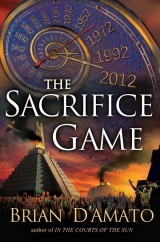
Текст книги "The Sacrifice Game"
Автор книги: Брайан Д'Амато
Жанры:
Триллеры
,сообщить о нарушении
Текущая страница: 7 (всего у книги 45 страниц)
(14)
The car at the head of the drive-thru line-a first-generation Equinox in Navajo Nectarine-had its window down, I guessed waiting for the rest of its order, and I edged forward to where I could see the driver.
A woman. Young. Plain. White. Fat. Bewildered by life.
Perfect.
Okay. Plan Um.
I held up the flashlight in that underhand cop style and flicked it on.
I don’t think I’ve mentioned this, but actually I have a pretty deep voice. “Police emergency!” I said, in as authoritarian a basso as I could manage while also reining in my chattering teeth. I flashed my American Malacological Society membership card. “License and registration, please.”
She obeyed. The license said she was Miss Kristin Dekey, 24, of Winter Haven, not that I cared, but I felt I had to look at it long enough to seem official. I tried to hand it back but she was fumbling in the between-seats thingie for the registration. The woman in the passenger seat blinked at me. She looked enough like her to be her twin sister, except all crackers look alike to me, so who knows. “I’m sorry, I can’t,” Kristin was saying, “I’m sorry, I have um, I have a proof of insurance, here, I’m not sure, the registration, I’m not sure where the registration is, is this going to be enough to, I’m sorry-”
I took the piece of paper. Pretending to look at it used up twenty seconds, but when you’re impersonating, it’s a good idea to get the subject used to the idea that you’re who you’re pretending to be before you tell them to do something unfamiliar. And the best way to do that is to put them through whatever rituals are most familiar. If you do it right, even if you’re, say, a five-foot Chinese teenager in a Gothlita dress-or if, like me, you’re covered in blood and your hair is smoldering and there’s smoking bloody charcoal scab all over your face-by the time they sign the report they’ll swear you were six foot six, wearing a full police captain’s uniform, and looked like Clint Eastwood.
I gave the paper back and took out the larger of my still-jammed phone. “One Adam thirteen,” I said into it. “I am in pursuit of suspect in a civilian ve hic le, over. Ma’am, you and your passenger must exit your ve hic le.” As normals usually do, she obeyed. Her vehicle mate took longer but also got out. Instead of both backing up, though, they sort of sought each other out and met in front of the car, standing there like they were going to confer about something. I got in and leaned over the open door.
“Ma’am, for you own safety, please step away from your vehicle.” She did. I said the same thing to her twin. Her twin did the same thing. Then, she thought of something.
“Are you hurt?” she asked.
“Hey, are you really a policeman?” Kristin got it together to ask, too late. I got in the rest of the way, slammed the door, reached over and slammed the passenger door, found the thingy that locks all the doors, locked all the doors, got the thing in gear, and took off.
Ahh. Freedom. I Oh, hell, I thought. I’d left my hat back in the kitchen. I thought of going back for it, realized that was ridiculous, and then got worried that just the fact that I’d considered it meant I wasn’t thinking clearly. Focus, Jedface.
Up the ramp. On the off ramp, on the other side of the highway, my abandoned Barracuda was lit up with halogen light. Above it, a helicopter swept a second light around the car in a widening spiral. Hah, I thought. They’re way behind. Way.
Onto 400. Forward. Upward. Ad astra per atrocitas. I adjusted the seat and wheel to suitable positions for nonporkers. The highway straightened out and pointed the Equinox toward the burnt-orange glow over the No-Go Zone. My hands were still shivering and my teeth were still chattering, and I was tired and light-headed, but I wasn’t quite in shock yet, and if I held on to the four quarts or so I had left, and if I kept making adrenaline, I’d keep going for another few hours. Just need to be supercareful until I find a dealer… well, the last time I heard they were selling blood packets there, so they ought to be able to get factor IX too… and maybe some thrombogen, a few burn packs… top up the O negative… hmm, while I’m at it, pick up some Oxy or at least some Hydro, and a saltshaker of the old benzoylmethylecgonine. Maybe a Glock 36 and couple of Heizer DoubleTaps, and a few hundred rounds of HydraShok. And a papered ride, of course. I just had to stay ahead of the ES people. And the way I’d set it up I knew I’d manage it. Finally my paranoia was coming in handy. I’d set up four different legends, of varying degrees of detail and remoteness, and if I cycled through all of them over the next few weeks they’d never catch up. ES was top-shelf, but nobody’s resources are unlimited. Of course, they’d be using the Game to find me, but I’d be using it to stay ahead of them. And I’d be doing it better.
I passed a row of abandoned detoxification trailers and a tossed-aside ROAD CLOSED barrier. There were more cars here, all heading to the twenty-four-hour cop-free party zone. The fugitive’s first rule is that the more people there are around, the harder it is to find the one you’re looking for.
Past eighty. Hmm. There’s a slow-pokin’ cat. I passed him on the right. I voiced the car’s “radio” onto commodities news. The Dalian and Zhengzhou had both just suspended trading. The fourth domino had tipped over right on schedule. Well, it’s out of my hands. Need to just sit back and wait.
EOE, I thought. Well, they deserve it. Factor IX indeed. They’d been planning to kill me for a long time.
And she knew it.
Marena was no damn good.
People were no damn good. Even dogs were no damn good. Even lichens were no damn good. I’d done the right thing. I was doing the right thing. I let myself feel a full blast of elation, not just the kind that comes after you make a narrow escape, but the deeper kind you get when you know your future’s assured. By the time I passed the abandoned checkpoint, I knew I’d make it. Mission good as accomplished. Fifty-two days left. Or, counting down by seconds:
Four million, four hundred and ninety-two hundred thousand and eight hundred…
Four million, four hundred and ninety-two hundred thousand, seven hundred and ninety-nine…
Four million, four hundred and ninety-two hundred thousand, seven hundred and ninety-eight…
Four million, four hundred and ninety-two hundred thousand, seven hundred and ninety-seven…
ONE
The Scorpio Carfax
Jaguara Skull with Jade Sphere
Recovered at the Ruins of Ixnichi Sotz
Curious Antiquities of British Honduras
By Subscription Lambeth • 1831
(15)
T he world had ended eight days ago, just as Lady Koh had predicted, on 4 Earthtoadess, 5 Vampire Bat, 9.1 1.11.12.17-or, in Gregorian terms, on May 1, AD 664. Or, at least, almost everyone here-and I really mean almost everyone, that is, the entire population of Mesoamerica and large swaths of North and South America-believed that it had. Today, the eighth in the new lineage of suns had just died at 289 degrees west by southwest, and still the light on the Altiplancie Mexicana, that is, the altiplano, the Central Mexican Highlands-was a disconcerting diffuse maroon, like they say daylight looks on Venus, hadn’t changed since dawn, and it was the same as it was yesterday and the day before. The faint path curved around a stand of scrub pines and up a gentle grade toward a line of wrinkled mesas. We hadn’t seen a living person for at least a thousand rope-lengths now-a little over four miles. And we hadn’t seen a dead one for least three hundred. At least not a whole dead one. Just a few odds and ends.
We still smelled them, though. It was really true that you never got used to that cadaverine foulness, the indescribable foetor that the 1945 generation brought back from the camps riveted in the snuggest fold of their brains and which they wanted to forget more than any other memory. Rotting flesh, burning flesh, and burning rotting flesh. It’s not just the worst smell in the world. It’s truly the worst thing at all in the world. And this is in a world that’s full of unsavory things.
Thousands, and thousands, and thousands, I thought. And more thousands. Poor bastards. Well, bless ’em. Even before this latest apocalypse, I’d estimated that suicide was at least the second main cause of death around here-second to starvation, that is, not counting deaths in childbirth-and now it was obviously a strong number one. And it probably would be for the fore Oops, I thought. If there’s one cliche I of all people really ought to give up, it’s “the foreseeable future.” Let’s just say the self-immolations would go on for a good long time. Thousands, and hundreds of thousands. In the seventh century-that is, now-Central Mexico had the largest and densest concentration of people in the New World and one of the densest in the world. There were thousands of villages and scores and scores of-hmm, I said scores, so I guess I’ve already been here long enough to start thinking in base 20-and dozens and dozens of full-scale hundred-thousand-plus-population cities. Corn was simply a hugely efficient, labor-unintensive crop, and a corn economy left people enough time to build purely ceremonial buildings, craft meticulous luxury goods, maintain troops of full-time athletes and entertainers, squander food in potlatch orgies, and kill, capture, torture, and sacrifice each other not out of any necessity but just for the sheer kicks. According to Michael Weiner, the Warren Group’s resident Mayanist, population here would have doubled in the last forty years, and in the next forty, despite the dip of the last few days, it would double again. Still, right around here, settlement was patchy. The populous river valleys were separated by wide swaths of near-desert, and up here we were in a high area without aquifers, on crappy soil that would never be cultivated. So it was on the Chocula team’s map of good areas to bury the gear. Although the gang would be amazed that I’d come this far from Ix. They Jeg jeg jeg jeg jegjedjwhzzeeew?
It was the long guggle of a nightjar.
Jeg jeg jeg jeg jegjegjegjedjwhzzzeeeew?
To almost anyone, even to a Mesoamerican who wasn’t a member of our sixty-two-man column, it would have sounded natural. But it came from one of our front-runners, or I guess we can call them recon men. They were fanned out about forty rope-lengths, or ten minutes’ walking, ahead of us.
Jeg jeg jeg jeg jegjegjedjwhzzeew?
Jeg jeg jeg jeg jegjegjegjedjwhzzzeeeew?
The call itself meant that there was a crossroads four hundred paces ahead of us, and repeating it four times meant all-clear in all four directions. Good.
A red deer darted across the path ahead, redward, that is, eastward, running away from the fires. One of the guards behind me must have looked like he was going to throw a javelin at it, because I heard Hun Xoc give a let-it-go whistle. We weren’t here to hunt. Anyway there were still so many animal refugees running in front of the fires you could net almost anything you wanted, field rats, jumping mice, hares, rabbits, armadillos, ocellated turkeys, quail, and even Mexican silver grizzlies. You’d have thought the villagers around here would have trapped and eaten them already, but I guess they believed they wouldn’t need food. After all, the world was still ending.
There was-were? – was a handful of skeptics, of course, master manipulators like Lady Koh or my adoptive stepfather, 2 Jeweled Skull. Or even Hun Xoc, who was pretty sharp. Or myself, who doesn’t count. But the bulk of the public had either been reborn-like Koh’s trail of eighteen thousand or so followers-or raptured, like the millions who had killed themselves or died in the fires or who were now starving to death or dying in interpolity raids.
Step. Step. Steppedystepstepstep. The pines gave way to ocatillo and prickly pear. Every so often we passed giant century plants, some of them two stories tall, like frozen land-mine explosions, with sawtoothed leaves that were so thick and wide you could walk out on them and bounce up and down like you were on a diving board. There Huh. I saw something.
Stop, I touched on Hun Xoc’s back. He touched the blood in front of him and the order to halt traveled through the three bloods ahead of him. Around here-I mean in Mesoamerica-the ranking hotshot usually came last. But on this job, the senior blood, Hun Xoc, was breaking protocol by marching near the head of the file, and he kept me behind him. Oh, by the way, “blood” is a literal translation, but it does work in English. Or Elizabethan English, anyway, like “young blood.” “As many and as well-borne bloods as those,” as I guess King Philip says. In Ixian it could mean any warrior-age male from one of the “great houses,” that is, from the ruling class.
The halt rippled back down our column, through fifty-seven other men all the way to the rearmost, the last of the four sweepers raking over our trail. I signed to Hun Xoc that I was going on alone. He edged aside, reluctantly, and tilted his head, asking me to be more careful. The bloods in the vanguard closed around me, but I pushed through them. Did they not see anything? I widened my eyes into the unnatural dusk.
A figure sat at the crossroads, a hundred paces ahead of us. A man. A man with a cigar. It wasn’t as though he materialized, and in fact he looked like he’d been lounging there a long time, but I’d just looked there a few beats before-when you’re marching, you develop a rhythm of looking at your feet, and then look around, and then look ahead of you, and then repeat-and I hadn’t seen him. And none of our forerunners had noticed him or they would have given us an owl screech.
I turned and signed to the sitz’, the fourteen-year-old boy, behind me. His provisional, preadulthood name was Armadillo Shit, and he was my k’ur chu’, my “fellator,” or I guess if we want to be delicate we can call him my squire. Or if we want to be indelicate we could call him my bitch. Every blood had at least one. It was kind of a Spartan erastes – and– eromenos system. The k’ur chu’ob who survived all the hazing-about forty percent, I figured-would, eventually, get admitted into whatever society it was, in this case the Harpy Ball Brethren Society. Like jonokuchi Sumo wrestlers, they did everything for us, including, shall we say, wiping.
He came up alongside me and spat drinking water into my eyes. I rubbed my face dry on his manto and looked again. The figure was still there. He wore a long orange-and-black-striped manto and a wide straw traveling-trader’s hat, almost a sombrero, that gave him an incongruous nineteenth-century-European-peasant look.
I walked forward, alone. The gentleman readjusted his hindquarters on the dessicated and defanged barrel cactus, took a deep drag on his cigar-it was a green Palenque-style stogie as thick as a Churchill-and studied me.
Hmm. He looked familiar.
I switched my gait to the deferential Ixian halt-step and then stopped four paces from him.
He let out a snake of blue smoke. I squatted, and touched the ashy ground. He didn’t speak, so I did.
“Salud, Caballero Maximon,” I said, and then, remembering when we were, I saluted him again with his older name: “X’taca, halach ahau Mam.”
He answered in Spanish, though. “Hola, cabron. Estas que Cholano gringo de San C.”
I clicked yes. His Spanish was rustic but awfully good for someone who, technically, probably hadn’t spoken it regularly for twelve hundred years.
“Estan buenas Piramides. ”
“?Perdon?” I asked. Oh, right, the cigars I’d given him back in San Cristobal Verapaz. Back in the twenty-first century. “Ah, cierto. Claro, yo soy…”
“Maybe you can score me some more of those sometime.”
“Oh, seguramente. I’ll go by the Great House humidor in BC.”
“Buen reparto,” he drawled, after largely resolidifying. The way he talked about it, it sounded like it had happened yesterday, not thirteen hundred and forty-eight years in the future. Although that’s how it is with guys like that, time just-or I guess you could call him a deity, although the English word doesn’t get the flavor, and anyway in the old days, to be polite, we just called them “smokers”-the deal is, with beings like that, time just rolls off them like scandal off Reagan. He took a long drag and blew out a plume of smoke that uncoiled as slowly as a satiate python.
Damn, I thought, now this is what you call a strong hallucination. As soon as the idea came to me, though, Maximon seemed to fade a bit, so I put it out of my mind. He might still come up with something of value. The thing was, there’s more in your mind than you realize. And when you’re in someone else’s mind, like I was, the whispers just keep on coming. And some of them strengthen into voices, and some of those solidify into, well, into something like I’d just seen. And some of those – not most, because then you’d be just another crazy person, but some-can be worth paying attention to. Especially in a place like this. Like everybody’s here in the old days, Chacal’s brain didn’t think hunches and insights came from within. They came from the smokers, like Maximon. And sometimes the smokers saw something in your head that you’d forgotten, or that you’d never noticed, but which was still something real.
“So,” Maximon asked, “how did you make your way to this glittering b’aktun?”
“I sent myself here,” I started to say, “into the skin of this hipball player, as you see-”
“What self is that?” he interrupted.
“Well, I mean, yes,” I said. “It’s not exactly my self, it’s that my memories, they got…” Damn. I tried the word pach’i, “printed,” like in a seal on wet clay: “They got printed and sent back here.”
“What are we in back of?” he asked.
“Well, that’s true,” I said, “we’re not really in back of anything, I mean, to here, earlier, than…”
I trailed off. “Llllll,” he went. It was the Mayan equivalent of “Hmm.”
“I still have Chacal’s brain,” I stammered out. “But it has the higher-level type of my twelfth-b’aktun memories, from Jed.” It was all the things that had happened to me, I explained, all the English and Spanish skills, the emotional habits, everything that made me think I was Jed DeLanda, and it had all been downloaded out of my head, encoded into a form somewhat like a holographic film image, and directed at a target brain, wiping out that brain’s own higher-level memories in the process. As far as current understanding of the universe went, it was the only possible process that was even close to time travel-a term that, by the way, we avoided, the way intelligence pros won’t use the word spy.
He took another monster inhale. Did he get it? I wondered. Or did it all sound like nonsense? Or did he know it all already? I can’t do this forever. Somehow-and Chacal’s reflexes were a phenomenon I’d come to heed, without understanding them-I felt the troop was getting restless. Wait, I signed behind me. The sense of motion on the hairs of my back faded and disappeared. One good thing around here was you could talk to the air and people wouldn’t think you were crazy, but just in tune with one of the folk of other levels, the Unheard, Unsmelled, and Unseen.
“So,” he asked, “are you Jed or Chacal?”
(16)
The words came out as smoke. Or, rather, what happened was, the smoke from his cigar contorted into a rising pillar of Ixian cursive glyphs, and at some point I noticed that I wasn’t hearing him speak, but just reading the vertical column.
“I don’t know,” I said. It was a question I’d been asking myself a bit lately, in a different way. At first, of course, I’d felt like I must still be pretty much like the Jed, for clarity let’s keep the convention and say Jed 1 – who’d stayed back-“back”-in 2012. But things happened to me, and I saw things, mainly disturbing things, and I did things-not all, or not even mainly good things. And I guess I’d changed because now, when I thought about the other Jed, the one we’re calling Jed 1, I thought of him as, well, not as a total dolt, maybe, but certainly as a lucky but clueless naif who wouldn’t know shit from Shinola, and it was only going to get more so, even if I got-hmm, I was going to use the word back again, but it’s bugging me. And, come to think of it, what does Shinola look like? Maybe I don’t know so much as I “And so,” he asked, “what ill chance has brought you into this vexed wilderness?”
“I came to plant a message in the Earthtoadess,” I said.
“You mean for your n’aax caan ”-the expression meant something like “favorite dominatrix” or “pussy-whipper prostitute”-“in the thirteenth b’aktun.”
Uh, right, I grunted. Should I offer him something? I wondered. What did we have with us? We’d brought jade celts worth about six hundred adolescent male slaves, just in case we had to trade our way out of something, but I didn’t think he’d want them.
“That Marena of yours, tia buena, ” he said, smacking his lips once.
I just nodded. How did he know about that? I wondered. Well, I guess he knows a lot. Not everything, like Jehova would, but still a lot. You’ve got to watch this guy around the ladies. I remembered something my mother had told me when I was six or so, how in her hometown in Honduras, back when her grandfather was young, one day all the men went off to fight the Spanish and left Maximon at home to protect the women, and then when the men came back, the women were all pregnant. So the men flayed Maximon alive, and hung his skin on a monkey-puzzle tree. But the women were so devastated that they made the men set up his effigy in the church. And then he didn’t stay dead for long anyway.
“So you need to find a quiet spot,” Maximon said.
“Yes. Exactly.”
“Quiet for how long?
“Like, four b’aktuns,” I said. About fourteen hundred years.
He raised his head and, leisurely-ly, looked over his left shoulder, toward the west. You could just see a low orange smudge, not the sun but the reflection of Coixtlahuaca, the nearest of the hundreds of cities burning in sympathy with the destroyed capital, Teotihuacan. Lady Koh’s caravan was between us and the city, back almost half a k’intaak– that is, a jornada, a day’s journey. We couldn’t go much farther if we were going to come back and meet up with them before dawn. And we couldn’t be walking around like this in daylight, even if the daylight was going to be as dim as twilight. Some village bumpkins would still be alive somewhere, and they’d spot us, and the word would get back to one of the Puma Clan’s hit squads, and that would be it. They’d have our guts for G strings. On the other hand, if the gear was going to keep for thirteen centuries before Marena dug it up, it would have to be pretty damn out in the boonies. Dang, darn, damn.
“Lllll,” Maximon went. He took another drag and blew a smoke snake that read, with the formal, archaic voice of written Mayan, “I would try up yonder.” He pointed northeast with his lip toward a pair of twin mesas. “No one ventures there.” He used a continuing indefinite tense that meant not now, not before now, and not ever. “Even our grandfather Rucan 400 Shrieks”-that is, the east-going Whirlwind-“refuses to dance there.” I almost didn’t get the last part because as soon as I was reading each word, it would start dissolving.
“Okay, buen consejo. Thank you, senor.”
“No problemo,” he said. He said it orally this time, and in Spanish. And the abruptness suggested that the interview was over, but I hesitated.
“Yes?” he asked, a little impatiently.
“Oh, I was, I was just wondering if you over me might have noticed anything farther down the road.”
“You mean the road to Ix?”
“Well…” I said.
I was getting the feeling that he knew the answer already, and was asking me just to see how honest I was, or how I’d justify what I was doing.
“… yes,” I finished. It was supposed to be a secret-that is, when we got into the lowlands we were going to lead the people to Ix and not toward Palenque like Lady Koh had given out.
“You’d better watch out for the Pumas and the rest of the pack,” he said.
I know that, I thought. But I just clicked-an Ixian gesture that meant “yes”-and then, redundantly, nodded.
By pack he’d meant, like, “pack of cats.” That is, the remnants-numerous remnants, I should say-of the feline clans of Teotihucan and its hundreds of satellite cities. They’d regrouped after the unpleasantness and were out gunning for Lady Koh and anyone connected with her.
“We’ll manage it,” I said. Be confident. Chicks and gods dig confidence. And it was true, right now I was ahead of the game. Especially with this Lady Koh thing. I knew a star when I saw one. She already had her eighty thousand-plus people under her little blue thumb. And she was just getting started. And for whatever reason of her own, to the extent that she understood my plans to preserve the Sacrifice Game and get myself back to the last b’aktun, she approved of them. “And I’m going to get the hell back too.”
This time he didn’t ask “Back to where?” and I was sure he understood that I meant back to the twenty-first century. If one can use the word understand in this context.
“You’re not worried about Severed Right Hand?” Maximon asked.
Zing. Maybe I’d sounded a little too flip there. Watch it.
Hmm. Severed Right Hand’s name had come up around Koh’s council mat, but he was kind of a shadowy figure. Supposedly he’d been a junior member of the synod of the red moiety of Teotihuacanian, that is, the war clans, and he owned only two bundles of pink reeds-that is, he was only eighteen years old. Yesterday, according to Lady Koh’s G2, he-well, of course we didn’t call them G2, we called them b’acanob, “whisperers”-hmm, let’s say, according to our intelligence units, he’d already killed the remaining patriarchs of his own Swallowtail Clan, and had captured the next two Puma duarchs and most of the surviving synodsmen.
“Maybe I should be much more worried,” I said.
“Severed Right Hand is quite energetic,” Maximon said. “And he’s just adopted another twenty-eight thousand bloods.”
I clicked three times, respectfully, meaning, “Please go on.”
Maximon said that Severed Right Hand was now commanding at least four thousand veintenas, that is, platoons of twenty. About fourteen thousand of those were full bloods from the Puma clans. They were experts with the javelin launcher, the Teotihuacanian signature weapon, and they’d be the hardest to fend off if there was a direct battle. He’d set up his mobile headquarters at Tehuacan-which, despite the similar name, was not the same as, or even a satellite town of, Teotihuacan. It was two jornadas due whitewards, north, of us. He’d brought along what was left of the city’s council of four hundred, which he now dominated. And he’d sworn to capture all the Rattler’s Children and give their heads and skins to the Green Hag, a sort of fresh-water elemental who’d been the elder patroness of Teotihuacan.
Severed Right Hand was claiming that Koh-or, as she was now styling herself, the Great-Elderess of All Star Rattler’s Children-hadn’t just foretold the city’s destruction, but had caused it. The claim had the advantage of being basically the truth, although this hadn’t seemed to have hurt Koh’s standing with her own followers. Even our cleverer clan leaders, the ones who’d gotten the gossip about her machinations, seemed more loyal to her than ever. So even though the official motive for the now-unavoidable civil war was, as always, revenge, it was revenge in the Maya sense of capturing Koh’s uays.
More specifically, Teotihuacan had been like the Lourdes, Jerusalem, Rome, and Mecca of Mesoamerica, and anyone who could have destroyed it was vastly powerful. If Severed Right Hand captured Koh and, through torture, annexed her uays-her most active souls-her powers of prophecy and domination would accrue to him. Her former followers would be constrained to obey him, since his uays would hold hers within his skin. He would become both the avenger of the destruction of Teotihucan and its prime beneficiary.
But even with all that, the main reason they were after us, like the real reason for almost anything, was economic. The displaced Puma clans had lost most of their wealth and they needed negotiable items to trade for new homesteads. And every family in our volkerwanderung had brought as much of their high-value gear as they could drag, jewelry, celts, top-grade blades and obsidian cores, textiles, feathers, furs, raw jade, gold dust, and even some chips and pebbles of unworked turquoise-which we called xiuh, a proto-Nahuatl word, since there was no word for it in Mayan, and which was the latest almost-unaffordable sensation from the farthest edge of the world’s bleached northeast. The greathouse lineages had also brought thousands of rubber-sealed baskets swelling with about a hundred varieties of spices and drugs, and thousands of examples of the sort of jade objects that we twenty-first-centuryites would call “art.” And, especially, they’d brought slaves. Although they weren’t really like old-world slaves. Maybe it’d be closer to the Cholan sense to call them “thralls.” For one thing, there wasn’t any clear line between slaves and nonslaves, since even rich clans were like slaves in respect to their local ruling lineage, and then that lineage was like slaves to the ahau, and then, the ahau was a slave to his most deified ancestor. And the slaves could be from any ethnic group. Still, they could be ordered around, and sold, and eaten. Just as, theoretically at least, anybody could be, all the way up to the ahau. And he could get eaten by the smokers.
Anyway, the point is that we-the long train of Koh’s followers-were, despite our bedraggled look, a seductive target. And we wouldn’t be able to put up much of a fight. Most of the support for Koh’s Star Rattler Society had come from Teotihuacan’s white moiety, the peace clans, who were related to the red war moiety through mandatory exogamy, but usually didn’t train their own sons as warriors. Our caravan had about eight thousand bloods with war experience who’d come from other Rattler-pledged clans, but they weren’t well organized like the Teotihuacanian infantry, or, yet, very well coordinated with each other. To say the least. And we had a few thousand Maya bloods from the expatriate Ixob Ocelot lineage and some allied Maya trading clans from Tik’al and Kaminaljuyu, but they already weren’t getting along with the Teotihuacanians. Finally, at the bottom of the social pyramid, we were dragging along about eighteen thousand families of thralls. About twelve thousand of these were warrior-aged males, nonbloods who we could send in to fight, but who were armed only with pikes and weren’t effective in battle except as a buffer. And their kinsfolk-well, they fetched and carried, and their young folks took care of the greathouse males’ sexual needs, and they were meat on the hoof, as it were-but really, most of the time they felt like a liability.