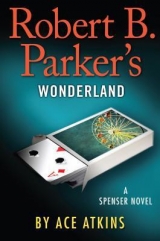
Текст книги "Robert B. Parker's Wonderland"
Автор книги: Ace Atkins
Жанры:
Криминальные детективы
,сообщить о нарушении
Текущая страница: 13 (всего у книги 16 страниц)
53
I SAT WITH HEALY in the passenger seat of his unmarked unit. We had a pretty good vantage point to watch the detectives and crime scene techs work. I was never really sure what the techs did these days, but Rita Fiore assured me they focused mainly on confusing juries. The coroner had already removed the bodies by the time I arrived. Now there were several yellow cones placed in spots where evidence had been found.
“No shells, of course,” he said. “But we should find a nice .22 short bouncing around in their skulls.”
“Who are they?”
“James Congiusti and Anton Nelson,” Healy said. “AKA Jimmy Aspirins and the Angel of Mercy.”
“Inspired.”
“Jimmy Aspirins because he takes care of the Mob’s headaches—”
“Naturally.”
“And Angel of Mercy because who the fuck knows. Nelson is a demolitions guy. Federal agent I called in Vegas says Nelson once blew up a dentist’s office because he pulled the wrong tooth.”
“What was Jimmy’s specialty?” I said.
“Crazy son of a bitch used a cordless drill into people’s heads.”
“And what were their ties with our beloved Commonwealth?”
“Zip,” Healy said. “This looks like an encroachment.”
“Of which someone was extremely resentful.”
Healy nodded. We had the windows down in the sedan. Parked along Shawmut Street, we had a lovely view of an endless row of sagging and paint-deficient triple-deckers. Empty trash cans, busted and turned upside down, lay along the curbs. Chain-link fences guarded front yards as big as area rugs. Another gorgeous day in Chelsea.
“What are you hearing?”
I shrugged.
“May I remind you that I have saved your ass on many occasions?”
“My ass is eternally grateful.”
“I’m getting a lot of pressure from the hill on this one,” Healy said. “I can’t turn something on Weinberg and I start hearing whispers of my retirement.”
“And then what do you do?”
“Watch soaps with the wife and drink light beer.”
“Did I not put you in touch with Weinberg’s second in command?”
“Belson put us in touch after the shooting.”
“A mere technicality.”
“Didn’t get us anywhere.”
“At least we know this thing is being stoked from Vegas,” I said. “But I’m not sure who is allied with whom.”
“Whom?”
I nodded. “Have you spoken to Harvey Rose?”
“This ain’t my first day on the job, Spenser.”
“What did you think?”
“I think he’s a schlub,” Healy said. “I think he resented Weinberg, but I don’t think he’s the kind of guy who knows people like Jimmy Aspirins exist.”
“Maybe.”
“What do you know?”
“I know the Sox are sucking this year,” I said. “And that Charles Mingus is the finest double bass player that ever lived.”
“I’ll tell you what I think,” Healy said. “I think there is a whole group of hoods in Boston who don’t want a casino to ever happen. They can’t get it into their thick heads that it’s happening whether they like it or not. But every day they continue to screw with the process is another day of big profits.”
I shrugged again.
“Jesus. What?”
“Or maybe they want a piece of the action,” I said. “And they are not evolved individuals when it comes to business negotiations.”
“Three men dead,” Healy said. “And we got zip.”
“Be nice to know who is negotiating exactly what.”
“You got something on that?”
“Gino Fish has removed his welcome mat.”
“And your other hoodlum friends?”
“That’s no way to describe some of the city’s most valuable resources.”
“Hoodlums.”
“At least they come honest,” I said. “It’s the ones in disguise that concern me.”
54
DEAN AGARWAL KEPT a neat and tidy office, as neat and tidy as one would expect of the head of Harvard Business School. A pal of mine named Bill Barke had made the introduction, Bill being a one-phone-call guy, and that afternoon I found myself drinking coffee with the dean in Morgan Hall. Agarwal was a professional academic, the framed paper hanging on his wall telling me he’d been educated in Bombay, London, and Cambridge. I noted from his bookshelf that he had authored several books with titles such as Leadership in the 21st Century, Leadership Through Economic Crisis, and Leadership and Building Trust.
Agarwal was a dark man, slight of frame, with a very shiny bald head and thin, trendy glasses. He was warm and polite, and spoke with a British accent overlaid with subtle tones of India. His hands were small, but he had a firm and assertive grip. He wore a light khaki suit and looked a bit like Vijay Amritraj, only with much less hair.
“Harvey Rose was one of our great stars,” he said. We sat a short distance from a large desk in a cluster of chairs set about a table with good china and a coffeepot. “I taught organizational behavior to many glum students. Harvey would attract hordes to courses that were somewhat unorthodox at the time. He said the key to corporate success was simple if you understood how to accurately predict consumer behavior. Many of the faculty frowned upon his methods, feeling they bordered on emotional manipulation, but one could not deny his genius.”
“Did he strike you as a future casino mogul?”
“Frankly, I never saw Harvey leaving the safe haven of academia,” Agarwal said. “On paper, Harvey is spectacular.”
“And in person?”
Agarwal reached over to the table behind us. With a small spoon, he extracted two cubes from the sugar bowl and plopped them into his coffee. He smiled and took a sip. “Less than,” he said.
“I’ve had the pleasure.”
“And now you are running a background check on him?”
“In a matter of speaking,” I said. “I work for the wife of the late Rick Weinberg.”
“Surely she doesn’t think—”
“No, she does not,” I said. “But part of my job is to check into the backgrounds of those who did business with Mr. Weinberg. I hope to learn a little bit more about his world and perhaps find some clues.”
“And even better with a competitor?”
“Some argue that Harvey Rose was running second.”
Agarwal took another sip and placed the cup on the saucer. He leaned back into a lemon-yellow Queen Anne chair. “If Harvey had entered the competition, then he had found a formula to win.”
“I believe his odds have improved recently.”
Agarwal smiled. “And had Harvey not taken his current position and left the business school,” he said, “this would be his office.”
The dean had a nice view of Shad Hall and some tennis courts. I added two sugars and a little bit of cream to the coffee.
“Besides being a mathematical genius,” I said, “why would a Las Vegas company hire a fairly bland figure like Harvey Rose?”
“The system.”
I drank some coffee. I waited for more.
“Surely you have heard about the Rose system,” Agarwal said. “It was quite the buzz in all the journals.”
“I only keep up my subscription to Guns and Ammo.”
“Harvey was the first to say the gaming industry was no different than any other form of retail,” he said. “He applied the same approach to the consumer as he would if he was working for JCPenney. What I would call a very macro point of view. Star Gaming hired him as a consultant and were so impressed with the results, they offered him the CEO position. What he’s done for them is really quite genius.”
“And what is that?”
“He got his best consumers to tell him everything,” Agarwal said. He smiled, pleased with the tidbit of information. “True genius. He gave everyone who came into his casino something called a Star Card. The more you played, the more points you would get. You could follow your card online and win dinners and trips. But you could also win a windbreaker or a Frisbee. He wanted everyone to add up their points.”
“I once earned a beer stein from S&H Green Stamps.”
“One and the same,” he said. “The prizes at the base level were worthless. But the data he was able to collect was priceless. He could track an individual every time he or she set foot in a Star Casino. He used a massive data bank to build computational models that predict the behavior of every consumer. Especially their ideal.”
“The Star Card.”
“Precisely,” Agarwal said. “Profits soared. Casinos raked in billions. He has doubled the number of Star Casinos to thirty or more.”
“Because of a formula?”
“Harvey can stand back and take an unemotional appraisal of a business situation. His moves and reactions are purely mathematical.”
“And this is revelatory?”
“Very.”
“Do you recall a student who was here when Harvey Rose taught?” I said. “A woman named Jemma Fraser. She was or is a British citizen. I don’t have the dates.”
“We do have certain privacy standards.”
“Of course,” I said. “But just to verify she was a student.”
“That should be easy enough to find out.”
He opened the door to an anteroom and requested the information from his secretary. He promptly closed the door and returned to our grouping.
“The name seems familiar, but I can’t place it.”
“She was one of Mr. Rose’s protégés.”
Agarwal shook his head and surreptitiously looked at his watch. The door opened and the secretary appeared with a computer printout. She smiled at me as she walked out.
“Ah,” he said.
“You know her?”
“Vaguely,” the dean said. “I think she worked with Harvey in some capacity.”
“Can you tell me more from her student record?”
“I’m sorry, but I cannot share academic information, Mr. Spenser.”
“I’m looking for more personal,” I said. “Do you know someone who knew her?”
He held the paper loose as he thought. He fluttered the paper in his fingers, studied the information in hand, and then called his secretary again. The door opened, and she appeared. This time she did not smile at me. I felt we were keeping her from something.
“Can you find out if Stephanie Cho is teaching today?” he said.
The secretary nodded and the door closed. Agarwal nodded.
“A lead?”
“I believe I have someone you should meet.”
“Goody,” I said.
55
“OF COURSE I REMEMBER Jemma Fraser,” said Stephanie Cho. “We called her the Duchess because of the accent and the attitude. She always wore these killer tall riding boots. God, that was a while back.”
“Who is ‘we’?”
“Other MBA students,” she said. “I’m pretty sure she attended Oxford and worked for some private equity group before coming to the States. Knew everything and thought everyone else was a lesser being. All the men, and some of the women, were crazy about her. But she didn’t really mingle. We had some classes together. Can’t say I liked her very much.”
We sat together at a table outside Spangler Hall, the student union of Harvard Business School. I had bought Stephanie a tall iced mocha. I had decided against more coffee and drank bottled water. Now out of sight of the dean, I again sported my Brooklyn Dodgers cap and slumped a bit in my chair.
“Do you remember the classes?”
Stephanie Cho thought for a moment. She was a pretty girl, a bit heavyset, with blunt-cut black hair and a wide face. She wore a short-sleeve cowboy shirt that fit tightly around her chest and upper arms. She tapped her front tooth as she thought. “Machiavelli, for one.”
“That was a business class?”
“It has a fancier title than that, something like ‘Machiavelli and Computational Models for Consumer Behavior’ or some kind of junk,” she said. “It was Harvey Rose’s signature class. We all read The Prince, and Rose would relate the text to using data to get your consumers to do what you want them to do.”
“As in the ends justified the means.”
“Computational models are not educated guesses,” she said. “Using data of past behavior, a well-built model allows its user to accurately predict what consumers will do in any given situation, often more accurately than the consumer assesses his or herself.”
“And what does that have to do with The Prince?”
“It reduces everything to a data set,” she said. “If you think of your consumers as data sets and not people, it allows you to completely disengage from morality. Data sets are amoral. If the data says low-income consumers are more likely to spend that extra fifty bucks than middle-income consumers, then you target them. You don’t care if they can’t pay the rent or go to the doctor.”
“Ah.”
“And as the model gets better and better, it becomes a manipulation tool. Based on past behavior, you can set up the optimal circumstances that pretty much guarantee the outcome. It almost destroys free will. We can know that they will, and how they will, and for how long, and under what conditions.”
“Yikes.”
“What did you think we discussed here?”
“Love thy neighbor?”
“Yeah, right.”
“How about Jemma?” I said. “Did she ever discuss Professor Rose’s lack of ethics?”
“I doubt it,” she said. “But I really didn’t know her very well. Sometimes I’d see her out for beers or at parties. That was rare. But mainly she was stuck up Rose’s ass.”
“A true believer.”
“More than that,” Cho said. She took a sip of the mocha. “I think she had a thing for him.”
“For Harvey Rose?”
“I know, I know,” she said. “Right? He was one of those professors who couldn’t match his socks. Had ketchup stains on his shirt all the time. Uncombed hair.”
“I’m not so good with ketchup myself. Worse with salsa.”
“So you know, he wasn’t exactly the kind of professor that made women swoon,” she said. “I think he found Jemma’s devotion very flattering. Especially with her style. And that gorgeous accent.”
“Was there preferential treatment?”
“Well, he hired her immediately when he left Harvard.”
“Do you think they were intimate?”
“I have no idea,” Cho said. “God, I hope not. I mean, that’s why you come here. To be independent, to impress employers into leadership positions. Not to screw your way to the top.”
“Do you recall anyone else she was close to?”
Cho shook her head. “I really can’t. I’m sorry. We all knew her. But she was very, very aloof. I can ask around.”
“Did she have family in the States?”
“I had the impression she was here just for the education. All I can remember are those clothes of hers. Wore very fancy stuff that was a bit out of place. Inappropriate for nine a.m. classes.”
“And the riding boots.”
“Always wore them.”
“And her without a horse.”
“You have to understand we don’t have traditional graduate assistantships here,” she said. “You are not required to have an internship, either. But we all pretty much do. I had one with Prudential and later with Bain. You work with a company and then you’re assigned a professor as a mentor.”
“And Rose was Jemma’s mentor.”
“And mine, too, and plenty of male students’,” she said. “I just don’t recall him taking that active a role in my off-campus work.”
“Do you remember what Jemma did?”
“I think she pretty much interned with Professor Rose,” she said. “Some of the students did that. But it was preferred that we left campus and worked in a real business setting. I just recall her always being in his office. Almost like his secretary, or a personal assistant. I thought the whole arrangement a bit weird. Maybe it was because I was always wearing sweatpants while Jemma was in haute couture.”
“You should see me on Saturday nights.”
“You seem very odd for a cop,” Stephanie said. She pulled her legs up and wrapped her knees with her arms. She stared at me, looking very much like a little girl, a bit quizzical. Her blunt-cut hair ruffled a bit in the spring breeze.
“I could not stand being a cop,” I said. “That’s why I work for myself.”
“That’s what I want,” Stephanie said. More wind kicked up on the common and you could smell the river. “My parents were first-generation. My father thought life was work. He believed that every day you must take a hard path to be a good man. You don’t seem that way.”
“I am often late for work.”
“My parents are very proud of me,” she said. “But they don’t understand why I left my job. And why I don’t take what I learned and put it in practice. I could never tell them I’m quite content to teach.”
“Makes sense to me.”
“You know, Professor Rose came back here last fall to speak,” Cho said. “He told us to be unemotional and detached in our decision making. He said you only need to know the who, what, and when, not necessarily the why.”
“I’ve been teaching an associate of mine the same thing.”
“Computational models?”
“Hoodlum ethics.”
56
Z MET ME at Danehy Park in Cambridge at sunset. People jogged along paths, and dogs frolicked about. I had decided to sort out what I learned by throwing the tennis ball to Pearl. She had spent much of the last week cooped up, which tends to make a hunting dog psychotic. So we worked out her issues by letting her sprint for the ball and return it. My arm had grown tired and I tossed the ball to Z. Pearl, tongue lolling from her mouth, showed no signs of fatigue.
“I heard about the two dead men,” Z said. “They part of the new team?”
“Healy thinks so,” I said. “Heavy hitters from Vegas. Someone wanted to make sure they were not welcome.”
“Maybe they were hired by Weinberg’s people,” Z said. “To come for the killers.”
“Or maybe they killed Weinberg and got their due.”
Z threw the ball over a rolling hill. Pearl disappeared for several moments. She appeared triumphantly with the tennis ball covered in slobber and blades of grass.
“What is Jemma saying?” I said.
Z shrugged. He watched Pearl intently.
“She won’t talk about Weinberg,” he said. “It makes her very upset.”
I nodded. Z tossed me the slobbery ball. I wound up and threw it to the moon. Pearl was off like a rocket.
“How does she treat you?” I said.
“Fine.”
“I found out today that she had been an intern for Harvey Rose,” I said. “Ten years ago at Harvard Business School.”
Z nodded.
“That was something she had not told me,” I said. “You?”
Z’s face was impassive, and he shook his head. Pearl returned. I rocketed the ball again. This time a black Lab broke into stride with Pearl but was no match for her. She beat him by three car lengths, and upon return, she teased him with the ball, nudging it to his mouth.
“Watch your step,” I said.
“She’s very scared and alone.”
I nodded.
“She said I make her feel safe.”
I nodded again.
Z took the ball from Pearl and threw it far and wide. His face was slick with rain as he stared up at the rolling hills and picnic tables. Pearl and the black Lab nuzzled each other. Pearl was faster and stronger, but for some reason, she dropped the ball in front of the Lab. I reached for the ball and threw it as far as I could.
“We had sex,” Z said.
“Uh-huh.”
“The other night,” he said. “She wanted me to come up to the room. She was naked.”
“Hard to resist.”
Z shrugged.
“I don’t know much about this woman,” I said. “But the more I know, the less I like.”
“Because she was Rose’s protégée?”
“That she didn’t mention it.”
Z nodded.
“She asks me a lot about you,” Z said. “Wants to know what you know. She asks me a lot about Rachel Weinberg, too. And wants to know about your meetings with Healy.”
Pearl returned. She looked happy and winded. A man in a red windbreaker called for the Lab, and the Lab trotted off. I placed my hand on Pearl’s head and attached her leash.
“What else?” I said.
“Jemma says you took advantage of her the other night.”
“By saving her life?”
“After,” he said. “She said you poured her a lot of drinks and that things happened.”
“She tripped on my rug and I put her to bed.”
“She said she does not remember it all,” Z said. “But she remembers you crawling on top of her in the night. And doing things.”
“You would think that I would remember, too.”
“I told her that I couldn’t trust you anymore,” Z said. “I said that you were a liar and a man without honor.”
“Gee, thanks.”
Z broke into a grin. “I said I was through with you,” he said. “But I would act as if we were still friends and pass along information.”
“Some sidekick.”
Z shrugged. He was still smiling.
“Perhaps you can find out why she kept her relationship with Harvey Rose secret?”
“If you slept with that man, wouldn’t you lie about it?”
“Most definitely.”
We walked back to our cars, taking a winding path covered with pebbles and stones. The air seemed to swell and expand, the dark, full clouds pregnant with an oncoming storm. Z walked to his car while I stopped at my Explorer.
“She does believe those dead men were coming for her,” Z said.
“Maybe so.”
“She has a lot of fear in her,” Z said.
“You would know,” I said.
“How long do we keep this up?”
“Me as the Lone Ranger?”
Z nodded.
“When we come to a fork in the road, we both take it.”